Does washing fruit and veg do anything

Not much.

"You can reduce the number, but you’re not gonna get zero," said Dr. Ted Labuza, of the University of Minnesota.

Dr. Francisco Diez-Gonzalez, a University of Minnesota associate professor who has studied the impact of various washing techniques on produce said,

"At the consumer level, washing from the point of view of numbers, may reduce risk to 10 percent of the original risk. That’s been fairly consistent. But it’s definitely not solving the problem … If you happen to be lucky and the cells of the pathogen are not going to be attached to the surface, you may get lucky. If the cells have formed some structure and are strongly attached to the surface, you may not.”

Washing with water and some scrubbing motion applies friction, which has been shown to dramatically reduce the number of bacteria on a fruit or vegetable — from 100 percent risk to 10 percent risk, for example. But when the original numbers are in the trillions, that 10 percent risk can still be significant.

Running water on a fruit can reduce the risk to 15 percent. Scrubbing gets you to 10 percent, and using a mix of 3 parts water, 1 part vinegar can reduce the risk to 1 or 2 perecent.

So, it’s doing something, but it may not be enough.

Live animal imports into America: agencies need better collaboration to reduce the risk of animal-related diseases

The United States legally imported more than 1 billion live animals from 2005 through 2008. With increased trade and travel, zoonotic diseases (transmitted between animals and humans) and animal diseases can emerge anywhere and spread rapidly.

That’s a lot of animals.

The U.S. Government Accountability Office (GAO) concluded the statutory and regulatory framework for live animal imports has gaps that could allow the introduction of diseases into the United States. Specifically:

(1) The Department of Health and Human Services’ Centers for Disease Control and Prevention (CDC) has regulations to prevent the importation of live animals that may pose a previously identified disease risk to humans for some diseases, but gaps in its regulations may allow animals presenting other zoonotic disease risks to enter the United States. CDC has solicited comments in advance of a rulemaking to better prevent the importation of animals that pose zoonotic disease risks.

(2) The Department of the Interior’s Fish and Wildlife Service (FWS) has regulations to prevent imports of nonnative live animals that could become invasive.

GAO recommends that the Secretaries of Agriculture, Health and Human Services, Homeland Security, and the Interior develop a strategy to address barriers to agency collaboration that may allow potentially risky imported animals into the United States and jointly determine data needs to effectively oversee imported animals.

Food poisoning incident at Singapore sports school

Over 100 students at Singapore Sports School were stricken with food poisoning from Nov. 1-3, 2010.

The Ministry of Health (MOH) and National Environment Agency (NEA) are investigating into a food poisoning incident involving a licensed caterer, ISS Catering Services Pte Ltd.

As a precautionary measure, the canteen operator, ISS Catering Services Pte Ltd, was required to clean up the food preparation and refreshment areas of the canteen. MOH has advised the school to be alert to new cases and to ensure high standards of hygiene among students, staff and food handlers. NEA will continue to work with the school to monitor the hygiene situation at the canteen closely.
 

Audit finds sanitation problems at some Canadian meat, poultry plants

There’s nothing new here, but once again, the Americans say the Canadians sorta suck at food safety, and the Canadians say, politely, thanks, we’ve fixed that.

The Toronto Star reports tonight that an American audit concluded Canadian Food Inspection Agency documents often painted an inaccurate picture of the conditions at some of Canada’s meat and poultry plants where sanitation problems persisted.

The audit, which looked at 23 of the 455 establishments certified to export to the U.S. between Aug. 25 and Oct. 1, 2009, identified weaknesses particularly in the areas of sanitation, oversight and record keeping.

A review of manuals and procedures at the food inspection agency’s administrative offices found acceptable controls for sanitation, but auditors found a different story at some plants.

“The actual conditions of the establishment visits were often not entirely consistent with the corresponding documentation,” the report says.

Among the sanitation issues identified in the report were: not consistently identifying contaminated product and inconsistently verifying plants were taking adequate corrective actions to problems.

Agriculture Minister Gerry-listeria-is funny- Ritz, responded with a statement emailed to The Canadian Press on Monday, stating,

“This audit is from a year ago and in that time our government has invested an additional $75 million to improve food safety and are hiring 170 new inspectors.”

Uh-huh.

Disney Cruise built-in hand sanitizer stations

The enterprising sanitarians at Disney have come up with built-in hand sanitizer stations incorporated into the Art Deco design of Disney Cruise Line’s new ship, the Disney Dream.

The photo (right) shows three of the built-in stations awaiting installation at the entrance to Animator’s Palate, one of the Dream’s three main restaurants.

Disney designers tell USA Today the built-in hand sanitizer stations will be incorporated into all the major eatery areas around the vessel as an alternative to the clunky plastic dispensers.

Hand sanitizer stands have become common on cruise ships over the past decade as the industry has increased efforts to reduce the number of shipboard outbreaks of communicable gastro-intestinal illnesses such as norovirus.

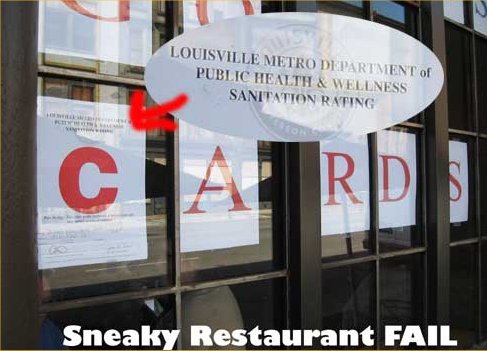
‘C’-rated restaurants in NY hiding their grades

The New York Post reports this morning the Health Department has identified the first 15 restaurants branded with a lowly C since the city’s A-B-C grading system was launched more than three months ago — but more than half of those eateries were caught hiding their lousy grades from customers.

A Post survey found only seven of the C restaurants posted the grade as required by law, with managers at the other eateries claiming they didn’t understand the rules or, seemingly, trying to game the system.

At the Bread & Pastry Cafe in Greenwich Village, which earned a C on Sept. 9 after racking up 41 violation points, a "grade pending" sign hung in the window Wednesday. Restaurants are slapped with a C when inspectors issue 28 violation points or more.

"It’s my choice," insisted clerk Mohammed Zaman, explaining that the cafe was due for another hearing at which it would get a higher grade.

When The Post inquired with the department, it sent over an inspector on Friday to demand the C be posted.
 

The secrets of a salmonella outbreak; over 100 sick

There are now over 100 sick with salmonella in France linked to hamburgers, primarily school kids, so as in the U.S., questions are being raised about food safety standards and procedures for products purchased by the school lunch program. After a USA Today expose last year, the U.S. asked microbiologist Gary Acuff to lead a panel to review and improve school lunch purchases.

My friend, Albert Amgar, wrote a particularly incisive blog post about the culture of food safety secrecy in France. Amy translated and excerpts follow:

The food poisoning outbreak caused by Salmonella in ground beef patties has raised many questions.

Of course, communication has been, as usual, opaque, but now the school cafeteria’s contract for the hamburgers is itself classified top secret, according to a Nov. 6 article by Emmanuel Coupaye of Centre Presse.fr, the newspaper for Vienne.

This journalist is asking questions: What are the established purchasing criteria for ground meat in the middle schools and high schools? After contamination, the question is disturbing.

Apart from the contamination of hamburgers with salmonella, "What is more upsetting is the National Education’s current difficulty in providing accurate information about the selection of products offered in school cafeterias. Since Thursday (November 4 – aa), we’ve been looking for an answer to a simple question: What are the selected criteria used in sourcing ground meat for Poitiers’ middle schools and high schools? Many parents as well as cattle farmers were surprised to learn that the meat for the hamburger patties was supplied by a foreign producer."

On Thursday, the manager of the high school, contacted by our editorial staff saw no problem with providing us a copy of the contract. We only had to come by the school yesterday morning (Friday, Nov. 5). Our goal was to know what are the established criteria for sourcing ground meat (French, EU or other) and the quality threshold (dairy breed, meat breed, meat with a seal of quality). But then, yesterday morning, after a night of reflection, the answer was no.

"I cannot give you this document," stated the school principal.

By late afternoon, the rector stated that he "did not have any information to add." Too bad the Ministry of Education’s website still boasts, under the catering section, its dual requirement "to maintain nutritional quality" and "better inform parents” (especially on issues related to food safety – aa).

In conclusion, the only thing left for us to do is to seize it through the Committee on Access to Administrative Documents!

I wish a lot of fun to those who would like to access these documents. Indeed, in France, transparency is often emphasized, but as pointed out in a recent book (Corinne Maier, Chao France, Flammarion, 2010) glasnost is not a French word. By comparison, the U.S. Congress passed a law on the freedom of information that requires the administration to establish clear standards to determine what documents can be classified as confidential, secret or top-secret, allowing citizens the right to challenge these classifications in court.
To be continued …

 

Acuff speaks, Kansas State Nov. 9

Some say he’s the nicest guy in food safety. Some say he’s great to sit beside at meetings because of his witty asides. Some call him Dr. – Dr. Gary Acuff.

Texas A&M University announced last month that Acuff was going to become director for the Center for Food Safety, and will lead expanded food safety efforts. This apparently involves a rock-star style tour of food safety hot spots so he can figure out what not to repeat and what to do, so Acuff is going to be talking with folks at Kansas State University on Tuesday Nov. 9, 2010, at 10:30 a.m. in Call Hall 205.

Acuff’s seminar is entitled, The end game: what is really achievable in pathogen reduction, but he told me he may talk about something else.

Prior to his appointment as Director of the Center for Food Safety, Acuff served as interim head and then head of the department of animal science from 2004 to 2010. And before that, he taught undergraduate and graduate level courses and laboratories in food microbiology for 20 years and conducted research on the microbiological quality and safety of foods through his appointment with Texas AgriLife Research.

A past-president of the International Association of Food Protection, Acuff currently is chairman of a 10-member committee for the National Research Council, which evaluates food safety requirements for the Federal Purchase Ground Beef Program.
 

Why doesn’t Hiliandale brag about its egg food safety accomplishments

Hillandale Farms, one of the Iowa culprits in the over-1800-sick-with-salmonella-and-500-million-egg recall, was cleared to start selling eggs again last month, but why would anyone knowingly buy them?

They wouldn’t know because of the Ponzi scheme of renaming food commodities for marketing, and the lack of food safety marketing at retail.
Besides, everyone has gone back to sleep.

Maybe an intrepid journalist can ask Hillandale about their most recent salmonella test results since I’m sure the company is eager to rebuild public trust.

Other jurisdictions aren’t waiting.

State Veterinarian Don Hoenig told Maine lawmakers yesterday the state’s comprehensive program to prevent salmonella contamination at egg farms has paid off.

"The result of it is, we have not had a positive building in over a year. We’ve achieved a measure of success, we’re cautiously optimistic that we’re on the right track–I don’t know for sure that we are–but the vaccination seems to have been a key component of the control program."

Hoenig says after the salmonella outbreak in Iowa this summer, he found himself answering more and more questions from national reporters about Maine’s egg inspection program. He told members of the Legislature’s Agriculture Committee that’s when he realized just how good Maine’s program is.

Klaus Torborg, of Lohmann Animal Health, has warned UK producers not to become complacent about controlling salmonella.
The UK has the lowest levels of salmonella in laying hens of any major egg-producing country, but he says that sustaining this relies on vaccination, hygiene, pest control and the disinfection of vehicles, water and buildings.

Reheating instructions are a great idea; would be even better if they had temps

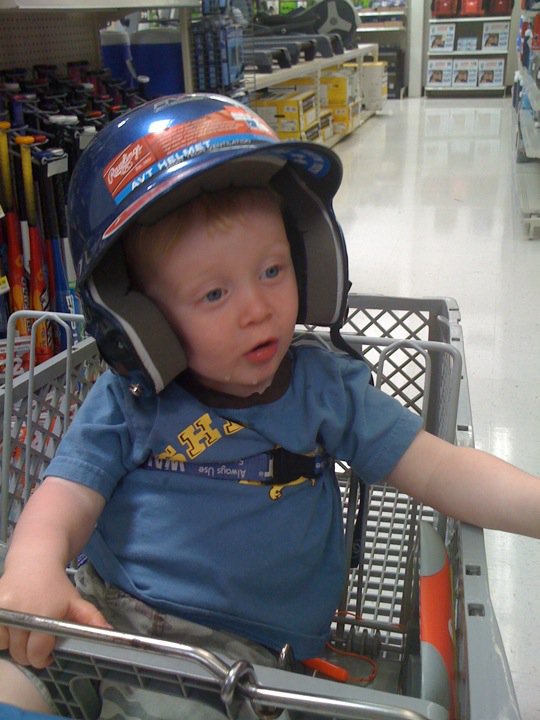
We’re in a bit of a waiting game. My wife and I are expecting our second child at any moment (for real, today’s the due date). For our first child, Jack (right, exactly as shown), planning was much less of an issue. We had him at home, didn’t have much else to worry about except making sure our dog was out of the way and we could deal with him coming whenever he was ready. Planning is much more part of the situation this time: we’re using a Chapel Hill-based birth center (40 min away) and have a calling tree of folks who will look after Jack once things start happening.

We had a midwife appointment today and following the check-in we hit a favorite restaurant of ours, Maggiano’s in Durham.

This was all part of the evolving plan.
 
We’re usually pretty good about putting together a menu and doing a big grocery shop once a week but with all of our baby uncertainty we’ve been pretty lax in the food planning department. Maggiano’s has a great deal where you get two entrees for the price of one: one to eat there and a refrigerated helping to heat up later. Even better about the deal is that I can seldom eat my in-restaurant meal so I end up with two or three leftover meals. All for what seems ridiculous like a ridiculous price of $12.95. Good value and we don’t have to do a lot of meal planning over the next couple of days.
We’ve participated in this deal on a few occasions but this time we were presented with a take-out insert card by our server with a 10 second blurb describing that we now had reheating instructions (below, exactly as shown). Being a food safety communication nerd, after she left our table I grabbed the card and scoured it for times/temps and anything I could see about safe handling.
 
I was a bit disappointed.
 
The card says to cook until “thoroughly hot” but doesn’t say anything about what temperature that might be, or that a patron might want to use a thermometer to verify it was hot enough.
 
Going to the expense of printing and distributing the insert cards is a great step. An even better step would be to engage folks into what they can do to reduce risks – not only does this start a dialogue with customers but it can help restaurants and food providers distinguish themselves in a competitive marketplace.
 
Brae Surgeoner led a project a few years ago when we were both at Guelph looking at this issue. Her study showed that a safe food handling label for take-out food was a promising value-added investment for restaurant operators as long as the stickers were used consistently and employees supported the initiative. Check out the abstract below for more.


Assessing management perspectives of a safe food-handling label for casual dining take-out food
01.oct.09
Food Protection Trends, Vol 29, No 10, pages 620-625
Brae V. Surgeoner, Tanya MacLaurin, Douglas A. Powell
Abstract
Faced with the threat of food safety litigation in a highly competitive industry, foodservice establishments must take proactive steps to avoid foodborne illness. Consumer demand for convenience food, coupled with evidence that consumers do not always engage in proper food-safety practices, means that take-out food from casual dining restaurant establishments can lead to food safety concerns. A prescriptive safe food-handling label was designed through a Delphi-type exercise. A purposive sample of 10 foodservice managers was then used to evaluate the use of the label on take-out products. Semi-structured in-depth interviews focused on the level of concern for food safety, the value of labelling take-out products, perceived effectiveness of the provided label, and barriers to implementing a label system. Interviews were audiotaped and transcribed, and the data was interpreted using content analysis to identify and develop overall themes and sub-themes related to the areas of inquiry. It was found that labeling is viewed as a beneficial marketing tool by which restaurants can be differentiated from their competitors based on their proactive food safety stance.