
I spent the morning hanging out with a couple of visiting food safety types from Jordan. What was striking was how much we agreed that arguments about government turf, the inadequacy of audits, and the failure of food .jpg) safety messages with consumers and other humans was a global phenomenon.
safety messages with consumers and other humans was a global phenomenon.
Beth Weise writes in tomorrow’s USA Today that if you’ve never heard of a third-party food-safety audit, you’re not alone. Few Americans know or care what they are. To the companies that produce much of our food, they’re an important tool to make sure it’s safe and wholesome — but critics say the certificates the auditors issue often aren’t worth the paper they’re printed on.
Recent foodborne illness outbreaks have raised questions in Congress and elsewhere about the effectiveness of these audits and the impartialness of the process.
Auditors are the eyes and ears of a company buying food from a producer. A frozen-pizza maker hires an auditor to make sure the company it buys tomato sauce from has a clean, safe and well-run plant. But many problems — including dead chickens, rats, manure and salmonella — can fall through the cracks of their visits.
Last year, the Peanut Corp. of America, whose products sickened over 600 and may have killed as many as nine, got a "superior" rating at its Texas plant even as it was churning out peanut paste tainted with salmonella.
And last week Congress showed that one of Wright County Egg’s egg-packing plants got a "superior" rating from the same company on June 8, just two months before Wright became part of the largest known egg recall in the United States.
The company, AIB International (of Manhattan, Kansas, sigh), lists five standards on its website that inspectors expect to see in a "facility that maintains a food-safe processing environment." They are: ensuring that raw materials are safely stored and handled; equipment, buildings and grounds are properly maintained; cleaning and sanitizing is adequate; pests monitored and managed; and staffers are working together to deliver a safe final product.
When FDA inspectors actually went into Wright County’s henhouses at its Galt, Iowa, plant, they found vermin, filthy dead chickens and manure oozing out of doorways. More than 1,600 people were sickened in a salmonella enteritidis outbreak linked to the farm, and over 550 million eggs were recalled due to contamination at this plant and at nearby Hillandale Farms, where lesser problems were found.
"Superior" clearly doesn’t mean much, says Rep. Bart Stupak, D-Mich. "How many dead mice do you have to find in your food before you get an ‘Excellent’ rating?"
Third-party food audits, like restaurant inspection, are a snapshot in time. Given the international sourcing of ingredients, audits are a requirement, but so is internal food safety intelligence to make sense of audits that are useful and audits that are chicken poop.
The third-party food safety audit scheme that processors and retailers insisted upon is no better than a financial Ponzi scheme. The vast number of facilities and suppliers means audits are required, but people have been replaced by paper.
Audits, inspections, training and systems are no substitute for developing a strong food safety culture, farm-to-fork, and marketing food safety .jpg) directly to consumers rather than the local/natural/organic hucksterism is a way to further reinforce the food safety culture.
directly to consumers rather than the local/natural/organic hucksterism is a way to further reinforce the food safety culture.
After the salmonella-in-peanut paste crap, Costco, a retail store, which previously limited AIB’s inspections to its bakery vendors, has now instructed suppliers to not use AIB at all.
“The American Institute of Baking is bakery experts,” said R. Craig Wilson, the top safety official at Costco. “But you stick them in a peanut butter plant or in a beef plant, they are stuffed.”
Or as Mansour Samadpour of Seattle said at the time,
“The contributions of third-party audits to food safety is the same as the contribution of mail-order diploma mills to education.”
I asked weeks ago, who were the buyers of DeCoster eggs who used AIB audits to justify putting salmonella on grocery store shelves? Any retailers want to step forward?
And market food safety at retail so consumers can choose the poop they wish to purchase.
 2010, just as thousands of Americans began barfing from salmonella in DeCoster eggs.
 peanut products shipped from that plant and another PCA plant in 2007 and 2008 sickened as many as 600 people and may have contributed to nine deaths.
 Commerce subcommittee meeting today to the
  Maryland regulators believed DeCoster eggs were such a threat that they banned sales of the eggs in their states.
.story.jpg)
(1).jpg) Just cook it don’t cut it.
Just cook it don’t cut it..jpg) Food and Drug Administration last month. The records show that over the past three years, Wright County, the company at the center of the outbreak that sickened about 1,519 people and led to the recall of 550 million eggs,
Food and Drug Administration last month. The records show that over the past three years, Wright County, the company at the center of the outbreak that sickened about 1,519 people and led to the recall of 550 million eggs, (1).jpg) about food safety and continuously work to minimize levels of risk.
about food safety and continuously work to minimize levels of risk. project concept I watch incessantly on Sesame Street but I’d rather my kid didn’t barf from salmonella-contaminated eggs. I’ll do my part, but I want producers to do their part, and advertize the results so I can vote with my money.
 results for the bacteria, but it would be typical to have half a dozen to a dozen over that period at the most. The test results are from tests of areas around the hen houses rather than of the eggs themselves.
.jpg) trash earlier this year on the Iowa farm at the center of the national egg recall, but didn’t notify health authorities.
trash earlier this year on the Iowa farm at the center of the national egg recall, but didn’t notify health authorities. everyone to pay attention in the absence of an outbreak – it’s that prevention thing.
 won’t because that would imply that other food is unsafe. Well guess what? Other food is unsafe. The best way the consumers can act is through their buying power. Right now they are doing it through the B.S. organic stuff. They are being held hostage by people who don’t make direct claims about food safety but hint at it. Why else do you think they buy natural or local?
.jpg) infestations cited in a federal report stretch back at least a decade.?? The workers also reported ammonia levels high enough to cause chronic health problems, and inconsistent availability of safety equipment such as face masks and gloves.
infestations cited in a federal report stretch back at least a decade.?? The workers also reported ammonia levels high enough to cause chronic health problems, and inconsistent availability of safety equipment such as face masks and gloves.(1).jpg) Risk comparisons are risky
Risk comparisons are risky.jpg) Disease Control (CDC) and the Food and Drug Administration (FDA) both state that thoroughly cooked eggs are thoroughly safe eggs. Consumers should know that salmonella is destroyed by the heat of proper cooking. Eggs should be cooked until the whites and yolks are firm. For dishes containing eggs, the internal temperature should reach 160 degrees Fahrenheit.”
Disease Control (CDC) and the Food and Drug Administration (FDA) both state that thoroughly cooked eggs are thoroughly safe eggs. Consumers should know that salmonella is destroyed by the heat of proper cooking. Eggs should be cooked until the whites and yolks are firm. For dishes containing eggs, the internal temperature should reach 160 degrees Fahrenheit.”.jpg) advocates — agvocates — have remained relatively quiet about the situation.
advocates — agvocates — have remained relatively quiet about the situation.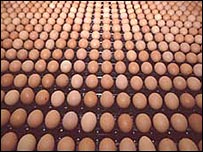 nearest town, is a neat collection of 350-foot- and 450-foot henhouses covered in white steel siding. They’re linked by overhead pipes that bring in ground corn and soybeans from the farm’s own feed mill and conveyor belts that take out chicken poop.