
To all broken hearts: don’t eat prepackaged cookie dough before it’s baked.
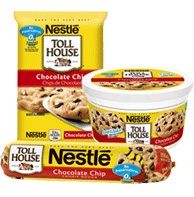
That’s the message health-types conclude from a June 2009 outbreak of shiga-toxin producing E. coli (primarily O157:H7) in Nestle Toll House cookie dough that sickened at least 77 people in 30 states. Thirty-five people were hospitalized – from cookie dough.
The 2009 investigation, which involved extensive traceback, laboratory, and environmental analysis, led to a recall of 3.6 million packages of the cookie dough. However, no single source,  vehicle, or production process associated with the dough could be identified for certain to have contributed to the contamination.
The researchers could not conclusively implicate flour as the E. coli source, but it remains the prime suspect. They pointed out that a single purchase of contaminated flour might have been used to manufacture multiple lots and varieties of dough over a period of time as suggested by the use-by dates on the contaminated product.
Flour does not ordinarily undergo a kill step to kill pathogens that may be present, unlike the other ingredients in the cookie dough like the pasteurized eggs, molasses, sugar, baking soda, and margarine. Chocolate was also not implicated in this outbreak since eating chocolate chip cookie dough was less strongly associated with these illnesses when compared with consuming other flavors of cookie dough.
The study authors conclude that "foods containing raw flour should be considered as possible vehicles of infection of future outbreaks of STEC."
During the investigation, three strains of STEC were discovered in one brand of cookie dough — although it wasn’t the same strain involved in the outbreak.
Manufacturers should consider using heat-treated or pasteurized flour, in ready-to-cook or ready-to-bake foods that may be consumed without cooking or baking, despite label statements about the danger of such risky eating practices, the authors conclude. In addition, manufacturers should consider formulating ready-to-bake prepackaged cookie dough to be as safe as a ready-to-eat food item.
Eating uncooked cookie dough appears to be a popular practice, especially among adolescent girls, the study authors note, with several patients reporting that they bought the product with no intention of actually baking cookies. Since educating consumers about the health risks may not completely halt the habit of snacking on cookie dough, making the snacks safer may be the best outcome possible.
A Novel Vehicle for Transmission of Escherichia coli O157:H7 to Humans: Multistate Outbreak of E. coli O157:H7 Infections Associated With Consumption of Ready-to-Bake Commercial Prepackaged Cookie Dough—United States, 2009
http://www.oxfordjournals.org//our_journals/cid/prpaper.pdf
 The impact of the infection has been especially severe for Rivera and nine other victims who developed a life-threatening complication known as hemolytic uremic syndrome. One, a 4-year-old girl from South Carolina, had a stroke and is partially paralyzed.
 Labeling is a lousy way to provide information about food safety risks, but better than nothing. I’m sure Nestle and ConAgra, in the best interests of their consumers, will publicly release the evaluative data they (probably? maybe?) acquired to show that these particular labels have a positive impact on consumer food safety behavior.
 DNA testing of E. coli found in an unopened package of cookie dough at Nestle’s plant in Danville, Va., determined the genetic fingerprint of the E. coli found at the plant is different than E. coli that has been linked to a 30-state outbreak that has sickened at least six dozen people, and that an altogether different strain of E. coli was found in dough recovered from the home of a victim.
.jpg) A FDA type said the dough had been manufactured on February 10, 2009 but had not yet been shipped.
A FDA type said the dough had been manufactured on February 10, 2009 but had not yet been shipped..jpg) The next morning, the U.S. Food and Drug Administration warned consumers not to eat any varieties of prepackaged Nestle Toll House refrigerated cookie dough due to the risk of contamination with E. coli O157:H7. At the same time, Nestlé announced a voluntary recall of all Toll House refrigerated cookie dough products, “out of an abundance of caution.”
The next morning, the U.S. Food and Drug Administration warned consumers not to eat any varieties of prepackaged Nestle Toll House refrigerated cookie dough due to the risk of contamination with E. coli O157:H7. At the same time, Nestlé announced a voluntary recall of all Toll House refrigerated cookie dough products, “out of an abundance of caution.”
 The next morning,
  Amy and Sorenne and I went grocery shopping this morning, and observed that the Nestle refrigerated products had been dutifully cleared out (left, exactly as shown). We did, however, buy a couple of other raw cookie dough products. I never eat the stuff, but understand that
  If you get the craving to eat cookie dough this weekend, lick this picture and don’t eat the real thing or you may doody until you dieeeeeee. … This weekend the grocery stores are totally going to be full of single depressed ladies trading in their unused cookie dough for SnackWells.
 If the link is proven, cookie dough would join a long list of foods like