No one seemed to care that N.Y. Times columnist and heath guru Jane Brody pooh-poohed evidence to not wash chickens, but several people wrote to say, what is that recipe for buckwheat pancakes? This is a modified version of a recipe in a book – those paper-based things that used to exist – by Jane Brody. The family likes it (that’s my Benjamin
Button-like mom, who seems to look younger as she gets older, along with 20-year-old daughter, Braunwynn, and the other usual suspects). 1 cup buttermilk (which is so bloody expensive in Australia I just add lime juice to lite milk) I egg 1 tbsp vanilla oil, if you want honey, if you want 2 cups buckwheat flour 1 tbsp baking powder 1 tsp baking soda dash of salt Garnish with fruit (they liked the mango) and maple syrup (from Canada, eh? Thanks mom).
Monthly Archives: August 2013
Eight children hospitalized with salmonellosis in Bulgaria
Focus News Agency reports eight children holidaying in the coastal town of Primorsko are sick with salmonellosis. The Salmonella bacteria has been isolated in a microbiological analysis in a lab in a hospital in the southeastern
city of Burgas, announced the hospital.
The children, who were on a children’s camp in a hotel in the town of Primorsko when they fell ill, were hospitalized on August 23 and 24.
26 now sick with E. coli from petting area at Brisbane fair; handwashing or sanitizers never enough
At some point, people will start asking, how did this happen? Why didn’t organizers of the Ekka pay attention to all the petting zoo outbreaks globally in the past 10 years? And why would the organizers of the Ekka issue a statement like they did on Aug. 23, 2013, stating, “The Ekka has
been held here for 136 years, with millions of people passing through our gates over this time, and this is the first incident of this type that we are aware of.”
According to Queensland Health nine people are confirmed to have STEC and a further 17 people are being tested for the infection. Three of these people have been admitted to hospital.
A table of petting zoo outbreaks is available at http://bites.ksu.edu/petting-zoos-outbreaks.
Blame the consumer: Jane Brody edition
People are experts in communication in that most of us talk; people are experts in food safety in that most of us eat.
So it’s no wonder the level of confusion and disagreement amongst talkers and eaters.
Me, I gather evidence and sort the wheat from the chaff (from a CSNY song, and it is time for a haircut, although I had to explain to 20-year-old
daughter last night who was in Buffalo Springfield).
Jane Brody, long-time talker and eater with the N.Y. Times, wrote yesterday that “people, not products, are the main cause of foodborne illnesses, and they can be avoided by following certain basic principles of food safety.”
Except Brody doesn’t follow all of them; like most experts, she cherry-picks to validate her ingrained and cultural preferences (don’t we all use the Internet to prove how right we are?).
Brody writes, “Although some suggest that poultry and meats not be rinsed lest they contaminate the sink, I find that hard to avoid. Instead, I rinse them, then clean the sink with a bleach spray. And I do use clean paper towels to dry raw food.”
I’ve used Jane Brody’s buckwheat pancake recipe for 25 years. The five daughters love it. But she’s wrong on washing chicken. That’s ol’ timey.
Go evidence or go home.
Safety vs tourism; 16 – mainly young children — now with HUS from E. coli O26 outbreak in Italy
An E. coli O26 outbreak appears to be spreading in the Apulia region of Italy, with 16 cases of hemolytic uremic syndrome, including14 children aged 10-to-36 months, a 15-year-old boy and an adult.
The most recent case occurred in Calimera, where an 11-month-old girl was admitted to hospital with symptoms that many now have learned to
recognize: diarrhea often characterized by the presence of blood in the stool, vomiting and abdominal pain.
Something may be lost in translation here, but the story says:
From the information gathered through the statements of the parents, children affected by Seu had eaten fruit (watermelon, in particular), dairy products and salad. In some cases, little had been spoon-fed after the parent had come into contact with the meat, maybe the one that bought a sandwich stuffed in one of the many stalls that fill the streets of Puglia during the summer. In short, too many elements, but no certainty, except that which is coming from sea water bacteria.
Perhaps, more likely, from the wells from where it draws water to irrigate the fields, but the controls are still in progress. Yet in recent days had spread the rumor that to facilitate the contagion might just be the sea water. A circumstance which had raised fears sudden emptying of the seaside resorts and a stampede of tourists from Puglia.
This has not happened, as confirmed by Fabrizio Santorsola, regional vice president of Assobalneari Puglia, federated Federbalneari, and holder of the beach and restaurant “Santos» Savelletri, on the coast of Fasano. “Our guests, and those establishments that belong to the association – he says – did not show any fear.
That gluten-free bar is for dogs, not humans
The whole gluten-free thing has jumped the shark, if it already hadn’t two years ago.
According to the New York Times, about 15,000 plastic-wrapped copies of The Hollywood Reporter arrived on desks in Los Angeles. Inside these special copies of the publication, which has a subscriber base of about
70,000, was a “gluten free” nutrition bar — seemingly no big deal, just another of the magazine’s advertiser-related giveaways.
The president of one television studio chomped into it, as did one of his subordinates. A senior publicist at PMK-BNC tossed the bar into a drawer and started eating it a week later for a snack. This reporter did the same thing.
It was dog food.
“Yes, we heard people ate the dog bar thinking it was for humans,” said a clucking Lynne Segall, The Reporter’s publisher. “On the plus side, it was gluten-free.”
The “stunt,” as Ms. Segall called the giveaway, was part of a $45,000 ad purchase by Dog for Dog, a pet food company backed by the comedian Chelsea Handler; the rapper Snoop Dogg, who now prefers to be known
as Snoop Lion; and Ryan Kavanaugh, the chief of Relativity Media. For every item bought, Dog for Dog says it donates an item to a needy canine.
The TV executives (right, not exactly as shown) and power publicist who privately acknowledged chowing down on the blueberry-flavored Dogsbars said they only glanced at the wrapper before taking a bite. (They refused to speak on the record, for the obvious reason.) Only when something didn’t taste quite right did they read the smaller print:
“All Natural. Gluten Free. Snack for Dogs.”
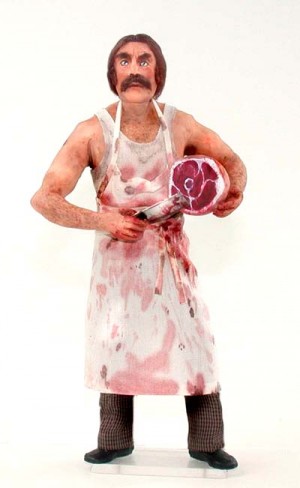
40 sickened with Salmonella linked to Paris butcher
Our food safety friend in France shared a report that concluded from Dec. 24 2012, the Paris Child Protection Service reported several cases of salmonellosis cases in children hosted in 4 nurseries located in the 7th borough of Paris. In a second step, the National Reference Laboratory for Salmonella noticed an increase of salmonellosis cases in Paris in
December 2012 and for several cases, an until now rare Crispol profile was identified — CT51.
Investigations were performed and 40 cases were identified: 30 confirmed cases, 4 possible cases and 6 probable cases. They were 10 children hosted in 4 nurseries and 30 community cases. The outbreak was due to 2 strains of Salmonella: S.Typhimurium CT51 and S.4,12:i:-, a monophasic variant of serovar Typhimurium.
During the telephone interview of the cases, it occurred that most of the cases went to a butchery located in the 7th borough of Paris a few days before the onset of the disease. A random inspection led in the butchery by the Food Hygiene Service revealed many infringements to food hygiene. Some samples were taken in the butchery and 2 S.Typhymurium CT51 and S.4,12:i:- strains were found on the surfaces and in the food sold by the butcher.
This investigation emphasized the role played by observation and early reporting of the Child Protection Service. This report was the visible part of a larger epidemic event that included both cases living in institutions and in the community which occurred simultaneously.
Washing poultry can spread pathogens
I still listen to a lot of punk rock and share the sentiment that the genre was built on: I don’t really like being told what to do. I’m not sure many folks do (even if they don’t describe themselves as punk rock). But if I don’t know where to start on something like how to tie a tie, change the oil in my car, or make a new dish, I go to the Internet.
Recipe websites or YouTube video how-tos (and even cookbooks if they still exist outside of used bookstores) are often looked to for guidance on how to do be an amateur chef. Stuff like making pancakes from scratch, cooking the perfect burger or baking a chicken are out there (and usually with no mention of food safety). Sometimes the pros and amateurs might get the cooking right but fail to reduce the risk (by not suggesting a thermometer). Sometimes it’s worse, and those who are being looked to as experts suggest something that can only increase risk.
This is the case with washing meat before cooking it.
To wash or not wash meat before preparation is a practice that elicits emotion in a lot of folks. Any time I mention to a group of commercial food handlers or normal folks who cook for their families that rinsing poultry before cooking it increases the likelihood that Salmonella or Campylobacter is spread throughout the kitchen it turns into a Johnny Rotten sneer-off. The approach I use is to provide the best available evidence culled from the literature to help eaters calculate the risks and benefits of food choices. Present the info in a compelling way and then step back to let the individual do their thing.
In November 2012, Shauna Henley Susan Stein and Jennifer Quinlan at Drexel University published the results of a set of focus groups conducted with various minority groups and they found culturally unique behaviors including using hot water or acidic solutions to clean raw poultry prior to preparation. In response to the results, they created a set of resources including culturally-appropriate videos and novellas.
From the Drexel site:
Although raw chicken and turkey can carry bacteria on their surfaces, research has shown that washing raw poultry under running water in your kitchen sink is a bad idea.
If germs were visible to the naked eye, you would see that washing poultry just splashes bacteria all over you, your kitchen towels, your countertops, and any other food you have nearby, such as raw foods or salads. This can make people sick, especially young children, pregnant women, older adults and the immunocompromised.
Instead, just take raw poultry straight from the package into the cooking pan. The heat from the cooking process will kill any bacteria that are present. Then clean up any splashes and wash your hands with soap and hot water.
Check out the resources here (some developed by the good folks at New Mexico State’s media lab).
There are multiple communication resources including cooking demonstration videos and photonovellas at the Drexel site (which can be found at www.drexel.edu/dontwashyourchicken).
This program and the research it was built on has garnered a lot of attention from NPR, Alton Brown and others, we’re happy to participate in the dialogue at barfblog and field questions from readers related to washing chicken and other related issues. Jennifer Quinlan will also be weighing in on questions and comments here.

17 sick with E. coli from petting area at Brisbane fair; handwashing or sanitizers never enough
With 17 sick from shiga-toxin producing E. coli linked to the animal area at the Queensland state fair, or Ekka, neighboring Gold Coast says they’re boosting hygiene for their fair that starts Friday.
Queensland Health today confirmed that eight people have tested positive to STEC and another nine have reported symptoms.
Gold Coast Show marketing manager Leisa Martin says the usual precautions have been increased.
“This year in keeping with the guidelines from Queensland Health we have actually put in more of those stations than Queensland Health has advised in an effort to ensure the same unfortunate occurrence does not happen at our show,” she said.
“So of course after you have been near the animals use one of the hand sanitiser stations that are nearby.”
The U.K. and many scientists say hand sanitizers are sorta useless in the presence of an organic matter; handwashing with soap and vigorously running water, followed by drying with paper towel is recommended procedure.
But in several previous petting zoo outbreaks, handwashing was not a factor: bacterial can be present on many surfaces or even aerosolized.
Maybe those guidelines should be updated.
A table of petting zoo outbreaks is available at http://bites.ksu.edu/petting-zoos-outbreaks.
17 (or 12) sick with E. coli from petting area at Brisbane fair; handwashing is never enough
A further 13 cases of shiga-toxin producing E. coli linked to the animal nursery at the Ekka – like the state fair — are being investigated, in addition to the four confirmed cases.
Although maybe it’s only eight additional cases being investigated because Queensland Health isn’t so good about this information thing; an additional five were announced
yesterday, so who knows.
The latest update on the web came from Facebook – it says, two hours ago.
Two hours from when? Two days ago?
Those concerns are minor compared to the plight of the sick people; here’s hoping teachers, retailers, fair promoters and others will start to take animal-human interactions more seriously.
A table of petting zoo outbreaks is available at http://bites.ksu.edu/petting-zoos-outbreaks.