UK restaurateur sentenced to 6 years after peanut allergy death

The owner of an Indian takeaway in North Yorkshire has been found guilty of manslaughter after a customer with a nut allergy was served a meal containing ground peanuts.

food.allergensThe trial was told Mohammed Zaman had cut corners by swapping the thickening agent almond powder for the cheaper groundnut powder, which contained peanuts.

Although the vast majority of restaurants are safe, a number each year are found to have breached laws and guidelines.

Since December 2014, takeaways and restaurants have been required by law to let customers know if any of the 14 most dangerous allergens are ingredients in their food.

They include peanuts, eggs, milk, fish, crustaceans and mustard.

Paul Wilson, 38, who suffered an anaphylactic shock after eating a meal from Zaman’s business, died before the change in the law, but the trial heard he had flagged up his peanut allergy to the restaurant and his meal had been labelled as “nut free”.

Another customer with a nut allergy had to be treated at a hospital after eating at Mr. Zaman’s restaurant three weeks before Mr. Wilson’s death. Like him, she had been assured her meal would not contain nuts, prosecutors said.

Mr. Zaman was convicted of manslaughter by gross negligence in the death of Mr. Wilson, and six food safety offenses. He was sentenced to six years in prison.

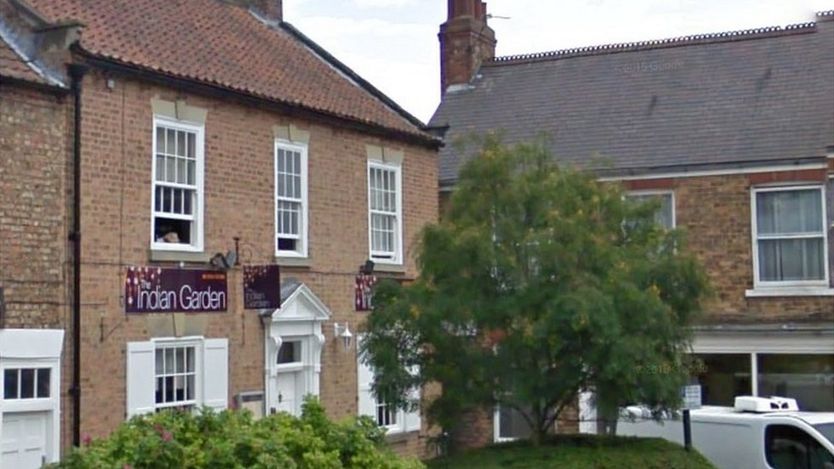
indian gardenHe had a “reckless and cavalier attitude to risk,” the prosecutor, Richard Wright, told a jury at Teesside Crown Court.

It marked the first time in Britain that someone has been convicted of manslaughter over the sale of food.

David Pickering, of the Chartered Trading Standards Institute (CTSI), said: “Some [restaurants] will have it in a book, some will give you the information verbally. If they can’t give you it, don’t eat there.”

Cross contamination nightmare

From the Retail Hell Underground:

I work for a supermarket in the Fresh Fish department. I actually enjoy the job, most of the time that is, but everyone has horror stories. This was an amusing thing that happened shortly after I started the job.

Fish HeadSo we had a sale on Whole Salmon at £4 a kilogram (around $2.50 for a pound, give or take for Americans). It was an incredibly good sale, and whenever the sale is on the department is absolutely rammed with customers. I don’t really mind as the day goes quicker and our sales go through the roof. The vast majority of customers don’t want the Salmon whole as it is, and ask for it filleting, which we are happy to offer and do for them even if it takes a bit longer. I was just about to go for my lunch, but as we had a lot of orders for whole salmon that needed filleting I decided I would stay for longer and help my colleagues get through it. In comes a customer who looks absolutely bewildered, lets call him AB.

Me: Hello Sir, how may I help you today?

AB: The whole salmon, how much is it?

Me: It is on special offer at £4 per kilogramme.

AB: No, how much are THEY?!? I don’t work in kilogrammes. (Despite the fact that the retail sector has been using metric weights for over 30 years and the man didn’t look older than his 50s)

Me: Well it works out at under £2 per pound and they are each individually priced as you can see, they range from between £10 to £16 each depending on which one you want sir.

AB: Give me that one!

Me: Okay sir how would you like it? As it is whole or filleted?

AB: I would like it filleting… quickly please!

Me: I’ll try get through it as soon as I can sir, it shouldn’t take more than 5 minutes. Would you like me to pin bone it?

AB: I SAID FILLETING THANK YOU!!!

Me: No problem, I’ll have it ready for you as soon as possible.

The customer was being irate, but as it was a hot day I didn’t really think much of it as everyone seems to get more aggravated when the sun comes out. I quickly filleted the fish, not bothering to pin bone it as he stated he just wanted it filleting, bagged it up and left it in the back up chiller for when he came back to pick it up. He comes back, I gave it to him and he seemed happy enough. I didn’t think more of it and went for my lunch.

As I came back to the department after my lunch I barely had my apron on when he came rushing back to the department.

AB: There are bones in my fish!

ME: Well yes, you said you didn’t want it pin boning.

AB: CAN YOU REMOVE THEM! I’M NOT EATING MY FISH WITH BLOODY BONES.

ME: Sure thing, but in future when asked if you want it pin boning please reply yes.

AB: (muttering under his breath) …ohh, right.

So I pin bone the fish, but I notice it all crumbled up to the bottom of the bag and it is incredibly wet. My colleague is speaking to the absolutely bewildered customer, and he suddenly bursts out laughing. I’m not really listening to the conversation, but I finish pin-boning the fish and give it back to him and he looks rather embarrassed but thanks me really nicely, like a total mood change.

So I ask my colleague what they were talking about. Supposedly the customer had gone to the customer bathroom after he paid for his shopping, and dropped the salmon in the actual toilet by accident, and he ran the salmon fillets under the water in the sink to clean it as if that would magically get rid of all the bacteria.

This man had just dropped his salmon in the toilet, without telling me, and expected me to handle it again and use a clean surface to de-bone it. Cross contamination nightmare! Me and my colleague had a good chuckle as he got what he deserved.

And that is how I ended up spending the next hour disinfecting the hell out one of our work areas.

How these people manage in daily life is beyond me haha.

German cockroaches invade filthy UK takeaway

The owners of the Chick ‘N’ Spice takeaway were fined and the premises were closed after inspectors found an infestation of German cockroaches.

cockroach_1_finEaling Council food safety officers found the cockroach infestation around a chest freezer in the takeaway, with evidence of adults, nymphs and egg casings.

The borough’s cabinet member for safety, culture and community services, Councillor Ranjit Dheer, said: “The vast majority of food outlets in Ealing comply with hygiene requirements.

“The council responded swiftly to tackle the serious and inexcusable hygiene breaches committed by Chick ‘N’ Spice, and had no hesitation closing the premises to protect public safety.”

1900 sickened: DeCosters appeal jail time in Salmonella egg case

Austin “Jack” DeCoster and Peter DeCoster were sentenced April 13, 2015 to three months in prison for introducing adulterated food into interstate commerce after eggs from their Iowa farms were linked to a 2010 national salmonella outbreak which sickened at least 1,900 people.

decostersU.S. District Court Judge Mark Bennett required the father and son to complete a year of probation following prison and pay $100,000 each. The DeCosters’s former company, Quality Egg LLC, was fined nearly $6.8 million.

More than 1,900 people across the country reported getting sick from Salmonella enteritidis linked to tainted eggs supplied by Quality Egg. The companies recalled 550 million eggs nationwide.

Quality Egg pleaded guilty in June 2014 to bribing public officials and misbranding eggs to make them appear fresher.

The DeCosters’s sentences — especially the prison time — were viewed as a warning to other food producers.

Jack DeCoster, 82, of Turner, Maine, and Peter DeCoster, 52, of Clarion, are now trying to get out of their jail time. They filed an appeal April 27, 2015, asking the U.S. District Court of Appeals 8th Circuit to remove incarceration from their sentence.

“They’re arguing that, based upon the type of offense, any sentence of jail time is not appropriate,” Assistant U.S. Attorney Peter Deegan said last week.

Pro-business groups, including the Cato Institute and the National Association of Manufacturers, filed briefs in support of the DeCosters, arguing executives shouldn’t serve jail time for this type of crime.

“If executives can be imprisoned for criminal violations of strict liability laws by virtue of the position they hold within a company, the United States economy would suffer,” attorneys for Cato and the manufacturing association argued. “Executive business decisions would be motivated less by good business principles and more by fear of possible future prison sentences.”

The 8th Circuit heard oral arguments in the appeal March 17 in St. Paul, Minn., and the parties are now waiting for a decision.

Hucksters abound: orangoutangs and gluten instead of real food safety

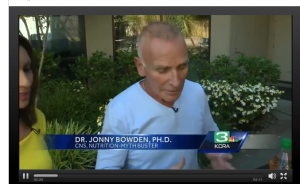
I learned so much from Dr. Jonny Bower, PhD’s KCRA segment on food safety for grilling.

Like preserving orangoutang habitats. Marinade to stay safe from acrylamide. Protect against gluten. Use a proprietary blend of probiotics. Add lots of spices.Screen Shot 2016-05-23 at 2.46.38 PM

Too bad the good doctor didn’t mix in a thermometer. Or talk about cross-contamination.

I couldn’t get the video to embed, check out the full segment here.

Chipotle outbreak makes Boston College commencement address

Part of our approach on barfblog is to inject surprise and humor, or what some might call shock jockery, into food safety messages to compel folks to employ risk reduction practices.

Sometimes we get it right, sometimes we don’t. Linking a norovirus outbreak with a tragic terrorist event isn’t the best idea. According to Boston.com, United States Secretary of Energy Ernest J. Moniz made the Chipotle/Boston Marathon bombing connection during a Boston College commencement speech.Screen-Shot-2016-05-23-at-10.38.40-AM-850x478$large

United States Secretary of Energy Ernest J. Moniz is a native of Fall River, Mass., an alumnus of BC and a professor at MIT, which means he knows very well what it means to be a Bostonian.

But Boston College’s commencement speaker gave a special shout-out to the class of 2016 for being what he called “Boston College strong.”

“You were here for the terrible Boston Marathon terrorism events, the terrible snow storm, and, as I understand, the perils of fast food became also known to this class,” he said.

Those “perils” occurred in December during a norovirus outbreak at the Chipotle in Cleveland Circle. More than 140 Boston College students got sick after eating at the restaurant, including many members of the basketball team.

Everyone has a camera: Food-safety-in-Oman edition

I’ve long been an advocate of electronics and digital monitoring for improving food safety outcomes.

Video-camera-1024x600But only with clear objectives and limits.

In Oman, cameras have been installed on a trial basis at different restaurants located at tourist spots, butcher shops and slaughterhouses in a bid to maintain hygiene standards.

“The aim is to keep an online tab on food processing,” the ministry said.

Ahmed bin Abdullah Al Shehhi, Minister of Regional Municipalities and Water Resources, said the project enjoys full confidentiality guaranteed by the laws to all of the information including visual and non-visual data of food establishments.

All food can be contaminated: Huge recall of frozen fruits and vegetables after Listeria outbreak

The N.Y. Times has noticed the growing number of recalls linked to Listeria-positive frozen produce packed by CRF Frozen Foods in Pasco, Wash., but offers little perspective on why.

beaker.the.screamZero-tolerance is not discussed. Neither is the test-and-hold approach used by many frozen-produce packagers. And of particular note: During our tour of Ontario processing vegetable growers and processors 15 years ago, Chapman and I were told that almost all processing vegetables are blanched – not so much for food safety but for quality – except onions.

Back to the onions at the end.

Brittany Behm, a spokeswoman for the U.S. Centers for Disease Control and Prevention, told the Times the scale of the recall reflects the severity of the outbreak of the illness, Listeria, and of concerns about how the contaminated food might have “trickled down” into other products.

The processing plant, has voluntarily recalled more than 350 frozen foods — including carrots, onions, peaches and strawberries — that were sold in all 50 states and Canada and Mexico, and the EU. The recall began on April 23, with 11 frozen vegetables, but was significantly expanded on May 2.

Eight people sickened with the bacterium Listeria monocytogenes have been confirmed since 2013 — six in California and one each in Maryland and Washington, Ms. Behm said. All of the cases, involving patients 56 to 86 years old, resulted in hospitalizations.

The two people from Maryland and Washington died, but the authorities did not directly attribute their deaths to Listeria because they may have already had weakened immune systems or other illnesses, Ms. Behm said.

It was not clear how many packages were affected by the recall. A spokesman for the company, Gene Grabowski, did not respond to a phone call on Friday. He told The Associated Press that the CRF plant closed two weeks ago and that the company was trying to pinpoint the source of the contamination.
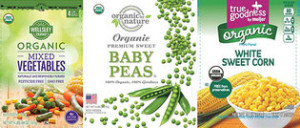
22xp-foodrecall_web2-master315“Unquestionably, this is a lot of product. … It reflects the severity of listeria as an illness, the long duration of illnesses and the outbreak and the long shelf life of the products,” said Matthew Wise, who leads the outbreak response team at the federal Centers for Disease Control and Prevention.

On May 14, 2016, Food Safety News reported that staff from the U.S. Food and Drug Administration inspected the CRF Frozen Foods LLC plant in Pasco, WA, from March 14-17.

The company stopped production at the plant April 25 after being notified by federal officials that frozen vegetables produced there had been linked by genetic testing to several people who had infections from Listeria monocytogenes.

The two-page FDA inspection report includes boilerplate citations of applicable sections of the federal Food, Drug and Cosmetic Act on its second page. The first page includes hand-written observations documenting:

a damaged plastic shovel used for food contact tasks;

chipping, cracking and missing pieces of plastic on food contact portions of equipment on the onion production line;

a plastic conveyor belt with missing plastic pieces on at least five legs that are in direct contact with onions;

utility knives used for trimming bad spots off onions that had initials etched on their blades; and

blue tape being used as a temporary repair on a cracked metal plate above a consumer pack line that was repacking product for export at the time of the inspection.

All of the examples cited by inspectors are cause of concern for the same reason — they mean it’s impossible to adequately clean the equipment that is in direct contact with food being produced.

“The materials and workmanship of equipment and utensils does not allow proper cleaning and maintenance,” according to the report.

“Investigations are ongoing to determine if food sources used to manufacture CRF Frozen Foods products could explain some of the illnesses,” FDA reported in its most recent update May 4.

One of those “food sources” could be onions from Oregon Potato Co., also located in Pasco, WA.

“March 2016 environmental samples collected by FDA from Oregon Potato Company, located in Pasco, WA, were found to be closely related genetically to seven of the isolates of ill people associated with this outbreak,” the FDA reported.

“Based on this information, Oregon Potato Company voluntarily recalled wholesale onion products, which led to subsequent downstream customer recalls, one of which publicly disclosed Oregon Potato Company as its product source.”


 

Nickelback? Really? So much for Trudeau being cool and Shiga-toxin producing E. coli in pigs

Still a deafening silence from public health types over whether or not people are definitively sick or just sick from Cantran Meat Co. raw pork and pork organ products linked to an E, coli O157 outbreak in Alberta.

TrudeauNickelbackSmallIt is a long weekend in Canada – Queen Victoria’s birthday or something as an excuse to go camping in the cold and mark the start of summer – so don’t expect anything public soon.

But an astute conversationalist did send along this abstract from last month to help answer the question, what is Shiga-toxin producing E. coli doing in pig?

Abstract

Similar to ruminants, swine have been shown to be a reservoir for Shiga toxin-producing Escherichia coli (STEC), and pork products have been linked with outbreaks associated with STEC O157 and O111:H-.

STEC strains, isolated in a previous study from fecal samples of late-finisher pigs, belonged to a total of 56 serotypes, including O15:H27, O91:H14, and other serogroups previously associated with human illness. The isolates were tested by polymerase chain reaction (PCR) and a high-throughput real-time PCR system to determine the Shiga toxin (Stx) subtype and virulence-associated and putative virulence-associated genes they carried. Select STEC strains were further analyzed using a Minimal Signature E. coli Array Strip. As expected, stx2e (81%) was the most common Stx variant, followed by stx1a (14%), stx2d (3%), andstx1c (1%).

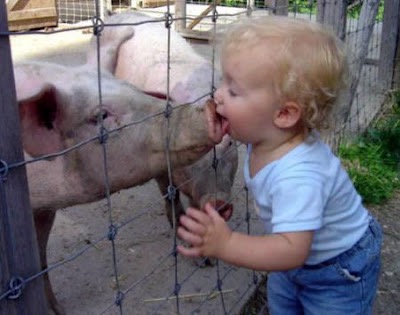
kid_pig_kissThe STEC serogroups that carried stx2d were O15:H27, O159:H16 and O159:H-. Similar to stx2aand stx2c, the stx2d variant is associated with development of hemorrhagic colitis and hemolytic uremic syndrome, and reports on the presence of this variant in STEC strains isolated from swine are lacking. Moreover, the genes encoding heat stable toxin (estIa) and enteroaggregative E. coli heat stable enterotoxin-1 (astA) were commonly found in 50 and 44% of isolates, respectively. The hemolysin genes,hlyA and ehxA, were both detected in 7% of the swine STEC strains. Although the eae gene was not found, other genes involved in host cell adhesion, including lpfAO113 and paa were detected in more than 50% of swine STEC strains, and a number of strains also carried iha, lpfAO26, lpfAO157, fedA, orfA, and orfB.

The present work provides new insights on the distribution of virulence factors among swine STEC strains and shows that swine may carry Stx1a-, Stx2e-, or Stx2d-producing E. coli with virulence gene profiles associated with human infections.

Characterization of Shiga toxin subtypes and virulence genes in porcine Shiga toxin-producing Escherichia coli

Frontiers in Microbiology, 21 April 2016, http://dx.doi.org/10.3389/fmicb.2016.00574

Gian Marco Baranzoni, Pina M. Fratamico, Jayanthi Gangiredla, Isha Patel, Lori K. Bagi, Sabine Delannoy, Patrick Fach, Federica Boccia, Aniello Anastasio and Tiziana Pepe

http://journal.frontiersin.org/article/10.3389/fmicb.2016.00574/full

£30k fine slapped on UK Indian takeway owner after pools of blood found in freezer

A takeaway boss has been forced to pay out more than £33,000 after health inspectors found pools of blood in a freezer and cobwebs on light fittings at his business.

Maya takeaway Salik Mohammed Miah, 42, the owner of Maya takeaway in Polesworth, was handed one of the largest fines in the history of North Warwickshire Borough Council after a catalogue of hygiene horrors were exposed during an inspection.

Uncovered boxes of prawns, chicken and rice were also discovered along with containers of curry sauce stored on the floor and a dirty sink containing disgusting cloths and sponges.