
Ben Chapman

About Ben Chapman

Dr. Ben Chapman is a professor and food safety extension specialist at North Carolina State University. As a teenager, a Saturday afternoon viewing of the classic cable movie, Outbreak, sparked his interest in pathogens and public health. With the goal of less foodborne illness, his group designs, implements, and evaluates food safety strategies, messages, and media from farm-to-fork. Through reality-based research, Chapman investigates behaviors and creates interventions aimed at amateur and professional food handlers, managers, and organizational decision-makers; the gate keepers of safe food. Ben co-hosts a biweekly podcast called Food Safety Talk and tries to further engage folks online through Instagram, Twitter, Facebook, YouTube and, maybe not surprisingly, Pinterest. Follow on Twitter @benjaminchapman.

Wake County (NC) surveys food handling practices; makes me a happy resident

I’m pretty happy to live in Wake County today. It’s not just the sunny and warm weather (supposed to be in the 80s today); great amenities for a family or the relatively low cost of living that have me excited.

It’s the food safety nerd stuff.  

Wake County Public Health (the same folks who followed-up with me during the Campylobacter 2009 incident) have been proactively evaluating potential legislation changes and released a report on how well the businesses and institutions they inspect are doing when it comes to reducing foodborne illness risk factors.
 
FDA has conducted similar surveys in the past (2003 and 2008) and now Wake has local data that can be used for lots of different things including evaluating inspection changes, food handler training interventions and system differences.
 
Using a FDA data collection instrument including observation, health officials evaluated 458 randomly selected food service establishments representing  various types of facilities (including schools, hospitals, delis, full service restaurants and fast food). 
 
According to the report,
 
Wake County staff used a combination of direct observations at each restaurant and responses from restaurant management and food preparation staff. For each of the facility types, the number of items recorded as non?compliant with the current FDA Food Code was recorded. 
 
Improper holding/time and temperature was the risk factor found to be most often out of compliance.  The highest percentage of OUT of compliance values were most commonly  associated with:  
-Improper cold holding of potentially hazardous food (PHF)  and  
-Inadequate date marking of refrigerated ready?to?eat PHF 
 
Poor personal hygiene was the risk factor with the second highest incidence of OUT of compliance values.  The OUT of compliance values were most commonly associatd with: 
– Non?compliant employee health policy and
– Improper handwashing. 
 
A study like this does have limitations (inspectors as observers might influence behaviors of food handlers and managers, more than if it was an outside observer; observers get tired and miss things, have their own biases) but this is a great starting point and more than what many others have. Reports like this might generate some scary headlines but they arm health officials and the industry with a starting point to compare future efforts against.
 
According to Andre Pierce, Environmental Health director, “Based on the survey, the County will direct its attention to the risk factors that are most frequently out-of-compliance in food service establishments, and implement programs to reduce or eliminate the frequency of all of the risk factors that contribute to foodborne illness.”
 
Food safety culture issues are featured prominently in the report – addressing things like having ill food handlers step away from the kitchen (and managers supporting them) and monitoring how long open deli meats sit in a fridge are more than just regulatory concerns.
 
I told Martha Quillin of the News and Observer,
 
"Legislation can only go so far. What’s more important is what happens when the inspector’s not there. You have to find a way to engage everyone, from the business owner all the way down to the 15-year-old who works in the kitchen, in the concept that we need to prevent food-borne illness."

Reducing some of these factors have less to do with different inspections and more to do with creating an environment within a business where staff know risks, how to manage them and value not making patrons ill.

Phillies fan pukes on the field; caught on Fox broadcast

Baseball is one of my guilty pleasures (along with Pearl Jam, taking baths and walking around malls). Fantasy baseball (known to nerds like me as Rotisserie baseball and to my wife as fake baseball) is an even guiltier pleasure. I started playing about 10 years ago with a bunch of guys I didn’t know and have continued to get together in-person and online with them to talk trash about players who we "manage".

A few years ago I came close to winning the league (but it all fell apart in the last two weeks of the season; I ended up in third place). That year I had Freddy Sanchez on my team (then of the Pittsburgh Pirates, now of the San Francisco Giants) for a couple of months. Last night, playing in the National League Championship Series vs the Phillies, Freddy fouled a ball towards the stands near 3rd base. As Fox’s cameras panned to follow the ball, they caught a fan in the first row throwing up on the field (see below, exactly as shown).

There’s something about puke at Phillies games: earlier this year another fan was charged with assault, reckless endangerment, and disorderly conduct after allegedly intentionally vomiting on an 11-year-old girl and her father during a game.

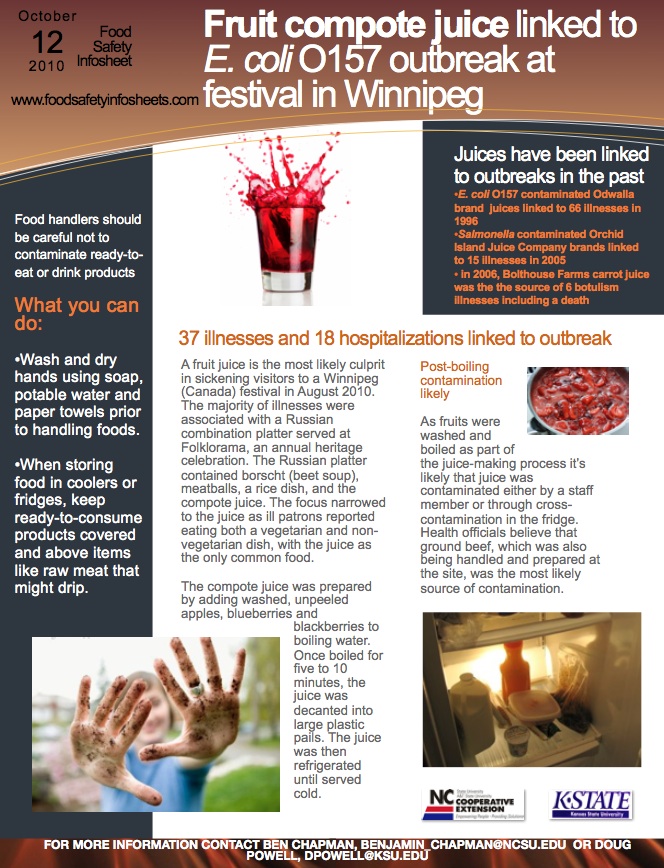
New Food Safety Infosheet: Fruit compote juice linked to E. coli O157 outbreak at festival in Winnipeg

The newest food safety infosheet, a graphical one-page food safety-related story directed at food businesses, is now available at www.foodsafetyinfosheets.com
Food Safety Infosheet Highlights:
– Juices have been linked to outbreaks in the past.
– Food handlers should be careful not to contaminate ready-to-eat or drink products.
– Wash and dry hands using soap, potable water and paper towels prior to handling foods.
– When storing food in coolers or fridges, keep ready-to-consume products covered and above items like raw meat that might drip.
Food safety infosheets are created weekly and are posted in restaurants, retail stores, on farms and used in training throughout the world. If you have any infosheet topic requests, or photos, please contact Ben Chapman atbenjamin_chapman@ncsu.edu.

You can download the infosheet here.

Kiwi drinking games at Oktoberfest include drinking vomit and urine; feces not allowed

As Oktoberfest festivities wrap-up in Germany (and begin in Kitchener-Waterloo, Ontario, which used to be known as Berlin), the New Zealand Herald reports that a group of Kiwis traveling around Europe have appalled the locals in Munich by participating in a drinking game that involves drinking urine and vomit as a penalty. The travel group, known as Van Tour, has been described by participants as a three-month unorganised drinking trip around Europe which involves visiting bars every night with a bit of sightseeing thrown in during the day. Culminating, ironically (and messily), at Oktoberfest.

The Kiwis’ behaviour, which disgusted some Germans, was performed by a group called the 100 Club.

About 40 people, both men and women, took part in 100 Club at Oktoberfest. Each had to drink a 35ml shot of beer every minute for 100 minutes. They weren’t allowed to wear underwear or have toilet breaks.

If a player vomits or urinates they have to drink it, or get someone else to, through a funnel or muddy gumboot.

According to participant Tim Russell, of Napier (that’s in New Zealand) "Feces are not allowed as you can get really sick from it … rumour has it someone got TB from it few years back. Other bodily fluids such as blood are also not allowed."

I’ve attended the Kitchener-Waterloo Oktoberfest a couple of times and it was pretty tame next to what folks have told me about the German originator. Although I’ve never been there with a Kiwi.

While I’m glad that the 100 Club has removed feces from their list of consumables, participants are still susceptable to a whole bunch of other infectious diseases and it’s not all that likely that they’ve reduced TB risks all that much (as TB is primarily a respiratory disease). Don’t eat poop; don’t drink vomit (unless you want to catch something).

Oklahoma salmonella outbreak grows; Iowa says that although it’s PFGE-matched, their cases aren’t linked

According to News9.com, 17 cases of salmonellosis have now been linked together as a cluster of illnesses in Oklahoma grows.  Most of the illnesses occured between September 2 and 13 with students in the Mustang School District but school and health officials did not contact parents until last week as the investigation unfolded. An additional three cases, matched genetically, have now been added to the cluster.

Two adult cases have been identified in Oklahoma County as well as another case in Carter County. Investigators are trying to figure out if those cases are connected to the Mustang outbreak. Only one person, an adult, has been hospitalized.

As Doug wrote last week, this sure looks like a common supplier issue with a ready-to-eat product like fresh produce, especially now since the outbreak includes illnesses outside of the school system. Although procuring safe food is about trust, knowing about the risks associated with ingredients/inputs and asking tough questions about how a supplier handles microbial food safety in production, preparation and handling is a responsible thing to do. And it’s more than just relying on audits; they are just one part of good procurement practices. Dave Theno, formerly of Jack-in-the-Box summed up the limitation of third-party audits in an interview with USA Today last week saying that, "especially with critical suppliers, you’re really betting your business on these guys [auditors]."
 
In a Bobby McFerrin-esque manner, state health officials in Iowa say not to worry, two Salmonella-positive cases in the state, which are reportedly a genetic match to the Oklahoma cases, are not likely linked.
 
Patty Quinlisk, Iowa’s chief epidemiologist, says there’s no cause for concern. “We’ve had two cases,” Dr. Quinlisk says. “We investigated both already. There’s no link for the two of them to each other. There’s no obvious exposure to any particular food products nor does there appear to be any link to people who are getting sick in other parts of the country, including Oklahoma.”
Based on their testing and follow-ups, Quinlisk says she’s convinced the Iowa cases are not related to the others. Quinlisk says, “We’re not asking anyone to do anything nor do we see any potential risk to Iowans, though we will continue to watch this and other strains of diseases like salmonella.
” While there may be a DNA “fingerprint” match between the Iowa and Oklahoma strains of salmonella, Quinlisk says that doesn’t mean these people all ate the same type of food or ate in the same restaurant.

“We do a follow-up,” Quinlisk says. “We go in and we interview the people and say, what have you been doing? What have you been eating? Have you been traveling? There’s no exposure link. There’s nothing that our people have been doing that’s anything similar to the cases in Oklahoma, in fact they’re not even in the same age groups, same kind of living situations or anything like that. They’re very different.”  


Bobby McFerrin – Don’t Worry, Be Happy

“Extreme gastric distress” knocks symphony conductor out of commission

According to the New York Times, The Chicago Symphony Orchestra’s lovefest with its new music director, Riccardo Muti, came to a sudden halt on Sunday, when the maestro canceled two weeks of concerts to seek treatment in Milan for what the orchestra called “extreme gastric distress.”

Mr. Muti suffered some discomfort while leading the orchestra on Friday, felt stomach pain at a rehearsal on Saturday and withdrew just before a gala concert on Saturday evening.
“He just couldn’t do it,” said Mary Lou Falcone, a spokeswoman for Mr. Muti and the orchestra, who said the maestro suffered severe stomach pain. The orchestra was able to perform without him.

Mr. Muti had been with the Chicago Symphony for only two weeks, beginning his tenure as its new music director after a lengthy courtship and much hoopla accompanying his arrival. “I cannot express the depth of my regret,” he said in a statement issued by the orchestra.
 
Extreme gastric distress sounds like something the percussion section could use.


Former President Carter hospitalized with “stomach virus”

Former President Jimmy Carter is reportedly resting at Cleveland hospital after feeling ill with symptoms resembling a norovirus infection.

Carter’s grandson, Georgia state Sen. Jason Carter, said his 85-year-old grandfather was doing fine. 

"He’s definitely resting comfortably and expected to continue his book tour this week," Jason Carter said. "I haven’t talked to him, but nobody in the family is concerned."

Carter is scheduled to appear tonight in Durham NC as part of a national book tour.

Sauerkraut blows up in Northern BC school; Hazmat team responds

Doug and I traveled to Prince George (that’s in British Colombia, Canada) in October 2005 for a workshop for local health inspectors and the place creeped me out a bit. The town was like many small Canadian locales I’d been to: a few Tim Hortons outlets and Labatt 50 on tap at the crowded local pubs. The hosts were fantastic as were the Northern BC inspectors we hung out with. That wasn’t the creepy part.

What was creeping me out was the 800km through the bush from pretty well anywhere. I was only there for a couple of days but I felt pretty isolated.
 
I was also worried about the bears (and this was pre-Colbert Report). 
 
Bears don’t like sauerkraut so maybe that’s why students in a Prince George school were messing around with a can of it. According to the Vancouver Sun, a canister of sauerkraut exploded causing some botulinum toxin exposure concern:
 
Two dozen students and four staff were quarantined while a hazardous materials technician and a safety officer investigated the substance.
 
It turned out to be sauerkraut, which had been fermenting in the can for several years.
 
When it was determined a botulism outbreak had not occurred, students were returned to their classes but dismissed early from school.
 
Could have been some incomplete fermentation allowing some gas-forming organisms to mess things up or maybe secondary fermentation.  I’m not really a sauerkraut fan; I prefer fried onions and peppers on my grilled brats if I’m really trying to class them up but if you’re looking for some home-made bear-repelling sauerkraut check out this tested recipe from the folks at the National Center for Home Food Preservation.

Reusable bags linked to lead — not really a food safety issue

In the on-again, off-again relationship between safety and reusable bags, NY-based Wegmans has stopped distributing a style of bag due to elevated levels of lead.  According to reports, Paradigm Environmental Services recently tested an unknown number of green, red, black and purple colored Wegmans bags for heavy metals. At least one green bag was found to have a lead level of 799 ppm – exceeding the NY state allowable level of 100ppm for packaging. The issue is around the disposal of the lead-containing bags – not holding or storing food in them.

Judy Braiman, president of the Empire State Consumer Project and Rochesterians Against Misuse of Pesticides, alludes to a food safety concern with the bags by saying there’s a possibility of exposure if the bags become worn over time, “It’s lead, and lead is toxic. Why take the risk?”
 
While Wegmans has announced that they will replace customer’s pea green and Holiday 2009 bags as a precaution.
 
Wegmans will post notices in its 76 stores and on a website as soon as today, offering consumers a replacement, Jo Natale, a company spokeswoman, said in a telephone interview. More than 725,000 bags were sold at stores in New Jersey, New York, Pennsylvania, Virginia and Maryland, she said.
 
“This is not a food-safety issue,” Natale said. “It does not present a public-health risk. Even so, we are very committed to the environment, to sustainability, and decided to err on the side of caution.”
 

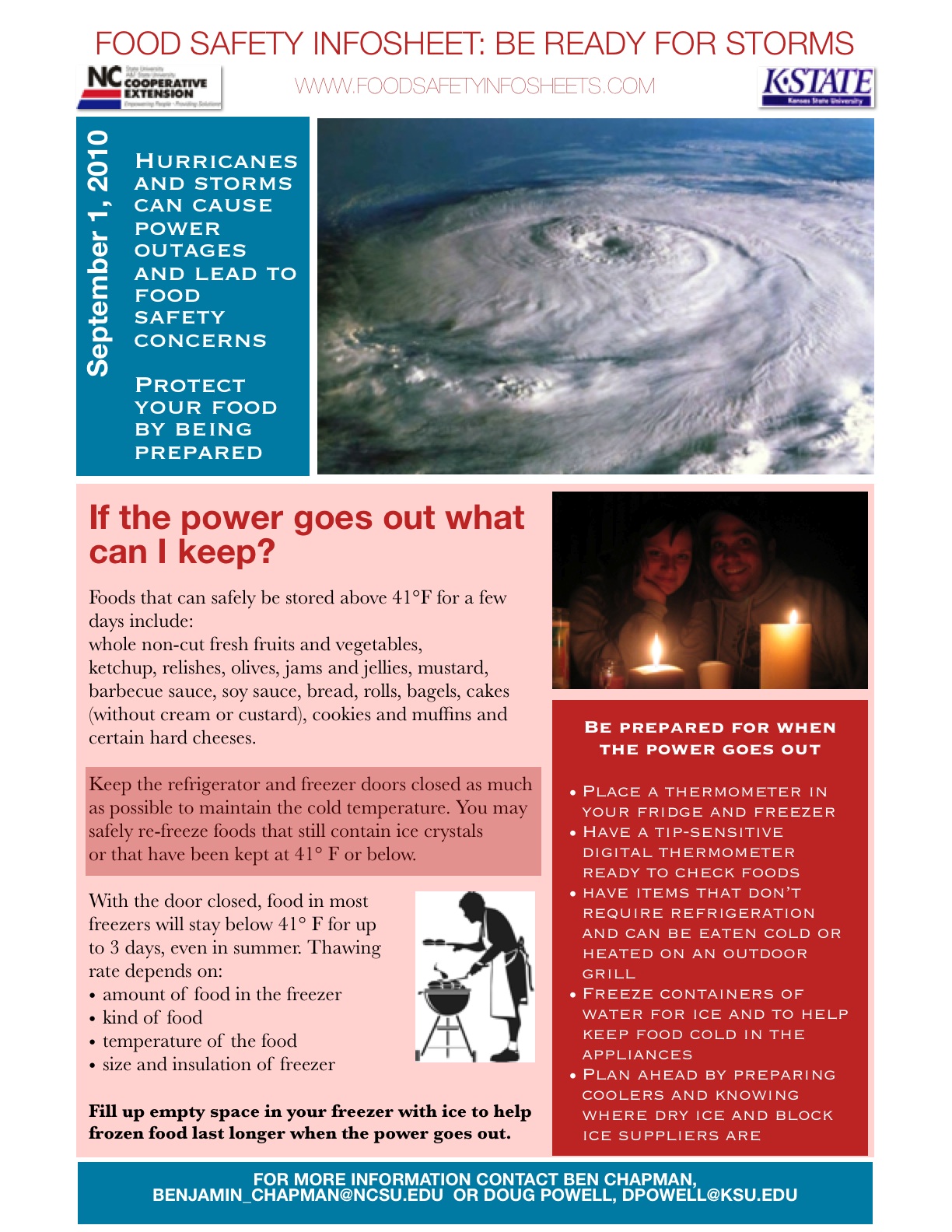
New food safety infosheet, Hurricane Earl edition: Be ready for storms

I’ve lived in North Carolina for just over 20 months and have yet to see the effects of a hurricane. Snow has shut things down in Raleigh a few times since December 2008, but nothing crazy has happened during the summer months. Our power went out about a month ago after a fire at a nearby power station and although it was 8:30pm, it only took 3 hours without electricity for the temperature in our house to go up about 5 or 6 degrees.

Living like that for a couple of days is a slight possibility with Hurricane Earl on its way sort of towards us. Fortuntely we’re far enough inland that it looks like we wont see the full effect, but many on the coast could find themselves without electricity, dealing with hot temps (close to 100F is forecasted for Friday) and a fridge/freezer full of food. Not fun.

Having a bit of a plan and prepping for losing power prior to an event can save food losses and reduce foodborne illness risks. That’s the focus of the newest food safety infosheet (which can be found here).