
Ben Chapman

About Ben Chapman

Dr. Ben Chapman is a professor and food safety extension specialist at North Carolina State University. As a teenager, a Saturday afternoon viewing of the classic cable movie, Outbreak, sparked his interest in pathogens and public health. With the goal of less foodborne illness, his group designs, implements, and evaluates food safety strategies, messages, and media from farm-to-fork. Through reality-based research, Chapman investigates behaviors and creates interventions aimed at amateur and professional food handlers, managers, and organizational decision-makers; the gate keepers of safe food. Ben co-hosts a biweekly podcast called Food Safety Talk and tries to further engage folks online through Instagram, Twitter, Facebook, YouTube and, maybe not surprisingly, Pinterest. Follow on Twitter @benjaminchapman.

Salmonella Enteriditis in eggs: Seen and heard

Headline writers across the U.S. have been increasing their egg-related pun usage as coverage continues. According to headlines, many seem to be scrambling (yes, most had the same joke).

Here are some of the select words over the past 24 hours.

Foodservice reactions (from AP):
"If someone asks for eggs over-easy, what do you do, put a skull and crossbones on their table?" said Louis Tricoli, who owns three Wisconsin restaurants with his family, including one where nearly two dozen people were sickened in late June after likely eating the now-recalled eggs. "Undercooked beef, undercooked pork, chicken, eggs, anything you ask to be undercooked, it’s at your own risk."

At Atlanta’s West Egg Cafe, business was brisk last weekend when customers chowed through nearly 2,900 eggs over the course of three days. Still, some diners made sure to ask whether the eggs were safe, said Chef Patric Bell. The restaurant’s eggs weren’t affected by the recall and he said so far no one was changing their breakfast orders. "If I couldn’t get eggs that were safe, I wouldn’t serve them at all," he said.

Safe is like a guarantee of risk-free, and raw/undercooked eggs are not — data shows that Salmonella Enteriditis is in or on 1 in 20,000 eggs in the U.S.. There is always a risk.

The harmful bacteria typically contaminate one out of every 10,000 to 20,000 eggs. That risk is always there for people who like eggs that aren’t cooked until the yolks are solid, said Benjamin Chapman, an assistant professor specializing in food safety at North Carolina State University. "It’s difficult to say if the risk is any different than it was two weeks ago or two years ago."

Food safety decisions are based on risk/benefit trade offs; and safety means a lot of things to folks (from AP):

The recall isn’t enough to scare off Charles Mettler, who ordered an eggs Benedict on Tuesday when he stopped by Drake Diner’s in Des Moines, Iowa. "I’m probably more worried about the Hollandaise sauce as far as cholesterol." Mettler said.

Risks aren’t just from undercooking or temperature abuse– cross-contamination is also a potential route to contaminate non-egg containing dishes (from the syndicated HealthDay):

During food preparation, take precautions by thoroughly washing your hands, countertops and utensils after handling raw eggs. "When you crack an egg, a little egg juice will usually get on your hands or countertop. You want to make sure you’ve washed that before you accidentally lay your toast on it," Chapman said.

An example of a restaurant operator evaluating risk/benefit of using eggs that were included in the recall, even with control measures such as cooking (from AP):

When Peggy Bevan, owner of the Egg Shell of Cherry Creek breakfast cafe in Denver , learned that the egg recall had expanded to Colorado, it was time to clear the decks. "We dumped everything we had prepped, from pancakes to French toast batters," she said. "We didn’t take a chance."

 

Martha Stewart clueless about egg safety; says it’s okay to store eggs on counter for a few days

Audrey Kreske, an N.C. State post-doc writes of a food safety blunder on morning television:

Today’s Today Show featured a segment with Martha Stewart discussing her top 50 tips for creating a kitchen that’s “not only beautiful but functional as well”.  Viewers were definitely waiting with pens in their hands to discover the Domestic Diva’s secrets.

Some of the household tips included: how to avoid breaking dishes while washing them; putting liquid soap in easy-to-use decanters; and the essential nature of multiple little dishtowels.

Fascinating.

Then things got weird (see the video below, beginning at 3:55). Martha got a bit wacky with the eggs.

In attempt to show how nice eggs look on the counter as a decoration accessory, the Diva points to eggs in a basket and says, “We’re having a big problem with eggs so everybody better be very careful where their eggs come from. But organically grown eggs from the farm, you can keep out for a few days on the counter”

Matt Lauer, somewhat taken aback by the statement chimed in and asked “Oh really, that’s not a problem?”

Martha said, “Oh, no, no; not if they’re fresh”

The big problem Martha refers to is the over 1300 Salmonella Enteriditis illnesses linked to egg and egg products that have led to a recall of almost half a billion eggs.

The problem that Martha misses is that it doesn’t matter where eggs come from or the production practice, there is still a risk of Salmonella Enteriditis being present. Contamination comes from the environment, humans or rodents; multiplies within the flock; and, an infected hen can result in the pathogen inside the egg (infection occurs in the ovary).What is problematic about the pathogen is that while it may infect a hen or group of hens, it typically does not create any clinical signs.  If Salmonella is in an egg sitting on the counter, even if Martha says it’s okay, the bacterium can grow and create a larger issue.

According to a 2005 USDA risk assessment, approximately 1 in 20,000 contains Salmonella;  even if they appear to be clean and uncracked.

The best available evidence suggests that eggs should be stored in the refrigerator/cooler and held below 45°F. The U.S FDA recommends buying eggs only if sold from a refrigerator or refrigerated case, checking that the eggs are clean and the shells are not cracked, and, refrigerating promptly to prevent egg-related illness.

Cooking is a valid control measure, Eggs can carry Salmonella and need to be cooked to 145°F for 15 seconds to reduce risk.
 
Audrey Kreske is a post doctoral researcher in the department of 4-H Youth Development and Family & Consumer Sciences at N.C. State and avid Today Show viewer.
 

Visit msnbc.com for breaking news, world news, and news about the economy

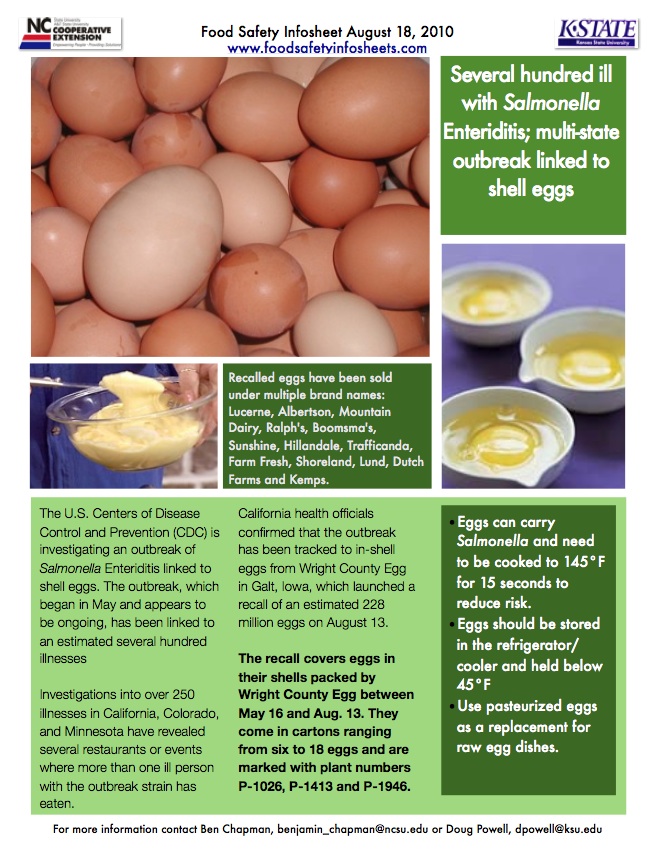
Several hundred ill with Salmonella Enteriditis; multi-state outbreak linked to shell eggs

An egg-linked outbreak of Salmonella Enteriditis in the U.S. is blowing up. An estimated 228 million eggs recalled, 260+ illnesses in California, another 7 confirmed illnesses in Minnesota and Pulsenet lighting up with four times the expected number of cases with this particular genetic fingerprint. Click here to download the newest food safety infosheet directed at food service food handlers that focuses on the outbreak and recall.

Chicago area market in a pickle; Salmonella confirmed in at least six patrons

Before I moved to North Carolina I didn’t know a whole lot of the specifics around home food preservation. I had never pickled, canned, or done anything preserve-y. My parents use to have a pickling party around Labour Day every year (the ‘u’ is in there because I lived in Canada then) but I never really got into it. In the past two years I’ve become a lot more involved with preservation stuff as the close to 100 extension agents across the state to whom I provide technical food safety support spend a pretty good chunk of their time teaching and answering questions about pickling, pressure canning and the likes.

I jumped into pickling last year and pressure canning this year so beyond the science aspect I have an idea of the practices – what’s tough and what might go wrong. Preservation is a bit like baking where recipes, ratios and processing times are important to create a final product that’s not going to paralyze or kill someone. Follow the rules and everything should be okay.

AP reports that something went wrong in the Chicago area and now a few folks are suffering from salmonellosis:

According to public health officials, six confirmed cases of salmonella has been linked to pickles purchased from the Assi Market in the Chicago suburb of Niles. Five people have been hospitalized.
Telephone calls to the market for comment Thursday were not immediately returned.
Health department officials say all confirmed victims of salmonella poisoning reported eating pickles made at the market and sold in plastic bags between July 25 and July 27, with a sell by date of Aug. 24.
 
Salmonella isn’t typically associated with fermented or acidified cucumbers (the heat processing of the product should kill it and the  pH is too low for growth of other pathogens). AP reports that the illnesses have been linked to pickles that were sold to customers in plastic bags. This outbreak looks like the result of a post-pickling issue; possibly dirty hands or equipment used to transfer the pickles to bags.
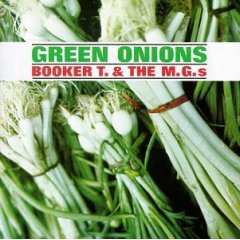
There are a bunch of 20-something men in Ontario ill with salmonellosis; possibly linked to green onions?

 The Toronto Star reports today that the Ontario Ministry of Health and Long Term Care is investigating a spike in Salmonella Oranienberg-linked illnesses in and around Toronto. Twenty-five cases of Salmonella have been reported to health authorities since late July, up from the expected three in the same time frame. The Star suggests that these cases may be linked to a CFIA investigation of green onions. The inspection agency issued a warning about unwrapped green onions that were sold between July 31 and August 1 at a Highland Farms grocery store located at 4750 Dufferin St.

Loose green onions sold in such a small window could suggest either contamination at the store (an ill food handler?) or problems further upstream (transport, distributors, wholesalers or even back to the farm).

But probably not in-home or shopping practices.

Making the below advice from Dr. Arlene King, Ontario’s chief medical officer of health, pretty far out of context (although health authorities have been known to call situations like this "a teachable moment"; research disagrees that this tactic works).

“People need to remember to properly handle and prepare food,” said King.

The ministry recommends four basic steps to prevent foodborne illness — clean, separate, cook and chill.

The steps include thoroughly washing hands, surfaces and equipment, keeping raw and ready-to-eat foods separated, cooking at high temperatures, and properly refrigerating and defrosting food.

Yeah, I’m sure refrigeration and defrosting was really a key factor with the green onions. How about giving folks some advice on how to ask questions about the conditions their produce was grown and talking about what regulators and the industry is doing to make sure this type of stuff doesn’t happen.

Food handler at Siler City, NC Burger King diagnosed with hep A

Line-ups for post hepatatis A IgG shots are expected at Siler City, NC Burger King this weekend after a food handler who worked on August 2 and 3rd has tested positive for the virus.

The Chatham County Public Health Department issued a statement late Friday urging patrons of the restaurant, at 1712 E. 11th St., to be vaccinated for hepatitis A.

Immunizations will be offered for free at the health department, at 1000 S. 10th Ave., Sunday from noon to 5 p.m. and Monday and Tuesday between 8:30 a.m. and 6:30 p.m.

The vaccine can prevent infection up to 14 days after exposure, so those who ate at the Burger King should get an injection by Aug. 17, the health department said.

If I was running a food business, hep A would scare me the most. It often turns out like this: no illnesses linked to the food handler yet (and maybe the individual is the best handwasher out there) but there will still be hundreds of people lining up resulting in pretty bad PR.

Here’s an old food safety infosheet detailing a hep A outbreak at a McDonalds in Illinois last year.

2007 U.S. outbreak stats published; norovirus tops the list

I spoke to a room full of restaurant managers yesterday and shared stories about outbreaks. Stats are great, but I find that what helps me connect best with front-line staff are the stories of real people like Mason Jones and Stephanie Smith, and their families, who have to deal with the consequences of foodborne illness everyday. We see at least a couple of outbreaks reported publicly each week and while not each have tragic endings, there are thousands of people affected.

Earlier this week I saw Rob Tauxe from CDC talk about how through Pulsenet, CDC sees on average, around 25 clusters of foodborne illness pathogens every week. Many of those outbreaks go unsolved due to a lack of data and resources Today CDC released the 2007 Outbreaknet report detailing the trends on almost 1100 foodborne illness outbreaks that year.

A CDC press release states:

"Knowing more about what types of foods and foodborne agents have caused outbreaks can help guide public health and the food industry in developing measures to effectively control and prevent infections and help people stay healthy," said Chris Braden, acting director of the CDC’s Division of Foodborne, Waterborne and Environmental Diseases.

Despite health officials’ efforts, the cause of an outbreak—either the food or the foodborne agent responsible—often cannot be determined or confirmed. This most commonly is the case when the outbreak is small. Of 1,097 reported outbreaks in 2007, 497 (or 45 percent) confirmed that one foodborne agent was responsible and in an additional 12 outbreaks more than one foodborne agent was responsible. Thus, in more than half of the outbreaks, a foodborne agent was not identified. Norovirus was the most frequently confirmed foodborne agent (39 percent), followed by Salmonella (27 percent).
 

Although most foodborne illnesses are sporadic, investigations of those that occur as part of recognized outbreaks provide insights into the agents, food vehicles, and food handling practices that lead to foodborne illness. Unlike laboratory-based surveillance systems, in which the sources of illnesses are rarely reported, the investigation and reporting of outbreaks provides important epidemiologic information that can be used to inform food safety policy.
 
And they provide the concrete examples that are effective in changing behavior. Outbreaks suck, especially for those who are affected, but when they do happen, sharing the outcomes of the investigation can be powerful in reducing the chance that a similar event happens again to someone else.

CDC: Feeding your pets in the kitchen (and washing their bowls) can lead to salmonellosis

Pet food/feeding just wont go away. Following last week’s frozen pet food linked outbreak, researchers led by CDC have released a report detailing salmonellosis associated with dry pet kibble from 2006-2008 linked to 79 illnesses in 21 states.

According to AP and USA Today:

Dry pet foods are an under-recognized source of salmonella infections in humans, and it’s likely other illnesses since then were unknowingly caused by tainted pet food, said Casey Barton Behravesh, the report’s lead author and a researcher at the federal Centers for Disease Control and Prevention.
 
While young children were most often affected, there’s no evidence that they got sick by eating pet food, Behravesh said. They probably became infected by touching affected animals or dirty pet food dishes, and then putting their hands in their mouths, she said.
 
In her study, sick children were no more likely to have played with or eaten pet food than other children. Instead, people were at risk for salmonella simply because they fed their pets in the kitchen, Behravesh says. People who became ill may have spread the bacteria around the kitchen because they failed to wash their hands after pouring dog chow into a bowl or handing the cat a treat.
 
With an almost-two-year old inquisitive boy in our house, I know how appealing pet food, pet food bowls, feeding pets and playing/laying on pet beds can be to a child. What’s most interesting to me is the reportedly 4-times higher rate of infection from feeding pets in the kitchen – as is the spread from washing pet food bowls as a factors. How this translates to general household dishwashing (especially after use with potentially contaminated raw foods such as meat) is worth looking at further and modeling.
 
Doug and Randy Phebus created the below video at the time of the pet food-linked outbreak. They’ve both aged a bit but the info remains current.
 

Message to stadiums: Jerry Macguire it up and show me the money

I’m on my way to the International Association for Food Protection annual meeting in Anaheim; it’s kind of band camp for the food safety nerds. I’m sure that at least once in the next 48 hours, last week’s ESPN food-safety-sucks-at-some-stadiums will come up. Demonstrating how mainstream food safety can be, sports talk radio got into the discussion with Mike and Mike in the morning (one of my favorites) carrying a couple of segments on Wednesday (the conversation took a weird turn into a do-you-really-want-to-know about your current partner’s sexual history).

The food safety story on Outside The Lines has caused a ripple effect with journos from pretty well every town that hosts a major sports team reported on the local angle. The response to the stories is following a predictable cycle: expose, local digging, canned responses from the operators.

The Detroit Free Press ran some of the statements, including the below from the food service operator at the Palace of Auburn Hills:

“We are committed to food safety in our operations, and we have a solid food-safety and sanitation program in place to provide the proper employee training, safety procedures and food-handling techniques required to meet or exceed our standards, as well as those of the local health department. We anticipate the health department’s regular visits as another set of eyes to ensure our operations are delivering consistent, safe experiences for our fans.”

Ho-hum. Of course you are committed to food safety and it’s your number one priority, what food proprietor would publicly say anything different? The responses all get kind of boring after awhile. Why aren’t the stadium and arena dudes consulting with the facility’s entertainment brethren (the folks who run the scoreboards and jumbotron) grab a video camera, hit the kitchens Blair Witch-style and give patrons and fans a tour to show exactly what “number one priority” means and throw it up on YouTube.
 
The statement from Joe Louis Arena was better, admitting problems, describing corrections and telling a more complete story about the food safety system. But they end by saying “Our guests can be very confident that we are vigilant in ensuring the highest standard of quality and safety in all the products proudly served during our events.” A better tactic would be to show patrons, explain why you do what you do (that means talking about risks) and let them decide whether they can be confident.