Cheddarvision: it’s not state-sponsored jazz from Wisconsin

The Sydney Morning Herald reports that Wedginald, the English cheddar cheese that has become a star of the Internet as it matures live on screen, is up for auction, with the proceeds going to charity.
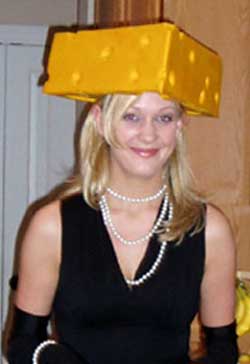
The 20-kg cheese that has attracted 1.65 million viewer hits on http://www.cheddarvision.tv since it went on the web late last year has nearly completed its 12-month maturation and will be ready to eat by Christmas, the owners said.

Jeff Wilson and I set up an experiment eight years ago, to let people watch corn grow. They loved it.  Watch for some of our Farmer Jeff greatest hits to show up on YouTube — we were doing this stuff years ago.

Safest meat in the world — especially in pot pies

While introducing a Senate motion to block the movement of older Canadian cattle into the U.S., U.S. Senator Byron Dorgan (D-ND) couldn’t help himself and played the "safest meat in the world" card.

"American beef is the safest in the world, but increased importation of higher risk Canadian beef and cattle would undermine the confidence of our trading partners and cause further damage to our domestic beef industry."

Observers said it was doubtful the motion would pass.

U.S. has safest meat in the world; outbreaks increase

I don’t know much about farm bills and state versus federal inspection.

But claims that,

"U.S. consumers enjoy the safest meat and poultry products in the world,"

especially as E. coli O157:H7 outbreaks in the U.S. appear on the rise and more sick people are identified in Wisconsin, seems to be the height of hubris.

But that’s what Ron de Yong, director of the Montana Department of Agriculture, wrote in the Montana Billings Gazette this morning.

An outdated federal law prohibits state-inspected plants from selling products across state lines despite a provision in the law that requires these plants to have safety standards that equal or exceed those of USDA-inspected facilities. …

There are many reasons to abolish the 1967 prohibition on interstate shipments of state-inspected meat. … Enabling interstate sales of state-inspected meat and poultry will provide economic fairness and open markets. New marketing opportunities not only will benefit producers, processors and small businesses, but also will give consumers more choices at the supermarket. This change is common sense and it’s the right thing to do.

Maybe. But spouting off about the safest anything in the world without the comparative data to back up such claims seems like a bad way to sell an idea.

“Safest meat products of any country in the world”

Rep. Denny Rehberg, R-Mont., apparently ignored my plea for a moratorium on the "we have the safest food in the world" comments unless some data was provided.

Go figure.

The Billings Gazette cited Rehberg as saying Wednesday that U.S. Trade Representative Susan Schwab has assured him that the Bush administration will not push a free-trade agreement with South Korea until the country opens its market to U.S. beef.

Rehberg said the country was using "false arguments" to keep its markets closed.

"We have the safest meat products of any country in the world."

Bland blanket statements serve only to amplify rather than mollify consumer concerns.

China GM: Our food is the safest in the world

Those Chinese learn fast.

No sooner had I posted about a USDA official proclaiming that the U.S. had the safest meat supply in the world as 25 were barfing from E. coli O157:H7, then China jumped into the fray, borrowing a page from the US, Canadian, British and Kiwi (and lots of other countries) playbook.

Zhong Yuhua, the general manager, Fusheng Food Co., was quoted as telling reporters who were invited on a government-organized tour of three food exporters in Shandong province, southeast of Beijing that,

"I am very confident in saying our food is excellent and the safest in the world."

The story says that Fusheng is part of a Chinese food industry elite of export-oriented companies that, often with foreign help, have improved quality to meet import standards in Japan, the United States and elsewhere.

I don’t believe any of youse. How about a moratorium on, "We have the safest food in the world," until someone publishes some meaningful comparative data in a peer reviewed journal. Or at least back the statement up with some data. Anything. Bland blanket statements serve only to amplify rather than mollify consumer concerns.

U.S. official says meat supply safest in world; 25 react by barfing

Dr. Richard Raymond, the Agriculture Department’s undersecretary of food
Safety, said on CBS’s ""The Early Show” this morning that,

"I think the American meat supply is the safest in the world. A recall like this does  show that we are on the job, we are doing our inspections, our investigation, and we respond when we find problems to make sure that  supply is safe.”

Raymond joins the Brits, Canadians and Kiwis, who all apparently have the safest food supply in the world.

They can’t all be right.

Meanwhile, an Associated Press story notes cited a Topps official as saying over the weekend that the company has now augmented its procedures with microbiologists and food-safety experts.

I’m sure all this is a tremendous relief to the at least 25 individuals who have been barfing with E. coli O157:H7 in eight states.

Jittering jingoism

First it was the Brits, now the Kiwis are jumping into the jingoism wars.

AgResearch New Zealand senior microbiologist Guill le Roux was quoted as telling the Waikato Times, "Eat it (meat) and enjoy it; we have the safest meat in the world. But for goodness sake, prepare and cook it properly."

le Roux was further quoted as saying,

"In general, we are better than most other places in the world. In the States, for instance, they use largely untrained Mexican labour, so there’s a language problem for a start. They have about 80 per cent staff turnover annually. And they work with very dirty animals, which are kept on feed lots where there’s mud and manure, which increases the possibility of disease. … We are lucky here, there is very little risk, even in hamburgers which are notorious overseas. But we can’t get complacent, because the goal posts are moving all the time especially in export markets."

The story notes that le Roux gained a certain profile a few years ago when he was reported as saying that New Zealand had the worst incidence of campylobacter in the world, adding, "We were at a conference and everyone else was saying the same thing, but the media focused on me."

He is quick to point out the statement needs clarification. "These bacteria can be found in water and in many food products such as chicken, fruit and vegetables. However, the high reported incidence in New Zealand is probably due to our good reporting systems as much as anything else."

Any country that claims to have the safest food in the world is probably wrong. Only one can be correct. Some data would bolster a claim of safety.