Top Chef dirty hands leave a bad taste

The producers of Bravo’s Top Chef have me pegged as their target audience. Tonight’s episode featured the Sesame Street characters Telly, Cookie Monster, and Elmo (who were hilarious judges), and new ads for Target featuring former Top Chef cheftestants and Padma. It’s an entertaining episode that left me with a bad taste in my mouth.

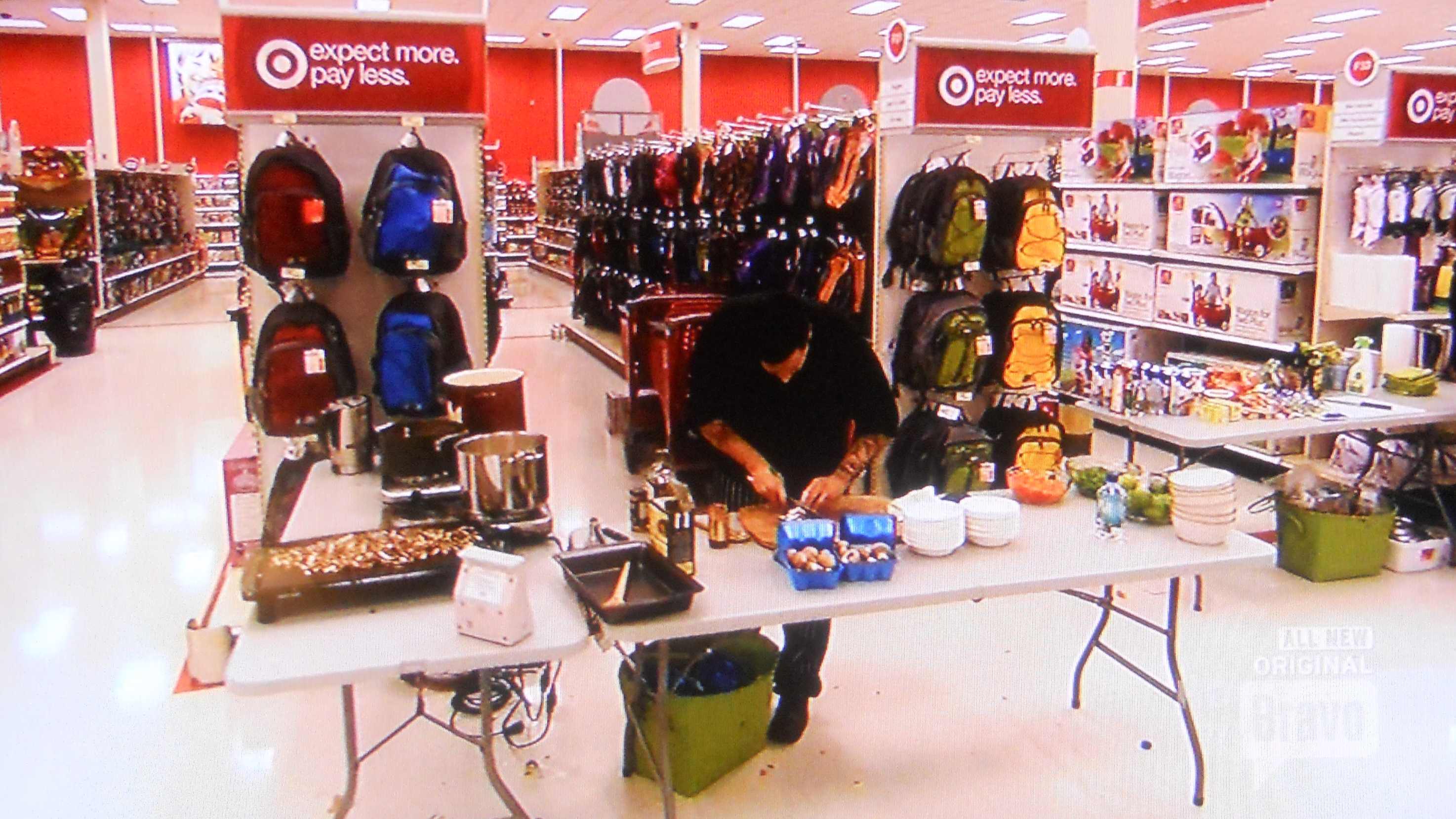
Tonight’s challenge was to cook a meal for 100 employees in a closed Target super store in the middle of the night. Because of the improvised cooking setting, the chefs were forced to set up their kitchens, find their ingredients, and prepare to serve the employees and judges within a 3 hour time limit. Some concentrated on table linens, some on flavors, but there was a frightening absence of handwashing. Granted, many of the chefs opted to make soup, which in theory should allow for thorough cooking of all ingredients. But what about any fancy garnish and fresh salad that ends up on the plate?

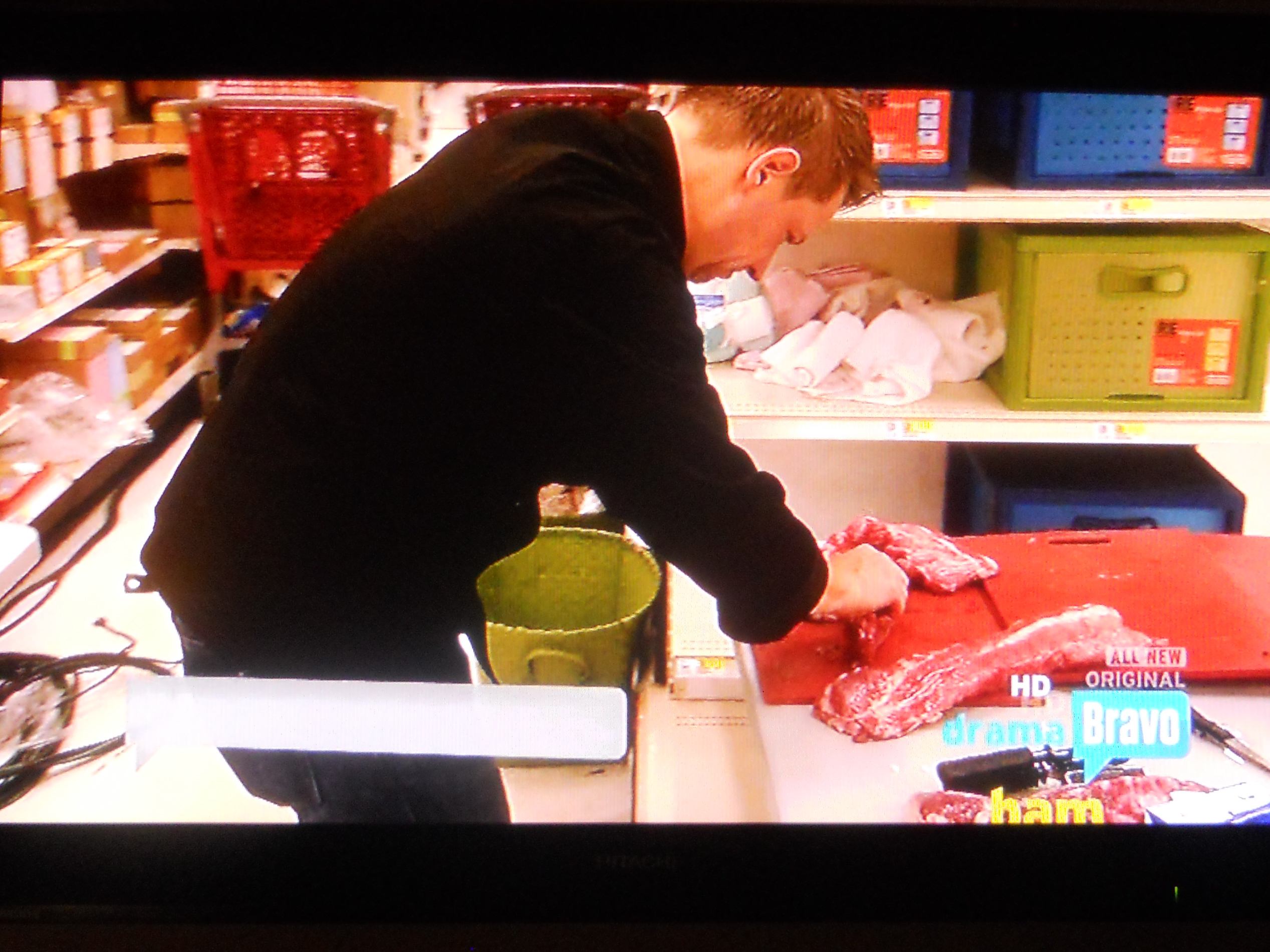
My favorite of the season, Richard Blais, made a pork tenderloin (pictured right exactly as shown). He then topped his finished pork with some freshly sliced apple and green chili slaw before serving. His concern? "It’s not the prettiest dish in the world. I know that. But I’m ready to defend my dish if I have to. I think it’s tasty."

Anthony Bourdain confirmed, "Frankly, I think Richard’s disk was butt ugly, but it was delicious."

One day I hope a chef will stand up and protest the cooking conditions or demand a meat thermometer. I will leave the food safety assessment to the experts, but I spotted a few potential concerns:

– using all cooking utensils and dishes straight from boxes with no chance to sanitize them

– improvised utensils, linens, garbage cans, etc.

– no handwashing stations, sanitizing solutions or rags to clean work surfaces or dishes.

I have hit pause on the DVR so many times that I’m not even done watching this episode yet, but I hope it does not end with a foodborne outbreak.

Salmonella soars in Canberra

Salmonella infection rates are skyrocketing across the ACT where more than 200 cases were officially notified in each of the past two years.

The ACT is the Australian Capital Territory, which is sorta like Washington, D.C. in the U.S. Canberra is the federal seat where lots of the federal food safety folks are located.

Apparently they’re barfing with salmonella.

The Canberra Times reports that as the ACT Government considers ”naming and shaming” restaurants and other food businesses which breach food safety standards, it can be revealed there have already been 31 notified cases of salmonella in the ACT this year.

Infections usually linked to poor food hygiene were reported 217 times in the ACT last year and 221 times in 2009.

It is not known what proportion of infections were linked to restaurant food.

There were 131 cases in the ACT in 2008, up from 101 cases in 2000.

It is a staggering increase considering just 18 ACT cases were notified in 1991 and actual infection rates are believed to be much higher this year because many cases are never officially notified to authorities.

The Canberra Times revealed on Saturday that ACT public health officials had issued dozens of warnings to Canberra restaurants and food outlets over the past two years for breaching food safety laws. Unlike other Australian jurisdictions, which publish online registers of businesses which fail hygiene standards, the ACT does not name offending eateries.

Health Minister Katy Gallagher said this week the Government was considering the most effective method for publicly naming food businesses which failed to comply with food safety standards.

Jersey-style raw milk cheese BS

What is it with New Jersey?

I’ve got Sopranos on in the background, a Jersey colleague telling me how great The Clash are (they aren’t) and then I get an e-mail from another colleague who snapped this photo at a Jersey retailer.

As the correspondent noted, the sign states as a matter of fact rather than opinion that raw milk cheese tastes better, but alleges that pasteurization does not make cheese safer, kills bacteria that may not be there, and destroys vitamins A and D. Pasteurization was and continues to be a huge benefit to the public health. Vitamin destruction is minimal. Bacterial destruction is real and is necessary, even if some good ones go with the bad. … at the very least you should advise pregnant women, small children, old people, and the immunocompromised to avoid unpasteurized products.

Jersey is the train-wreck that is compelling to watch. Not Snooki.
 

Sicky sprouts

A Maryland sprout processor has ceased operations while federal health-types report that 140 people were sickened in the salmonella-in-sprouts-served-at-Jimmy-John’s outbreak.

The two items are unrelated, except they both involve sprouts.

Last week, U.S. Attorney Rod J. Rosenstein filed a complaint in U.S. District Court in Maryland against Mount Airy-based Vegi-Pak Farm LLC, general manager Brian Lee and President Sun Ja Lee seeking a permanent injunction until the facility can be brought into compliance. A consent decree details a list of required actions, including cleaning the facility, storing seeds safely and treating them to reduce pathogens.

"We’re 100 percent complying with their finding and how to resolve any and all issues," Brian Lee said in a telephone interview.

Vegi-Pak had been processing and packaging tofu and soybean and mung bean sprouts distributed to Korean markets in Maryland, Virginia and Washington. According to the complaint, Food and Drug Administration inspectors found equipment coated in food waste and a fly infestation inside the facility in September. In addition, workers were not adequately washing and cleaning the soybeans, and reported they were instructed by the company president to fabricate disinfection records, according to the complaint.

Yesterday, the U.S. Centers for Disease Control reported that from November 1, 2010, through February 9, 2011, 140 individuals infected with the outbreak strain of Salmonella serotype I 4,[5],12:i:-, whose illnesses began since November 1, were reported from 26 states and the District of Columbia. Results of the investigation indicated a link to eating Tiny Greens Alfalfa Sprouts or Spicy Sprouts at Jimmy John’s restaurant outlets.

* Testing by the U.S. Food and Drug Administration (FDA) of one environmental (water run-off) sample identified Salmonella serotype I 4,[5],12:i:- that was indistinguishable from the outbreak strain.
* Consumers should not eat recalled Tiny Greens Alfalfa Sprouts or Spicy Sprouts, and restaurant and food service operators should not serve them.

Foodborne illness outbreaks come from multiple failures, not acts of god

My friend Roy Costa (right, pretty much as shown) writes that he has now been involved in over 60 investigations of foodborne illness as an expert, for both plaintiffs and defendants, and concludes:

• most outbreaks that result in lawsuits have evidence of multiple major sanitation deficiencies;

• most have pest problems as part of the documentation;

• many have serious time and temperature issues; and,

• many have personal hygiene issues.

It seems like to have an outbreak that results in a lawsuit requires a lot of negligence. It is usually not some failure at a CCP, or an invalid HACCP plan due to some error in thinking. It’s gross sanitation issues that put people in this spot more often than not. Those that have at least a semi-scientific program with oversight of any type and are managing basic sanitation adequately seem less likely to get into deep trouble with litigation, and if they do, there is less likely to be a smoking gun.

Totally agree. Multiple failures that make an investigator wonder, why didn’t this happen earlier?
 

Canadians encouraged to use digital food thermometers when cooking

It’s like me and Health Canada doing a two-step at a Good Brothers concert in Peter Clark Hall at the University of Guelph.

Or not quite.

But Health Canada did issue a statement today saying that Canadians should make sure their meat, poultry and seafood dishes reach safe internal cooking temperatures before serving, and that the only reliable way to ensure that your food has reached a safe internal cooking temperature is by using a digital food thermometer.

Despite many different types of food thermometers currently available on the Canadian market, digital food thermometers are considered the most accurate because they provide instant and exact temperature readings.

While we often look for other signs that our food is cooked properly (for example, the colour of the meat and its juices), these methods can’t accurately confirm that harmful bacteria have been eliminated from our foods. Bacteria, such as Salmonella, E. coli and Listeria, which can cause foodborne illness can’t survive at certain high temperatures.

I don’t know who the we are Health Canada is referring too. And a tip-sensitive thermometer will help bunches.

Des pâtisseries à la crème (ou costarde au Québec) ont été liées à au moins 73 personnes malades dont 30 hospitalisations

Translated by Albert Amgar

Des beignets, des éclairs et des cannolis à la crème vendus par deux entreprises australiennes de pâtisseries ont été liés à au moins 73 cas de maladies et 24 autres cas sont en cours d’investigation ; 30 personnes ont été hospitalisées. La maladie, due à Salmonella Typhimurium, a été associée avec des produits vendus auprès de distributeurs à travers le sud de l’Australie.

L’enquête des responsables de la santé a retracé l’éclosion par des tests épidémiologiques et des produits concernés aux deux fabricants, Vili’s et St. George Cake & Gelati. La production des aliments impliqués contenant la crème a été arrêtée et toutes les pâtisseries ont été retirées de la vente. La source de la contamination demeure inconnue.

Ce que vous pouvez faire :

• Parce que des oeufs crus peuvent héberger Salmonella, utiliser des oeufs pasteurisés pour la réalisation de la crème.
• Nettoyer et désinfecter les équipements pour éviter toute contamination croisée lorsque vous travaillez avec des oeufs.
• Apprendre à connaître les produits qui contiennent des oeufs crus et les réfrigérer pour réduire le potentiel de croissance de Salmonella.

Les symptômes de la salmonellose comprennent des nausées, des vomissements, des crampes abdominales, de la diarrhée, des maux de tête, et de la fièvre. Quelques cas peuvent induire une arthrite après guérison.
Il peut être sage de ne pas consommer aussi des cannolis.

Les préparations à base d’oeufs crus comme la crème, la sauce pour salade César, la sauce hollandaise, la mayonnaise, la mousse, le glaçage et la crème glacée maison ont été liés à des éclosions de salmonellose par le passé.

Pour plus d’information, contactez Ben Chapman, benjamin_chapman@ncsu.edu ou Doug Powell, dpowell@ksu.edu
www.foodsafetyinfosheets.com
 

Japan salmonella poisoning toll tops 1,000; school lunch suspected

More than 1,000 students and teachers in northern Japan have been sickened by food poisoning — and school lunch is being blamed.

Officials say more than 800 students at nine schools in Iwamizawa City have missed classes after developing diarrhea, vomiting and fever. Some schools will be closed until Sunday. The sickness tally rose to 1,048 on Tuesday.

City official Naomi Kurata says doctors suspect school lunches were contaminated with salmonella after detecting the bacteria in many of the patients.

Health officials are investigating lunch samples from last week and how they were stored. Kurata says a likely culprit is Thursday’s meal — turnip with ground chicken, soybean soup with sliced potatoes, green salad, rice and milk.
 

UK guidance to prevent E. coli contamination: too little, too late***

In November 1996, over 400 fell ill and 21 were killed in Scotland by E. coli O157:H7 found in deli meats produced by family butchers John Barr & Son. The Butcher of Scotland, who had been in business for 28 years and was previously awarded the title of Scottish Butcher of the Year, was using the same knives to handle raw and cooked meat.

In a 1997 inquiry, Prof. Hugh Pennington recommended, among other things, the physical separation, within premises and butcher shops, of raw and cooked meat products using separate counters, equipment and staff.

Five-year-old Mason Jones (right) died a painful and unnecessary death on Oct. 4, 2005, from E. coli O157 as part of an outbreak which sickened 157 — primarily schoolchildren — in south Wales.?

In a 2009 inquiry, Prof. Pennington concluded that serious failings at every step in the food chain allowed butcher William Tudor to start the 2005 E. coli O157 outbreak, and that while the responsibility for the outbreak, “falls squarely on the shoulders of Tudor,” there was no shortage of errors, including:??

• local health types did not sufficiently assess or monitor John Tudor & Son’s food safety management or HACCP plan;??
• the abattoir was allowed to continue slaughtering despite longstanding and repetitive failures, in breach of legislative requirements and without significant improvements; and,?
• the procurement process was “seriously flawed in relation to food safety.”??

Pennington also heard that butcher Tudor:

• encouraged staff suffering from stomach bugs and diarrhea to continue working;
• knew of cross-contamination between raw and cooked meats, but did nothing to prevent it;
• used the same packing in which raw meat had been delivered to subsequently store cooked product;
• operated a processing facility that contained a filthy meat slicer, cluttered and dirty chopping areas, and meat more than two years out of date piled in a freezer;
• a cleaning schedule at the factory that one expert called "a joke;"
• falsified crucial health and safety documents and lied about receiving hygiene awards; and,
• supplied schools with meat that was green, smelly and undercooked.

Prof Pennington said he was disappointed that the recommendations he made more than 10 years ago, following the E. coli O157 outbreak in Wishaw, Scotland, which killed 21 people had failed to prevent the South Wales Valleys outbreak.

Today, the U.K. Food Standards Authority issued guidance to clarify the steps that food businesses need to take to control the risk of contamination from the food bug E. coli O157.

Serious outbreaks of E. coli in Scotland in 1996 and Wales in 2005 resulted in serious illness in some individuals and, in a few cases, death. These outbreaks were attributed to cross-contamination arising from the poor handling of food.

Seriously, I don’t know who writes this stuff; 23 died in the Scotland outbreak.

Yes, the butchers in both cases made terrible food handling decisions that led to illness and death. But people are going to do dumb, or criminal things with food, which means the overall microbial load must be minimized as food moves from farm-to-fork.

FSA has nothing to say on this.

It is also expected that the guidance will be used by local authority food safety officers when inspecting businesses in their area.

Those inspectors didn’t catch anything at either John Tudor & Sons, or John Barr, the butchers of Wales and Scotland, respectively.

In 1999 Prof Pennington said,

“The prospect of another Mr Barr type situation is still quite real because everybody I talk to in meat inspection and environmental health tells me there are people who are still not doing the right thing.”

So almost 15 years after the Scotland E. coli outbreak, FSA says some of the key measures highlighted in the guidance to control E. coli are:

* identification of separate work areas, surfaces and equipment for raw and ready-to-eat food;
* use of separate complex equipment, such as vacuum-packing machines, slicers, and mincers for raw and ready-to-eat food; and,
* handwashing should be carried out using a recognised technique and anti-bacterial gels must not be used instead of thorough handwashing.

Verifying cooking procedures with tip-sensitive digital thermometers rather than relying on the terrible advice of “until the juices run clear” or “piping hot” would help. But don’t expect FSA to say anything. Maybe in 15 years.

 

Nuevo Folleto Informativo: Facturas rellenas con crema pastelera causan al menos 73 enfermedades; 30 hospitalizaciones

Traducido por Gonzalo Erdozain

Resumen del folleto informativo mas reciente:

– Debido a que los huevos crudos pueden contener Salmonella, use huevos pasteurizados cuando vaya a cocinar algo que requiera huevos crudos.
– Limpie y desinfecte los utensilios entre uso para prevenir la contaminación cruzada.
– Sepa que productos contienen huevos crudos y manténgalos refrigerados para prevenir el crecimiento de Salmonella.

Los folletos informativos son creados semanalmente y puestos en restaurantes, tiendas y granjas, y son usados para entrenar y educar a través del mundo. Si usted quiere proponer un tema o mandar fotos para los folletos, contacte a Ben Chapman a benjamin_chapman@ncsu.edu.

Puede seguir las historias de los folletos informativos y barfblog en twitter
@benjaminchapman y @barfblog.