
My wife and I have been preparing lunches for my 6-year old son since he started back at school earlier this month. He’s half Italian, half French meaning that his lunches are 5 course meals, the veal piccata needs to be refrigerated….
Stephanie Casanova reports:
Using a brown paper sack as a lunch bag for a turkey sandwich could be unsafe, according to a Kansas State University food safety specialist.
Paola Paez, research associate professor for Kansas State University’s Center of Excellence for Food Safety Research in Nutrition Programs, says instead of a brown paper bag, use insulated lunch bags and sanitize them frequently.
“If we are sending a deli sandwich or other perishable food, we don’t want to use paper bags because they cannot keep food at proper temperatures,” Paez said. “When food does not stay at the right temperatures, bacteria can grow and make food unsafe for our children to eat.”
Hot food should be kept above 140 degrees Farenheit or 60 degrees Celsius, and cold food should be kept below 41 degrees Farenheit or 5 degrees Celsius, Paez said. The food needs to be kept at safe temperatures from the refrigerator to the lunch bag to the lunch table at school. That means the lunch bag, an important variable in that process, must be insulated, Paez said.
Still, just tossing cold or hot food inside an insulated bag is not enough to keep it properly chilled or warmed until lunch time, Paez said.
For cold food, she recommends placing two frozen items — such as two ice packs or an ice pack and a frozen water bottle — on either side of the meal.
“If students bring a frozen bottle of water, it does double duty because it keeps the food cold and it will be thawed enough to drink by lunch time, so the child can stay hydrated,” Paez said.
Hot foods, such as soups, should go into insulated containers especially designed for that purpose, Paez said. Some containers are made to hold hot or cold food, but others can insulate only hot or only cold food.
“It is important to choose the right one depending on the type of food the student is bringing,” Paez said.
If packaging hot food, 10 minutes before packing the lunch, pour boiling water into the container and let it sit a few minutes. Then, dump out the boiling water, put the hot food into the container and close it tight. That process will heat the container and help the food stay hot longer, Paez said.
At the end of the day, the inside and outside of the lunch bag need to be cleaned and sanitized to prepare the bag for the next use.


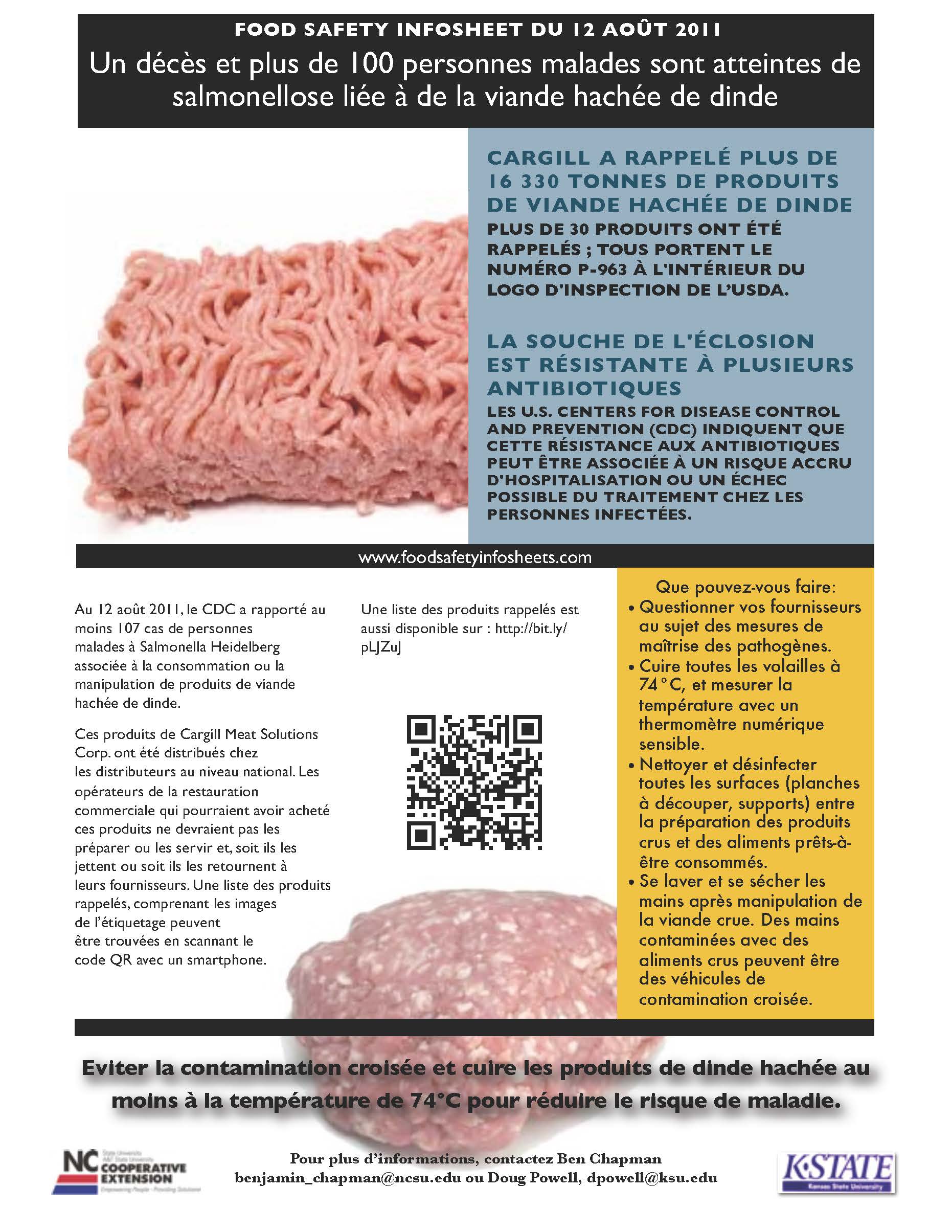 Plus de 30 produits ont été rappelés ; tous portent le numéro P-963 à l’intérieur du logo d’inspection de l’USDA.
.jpg) en cause n’ont pas détecté la souche épidémique, l’épidémiologie a fait le lien entre la consommation de graines germées et la maladie.
en cause n’ont pas détecté la souche épidémique, l’épidémiologie a fait le lien entre la consommation de graines germées et la maladie. salsa de tomate, qui contenait aussi les piments, a été conservée au-dessus de 5°C pendant plus de 4 heures et a ainsi augmenté le risque que des personnes soient malades. Les tomates en dés, en tranches ou en purée peuvent fournir un excellent environnement pour des bactéries comme Salmonella de se multiplier. Il s’agit d’une pratique usuelle mais il est risqué de maintenir la salade salsa et le guacamole à température ambiante pendant plus de 4 heures.
 symptômes suivants : nausées, crampes abdominales, diarrhées, et vomissements, le lendemain de l’événement.
 George Cake & Gelati. La production des aliments impliqués contenant la crème a été arrêtée et toutes les pâtisseries ont été retirées de la vente. La source de la contamination demeure inconnue.