
Is that a pop-up timer in your belly or are you just happy to see me; the ups and downs of turkey temps

Michéle Samarya-Timm, a registered environmental health specialist with the Somerset County Department of Health in New Jersey (represent) writes:

I roasted my first turkey as a teenager, long before I was smitten with public health as a career, and ages before I really learned to cook. I thought it was easy, especially since the pop-up timer told me dinner was ready. That bird – raw on the inside and burnt on the outside—looked okay to us. That meal was scarfed down by a group of very hungry – and very poor – college students. We knew nothing of food safety, and probably didn’t care.

It was my first encounter with a pop-up timer. Perfect for the inexperienced cook, right? When the plunger pops the turkey is done, and safe to eat. Or is it? Was that experience unique?

Since a pop-up timer is embedded in 30 million of the 46 million turkeys Americans will be eating this holiday, I sought to be a little more informed. Here’s what I found:
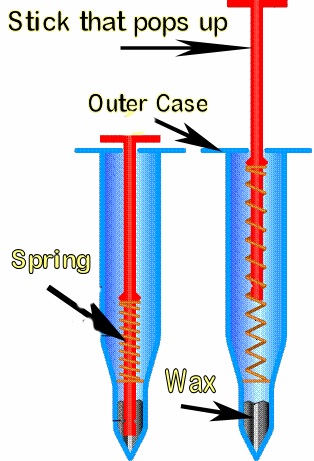
The pop-up timer found in turkey normally has four parts:

• The outer case (typically white or light blue)
• The little stick that pops up (typically red)
• A spring
• A blob of soft metal at the tip

The soft metal at the tip is solid at room temperature and turns to a liquid (melts) at about 185 degrees Fahrenheit . When the metal turns to a liquid, it frees the end of the red stick that had been trapped in the metal. The spring pops the red stick up and presumably the turkey is done.

Pop-up timers are thought to be relatively fool-proof because they are binary – a popped plunger means “Yes the turkey is done” and an unpopped plunger means “Nope, keep cooking.” But as with anything, this is only true under optimal conditions. Since my first turkey experience, I’ve had pop-up thermometers pop up too soon or not at all, fall apart and even disappear.

While researching this, a colleague told me Butterball turkeys do not have pop-up timers this year. Turns out, they never did. A pleasant representative at the Butterball Turkey Talk line explained. The placement of a pop-up timer is usually mechanical. This mechanical placement of the pop-up is temperamental – depending on the machines and the turkey placement (they’re slippery when raw!) — so breast, leg or other body parts may be pierced. Variations in the pop-up placement can affect pop-up timing, and presumed temperature. White meat (done at 165ºF-170ºF) cooks quicker than dark meat (where 180ºF is recommended). So instead of including a maybe-not-so-accurate thermometer, Butterball recommends using a probe thermometer to assure proper cooking. The U.S. Department of Agriculture’s meat and poultry hotline, and the Ask Karen online chat had similar information. A pop-up timer is calculated to pop when the breast meat measures about 180 degrees, which is when the leg and thigh area is most likely at the 165 degree temperature. Although pop-up timers are accurate to +/- 2ºF, they recommend verifying temperature of your bird with a thermometer that gives a numeric reading.

But what about foodsafe Thanksgiving temperatures for vegan friends? Meatless turkey substitutes are gaining in popularity, but how to best prepare a Tofurkey, a mock turkey product made of tofu, shaped like a roast? Tofu, a soybean curd that is protein-rich, meets the criteria to be classified as a potentially hazardous food. But what temperature should it reach to assure food safety? USDA didn’t have an answer. Neither (not surprisingly) did Butterball. A call to the Tofurkey folks gave me an initial answer of 350ºF, which was later corrected to 165ºF to 180ºF. And pop-up timers are not included.

Back to my initial Thanksgiving cooking disaster. I really needed a numeric thermometer to assure my cooking techniques and ancient oven roasted the meat safely. My lesson learned is that plungers are for clogged sinks. Setting a binary temperature plunger in the turkey (or tofu substitute!) brings some awareness, but nothing beats proper use of an appropriate numeric thermometer, and clear, accurate cooking instructions. It would have been safer to have an overcooked entrée masked with gravy, then the food safety disaster I fed to my friends. Thankfully, they survived.
Hopefully my lesson and my writings will assure at least a few more safely cooked, thermometer checked, meals this holiday – be it tofu, turkey, or some other tempting dish.

This Thanksgiving, I’m thankful that I have happy faces around the dining table, an accurate thin-probe thermometer to verify that my turkey won’t become the stuff of outbreak legends, and that I still have a job in public health.
 

Socializing for the holiday – food safety style

Michéle Samarya-Timm, a registered environmental health specialist with the Somerset County Department of Health in New Jersey (represent) writes:

Thanksgiving Day, as its name implies, is a time to give thanks. Many of us will travel far and wide to be with those who are important in our lives – you know – those whom we have been texting and Facebooking all year. In Thanksgivings past, socializing meant gathering with friends, family, loved ones and straggler students to share good food and good times. These days, being social around the holiday dinner table also takes on the meaning of regularly corresponding to all and sundry (a.k.a. our extended friends) about the food, the people, the football game, and the current goings on.
Modern technology and connectivity can be a wonderful thing for holiday fun.

Through sites like YouTube and Hulu, we can relive our favorite virtual Thanksgiving food safety moments –

“As God is my witness, I thought turkeys could fly.” (WKRP) www.youtube.com/watch?v=4FXSnoy71Q4

“I can’t cook a Thanksgiving dinner. All I can make is cold cereal and maybe toast.” (A Charlie Brown Thanksgiving)
www.hulu.com/watch/193930/a-charlie-brown-thanksgiving

“If I cook the stuffing inside the turkey, is there a chance I could kill my guests?” (The West Wing).
www.youtube.com/watch?v=4TcGEcKjSu4

Ever consider that the same modern technology and connectivity can also function as an essential ingredient to safely feed ourselves and others. No one wants to relive Thanksgiving dinner ad nauseum. Surely we all have stories about Thanksgivings that didn’t quite go as planned…Why take a chance that this year will top them all?

With electronic media and the web, we have everything we need at our fingertips, through on-demand videos, online metasearches, and virtual recipe collections. This year, put your laptops and iPhones to good use and avoid kitchen and food safety disasters by expanding your social network to include a few essential friends.

Share info on your favorite food safety apps with your loved ones – both those next to you and those virtually connected. Along with forwarding tidbits about Uncle’s Bob’s latest joke, or debating the aesthetic value of melting marshmallow peeps on sweet potatoes, you can help assure that while Thanksgiving gatherings may wreak havoc on the nerves, digestive systems won’t be affected.

Selected web apps:
Ask Karen: www.fsis.usda.gov/food_safety_education/ask_karen/index.asp
Butterball mobile site: www.butterball.com/tips-how-tos/turkey-experts/mobile-site
bites – Safe Food from Farm to Fork http://bites.ksu.edu/

Traditional phone:
Butterball Turkey Hotline: 1-800-288-8372
Reynolds Turkey Hotline: 1-800-745-4000
USDA Meat and Poultry Hotline: 1-800-535-4555
Doug Powell: deliberately unlisted ? 785-317-0560

Michéle Samarya-Timm is thankful for the many unnamed professionals who work to assure a safer food supply.

Turkey day in Raleigh a day earlier than normal

We’re preparing our Thanksgiving meal today as my Mother-in-law, who’s been here for the past week and is an enormous help with the new baby, is traveling back to Canada tomorrow. Stuffing, potatoes, squash and apple crisp are all prepared and chilling in the fridge. The bird is in the oven and is on target to be done around 5pm.

I’ve been getting some intermittant calls and emails from extension agents and others for some last minute tips; here are a few of the tidbits:

-Cooking turkeys overnight at a really low heat is still a common practice (without using a thermometer)– it’s not a best practice and not recommended, especially without watching the temps of the meat as it cooks.
– It takes a few days to thaw a frozen turkey in the fridge — putting it in the fridge or on the porch now, in preparation for tomorrow is probably not enough time. Cooking from frozen is a good alternative.

-The inside of the carcass is the most contaminated part — cross contamination while stuffing a bird (if that’s the technique being used) can be a big problem.

-Timing of the meal is tough — heard an anecdote from an infosheet subscriber who attended a family meal a couple of years ago where the turkey was cooked and sat on the counter for 4+ hours as the rest of the meal was prepared.

Earlier in the week I spoke with Jeanna Bryner from LiveScience and we talked about some of the risks associated with Thanksgiving meals (including the infamous exploding-a-turkey-in-a-deep-fryer-trick).

From the article:

Don’t wash the turkey. What?! "As soon as you have the pressure of the water hitting the turkey it can spray anything on the outside of that turkey around the kitchen," Chapman told LiveScience. Researchers in the United Kingdom recently found that forceful water hitting a turkey could spray its pathogens up to 3 feet (about 1 meter) away. Chapman recommends wiping the outside of the bird with a damp rag, and then immediately throwing that rag into the washing machine. "Treat that damp rag like a raw chicken," he said, adding that it likely contains the pathogens you’re trying to avoid.

Cook that bird. "The most important thing is cooking that turkey to 165 degrees Fahrenheit (74 degrees Celsius), and there’s only one way to know whether you’ve cooked it safely and that is to use a thermometer." Campylobacter and Salmonella can’t grow until the temperature hits 41 degrees F, and they are killed off when the thermometer reaches 165 degrees F. While turkey juices do change from raw-meat pink to a clear color as the bird cooks, that doesn’t equate with safe eating. Here’s how to measure a turkey’s doneness: Stick a tip-sensitive digital thermometer into perhaps eight to 10 spots on the turkey. If the thermometer reads at least 165 degrees F all around, it can come out. Chapman says to target areas of thick muscle away from the turkey cavity and bone, since the bone conducts heat much better than does the meat and so could give you a false reading.

Quick, get the bird in the fridge. As soon as the meal is done, Chapman suggests getting the turkey meat into the refrigerator, because if any pathogens were left on the meat they could start growing as soon as temperatures get below about 135 degrees F (57 degrees C).

And for your viewing pleasure here are some links to our holiday food safety infosheets and other relevant ones for the past couple of years:

Holiday meal food safety

Avoid foodborne illness during the holidays

Bathing birds is a food safety mess

Keeping poop off the plate

Avoid the runs around the holidays

Salmonella in South Dakota; 4 kids confirmed ill, at least 20 suspected

Brown County, South Dakota, is reporting four children with confirmed Salmonella casesin in the past week and at least 20 other children have been ill, but not confirmed.

The source of the has not been identified. Through November 23, a total of 154 cases of salmonellosis were reported in South Dakota for the year. Of these 154 cases, 23 (15%) have been from BrownCounty. Statewide 31% of the Salmonella cases have been children 14 years and younger.
Party on my porch: how I thawed my turkey

Much has been written about how to properly defrost a turkey for the Thanksgiving food orgy. Sure, some buy fresh birds – I did a couple of times in the 1990s and decided it wasn’t worth it — or cook directly from frozen (which actually works, thanks, Pete), but U.S. government advice is to defrost the turkey, in the fridge, in cold water, or in the microwave.

I don’t like any of those options.

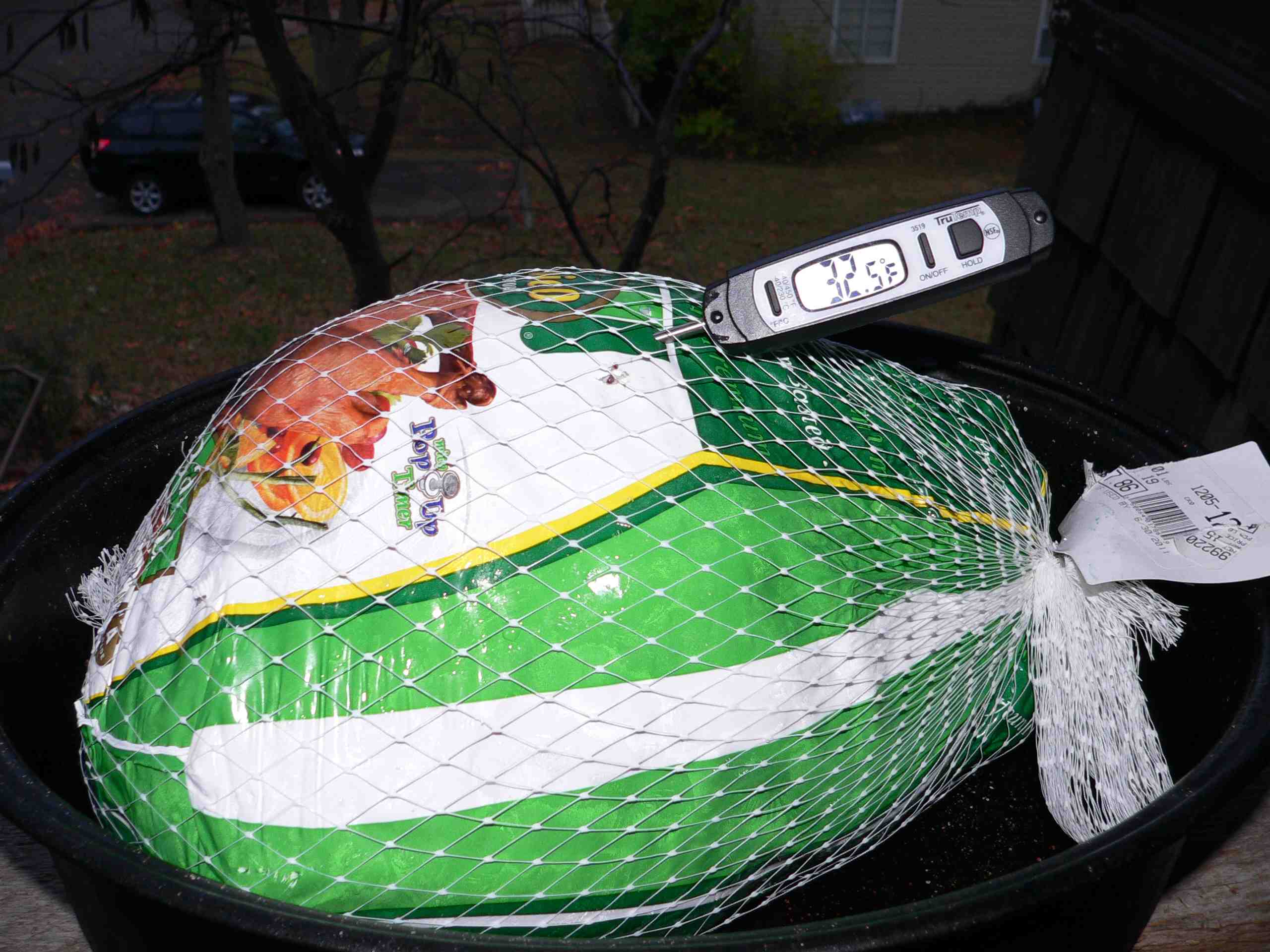
I purchased a 15-pound a Jennie-O frozen turkey on Saturday, Nov. 20, 2010, at 6 p.m. from Dillons in Manhattan (that’s in Kansas). At $0.68 a pound, it was a protein centerpiece bargain.
According to the U.S. Department of Agriculture, a 15-pound bird should take 36-48 hours to defrost in the refrigerator, or 6-8 hours in cold water in the sink. The later is a potential cross-contamination nightmare so no water is going near my bird. And I don’t have room in the fridge.

Instead I left the bird in its plastic wrapper and put it directly into the roasting pan, with a lid. It was so frozen and so solid, I left the bird at room temperature – about 66 F – overnight for 13 hours. It was still frozen in the morning.

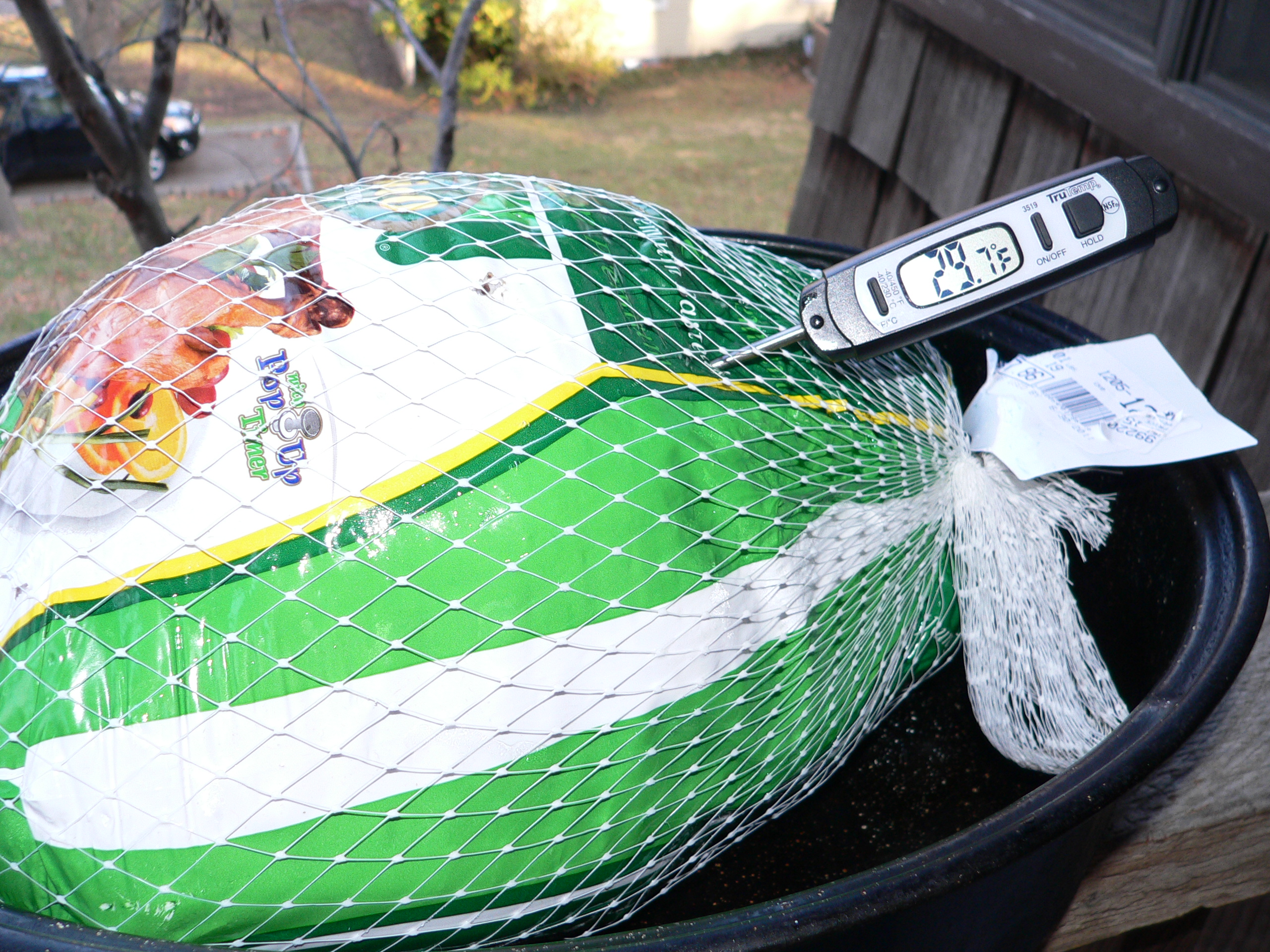
On Nov. 21, at 8 p.m., I placed the bird in the covered roasting pan on front porch overnight where the ambient temp varied from 45F – 30F. On Nov. 22 at 8 a.m., 36 hours after purchasing the frozen bird, with an ambient temp 38F, the surface of the bird was 35F and the interior 29 F.

This is not for food service, this is for the home cook. And while I was initially concerned about cats and ‘coons, neither had penetrated the lid on the roasting pan.

On Nov. 23 at 8 a.m., the surface of the bird was 35 F and the interior, 29 F.

Same thing this morning, Nov. 24, 2010, at 8 a.m. I’ll probably leave it on the porch another night, and then bring the bird inside first thing Thursday morning so it starts to warm up and the center actually thaws.

Depending on where you live, a garage can work equally well for a long, slow thaw.

Pete Snyder at the Hospitality Institute of Technology and Management in St. Paul, Minnesota, has a summary available demonstrating the safety of thawing poultry at room temperature at http://www.hi-tm.com/Documents/Thaw-counter.html.??

My group wrote a review note on the topic a few years ago, and it is included in its entirety at http://barfblog.foodsafety.ksu.edu/2007/10/articles/food-safety-communication/how-to-thaw-poultry-ignore-government/??.

And however the bird is thawed (or not) verify the temperature using a tip-sensitive digital thermometer and cool the leftovers within two hours.

Clostridium perfringens suspected in Kansas turkey church dinner outbreak, 179 now sick

That Kansas turkey church dinner outbreak mentioned in today’s USA Today was probably caused by Clostridium perfringens, highlighting the need for proper cooling after cooking and sufficient reheating.

The Kansas Department of Health and Environment (KDHE) and City-Cowley County Health Department, with assistance from the Kansas Department of Agriculture and the cooperation of the Sacred Heart Catholic Church in Arkansas City, have been conducting an investigation of a foodborne illness outbreak associated with the Sacred Heart Turkey Dinner that was held on the evening of November 8.

Since that date, 179 people individuals who attended this event have reported becoming ill, with one requiring hospitalization. Preliminary results from initial testing indicate that the illness is due to exposure to toxin produced by bacteria called Clostridium perfringens; however, further results are still pending.

Many Clostridium perfringens outbreaks are associated with inadequately heated or reheated beef, turkey or chicken, allowing the bacteria to multiply to high levels. Once eaten, the bacteria produce a toxin that can lead to illness.

Incubation period, or the time from eating a contaminated food to onset of symptoms, is usually about six to 24 hours; however, this can vary depending on the amount of bacteria present.
 

Coroner returns verdict in Mason’s 2005 E. coli O157 death

BBC is reporting that the coroner at the inquest into a five-year-old boy who died in an E. coli outbreak in south Wales has recommended stronger enforcement of food hygiene laws, but would not back a verdict of manslaughter by gross negligence.

David Bowen said Mason Jones, from Deri near Bargoed, died after eating infected meat prepared with disregard for good food hygiene.

About 160 people became ill in the 2005 outbreak – the UK’s second largest.

The two-day inquest in Newport heard that butcher William John Tudor, 58, of Cowbridge, Vale of Glamorgan, had sold rotten meat for years, and that the butcher was aware of the risks he was taking using the same equipment for cooked and uncooked meats.

One vacuum packer was used for packaging raw and cooked meats supplied to schools and care homes across south Wales.

Sounds like manslaughter to me, but Mr Bowen disagreed.

"I have agonised over a verdict of unlawful killing but despite substantial, some might say horrific, breaches of food hygiene regulations the evidence is not strong enough. There is little doubt Mason was owed a duty of care and a catalogue of failures to observe basic food hygiene breached that duty. But it is not enough for there to be a breach of the duty of care, however extensive and reprehensible that may be."

Mason’s mother Sharon Mills, a police community support officer, who now campaigns for food safety, wept as the verdict was returned.

Food safety story time: researchers find stories can help improve food safety behavior

I never thought Chapman would finish — his degree, his fantasy football, and especially this paper.

We’ve been talking about food safety stories since at least 2002. I knew from research done in the 1990s about food and dieting and the power of exemplars – personal examples to get people’s attention. Chapman dug into the literature and found references going back decades.

The storytelling approach has underpinned much of what we’ve done over the past seven years, including food safety infosheets and the posts in barfblog.com. Now we, along with our colleague Tanya MacLaurin of Guelph (who used to be at Kansas State, go figure) can say, see, these things work. And here’s how it’s done.

From the K-State press release this morning:

Food safety advice may fail because it’s too prescriptive — wash your hands, use a thermometer — and it often doesn’t include stories to make such information relevant. Researchers at North Carolina State University, Kansas State University and the University of Guelph have found that using short food safety stories with vibrant graphics can be a better training tool for food service workers.

A new paper by the researchers in the British Food Journal details the concept, creation and distribution of food safety infosheets, like those found at http://foodsafetyinfosheets.wordpress.com/. These single-page posters are created around a current food safety issue or outbreak, and are supplemented with graphics and information targeted at the food service industry. The infosheets are used to provide food safety risk-reduction information to generate behavior change and support a food safety culture.

"Food safety infosheets were designed with the goal of communicating risk reduction messages with the objective of changing behavior," said Ben Chapman, assistant professor in the department of 4-H youth development and family and consumer sciences at North Carolina State. "These infosheets differ from much of what is currently used in training, because we focus on the consequences of mishandling food by providing real examples taken from recent events."

A recent food safety infosheet detailed an outbreak of E. coli O157 linked to a festival in Winnipeg, Canada, that sickened 40. Another focused on food preparation and cooling for large crowds, sparked by an outbreak at a church turkey dinner in Kansas that sickened 159.

"Whether it’s a waitress, a line cook or the stock boy, people learn through stories," said Doug Powell, an associate professor of food safety at K-State. "We want to reach out to the last person who touched your food and make it safer."

Over the course of two years and using multiple methods, food safety infosheets transformed from a text-heavy memo to compelling, story-laden posters supported with contextual messages on what a food handler could do to reduce food safety risks, according to the researchers.

As part of the design phase of the infosheets, Chapman spent 185 hours working as a dishwasher in a local restaurant.

"We felt it was important to really immerse into the culture of a food handler, and get a better understanding of what types of conversations occurred and what the hierarchy was like," Chapman said. "The experience directed us to refocus our messages to be a bit edgier and include references to celebrity and music where possible."

Food safety infosheets at http://foodsafetyinfosheets.wordpress.com/ are created semi-weekly and are posted in restaurants, retail stores and on farms. They also are used in training throughout the world. Since September 2006 more than 150 food safety infosheets have been produced. They are available for download at no cost. The website has been recently redesigned, adding a search function, automatic e-mail alerts and RSS feeds. The new database is also sortable by pathogen, location and risk factor.

Citation and abstract:
Food safety infosheets: Design and refinement of a narrative-based training intervention
British Food Journal, Vol. 113 Iss: 2 (pre- print edition)
Benjamin Chapman, Tanya MacLaurin and Doug Powell
http://www.emeraldinsight.com/journals.htm?issn=0007-070x&volume=113&issue=2&articleid=1895862&show=abstract

Purpose – Despite extensive investments in food handler training, research suggests that training programs are inconsistent, and rarely evaluated for efficacy. The generic prescriptive content and school-like delivery methods used in current food safety training may be a barrier to application. The purpose of this research was to develop a food safety communication tool, food safety infosheets, targeted specifically to foodservice food handlers utilizing popular media stories to illustrate the consequences of poor food handling.

Design/methodology/approach – Food safety infosheets were designed to be surprising, connect food handlers’ actions and consequences, and generate discussion through a verbal narrative framework. A Delphi-like exercise (n = 19), a posting pilot (n = 8) were carried out to assess the appropriateness of the concept of food safety infosheets. An intense participatory ethnographic study with an Ontario, Canada restaurant, and in-depth interviews with food service operators in Manhattan, Kansas, and Lansing, Michigan (n = 17) were conducted to gather qualitative data on the food service kitchen environment, including barriers to food safety practices, and the communication preferences of those who work in such kitchens.

Findings – The expert group, foodservice operators, and food handlers accepted food safety infosheets as an appropriate concept and valued storytelling as an effective communication strategy. Learning in the kitchen environment is largely hands-on and visual, and time pressure dictates practices. It is often difficult to attract and keep the attention of food handlers. Storytelling, celebrity and local outbreaks are of interest to the target audience.

Originality/value – This research provides a blueprint for the design and refinement of food safety communication tools targeted towards a specific audience. By utilizing multiple methodologies, this article provides a framework for other researchers to follow.
 

Vibrio rises in Virginia; ‘I think it was some bad crabs I ate ‘

Liza Cabell says she’ll never forget how sick she felt after getting food poisoning.

"I had food poisoning years and years ago, I think it was some bad crabs I ate", says Cabell.

CBS 6 reports that now, at the start of the holiday season, the Virgina Department of Health is warning doctors to be on the lookout for a foodborne illness found in certain raw shellfish.
"We’re concerned about a bacterial infection called Vibriosis", says Seth Levine, Virginia Department of Health Epidemiologist.

One way to protect yourself from getting the illness is cooking shellfish to a temperature of 145 degrees. That will kill the bacteria.

So, should you or your loved ones avoid eating shellfish this holiday season?

"No, I wouldn’t necessarily say that", says Levine, but he warns people with a high risk of developing an infection, or with liver disease to avoid undercooked or raw shellfish.


‘E. coli destroyed Mason’s organs from the inside’

Sharon Mills, the mother of E. coli victim Mason Jones told a coroner’s inquest today,

“It’s not just a tummy bug; it’s not just diarrhea,” she said. “It killed Mason’s organs and destroyed him from the inside. I didn’t realize that at the time because on the outside he just looked healthy.”

The South Wales Echo reports the inquest heard that Mason, who had only just started having school dinners at Deri Primary School that month, had eaten cold gammon and turkey supplied by butcher William Tudor.

Schools run by Caerphilly council used the cold cooked meats in sandwiches and served it with warm gravy – the meat was not reheated.

Ms Mills told the inquest she had repeatedly tried to get medical help for Mason – “I rang anyone who would listen” – but he was sent home.

Ms Mills told the inquest, at Newport Coroner’s Court, the age of “light-touch” regulation of abattoirs and meat processing plants must end after it heard evidence of Tudor’s disregard for food hygiene at his Bridgend plant.

It emerged he was still trying to sell meat unfit for human consumption during the E.coli outbreak; that he sold frozen New Zealand mutton as Welsh lamb and ordered his staff to turn rotten meat into faggots.

Detective Superintendent Paul Burke, of South Wales Police, who investigated Tudor following Mason’s death, said independent food safety experts consulted by the force had concluded the “prevailing culture in the business was not about food safety but the emphasis was on making and saving money.”

Ms Mills told the inquest she wanted E. coli expert Professor Hugh Pennington to be invited back to Wales to examine whether his recommendations from the public inquiry had been implemented.

“I want to avoid this happening to another family and to stop rogue traders from allowing contaminated meat to get into the food chain. If this prevents another death then I know my son’s death won’t have been in vain.”