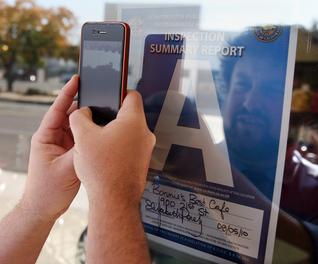
Sharing food safety porn is about increasing discussion

“Hopefully no one ends up in jail.”

That’s what I told Susan Berfield of Bloomberg Business week when she asked me about #citizenfoodsafety, the project created to encourage regular folks to take and share pics of thermometer use, handwashing, restaurant scores and the likes.
Dani has been all about Instagram for the past couple of months and got me hooked on the voyeuristic excitement of following people through the photos they take. So much of what I see is food (I guess because I follow self-described foodies) – why not do the same thing with food safety.xl_2874_food-photography-tp
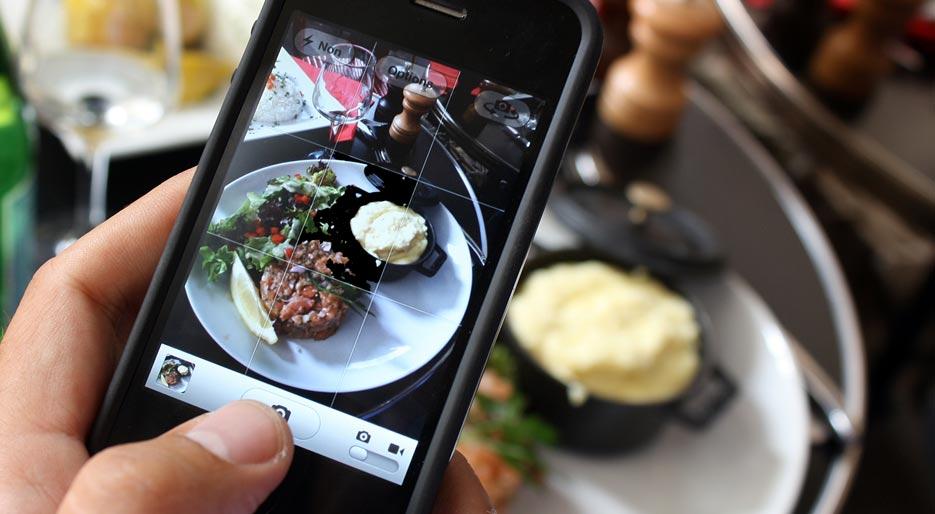
Susan writes,

You could imagine all sorts of activity emerging from this, but for now, Chapman says he wants only to encourage foodies to ask questions about the safety of what they eat. It’s citizen science, not vigilantism. In this noble version of life on the Internet, the photos will be conversation starters. “There’s just too many illnesses from foodborne pathogens, about 48 million a year,” he says. “There’s a lot of interventions out there, and we haven’t seen the payoff in reduction of illnesses.” The latest salmonella outbreak has already sickened 278 people.

There’s also the possibility that someone will send him a photo of a Taco Bell employee licking a stack of taco shells. Whether it’s rats, a fast-food employee sneezing into your drink, or a dude eating Ramen noodles out of a bowl he made with his beard, Chapman wants to see it—in the name of education. “We’ve seen lipstick on a drinking glass, I’m sure we’ll see hair on pizza, cockroaches in restaurants,” he says. “There’s a yuck factor in those, but they’re not as risky as someone handling raw meat and then not washing their hands before making a salad.”

“This isn’t meant to out restaurants,” he says. Nor is he encouraging people to sneak onto corporate farms or into fast-food kitchens. But “if it does get crazy, that means people are interested,” he says.

Lydia Zuraw of the Food Safety News also wrote about the project:

Food and public-health voyeurism has been around for a while, Chapman says, adding, “The project became reality with the advent and improvement of smart phones and the rise of the interest in citizen science.”

In his post, Chapman references a 2005 program in South Korea that encouraged diners to take pictures of food-safety infractions in restaurants and submit them to health inspectors who could follow up and potentially fine the establishment. The United Kingdom since launched a similar program, and there have been multiple examples of pests in New York and Toronto shared online.

“Better dialogue around food safety isn’t just about awareness. It’s about increasing the value society puts on working towards producing foods in the safest way,” Chapman says. “More dialogue and more informed shoppers and eaters keeps pressure on everyone to do better.”
On how I became a food safety nerd

This post was originally published at the official blog of the Institute of Food Technologists Student Association (IFSTA) blog – Science Meets Food.

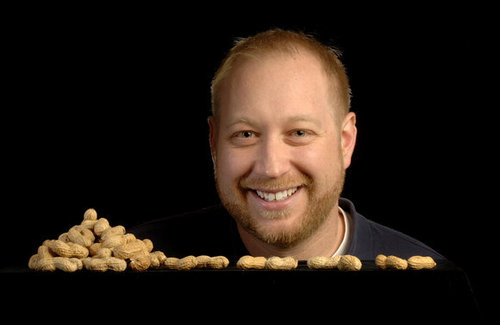
I’m a total food safety nerd (at right, exactly as pictured). Had I not emailed my graduate school mentor, colleague and friend Doug Powell in the winter of 2000 looking for an on-campus summer job (while I was an undergraduate student at the University of Guelph) I’d be some other kind of nerd. I’d probably be a fantasy football blogger or Starbucks barista.chapman-peanuts-1

The story would be a lot cooler if I had sought out Powell as a potential employer because I was interested in the stuff he did, but I didn’t. I had no idea what he did — and being a bit of an idiot, I didn’t bother to look it up. I emailed Doug on the advice of a friend who knew I was desperately looking for a job, and didn’t tell me much else about the dude or what he filled his days with. My friend just said “I think you two will get along”. I didn’t really know what that meant, but really had no other prospects. So I emailed him. And he hired me to pull news.

Pulling news meant that I surfed through the tubes of the interweb for anything food risk-y (microbial food safety, GMO foods, animal disease, etc) and the stories I found (along with the other news pullers) become the content for FSnet, the precursor to barfblog, and the other listserv postings Doug put together every day.

About three weeks in, I found my passion for food safety. That’s when an E.coli O157 outbreak linked to Walkerton Ontario’s town water system became big news ) . This was real life, seven people died and over 2,300 were ill. I was already interested in disease (probably because of Outbreak or the Hot Zone), but the coverage and discussion within the Powell lab around Walkerton (how the outbreak was handled and communicated to the folks drinking the water) drew me in. I was introduced to the field of risk communication where the technical info and real people intersect.

And I made my move from molecular biology and genetics to food safety. That’s where it all started.

That news-pulling gig turned into an MS working with farmers to shape and evaluate an on-farm food safety program. The MS degree turned into a PhD where I looked at handwashing and cross-contamination in kitchen settings. Both degree projects were about evaluating what works to change behaviors – and exploring different messages/delivery methods based on the best available food safety and communication evidence.

Since then I’ve spent time conducting applied and action research leading to extension outputs. But that’s just a fancy way of saying I’ve become a food safety voyeur and storyteller. What really matters, and is central to any food safety intervention that targets behavior, is not what people say, but what they actually do. To get at the real practices food safety folks have to gain access to real life situations, observe and understand systems. And then design something to address risk.  The literature says that for something to connect to someone it has to be specific, timely, compelling, and provide a control method. This can be done through constructing a narrative around a situation.  Once some intervention is made, evaluating the effectiveness is often forgotten. Lots of effort goes into designing things, not as much effort goes into figuring out whether the creation worked.

As an undergraduate I didn’t really know what I was interested in and by chance I found a problem that connected with me personally: there are too many sick people. By exploring different venues within the food system, and having super mentors that supported my interests and ideas, I found a passion for exploring solutions.

Lots of barfblog friends including Lily Yang, Ben Raymond, Jon Baugher and Thomas Siebertz contribute to – Science Meets Food. Check it out.

Real-life Airplane as passenger lands plane after pilot ill

I first saw the 1980 movie Airplane at the drive-in. I thought it was dumb, because I was more interested in the girl I was with. I’ve since re-watched about 30 times, and it’s in my top-5 movies of all time (World According to Garp, Wonderboys, American Beauty, O Brother Where Art Though round out the current list).

Whatever plot there was in Airplane revolved around passengers stricken with food poisoning.

That plot seems to have been borne out in real life after the pilot of a small plane fell ill at the controls and two flight instructors were called in to the airport to give his only passenger a crash course in not crashing.

The man—who had no flying experience—managed to bring the plane in for a safe, though somewhat bumpy, landing at England’s Humberside Airport. “He made quite a good landing actually,” one of the flight instructors tells the BBC.

81 sick with Salmonella; illegal guinea pig slaughter at Minn. fair

Leading up to any food festival or state fair, there are lots of allegedly comforting messages about how things are thoroughly inspected and food safety is a top priority.

Doesn’t always work out that way.

In Minneapolis, at least 81 people were sickened with Salmonella after eating food at an Ecuadorian festival on Aug. 11, 2013.

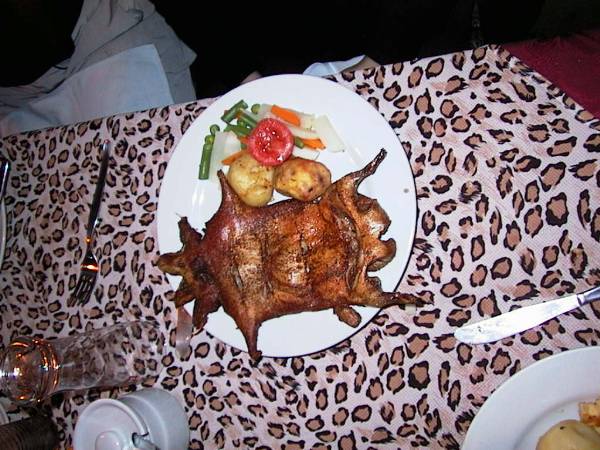
Now, the Star Tribune reports the owner of New York Plaza Produce, which was linked to the outbreak, obtained guinea pigs cuy.guinea.pigfrom an unlicensed supplier and “slaughtered live guinea pigs in the back warewashing area of the meat market,” according to a Minneapolis inspection report.

Nieves Riera was issued a $1,000 citation on Oct. 1 for five violations, discovered in an inspection of the market four days after the festival. There were three “critical” violations, one pertaining to cooking food at an unlicensed facility and two others related to the handling and purchasing of the guinea pigs. 

“Nieves Riera obtained guinea pigs from an unlicensed supplier. The guinea pigs were sold at the Ecuadorian Festival,” the compliance officer noted in the inspection report. “Cooked pork was purchased from a Minneapolis Meat Market. The pork was resold at the Ecuadorian festival. The source of the pork is not an approved wholesaler.”

According to the report, Riera stated that she slaughtered the live guinea pigs in the back area of the meat market. “This is not a slaughterhouse and live animals are not allowed on the premises,” the report says.

Calgary Wendy’s shut down over health violations

Brisbane is like Calgary, 20 years ago – a cow-town flush with resource money and trying to act sophisticated but still overrun with bogans (fubar).

The Wendy’s on Macleod Trail and 70 Ave. in Calgary was visited by inspectors last Wednesday, who uncovered16 safety violations.

The issues included an employee who didn’t wash their hands while handling raw meat, raw hamburger in a cooler that was too fubarfeat__spanwarm, black mold and water damage in the staff room and grease and oil on the floor.

“The reason that the restaurant has been closed is not because someone has been made ill, it is because we have an older building that requires repairs,” says Lisa Deletroz, spokesperson for Wendy’s Canada. “Part of those repairs involves making it a safer working environment.”

Employees at the affected location have been reassigned and will undergo additional training, and the restaurant will have to be visited by health inspectors again before it can reopen.

Entire food system should be accountable for outbreaks

Arresting the Jensen brothers without indicting anyone else in the food system is like arresting Richard Eggers to curb the excesses of the global financial crisis.

Eggers, a 68-year-old Des Moines resident, who gained national attention after being fired by Wells Fargo & Co. in July 2012, was featured on the Colbert Report (video below for North Americans) in a segment satirizing the federal government’s failure to jail a cantaloupesingle high-level banker who helped precipitate the global financial crisis.

Eggers was fired after the nation’s largest bank by market value learned that he had been arrested 49 years ago for putting a cardboard cutout of a dime in a Carlisle laundry machine. He is one of an estimated 3,000 low-level bank employees who were fired last year under employment regulations meant to deter the kind of high-level excesses that helped precipitate the global financial crisis.

The Jensen’s case is far more serious, involving the death of 33 people and sickening 143 from Listeria in cantaloupe in 2011, but focusing on the farmers who received stellar audit reports lets the system off the hook.

And the system is at fault.

The nation’s food safety system, especially for produce, is a patchwork of third-party audits, personal assurances, and profit before protection.

The government – the U.S. Food and Drug Administration – says it’s sending a message, but it’s sending the wrong one.

Eric Jensen, 37, and Ryan Jensen, 33, were accused of six counts of introducing adulterated food into interstate commerce and aiding and abetting.

The Jensens should be held accountable, as should everyone else in the food system, including the auditors that gave the Jensens a big thumbs up and the retailers who rely on paperwork in the absence of evidence. Going after the weakest link only displays a decrepit and ineffectual system.

Some companies – to their credit – are going beyond the paper trail and using their own staff along with outside expertise to build a credible food safety system; some companies really are better.

And they should brag about it.

Because as a consumer, I have no way of knowing whether one cantaloupe was raised, harvested, packed and shipped more hygienically than another. Retailers insist all food is safe, but weekly outbreaks, especially with repeat offenders, shows the system is broken.

(Meeting government standards implies no sort of microbial food safety; that is a tactic to deflect responsibility, what some call the Pinto effect.)

The FDA may be flexing its tiny muscles against the weak kids, but is doing nothing visible about that troubled third-party system in food, where the company selling the food is paying the auditor to approve the safety of the food.

The best producers won’t rely on government and will get ahead of the food safety curve.

‘No excuse for negligent practices’ seven Ireland food businesses served closure orders in September

The Food Safety Authority of Ireland (FSAI) has reported that seven closure orders were served on food businesses during the month of September for breaches of food safety legislation. The orders ireland.pubwere issued by environmental health officers in the Health Service Executive.

Three closure orders were served under the FSAI Act, 1998 on:
• Davak Superstores (grocery), 17 Bolton Street, Drogheda, Louth
• 10 Thousand Restaurant, 39 Middle Abbey Street, Dublin 1
• Tasty Grill (restaurant), 39 Richmond Street South, Dublin 2

Four closure orders were served under the EC (Official Control of Foodstuffs) Regulations, 2010 on:
• The Morning Star Food Hall (grocery) (Closed area: Store area only), Townparks, Commons Road, Navan, Co. Meath
• Utterly Nutty (bakery/confectionery), Bakery Mews, Kenmare, Kerry
• Tralee Central Hotel, Maine Street, Tralee, Kerry
• Planet Spice (restaurant), 51 Church Street, Tullamore, Offaly

Also during the month, successful prosecutions were brought against:
A1 Cafe Limited, Cafe India, Patrick’s Court, Patrick Street, Tullamore, Offaly
Mr John Muldowney, The Old Bank House Restaurant, 17 Main Street, Portlaoise, Laois

Commenting on these latest closure orders, Prof. Alan Reilly, Chief Executive, FSAI, stated that vigilance is always required in relation to food safety and that standards must not be permitted to slip to such levels that consumer health is put at risk.

“While most food businesses are committed to high standards for the health of their customers, this is not always the case.  We’re urging food businesses to make sure that they have a food safety management system in place and that it is consulted on a regular basis and updated, where necessary, to ensure non-compliance issues and breaches of food safety legislation don’t occur.  There is absolutely no excuse for negligent practices.”

Schools in Scotland fail food hygiene standards

Thousands of children have been served meals from school kitchens that have failed to meet food hygiene standards.            

Five schools have been told to improve or face further action from the Food Standards Agency in Scotland.        

They are among 30 establishments in the Kilmarnock and Irvine Valley area which have just been named and shamed online for Please-sir-may-I-have-some-moretheir poor hygiene standards.            

The five schools are:            

* Kilmarnock Academy            

* Loudoun Academy            

* Stewarton Academy            

* Hillhead Primary School            

* Crosshouse Primary School            

Kitchens at Onthank Community Centre and Hurlford Community Centre have also failed.            

The council-run sites have been published on the Internet under a new scheme to allow members of the public to see if the places they are eating are safe.            

Other commercial facilities which haven’t met legal standards include take-aways, cafés, hotels and national chains.            

Log onto www.eac.eu/foodhygiene or www.food.gov.uk/ratings to see full details of every pass and fail in East Ayrshire.

NYC Salmonella cases rise in 2012 despite restaurant letter grades

Restaurant inspection grades do not reduce rates of foodborne illness – not in any scientifically credible and measurable manner.

Publicly available grades, like the A, B, C of LA and New York City, or the red, yellow, green of Toronto do increase public restaurant.inspection.la.porn.mar.13awareness and discussion of food safety, enhancing the overall food safety culture for staff and patrons.

I understand the desire to say, hey, this program made fewer people sick, but we’re not there yet, so why overstate when it will only lead to disappointment (also valid in budget estimates and personal relationships, and pretty much everything).

The International Business Times reports New York restaurant-goers are eating up the city’s three-year-old grading system, but its effect on public health is still a bit of a mystery taste test.

Salmonella infections in New York City rose more than 4 percent in 2012 to 1,168 cases, up from 1,121 cases the year before, according to the city’s Department of Health and Mental Hygiene. The uptick follows a much-publicized 14 percent decline in salmonella infections in 2011, the first full year that the letter grades were implemented. City officials had touted the initial decline as an early sign that the letter-grade posting may be contributing to a reduction in foodborne illnesses.

According to city health officials, the annual number of salmonella infections is a useful indicator of trends in food-related illnesses: Salmonella cases occur relatively frequently and about 95 percent of them are believed to be caused by eating contaminated food.

New York’s letter-grading system — in which restaurants are required to display a large A, B or C grade in the window of their establishment — was instituted in July 2010. Since that time, the qr.code.rest.inspection.gradeHealth Department has published a progress report every six months, updating New Yorkers on the system’s effectiveness. But those reports stopped coming after 18 months: the last one was published in January 2012.

Asked why the reports stopped, the Health Department told International Business Times that city officials “continue to evaluate the letter-grading initiative and are looking at the impact of the improved inspectional program on restaurants and on hospitalizations and emergency visits for foodborne illnesses.”

While popular with the public, the grading system has been described as unnecessarily burdensome and even humiliating by restaurant owners and food handlers who complain of steep fines, arbitrary inspections and bloated hearings procedures.

Patti Jackson, a veteran New York chef, said, “The grades are punitive and silly, but I don’t think they’re the worst thing that’s ever happened. They’re just a giant throbbing pain in the ass.”

Maybe. Or maybe the grades hold people a little more accountable. How best to improve the system?

Norwegian admission: smoked salmon may harbor listeria

Norwegian researchers have found that nine types of Listeria monocytogenes identified in three salmon-processing companies in Norway are of a genetic variant which are also found in patients suffering from listeriosis.

In a press release issued on Tuesday, Norway’s National Institute of Nutrition and Seafood Research (NIFES) said that a study of smoked.salmon.bagelthree companies producing farmed salmon in different parts of Norway have identified 15 types of Listeria monocytogenes.
Of the 15 types, nine are of a genetic variant that scientists have also found in patients with listeriosis.

Emphasizing that no link has ever been established between any cases of listeriosis and the salmon products from Norway, the researchers cautioned that salmon can not be discarded as a possible source of the disease, which mainly affect human fetuses, neonates and persons with conditions weakening their immune systems.

This is the first time for the researchers in the institute to conduct a study comparing the samples with Listeria monocytogenes obtained from Norwegian salmon factories and the human cases of the disease, Bjoern Tore Lunestad, a senior scientist with NIFES, told Xinhua in a telephone interview from Bergen, a Norwegian city on the western coast.

“This background in not sufficient for us to claim that fish are the sources of the cases of listeriosis in our study. But on the other hand, we cannot ignore this possibility. Salmon are one of several potential sources of L. monocytogenes,” said Lunestad. Their findings is published in the October issue of the Epidemiology and Infection journal.