NC mom wants tougher food regulations after listeria in cheese caused illness

Erin Stadler was at her baby shower when she at a piece of brie cheese that was contaminated with Listeria. The disease made Stadler and her unborn child deathly ill.

"You don’t think about eating one piece of cheese and almost dying. That’s basically, what happened for both of us," said Stadler.

The disease came as a surprise to Stadler in 1997 because up until her baby shower, she had a normal, healthy pregnancy. However, shortly after the party, she began to feel the symptoms of the disease.

When Stadler went to the hospital, doctors immediately delivered baby Allison. She was premature at 33 weeks and weighed just 4 pounds, 33 ounces. Allison was in the hospital for two more weeks for additional tests when doctors realized how ill both Erin and Allison were.

Stadler will be traveling to Washington D.C. next week to talk with senators about passing tougher food regulations. Allison, now a healthy 13-years-old girl will travel to Washington with her mom to discuss a proposed bill called S-510.

Listeria in cheese from Austria killed six last year

Austria’s health ministry says contaminated cheese has killed six people.

The ministry said the deaths – four in Austria and two in Germany – occurred last year and were caused by listeria, an organism that can cause serious and sometimes fatal infections in young children, frail or elderly people and others with weakened immune systems.

The ministry said the four Austrians who died were senior citizens.

The contaminated cheese was made in the southern province of Styria by Prolactal.

It issued a recall last month and said it had halted production until the case is cleared up.

In 2009, Austria recorded 45 listeria infections that led to a total of 11 deaths.
 

FDA going to court to close NEW JERSEY cheese manufacturer for repeat listeria problems

I’m still not sure of the difference between insanitary and unsanitary, like insane and unsane, but the dictionary says insanitary means, “so dirty or ridden with germs as to be a danger to health,” whereas sanitary is defined as, “of or relating to the conditions that affect hygiene and health,” and the word unsanitary does not exist.

Perhaps a linguist can settle this. In the meantime …

The U.S. Food and Drug Administration today announced intentions to ask a federal court to shut down a New Jersey cheese manufacturer with an alleged history of operating under insanitary conditions and producing cheese contaminated with Listeria monocytogenes.

The U.S. Department of Justice filed a complaint for permanent injunction against Quesos Mi Pueblito and two of its officers, Felix Sanchez and Jesus Galvez. The complaint alleges that recent inspections by the FDA and the New Jersey Department of Health and Senior Services found Listeria-contaminated cheese and insanitary conditions at the Passaic company.

If entered by the court, the injunction would stop the company and its officers from manufacturing and distributing food until they can bring their operations into full compliance with FDA food safety regulations and produce cheese that does not test positive for the presence of Listeria. The complaint for permanent injunction was filed in the U.S. District Court – District of New Jersey.

Gratuitous (comfort) food porn shot of the day: tomato soup and grilled cheese

Sorenne eating lunch with dad, 11:00 a.m., Dec. 27, 2009.

It’s not always a food porn extravaganza around the Hubbell household. Sure, last night’s dinner was marinated and oven-grilled tuna steaks, with asparagus and roasted sweet potato fries, but with the snow sticking around, and Sorenne’s nose draining like a running faucet, sometimes it’s best to stick with basics.

Tomato soup made with milk in my Dad cup — because I have a daughter who goes to McMaster University in Hamilton, Ontario — along with a grilled cheese sandwich made with whole wheat bread, a drizzle of butter, lots of extra sharp cheddar, prepared in a frying pan, and served with a pickle and ketchup.
 

Salmonella contamination from head cheese warns Missouri health dept.

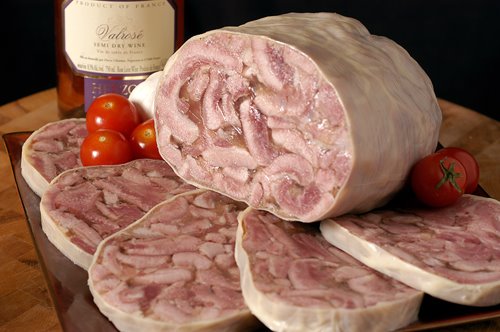
Head cheese is a product made from meat pieces of the head of a calf or pig and combined with spices. It is usually eaten cold or at room temperature. Thorough cooking kills salmonella bacteria, but since head cheese isn’t cooked, the bacteria stays in the product.

That’s gross.

Missouri’s Scott County Health Department is asking people who may have purchased head cheese that originated in New Hamburg to discard it for fear it may be contaminated with salmonella.

According to a health department news release, a public health investigation has determined that there may be a risk of salmonella contamination associated with the consumption of head cheese produced and distributed at a private residence in mid-November in New Hamburg.

Raw milk: save the family farm while making kids barf?

The N.Y. Times has a story running in tomorrow’s edition flaunting the value of raw milk as a way to save the family farm because a small percentage of people pay a hefty premium for the raw stuff.

The story lacks any mention of adverse health effects from raw milk , other than quoting an FDA type as saying, “raw milk should not be consumed by anyone, at any time, for any reason.”

Such proclamations are not particularly persuasive.

The story, like many others, notes that people want to know where their food comes from; but that doesn’t make food safer. Knowing how to control and minimize the spread of dangerous microorganisms makes food safer, whether it’s from around the corner or around the globe.

The Times story does however make mention of the Quebec listeria outbreak of 2008 that was traced to cheese made from unpasteurized milk, stating that “one person died; more than 30 became ill,” and proclaiming that the government went crazy recalling nearly 60,000 pounds, of cheese from hundreds of producers.

The Times story appears to be something about government out-of-control, although it’s a mish-mash.  And it fails to mention that the 2008 Quebec outbreak, led to 38 hospitalizations, of which 13 were pregnant and gave birth prematurely. Two adults died and there were 13 perinatal deaths. Recent research has demonstrated listeria can cause illness in fetuses and infants at much lower doses than previously thought.
 

An updated table of unpastuerized milk and cheese outbreaks is below.

http://bites.ksu.edu/raw-milk-outbreaks

Aerosmith’s Joe Perry, hot sauce and macaroni

It’s no secret I’m a Rolling Stones fan, especially of the inspired work between 1968 and 1972.

Every generation has their Stones knockoff band. In the 1970s it was Aerosmith. The 1980s brought the Black Crowes. Not sure what the recreations were in the later decades, but they exist.

Turns out Aerosmith guitarist Joe Perry is, at least according to the Baltimore Sun, a bit of a foodie.

Nightlife reporter Sam Sessa hung out with Perry for a while on his tour bus, and spent a lot of time talking about food.

“I had no idea he’s been a foodie for more than 35 years, and has his own line of hot sauces. He also told me he’s planning on launching his own brand of mac ‘n’ cheese in the near future, called Joe Perry’s Rock ‘n’ Roni.”

Does your own brand of mac ‘n’ cheese – or KD, as in Kraft Dinner  in Canadian-speak – make one a foodie?
 

Deli clerk refuses to sell UK mom-to-be cheddar cheese, says pregnant women shouldn’t eat cheddar; wrong

From the a-little-knowledge-is-dangerous category, a UK deli clerk at a Sainsbury’s supermarket refused to sell a pregnant woman a piece of cheddar cheese until she lied and promised she wouldn’t eat the cheese.

Janet Lehain wrote in a letter of complaint to Sainsbury’s that the female clerk at the Clapham, Beds store was "patronising" and said, “how lucky my generation are to have such information available as this was not the case ‘in her day’."

Sainsbury’s said the worker was wrong, adding,

"It isn’t policy to refuse a sale on grounds goods may be unsuitable for pregnant women."

Whatever the policy is, Sainsbury’s could at least get the information correct: there are certain soft cheeses that should be avoided by pregnant women because of the potential to support growth of listeria. Amy has written extensively about this.

Me, I view the grocery store and the restaurant as my laboratory. I watch and ask questions of people, especially front-line staff. The head of food safety back at corporate HQ may know the correct food safety answer, but are they providing support to front-line staff, the people customers are most likely to interact with? That’s why we do food safety infosheets, a tool to provide continuous updates to employees, and that’s why we do secret shopper experiments.

The key findings after sending trained shoppers to a bunch of stores in southern Ontario in 2004?

“Although many grocery store employees appeared confident in their food safety knowledge, when asked for storage and handling advice, many were unaware of the proper methods within their department and were willing to offer incorrect advice. This advice often conflicted with the food handling information posted throughout the grocery store.”

Any organization is only as good as its weakest link. There’s already enough bad food safety information out there.

Secret shopper: Grocery store employee food handling practices from a customer’s perspective
01.aug.05,
Food Protection Trends
Lisa Mathiasen and Doug Powell

http://www.foodsafety.ksu.edu/en/article-details.php?a=3&c=11&sc=82&id=840

Food safety is critical along the entire agri-food chain, but it should be emphasized particularly in grocery stores because this may be the last opportunity to prevent food from becoming contaminated before it is purchased.

The responsibility for safe food handling has increased for the newer North American supermarkets, which offer a variety of additional food services and products. This research reports on food handling trends discovered by observing the food handling practices of grocery store employees and by inquiring about specific food safety-related topics in supermarkets across southern Ontario.

Ten researchers, trained to portray customers, visited 13 randomly selected supermarkets in Southern Ontario, three times. Observations and information were evaluated against the content of supermarket training programs and current literature. The triangulation of results was used to establish and confirm the observed trends.

During the store visits, a number of poor food handling practices were observed including improper glove use; cross contamination between raw and ready-to-eat meats and poultry; improper food storage; and poor personal hygiene. In addition, although many grocery store employees appeared confident in their food safety knowledge, when asked for storage and handling advice, many were unaware of the proper methods within their department and were willing to offer incorrect advice. This advice often conflicted with the food handling information posted throughout the grocery store.

This research highlights the need for more interactive training specific to individual departments within a supermarket, and will help in the improvement of training resources for grocery store food handlers.

 

Confused Moms to Be

When I was pregnant with Sorenne in the summer of 2008, we spent a month in Canada while the Maple Leaf Listeria outbreak was, in retrospect, percolating in cold-cuts that were being consumed across the country.

If I hadn’t been informed by my food safety guru husband, I could have very easily consumed ready-to-eat deli meat on our car trip north, potentially putting my baby at risk. Sorenne turned out healthy, huge and wonderful. And we are thankful every day.

Several of my former students, friends, and family members are pregnant right now, and somehow I’ve become the expert on food safety during pregnancy. These women have expressed frustration and confusion about the conflicting information they read and receive from their doctors regarding what they can and cannot eat during pregnancy. While I generally think moderation and eliminating stress are priorities, there are a few food safety concerns that are definitely worth considering. I’ve already written on “What you can and cannot eat during pregnancy,” but in light of major outbreaks (and this is barfblog, of the 4 Rs), the information bears repeating.

Pregnant women should avoid:

–       ready to eat refrigerated foods such as deli meats, smoked fish, hot dogs, sausages, pâté, and the like. If the food is shelf-stable (canned), it should be ok. Unfortunately, it was impossible to find canned pâté in Manhattan, KS during my pregnancy – but now it’s available at Hyvee.

–       soft-serve ice-cream which has been suspected as a listeria risk

–       soft cheeses (brie, camembert – pasteurized or not) and we are uncertain about blue-veined cheeses (I toasted or melted my cheese to alleviate my fears. Now this seems laughable since I’m not eating any dairy while I breastfeed.)

–       and sprouts because they have been identified as a source of listeria and other pathogens.

Listeria is one of the main food safety concerns during pregnancy because it causes a high rate of miscarriage and stillbirths.

For further reading, consult the Bad bug book, http://www.foodsafety.gov/~mow/chap6.html and the CDC’s excellent site http://www.cdc.gov/ncbddd/pregnancy_gateway/infection_list.htm#protect