
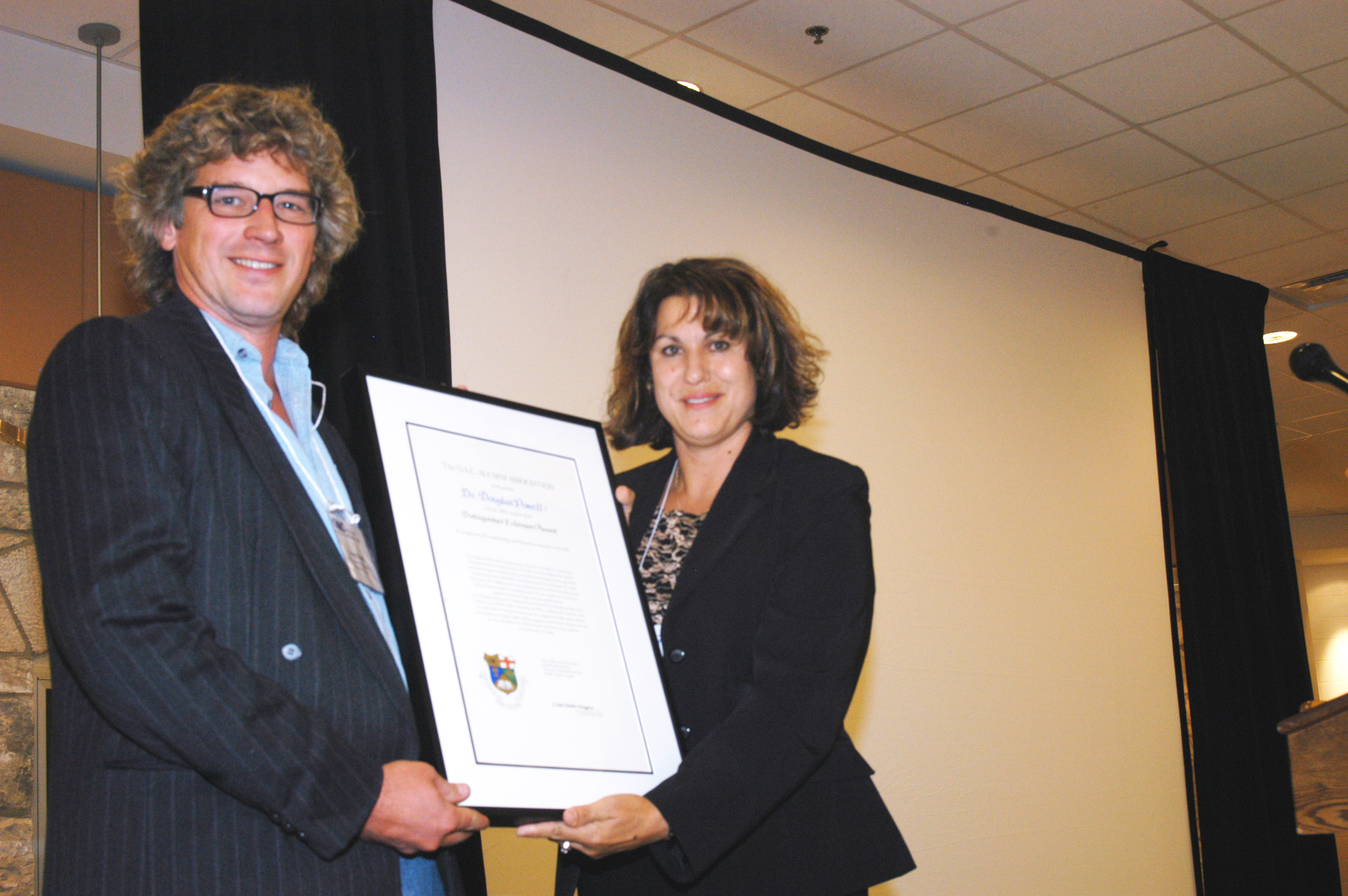
In 1999, I gave a talk to hundreds of farm leaders in Ottawa and told them that DNA fingerprinting – via PulseNet – would revolutionize foodborne illness outbreak investigations and that farmers better be prepared (the pic is from a 2003 awards ceremony where I was acknowledged for my outreach and extension efforts, the hair was fabulous).
 Twenty years later and whole genome sequencing is even further piecing together disparate outbreaks.
Joanie Stiers of Farm Flavor writes that Michigan’s laboratory toolbox now includes whole-genome sequencing, allowing public health officials to stop the spread of foodborne illness faster than ever.
Since January of 2017, the Michigan Department of Agriculture and Rural Development (MDARD) has actively used whole-genome sequencing to precisely identify illness-causing pathogens and defend against widespread outbreaks of foodborne diseases.
MDARD’s Geagley Laboratory works in tandem with laboratories in the U.S. Food & Drug Administration’s GenomeTrakr network, which allows global collaboration in the fight against foodborne illness.
“With food now being distributed worldwide, illness can be spread from anywhere in the world,” says Ted Gatesy, laboratory manager of the microbiology section at Geagley Lab, which houses the whole-genome sequencing. “Using whole-genome sequencing, an illness can be tracked, for the most part, to the point in the food chain where it originated.
.jpg) Producers of food, big and small, have all employed various lines over the years to say, the evidence doesn’t really prove a specific food made a bunch of people barf or kill them. Governments have done the same thing in protecting various food-producing industries. The widespread standard of proof in the form of DNA fingerprinting was just being contemplated when I graduated with a molecular biology and genetics degree in 1985, and was dependent on a couple of other technologies, especially polymerase chain reaction of PCR amplification of small amounts of DNA.
Producers of food, big and small, have all employed various lines over the years to say, the evidence doesn’t really prove a specific food made a bunch of people barf or kill them. Governments have done the same thing in protecting various food-producing industries. The widespread standard of proof in the form of DNA fingerprinting was just being contemplated when I graduated with a molecular biology and genetics degree in 1985, and was dependent on a couple of other technologies, especially polymerase chain reaction of PCR amplification of small amounts of DNA. Minnesota. Furthermore, laboratory tests confirmed that cheese samples collected last week from the farm contained another form of Shiga toxin-producing E. coli, demonstrating that an ongoing pathway of contamination existed on the farm. …