
Megan Hardigree, a research associate at Kansas State University working on hand hygiene, writes that this year, Cinco de Mayo wasn’t just a holiday to celebrate the Mexican army’s victory over the  French in the Battle of Puebla (yesterday) or a song by the band, Cake. It was also a day to celebrate the launch of the World Health Organization’s (WHO) newest hand hygiene campaign: Save Lives: Clean Your Hands.
The aim of Save Lives: Clean Your Hands is to stop the spread of infection by increasing hand hygiene of healthcare workers. This is said to be the next step of the original, Clean Care is Safer Care, from 2005. The initiative persuades individuals to join the movement with gain-framed messages (they apparently encourage positive behavior) such as “Help stop hospital acquired infections in your country” and “Make patient safety your number one priority.”
 To help support this initiative, WHO has accompanied the promotion with a variety of tools and resources to aid healthcare facilities in promoting and enforcing better hand hygiene. These tools include: tools for system change, tools for training and education, tools for evaluation and feedback, tools as reminders in the workplace, and tools for institutional safety climate. My personal favorite, mostly because of the fun diagram, is in the “tools as reminders in the workplace” which includes “My 5 Moments for Hand Hygiene:”
• before touching a patient;
• before clean/aseptic procedures;
• after body fluid exposure/risk;
• after touching a patient; and,
• after touching patient surroundings.
“Be a part of a global movement to improve hand hygiene, “ says WHO.
Now to evaluate whether any of these messages actually compel people to wash their hands.
 Is that a better use of resources than increasing monitoring activities of flu-like symptoms in humans?
.jpg) The N.Y. Times reports this morning
The N.Y. Times reports this morning The U.S. Food and Drug Administration suspects this packing plant, its warehouse in McAllen, Texas, and a farm in Mexico are among the sources of the United States’ largest outbreak of food-borne illness in a decade, which infected at least 1,440 people with a rare form of salmonella.
 Dr. David Acheson, the Food and Drug Administration’s food safety chief, has just told a
 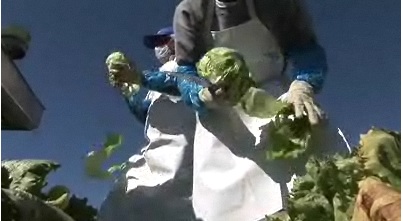 Glenn Fry helps run Taylor Farms de Mexico’s new $14 million plant in San José Iturbide, Mexico. He picked the land where it sits, designed just about every facet of it, and he manages more than 800 workers who plant, harvest and package produce – including lettuce, onions and broccoli – for export to the U.S.
.jpg) Dr. Mike Landen, deputy state epidemiologist with the Department of Health, said,
Dr. Mike Landen, deputy state epidemiologist with the Department of Health, said, We stayed for an hour; didn’t like it. So we headed south, stopping for the night in Socorro, NM. We spent the next morning walking around the campus of New Mexico Tech, raising suspicions by wandering to close to classified areas, and checking out the PhD hair salon. Then it was off to a bizarre encounter in Truth or Consequences, NM, and eventually to Tuscon.