
Turtles in the 1960s and 1970s were inexpensive, popular, and low maintenance pets, with an array of groovy pre-molded plastic housing designs to choose from. Invariably they would escape, only to be found days later behind the couch along with the skeleton of the class bunny my younger sister brought home from kindergarten one weekend.
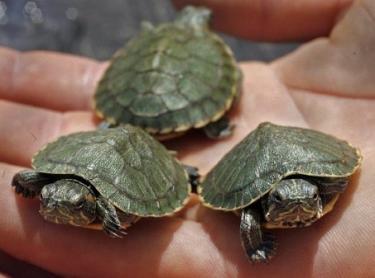 Maybe I got sick from my turtle.
Maybe I picked up my turtle, rolled around on the carpet with it, pet it a bit, and then stuck my finger in my mouth. Maybe in my emotionally vacant adolescence I kissed my turtle. Who can remember?
The U.S. Centers for Disease Control reports there are now 124 confirmed cases of people, primarily kids, infected with outbreak strains of five different Salmonella outbreak strains in 27 states.
There’s a country-wide love for turtles in 2012, even though the U.S. Food and Drug Administration banned the sale and distribution of turtles less than 4 inches in size as pets since 1975.
Two new multistate outbreaks linked to small turtles have been identified since the prior update on April 5, 2012. Overall, 5 multistate outbreaks of human Salmonella infection are linked with exposure to small turtles. Results of the epidemiologic and environmental investigations indicate exposure to turtles or their environments (e.g., water from a turtle habitat) is the cause of these outbreaks.
• A total of 124 persons infected with outbreak strains of Salmonella Sandiego ( and B), Salmonella Pomona (A and B), and Salmonella Poona have been reported from 27 states.
• Small turtles (shell length less than 4 inches) were reported by 92% of cases.
• Forty-three percent of ill persons with small turtles reported purchasing the turtles from street vendors.
• 19 ill persons have been hospitalized, and no deaths have been reported.
• 67% of ill persons are children 10 years of age or younger.
• Small turtles (shell length less than 4 inches) were reported by 93% of cases with turtle exposure. Forty-three percent of ill persons with small turtles reported purchasing the turtles from street vendors.
The number of ill persons identified in each state is as follows: Alaska (2), Alabama (1), Arizona (3), California (21), Colorado (5), Delaware (3), Georgia (3), Illinois (1), Indiana (1), Kentucky (1), Massachusetts (3), Maryland (6), Michigan (2), Minnesota (1), Nevada (4), New Jersey (7), New Mexico (3), New York (24), North Carolina (1), Ohio (2), Oregon (1), Pennsylvania (9), South Carolina (3), Texas (12), Virginia (3), Vermont (1), and West Virginia (1).
The complete update is available at http://www.cdc.gov/salmonella/small-turtles-03-12/index.html.
 that can lead to illness. Washing hands after touching them is very important.
.jpg) * Problems with access to veterinary care
* Problems with access to veterinary care.jpg) * What disease or injury (e.g. bite) risks are present and how will they be managed.
* What disease or injury (e.g. bite) risks are present and how will they be managed. "I know I’m fat, but was Captain Leysath really justified in throwing me off a flight for which I was already seated?" he ranted through his Twitter account to over 1.6 million followers.. "Again: I’m way fat… But I’m not THERE just yet. But if I am, why wait til my bag is up, and I’m seated WITH ARM RESTS DOWN.”
 Pets can be accommodated comfortably and safely in airplane cargo holds, which is where they belong. Airlines must choose to put the needs of their human passengers first, or be forced to do so.
 campaign to replace mops and brooms with Swiffer products, featuring celebrity spokesthingy Cesar Millan.
 That’s just one of the recommendations in
  The outbreak, linked to Peanut Corp. of America’s peanut paste and related products
.jpg) Besides evidence that they can carry dangerous and sometimes potentially deadly germs, exotic pets may be more prone than cats and dogs to bite, scratch or claw — putting children younger than 5 particularly at risk, the report says.
Besides evidence that they can carry dangerous and sometimes potentially deadly germs, exotic pets may be more prone than cats and dogs to bite, scratch or claw — putting children younger than 5 particularly at risk, the report says. I’ve just started my first year of
.jpg) Turtles do not make good pets
Turtles do not make good pets in people’s homes.