
Journalism reaches new food safety lows

There’s a food safety feeding frenzy going on in the nation’s media outlets. Not a week goes by when Ben or I (and I’m sure dozens of other food safety geeks) get a call from an earnest reporter who wants to dish the dirt on dangerous dining, or seep into the city’s soiled food service underbelly, or test for toxins in takeout.

But there’s always someone who will play along. Yesterday it was menus and movie theaters.

Not the food on the menu, but the actual menu as a source of dangerous microorganisms, Same with movie theater chairs.

South Carolina’s Live 5 News –with Tracey Amick — reported that they tested a single menu from a single outlet of chain restaurants.

"The menu from the Olive Garden had no bacteria…and the ones from Noisy Oyster, Applebees, and Waffle House had normal levels of normal staph…nothing to cause concern.

"But the TGI Friday’s menu had 100 units of Bacillus Cereus which if ingested…could make you sick with diahrrea and vomiting."

Charlotte, N.C’s WCNC — with action reporter Jeff Sonier — bought tickets at a half dozen Charlotte area movie theaters.

Then we took our hidden cameras inside, along with a black light to locate stains and other foreign material, and swabs to take samples. We sealed up everything we found in test tubes, and sent them off to a laboratory near Raleigh.

… most of the germs WCNC found in most of the movie theaters we tested probably won’t make you sick. But there were some exceptions – such as the seatback sample of bacteria we swabbed from the Carolina Pavilion theater on South Boulevard. The laboratory identified it as bacillus cereus.

Don’t eat the menu. And don’t lick movie theater seats.
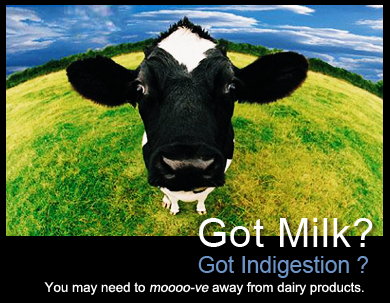
Milk — kudos to a government-type explaining what they do

Terrence Philibeck, Director, Dairy Inspection Division Indiana State Board of Animal Health Indianapolis, writes to the Indianapolis Star in reference to Shari Rudasky’s article ("Four ways to shop smart," Oct. 16)

Philibeck says that to tell consumers to check their dairy products for hormones is misleading. All milk contains naturally occurring hormones produced by lactating animals. Labeling as "hormone-free" reflects only the absence of synthetic hormones given to the cows, a practice that will be virtually eliminated by year-end as a result of new industry-imposed policies.

Second, to recommend consumers seek out antibiotic-free products is simply a marketing gimmick. All fluid milk is tested for the presence of antibiotics before it is processed. Milk that tests positive for antibiotic residues is discarded as unfit for human consumption. To recommend consumers seek out antibiotic-free-labeled milk is to imply that other products are somehow contaminated or unsafe, when in fact all dairy products must abide by this industry standard for safety.

As the state’s regulatory agency for dairy products, the Indiana State Board of Animal Health has a compliance and education program to help producers avoid contamination of milk through the use of antibiotics in their herd. Producers who violate the antibiotic-negative requirement must complete a 10-point action plan with their herd veterinarian and are subject to fines for repeated occurrences. Our staff also works with dairy processors and cooperatives (the wholesalers) to verify that regular testing is done routinely and correctly to ensure the wholesomeness of our dairy supply.

How hard was that? It’s rarely done. Instead, government and industry folks are usually content to make pronouncements about the ignorant masses, in meetings or sometimes in public. American culture is awash in food porn and hucksterism. It’s up to those who manage risks to communicate with the public they serve. I wrote a book about it, Mad Cows and Mother’s Milk. Kudos to Terrence Philibeck.

Home test kit for E. coli and Salmonella?

Magna Medical Services (MMS) is pumping out the press releases following high profile outbreaks.  These dudes have been around for a while, and usually after every outbreak they fire out something about testing your food with their high-powered testing.  Today’s says:

With the recent string of food recalls, food and health retailers are scrambling to offer instant food testing kits for E.coli and Salmonella manufactured by Magna Medical Services, Inc. MMS Quick Results Food Testing Kits are home food test kits for E.coli and Salmonella.
“Retailers will be able to sell home kits for E.coli and Salmonella to clients that need to quickly check their food areas and food products for possible bacteria outbreaks,” says Robert Greene, General Manager for Magna Medical Services, Inc “This is a product that should be right next to every home first aid kit.

They also put out releases following the 2006 spinach-linked E. coli O157:H7 outbreak, and another that cites "recent E. coli outbreaks that have affected the Northeastern United States" back in January.  Seem to be capitalizing on public interest in food safety, but I have lots of questions about the product.

Does this product even work (and how would we know)?
Where is the data (because it’s not on their website)?
How sensitive is it? 
What’s the utility of using quick strips on food in your home? 
How do you sample food in your house?
What would happen if a firm,or a temporary food stand, or my mom used these strips, the results showed no contamination, and the food still resulted in an outbreak?

Maybe it’s a good tool, but without some of these questions answered I file MMS into the huckster category, capitalizing on food safety hysteria. Maybe MMS have some good answers, and I welcome any comments on this product here on barfblog.

Some of my food microbiologist friends are struggling with figuring out the best way to use traditional, labour-intensive methods of sampling different foods (especially produce) and there are disagreements on sample preparation. Seems MMS has got it all figured out.  And only for "less than $4 USD"

I think what MMS is trying to sell is a magic bullet — test with our strips and you can be sure about your food.  And without the data, I’m not sure they can say that, I don’t believe that there are magic bullets in food safety, it’s not that simple.