Food Safety Network year-in-review

I was walking around the vet college at Kansas State the other day with baby Sorenne strapped to me, and was telling anyone who would listen that Kansas State now had the foundation of a NCAA woman’s hockey program, if only they would build an arena in Manhattan.

Someone asked me, what is it you like about hockey, and I said it’s so fast and violent and requires skills like no other game. Don Cherry, right, agrees.

You can see that on display right now as Canada and the U.S. are playing in the World Junior Hockey Championships in Ottawa. I’m in Manhattan, Chapman is in North Carolina, and we’re both watching hockey on the NHL channel. Nerds.

Daughter Braunwynn, below, – herself a great skater and hockey player – arrives tomorrow for a visit.  And while I’m all nostalgic, here’s the year in review.

I’m not sure what to make of these statistics. Like media hits, I had thousands if all the media appearances are counted, and I’m not sure what to count anymore. And am too busy doing to count what I’m doing.

The listservs have peaked and I need to exploit new technology to get the news out. That will be happening soon enough. For this year, I developed 2 on-line courses which will start being offered in Jan. 2009, and got together 16 journal articles and book chapters. So I was doing that academic thing.

Mich??le Samarya-Timm: Handwashing for the holidays

Michéle of Jersey’s own Franklin Township Health Department – represent – writes in this guest blog that her Christmas shopping for 2009 (yes, 2009) is well on its way.  

As I get creative with my gifts, I often find things that put a fun spin on gift giving – while still spreading a positive handwashing message.

So whether you are thinking of next year’s holidays…or very belatedly catching up on this one, perhaps some unique musings on present possibilities may help you give the gift of health to your loved ones.   

Consider the following:

(1) The Florida Department of Health encourages giving the Gift of Wellness to your local school.
The “Perfect Classroom Gift” includes tissues, hand sanitizer, antibacterial soap and hand wipes.  Don’t have a kid in school?….Seems that these items (and their active use) would be a perfect gift to combat any office hacking, sniffling, wheezing and dripping.

(2) Fisher Price has a doll that pees (nothing unusual there),  poops (yup, dolls do that too) and  talks about handwashing??! The company touts:   Just like a real toddler, the Gotta Go Doll goes both “number 1” (and “number 2!”) on her very own small potty, but, unlike real toddlers, there is no mess and no water—just realistic sights and sounds! The doll can flush and knows to wash her hands.   I played with it in Kmart…she really does say I gotta wash my hands.

Wow.

Now only if a toy manufacturer can create a toy to teach adults to handwash.

(3) Are you a creative sort?  How about spending those cozy winter evenings stitching a decorative handwashing reminder?  Handcrafted items still surely are treasured gifts…and these may help put all those guest soaps to good use.

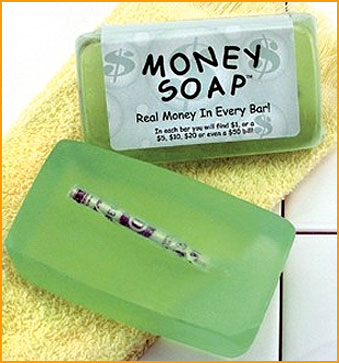
(4) How do you handle those who wish a gift of good old fashioned cash?  You can give a gift of soap with an unknown denomination of currency inside…the best way to ensure that the recipient won’t play with dirty money.

(5)  Want something a little more fun?  How about buying (or making) real working snowglobes made of soap?  I don’t know what happens when you lather your way to the center…but certainly will be good clean fun to find out.

(6) Sending greetings electronically?  The California Department of Public Health and the UC Men’s Octet has an extended play holiday handwashing jingle and video that will have you singing at the sink all winter long.

(7) Is handwashing humor more your style?   Clip handwashing comics all year long for a happy handwashing montage. Or search the Internet for some handwashing humor from up and coming artists.  Here’s a start.

(8) Reading this blog?  Then you must buy quantities of the Don’t Eat Poop shirt for yourself and loved ones. (Thank me later, Doug!) Don’t Eat Poop shirts come in four of the hippest languages around: English, Chinese, French and Spanish. They are a bargain at $20 per shirt (who can put a price on spreading the message of safety?) and come in a variety of sizes.  Somehow I think infant and toddler sizes may not be too far off. 

But the best gift of all only takes 20 seconds…so wash your hands (with soap!), and enjoy a Healthier New Year.

67 sick from raw milk cheese in Kansas

For all the fawning media coverage and energy expended, I figured there would be millions of Americans drinking raw milk.

A story in the Dayton Daily News pegs the number at 500,000.

That’s nothing when it comes to food dollars. And there are reasons why the numbers are so low. As the U.S. Centers for Disease Control reported in its Morbidity and Mortality Weekly Report today,

“On October 26, 2007, a family health clinic nurse informed the Kansas Department of Health and Environment (KDHE) that Campylobacter jejuni had been isolated from two ill persons from different families who were members of a closed community in a rural Kansas county. By October 29, 17 additional members of the community had reported gastrointestinal illness and visited the clinic within a week. All 19 persons reported consuming fresh cheese on October 20 that was made the same day at a community fair from unpasteurized milk obtained from a local dairy.

"This report summarizes the findings of an investigation by KDHE and the local health department to determine the source and extent of the outbreak. Eating fresh cheese at the fair was the only exposure associated with illness (relative risk [RR] = 13.9). Of 101 persons who ate the cheese, 67 (66%) became ill. C. jejuni isolates from two ill persons had indistinguishable pulsed-field gel electrophoresis (PFGE) patterns, and the isolate from a third ill person was nearly identical to the other two. Although all samples of cheese tested negative for Campylobacter, results of the epidemiologic investigation found an association between illness and consumption of fresh cheese made from unpasteurized milk. To minimize the risk for illness associated with milkborne pathogens, unpasteurized milk and milk products should not be consumed."
 

Websites on stickers so consumers know where their food is from: a cool idea 10 years later

About every 10 years I, briefly, become cool, at least in my own mind.

In high school in the late 1970s, I played air bass in an air band called Tone Deaf for one memorable performance. I should have stuck with it; 30 years later, kids are shelling out millions to play air whatever in Guitar Hero.

In 1991, Nirvana came out with grunge, Canadian Neil Young was the godfather and my closet of plaid shirts otherwise known as Kenora dinner jackets was all the rage.

Today, Canadian Press predicted that in 2009, products from apples to chicken will carry codes purchasers can enter into a website for sourcing details. When I started working on the on-farm food safety program with the Ontario Greenhouse Vegetable Growers back in 1998, I said, hey, you growers are doing this great food safety stuff, you should at least put a url on those stickers so those shoppers who want to know can find out all about your great food safety program.

Guess it wasn’t cool enough.

Handwashing help wanted – the Pedro version

Amy read the help wanted advert and apparently thought it was boring.

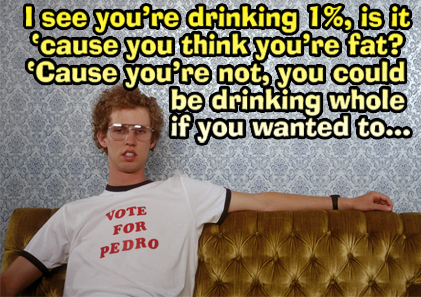
She wants a Napolean Dynamite theme.

So, work with me on handwashing, and all your wildest dreams will come true.

Reach for the Stars with Pedro.

Dude, wash your hands – researchers required

http://barfblog.foodsafety.ksu.edu/2008/12/articles/handwashing/dude-wash-your-hands-researchers-required/index.html

Handwashing compliance has been identified as a significant factor in reducing foodborne, hospital-acquired and other infectious disease. People say they wash their hands, but often don’t. Our goal is to develop evidence-based, culturally-sensitive messages using a variety of media to compel individuals to practice good handwashing in numerous settings, and to accurately evaluate the effectiveness of different approaches.

That’s a bunch of projects – and we’re looking for a bunch of people with diverse skills. Whatever your background, from microbiology to psychology, as long as you have excellent communication skills and can work both independently and collaboratively, we’re interested in chatting with you. Undergraduate or graduate students, if you’re interested – passionate – about compelling individuals to wash their hands and enhance public health, please contact Dr. Kate Stenske at kstenske@vet.ksu.edu, or Dr. Doug Powell at dpowell@ksu.edu.

Don’t eat poop – wash your hands.
 

Dude, wash your hands – researchers required

Handwashing compliance has been identified as a significant factor in reducing foodborne, hospital-acquired and other infectious disease. People say they wash their hands, but often don’t. Our goal is to develop evidence-based, culturally-sensitive messages using a variety of media to compel individuals to practice good handwashing in numerous settings, and to accurately evaluate the effectiveness of different approaches.

That’s a bunch of projects – and we’re looking for a bunch of people with diverse skills. Whatever your background, from microbiology to psychology, as long as you have excellent communication skills and can work both independently and collaboratively, we’re interested in chatting with you. Undergraduate or graduate students, if you’re interested – passionate – about compelling individuals to wash their hands and enhance public health, please contact Dr. Kate Stenske at kstenske@vet.ksu.edu, or Dr. Doug Powell at dpowell@ksu.edu.

Don’t eat poop – wash your hands.
 

136 hospitalized; Australian bakery fined $40,000

The Sydney Morning Herald reports that the Sydney bakery responsible for a food poisoning outbreak that affected 319 people, of whom 136 were admitted to hospital, has been fined more than $40,000 for breaches of the Food Act.

The NSW Food Authority closed French Golden Hot Bread, in Homebush West, in March last year after tracing a salmonella outbreak to the egg mayonnaise served with its pork and chicken rolls.

Contrary to government regulations, the egg mixture was not heat-treated or kept below the specified 5 degrees.

A faulty refrigerator was also blamed for the elevated temperature of the mayonnaise, which allowed the bacteria to develop.

The Herald also reports this morning that more than half the local councils in New South Wales, the Australian state that contains, Sydney, have not fined any food businesses caught breaking food safety laws in the past four years, raising fears that much of the state has no effective protection against food poisoning from unhygienic restaurants and cafes.

Figures provided by the Office of State Revenue, which collects payments for fines imposed by councils, show that since 2004 only 67 out of more than 150 councils imposed any fines on restaurants and takeaway food businesses flouting hygiene laws.

"If you never issue a fine, they will laugh at you," said Des Sibraa, a former chief food inspector for NSW and now a food safety consultant.

He said the only conclusion to be drawn from the fact so many councils did not issue any fines was that many of them did not have serious inspection regimes.
"There is a place for warnings, but only for any minor matters, not for anything serious … Some councils are not doing anything," Mr Sibraa said.

FDA and EPA acting fishy about mercury

I love fish, and would eat it at every meal if I could.  But I know quite a few people that can’t stand it.  Some claim the smell, it’s so…. fishy.  Why eat fish in the first place? According to the American Heart Association, fish is a good source of protein and, unlike fatty meat products, it’s not high in saturated fat. It’s also a good source of omega-3 fatty acids, which benefit heart health.

When choosing what kind fish to eat, pregnant women and young children should stick with sea creatures with the lowest known levels of mercury, such as shrimp, oysters, clams, sardines, anchovies and herring, as well as hake, tilapia, crayfish and whiting.  Large predatory fish, such as shark and swordfish, are very likely to contain high levels of mercury and consumption of them should be restricted if not avoided by high-risk individuals.
FDA and EPA experts currently advise pregnant women and women of childbearing age, who may become pregnant, that they can safely eat up to 12 ounces — roughly two servings — of most fish a week, but should limit their intake of albacore tuna to 6 ounces a week.

Now the two agencies are in disagreement over the two-serving limit.  The F.D.A. has circulated a draft report suggesting that the vast majority of fetuses and infants would actually benefit if their mothers ate more than two servings of fish a week because fish contain highly beneficial nutrients that aid in brain development and that those benefits outweigh any potential harm.  Those contentions are sharply disputed by specialists at the E.P.A. who charged that the report had “serious scientific flaws,” relied on questionable models and should not be used as a basis for decision-making.

We’ll have to see where the final lines are drawn.  Until then, enjoy moderate amounts of safe seafood.  As with all meat products consumed by pregnant women, the fish should be thoroughly cooked and properly stored.  Pregnant women should always avoid sushi and other kinds of raw meat.


Top 10 food safety issues 2008 – the PR version

Researchers at Kansas State University’s International Food Safety Network use blogs, YouTube videos, food safety info sheets and other means to remind people about food safety hazards. The researchers are among more than 150 K-State faculty and staff active in the food safety and animal health arenas. Since 1999, K-State has dedicated more than $70 million to related research.

"During an outbreak, food safety is at the top of many people’s minds," said Doug Powell, scientific director of the International Food Safety Network at K-State, where he is an associate professor of diagnostic medicine and pathobiology. "The real challenge is to compel everyone, from farm to fork, to practice safe food habits before an outbreak occurs. It’s sort of boring, but it reduces the number of sick people."

Casey Jacob is a research assistant working with Powell. A May 2008 K-State bachelor’s graduate in food science and industry, Jacob compiled a list of the top 10 food safety issues of 2008 available at http://tinyurl.com/4q4efw

Salmonella-laden tomatoes and/or peppers topped Jacob’s list, highlighting the importance of being able to trace fresh produce to its source.

"Companies that can provide efficient traceability systems for their products provide an advantage to the retail food service sector during recall and outbreak situations," Jacob said.

Other top food safety issues on the list were melamine in Chinese infant formula, listeria in deli meats and soft cheeses, and E. coli O157:H7 linked to negligent butchers in the United Kingdom. Jacob said that these incidents demonstrated the importance of knowing one’s food suppliers, warning vulnerable populations of food safety hazards associated with certain foods, and establishing a culture of food safety among food handlers.

The list includes signs that restaurant inspection disclosure systems are on the rise.

"The food service sector should recognize that certain diners are interested in the information provided by inspection reports and summaries," Jacob said. "This increase in transparency highlights the importance of maintaining — or improving — compliance with food safety regulations during inspections."

The list also recalls how patrons are using cell phone cameras to document food safety issues. In Toronto, a passerby took a photo of rats on a countertop at one of the most prominent restaurants in the city’s Chinatown. Public health authorities shut the restaurant down.

"Everyone eats, and in a networked world, consumer experiences can really impact what people know about food safety," Powell said. "At the International Food Safety Network, we try to develop tools to help consumers share their wisdom with everyone in the farm-to-fork food chain and hope that leads to fewer people getting sick."

More information about the International Food Safety Network is available at http://www.foodsafety.ksu.edu/en/

 

Obama: Forget the fashion and focus on food safety basics

Baby Sorenne woke up around 4 a.m. and, after nursing, hung out with daddy and watched Mallrats until she went back to sleep.

Daddy – that’s me – started prepping for the Christmas meal: boneless leg of lamb marinated in fresh rosemary – the one herb that seems to flourish indoors – and lime-garlic sauce. And some other stuff, which I could describe in pornographic detail, but will instead call side dishes.

As I prepare the lamb, I’ll keep in mind the World Health Organization’s factors that contribute to foodborne illness:

• improper cooking procedures;

• temperature abuse during storage;

• lack of hygiene and sanitation by food handlers;

• cross-contamination between raw and ready-to-eat foods; and,

• foods from unsafe sources.

Yet increasingly, food safety is used as a catch phrase to encompass whatever political goals some group wants to achieve

The N.Y. Times yesterday encapsulated what has been circulating on the Interwebs for weeks, stating that,

“From the moment it was clear that Barack Obama was going to be president, people who have dedicated their lives to changing how America eats thought they had found their St. Nicholas. It wasn’t long before the letters to Santa began piling up.

“Ruth Reichl, the editor of Gourmet magazine, wants a new high-profile White House chef who cooks delicious local food. Wayne Pacelle, head of the Humane Society of the United States, wants policies requiring better treatment for farm animals. …

“Not only does (Obama) seem to possess a more-sophisticated palate than some of his recent predecessors, but he will also take office in an age when organic food is mainstream, cooking competitions are among the top-rated TV shows and books calling for an overhaul in the American food system are best sellers.”

Running through all of this is some kind of food snobbery that assumes whatever is fashionable is somehow safer.

Even the groups advocating more food safety are reeking of political ambition rather than focusing on the things that make people sick.

Like Brody in Mallrats, no one wants a stink palm.