Animals can make humans poop: a systematic review and meta-analysis

Domestic animal husbandry, a common practice globally, can lead to zoonotic transmission of enteric pathogens. However, this risk has received little attention to date. This systematic review and meta-analysis examines the evidence for an association between domestic exposure to food-producing animals and cases of human diarrhea and specific enteric infections.

family.guy.diarrheaWe performed a systematic review of available literature to examine domestic livestock and poultry as risk factors for diarrhea and applied pre-determined quality criteria. Where possible, we carried out meta-analysis of specific animal–pathogen pairs.

We found consistent evidence of a positive association between exposure to domestic food-producing animals and diarrheal illness across a range of animal exposures and enteric pathogens. Out of 29 studies included in the review, 20 (69.0%) reported a positive association between domestic animal exposure and diarrhea. Domestic exposure to poultry revealed a substantial association with human campylobacteriosis (OR 2.73, 95% CI 1.90–3.93).

Our results suggest that domestic poultry and livestock exposures are associated with diarrheal illness in humans. Failure to ascertain the microbial cause of disease may mask this effect. Exposure to domestic animals should be considered a risk factor for human diarrheal illness and additional studies may identify potential mitigation strategies to address this risk. 

Human diarrhea infections associated with domestic animal husbandry: a systematic review and meta-analysis

Trans R Soc Trop Med Hyg, March 2014

Laura D. Zambrano, Karen Levy, Neia P. Menezes and Matthew C. Freeman

Food hygiene ratings: why Wales did the ‘dirty dozen’

The dirty dozen in the U.S. is equated with pesticide resides on produce items and largely bullshit.

However, residents of North Wales have shown unprecedented interest in the standard of food hygiene in our local restaurants, takeaways and food shops since the Daily Post first published a series highlighting ‘North Wales’s dirty dozen’, highlighting the local establishments which received a zero rating for hygiene, as ruled by the Food Standards Authority.  

bullshitThere were criticisms that the Daily Post went “too hard” on these food outlets, as some of the owners had claimed that the negative rating was due to poor document keeping or incomplete paperwork.

Daily Post editor Mark Thomas writes, we have done a lot to promote and encourage excellence in our small businesses, and will continue to do so, but I believe we also have a duty to share with you issues like this which ought to be of concern to you as consumers.

That is not sensationalist, or inaccurate reporting. It is us doing our job for you.

The Food Hygiene Rating Scheme means that people can choose instead to eat out or buy food at places with higher ratings and businesses with low ratings are in danger of losing customers and so will be encouraged to improve standards more quickly and to maintain these in the future.

Cafe hygiene link to councilors’ norovirus in NZ

Poor hygiene may have been responsible for a norovirus outbreak that knocked out seven Hutt city councillors.

Four property developers also contracted the severe stomach bug after being invited to the council-hosted event at Reka Cafe, in the Dowse Art Museum on April 28.

nepotism-bushOne of Reka’s cooks started to feel sick while working but did not display stomach bug symptoms until the next day, Annette Nesdale, of Regional Public Health, said.

Wait, councilors meeting with property developers? I may barf.

Filthy conditions land UK takeaway bosses in court

It’s with a disturbing regularity that I come across restaurants and other food service outlets being fined or doing dumbass stuff.

Two businessmen ended up before UK magistrates after routine inspections uncovered filthy conditions and health risks at their premises.

vomit cgThe owners of The Green, in Cockerton, and Simo’s Pizza, on Brignall Moor Crescent, appeared separately at Darlington Magistrates Court charged with a number of hygiene related offences.

Contamination risks and “extremely dirty” conditions greeted environmental health officers who visited The Green in February.

Work surfaces and tiles were covered in grime, drinks were stored close to the toilet and staff members were not suitably dressed or appropriately aware of food safety issues, Yvonne Wood, prosecuting on behalf of Darlington Borough Council, told magistrates.

The shop’s owner, Adam Khalid Ali – of Marwood Crescent, Darlington – pleaded guilty to four contraventions of the Food Safety and Hygiene Regulations Act, including failing to register the business with the council.

Representing himself, he said family problems, including the death of his grandmother, had led to the business becoming neglected.

C is for Chinese in UK too; Golden Dragon Palace takeaway in Northbourne closed by council over food hygiene issues

A Chinese takeaway has been closed down on food hygiene grounds.

Officials from Bournemouth council made the decision to close the Golden Dragon Palace in Wimborne Road, Northbourne on Friday evening.

Golden Dragon Palace takeaway in NorthbourneThe takeaway, situated on Ashridge Parade, received a damning report from the Food Standards Agency two years ago when it was given a rating of poor for food safety and hygiene.

The reasons for the drastic action are displayed in the window of the Wimborne Road takeaway, alongside a hand-written sign claiming the business is closed for “inside decoration.”

Food fraud: Ireland to crackdown on fake honey, fish scams

Fake honey and fish are set to come under the microscope as health authorities across Europe crack down on organized food fraud.

The Food Safety Authority of Ireland (FSAI) is also carrying out a fresh round of DNA tests on beef as part of an EU-wide follow-up to last year’s horsemeat scandal.

the_godfather_luca_brasi_sleeps_with_the_fishes-tAnd FSAI chief executive Prof Alan Reilly told the Irish Independent that honey and fish would also be systematically surveyed in Ireland as part of new EU Food Fraud network attempts to tackle widespread organized crime in the European food chain.

Prof Reilly said food fraud was a huge issue as there was so much money to be made and so many ways to hoodwink consumers.

“There are endless possibilities for fraud and the way to tackle that is to combine intelligence with our European partners in this Food Fraud Network.”

Restaurant inspection disclosure: a dissenting view from NYC

Maury Rubin, founder and owner of The City Bakery at 3 W 18th Street in Manhattan, first opened his doors 24 years ago and is well-known around the Union Square neighborhood for creating a hot chocolate so rich, you can almost chew it. Rubin still walks to work in the mornings and loves to shop at the outdoor Greenmarket for ingredients.

qr.code.rest.inspection.gradeLast December, health inspectors from New York City’s Department of Health and Mental Hygiene served his bakery a “C” – the most damning letter grade on the rubric – for the second time in three years.

Inspectors found mice, roaches and flies on the premises and cited employees for not holding food at proper temperatures. Recently, Rubin sat down with me at a small table overlooking his spacious café, and explained why he thinks that “C” has more to say about the NYC Department of Health than his bakery.

There is a very clear point in time where everything that a food business in New York had to deal with became more burdensome. Roughly 12 to 14 years ago, the city had budget issues and discovered that very aggressive policing of the food business by the Health Department was an awesome new revenue stream. And I think that’s the no-turning-back moment. …

New York City, when it converted to the letter grade system, kept waving the banner of LA as its go-to example, but it literally took only one thing from LA — the letter grades. It took no methodology, it took none of the approach. It just took the scoring system. When the LA Department of Health walks into your restaurant, they are expecting it to be faithful to the plans that they’ve approved. What New York City is counting on is the opportunity to see things for the first time and say, “Oh no — that’s wrong.” It’s a gotcha system. It’s more adversarial, and it has nothing to do with a very simple, fabulous approach in LA of, “We’re in this together.”

My interest of a safe food supply has everything to do with the welfare of my customers and my business before I even start thinking about the New York City Department of Health. I think most reasonable people would agree on the reasonable view of an operation’s cleanliness, presentation and sanitation. I think that food inspectors walk into City Bakery and they see a big, clean, presentable place. I think this shifts their criteria to where they’re in our sub-basement looking — hoping — for a sink with a washer that’s loose. So 40 feet underground New York, you have a 10-inch hand sink that has a small leak — you’re going to pay about $1,200 for that leak. And that leak is going to be considered a critical violation.

Where one would hope that reason comes to bear in that moment — reason does not exist within the New York City Department of Health. It just doesn’t.

California county to continue debating color-coded food safety inspections

In the on-going saga that is restaurant inspection disclosure, this time in Orange County, California, a grand jury report has caused a reevaluation of the process among public health officials.

Restaurants in Orange County currently use a food inspection notification system that is visibly vague and, at a glance, does not inform the public about inspection status, as stated in the report.

OC.color.gradesThe report calls for a pronounced placard in the windows of these food facilities that is “graphically enhanced” and leaves no room for misinterpretation.

One of the alternative approaches would be a color-coded system, which designates a green, yellow or red placard, similar to traffic lights, indicating their level of compliance.

The counties of Sacramento, Alameda and Merced currently use this color notification method.

The color-coded system would be more effective than the one currently in use, said 
Christopher Waldrop, the director of the Food Policy Institute at the Consumer Federation of America.

The neighboring counties of Los Angeles, Riverside and San Diego all use a letter-grade format for food facility health inspections. Either an A, B or C grade can be earned during the inspection.

But Waldrop said there has not been sufficient research done yet to come to a consensus of which system is the most effective.

“I think at this stage there is a lot of different systems that are being tried,” Waldrop said. “Whichever system it is, the one that gives consumers accurate information that’s very readily available, those types of systems are the ones that work best for consumers.”

USDA scientists scrutinize role of supershedder cattle in E. coli O157:H7 contamination

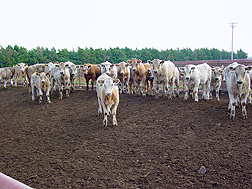
On average, about 2 percent of the cattle grazing in a pasture, or eating high-energy rations in a feedlot pen, may be “supershedders” who shed high levels of pathogenic organisms such as Escherichia coli O157:H7 in their manure, according to research led by U.S. Department of Agriculture (USDA) scientist Terrance M. Arthur. 


supershedder.e.coliSupershedding is of concern because it could increase the amount of E. coli O157:H7 that makes its way from pasture or feedlot pen into packinghouses where steaks, roasts, ground round or other beef products are prepared. Often referred to as O157, this bacterium is apparently harmless to cattle, but can cause vomiting, severe stomach cramps, diarrhea or other illness in humans.

Findings from studies by Arthur and his colleagues at the USDA Agricultural Research Service (ARS) Roman L. Hruska U.S. Meat Animal Research Center in Clay Center, Nebraska, may provide a scientifically sound basis for new and effective strategies to curb shedding of this bacterium. ARS is USDA’s chief intramural scientific research agency. 


Arthur and his co-workers have designed and conducted studies of 6,000 head of feedlot cattle and more than 13,000 manure, hide and carcass samples. The team was the first to show that, in supershedders, O157 colonization may occur not just in the lower digestive tract, but also throughout the supershedders’ entire digestive system. Packinghouse managers can take that information into account when evaluating their facility’s sanitation procedures. 

The researchers were also the first to determine that supershedding was not restricted to any particular O157 strain. Their work rules out the idea that tactics designed to reduce supershedding should target a specific strain or strains. 

Research by Arthur’s group has also indicated that, in order for a cattle-management strategy to be deemed successful for reducing transmission of O157, no more than 20 percent of the cattle targeted by the intervention would be shedding the microbe at any one time, and none would be shedding it at supershedder quantities.


Arthur and his coinvestigators, including ARS scientists Joseph M. Bosilevac, James L. Bono, Dayna M. Brichta-Harhay, Norasak Kalchayanand, John W. Schmidt, Steven D. Shackelford and Tommy L. Wheeler, all at Clay Center, have documented these and related findings in peer-reviewed scientific articles published in 2014, 2013, and 2009 in Applied and Environmental Microbiology.

ARS and the Beef Checkoff program funded the research.