Pest problems, no hot water violations prompt closures in DC area

Russ Ptacek of WUSA9 reports on recent restaurant infractions throughout Washington, D.C.

A pesky problem at a coffee house, a pizza shop with sanitation issues, cooling issues at a Peruvian restaurant, a café using unapproved kitchen equipment, and a kabob carry out with 25 health code violations are part of this week’s Food Alert.

12 sick? Iguana Joe’s in Texas closed

Mother’s Day in Canberra, Father’s Day in Texas. Eating out on these holidays can be risky.

KHOU reports the Harris County Health Department has temporarily closed a Humble restaurant after multiple patrons reported being sickened over Father’s Day weekend. The health department said it iguana.joe'swarned Iguana Joe’s about critical violations and how to fix them, but the restaurant didn’t listen so it had no choice but to close the place down at 9 a.m. Tuesday.

“The four major problems that they have right now is cold/hot hold violations. It’s how they cool their product after they’ve heated it up — they’ve cooked it, and now they need to cool it down. And food contact surfaces—you have to remember there are danger zones in foods — so between 41 and 135 degrees is when bacteria grows,” said Harris County Environmental Public Health Services Director Michael Schaffer.

For example, health officials said the employees weren’t cooling the batches of beef, chicken and guacamole at the proper temperatures. However, it’s not clear what made people sick.

Iguana Joe’s released a statement late Monday apologizing for what it called an “unforeseen incident.”

Unforeseen because they didn’t look?

Café serving healthy fare in Vegas medical clinic shuttered for food safety issues; declines to comment

The Red Velvet Cafe is known for vegetarian and vegan fare. Their three Valley locations focus on healthy food.

But, as Darcy Spears of KTNV Las Vegas reports, the Health District found plenty of problems at its snack bar in, of all places, a medical center.

The Red Velvet Cafe has a snack bar inside the Lou Ruvo Center for red.velvet.cafeBrain Health on West Bonneville.  

It’s not run by the clinic, but it caters to their clients.  

And it caught the Health District’s attention in ways the chef doesn’t want to discuss.

When we called the cafe for comment, we were directed to Chef Aneesha.

After leaving multiple messages for her, we got a one sentence e-mail saying “Red Velvet Cafe declines to comment.”

What they don’t want to talk about is the 31-demerit “C” grade from their June 11 inspection for things like improper hand-washing, employees using the dump sink to wash dishes, and no soap in the restroom.

Some blueberries in the fridge weren’t so blue anymore.  They were grey and fuzzy with mold, not to mention shriveled and dried out.  Red Velvet Cafe threw them away after health inspectors reminded them to “sell only wholesome food to the public.”

There were also multiple items including cooked beets and chipotle sauce that were past their shelf lives.

Dirty dishes and chemicals were stored next to food and on food contact surfaces.  

The ice scoop was stored on the dusty top of the ice machine.  

And inspectors found hand lotion on the hot plate where the coffee pot should have been.

Thermometers were missing and a bunch of stuff in the fridge was mis-labeled.  Chicken, vegan cheese and chipotle sauce had expiration dates that were too late.  You’re only allowed to keep prepared food for seven days, but Red Velvet Cafe’s labels showed they were keeping it for ten.

They only hung onto that “C” grade for three days.  

They were reinspected on June 14 and are currently operating under a 3-demerit “A” grade.

The best don’t hide; NY restaurants are still hiding their bad health department grade

Nell Casey of gothamist writes, “Like a high schooler hiding that C+ in algebra from mom and dad, many of the city’s restaurants are concealing their Health Department grade from would-be diners. The Daily News reveals that 1,356 restaurants were fined over the past year by the Health Department for camouflaging or not displaying their inspection grades. Of rest.inspec.grade.nyc.hide.jun13the deceptive dining spots, 745 had received “C” grades and 581 received “B” grades, leaving 30 over-achievers hiding their “A” grades… presumably because they thought they deserved an A+?

“Knowing that some diners might pass by an establishment with a poor grade, some restaurants take the risk of fine over the potential loss of a customer. “I’d rather take the fine than place (the C) up there.” explained Thomas Mak, manager of Williamburg’s Juniper. “It would have ruined my business.” Other restaurants cited more dog-ate-my-homework excuses, like letter grades getting lost in the mail or patrons pilfering the grades from out of the windows.

“Still others refused to display their grades as a kind of protest against the grading system in general. “There are many business owners who don’t like the stigma associated with letter grades, period,” head of New York City Hospitality Alliance Andrew Regie told the News.”

Doh; voluntary grades provide no incentive; Aussie restaurants regret scores on doors

Port Stephens restaurateurs have voted with their feet in rejecting the New South Wales Food Authority’s Score on Doors food safety campaign.

Scores on Doors is a volunteer star-rating system given to food outlets to display in store following routine food safety inspections.

According to the Port Stephens Examiner, the town signed up in October 2011 to be part of a state-wide trial of the program, with a staff report homer-dohstating it was an opportunity to “improve consistency of inspections and outcomes for food businesses”.

However, more than a year later the program has been dubbed a failure, with only 10 food outlets out of 338 within the Port Stephens Local Government Area signing up.

Matthew Brown, the council’s development assessment manager, wrote in a report to councilors, “It is the opinion of the environmental health team that the lack of interest from food business proprietors is due mainly to the initiative being a non-compulsory trial [and] participating voluntarily could potentially result in an unsatisfactory rating that they had no choice but to display to the public.”

One business supportive of the plan was Medowie Macadamias, which received a five-star rating, the highest available.

Owner Scott Leech said it was hard to understand why businesses would not support the plan.

“I think it’s a great idea, I really do. If you have nothing to hide you have nothing to worry about,” he said.

Restaurant inspections apply to celebrities and mortals; Lady Gaga’s parents pissed

If you’re the father of a celebrity, expect to get covered when complaining about something – like a restaurant inspection grade  — especially in New York City.

As reported in the Daily Mail, Lady Gaga’s father, Joe Germanotta, was so angry after his restaurant’s hygiene rating was downgraded to a B, he took lady-gaga-meat-dress-01to Twitter to vent his frustrations and reveal the hygiene inspector’s identity.

“Great story of NYC making progress, money and corruption. We had a bad potato in a bin with 40 good potatoes.

“It wasn’t being served to a customer, it was raw, and when the inspector pointed it out we threw it away. How many bad veggies do you toss?

“Regardless, the inspector gave us seven points for a bad potato in a storage bin on our health department inspection, that shifted us from an A to a B or Grade Pending, inspector said it was our choice. (sic)’

The restaurant, Joanne Trattoria, which Mr Germanotta opened with his wife Cynthia last January, has received a number of negative reviews in the past year.

In August, the New York Post reported that New York City’s health department slapped it with a C rating, after discovering various violations that added up to a whopping 42 negative points.

And Leo Carey, The New Yorker’s senior editor, wrote that the restaurant’s homemade focaccia was ‘good in the same way that the garlic bread at Domino’s is good.’ 

Mancini speaks: new effort in food safety training

In 2010, the Russian pavilion at Folklorama in Winnipeg (or, as the Guess Who were always introduced, from Winnipeg, Manitoba, Canada), was implicated in a foodborne outbreak of Escherichia coli O157 that caused 37 illnesses and 18 hospitalizations.

The ethnic nature and diversity of foods prepared within each pavilion presents a unique problem for food inspectors, as each culture prepares Rob_Mancini_001food in their own unique way.

The Manitoba Department of Health and Folklorama Board of Directors realized a need to implement a food safety information delivery program that would be more effective than a 2-h food safety course delivered via PowerPoint slides. The food operators and event coordinators of five randomly chosen pavilions selling potentially hazardous food were trained on-site, in their work environment, focusing on critical control points specific to their menu. A control group (five pavilions) did not receive on-site food safety training and were assessed concurrently. Public health inspections for all 10 pavilions were performed by Certified Public Health Inspectors employed with Manitoba Health. Critical infractions were assessed by means of standardized food protection inspection reports.

Rob Mancini, a MS graduate of Kansas State University, a health inspector with the Manitoba Department of Health, and someone who seems perpetually young with cinematic good looks (bit of a man-crush) led a study of how to improve food safety at Folklorama and the results were published in the Oct. 2012 issue of the Journal of Food Protection.

He’s at it again, and will be reporting on follow-up research he subsequently conducted with almost no help from me and Chapman at the Canadian Institute of Public Health Inspector Conference in Winnipeg, on June 24th, 2013.

Several sick, linked to Campylobacter at NY Burger & Beer Bash

Bacterial contamination was being blamed Monday for an outbreak of foodborne illness following the popular Burger & Beer Bash in Westchester County earlier this month.

The county Health Department said Monday that the campylobacter bacterium was to blame for the outbreak at the June 6 outdoor food festival burger.beerwestchester.13at the Kenisco Dam in Valhalla.

The bacterium was identified through tests on samples from several people who got sick at the event. The department did not specify exactly how many people were sickened.

But health officials have not determined the source of the bacteria, since most attendees ate food from many of the 30 different vendors at the event, the department said. The department has launched an investigation and has been interviewing people in an effort to trace the source.

Money or safety? Restaurant inspection outrage in NYC

Restaurant owners are pissed.

According to data from the New York City Health Department, cited by the New York Post, most fines issued over the past two fiscal years — 65.7 percent so far this year and 66.7 percent last year — are for breaches unrelated to food quality (maybe they mean safety – dp), according to stats obtained by The Post.

For instance, 11.5 percent of the 273,999 fines issued in fiscal year 2012 and 12.1 percent of the 198,779 given out so far this fiscal year were written for qr.code.rest.inspection.gradewalls, ceilings and equipment being poorly maintained.
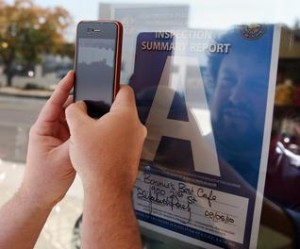
Another 11.5 percent so far this year and 11.2 percent last year were issued to restaurants being inadequately vermin-proof.

Fines for sanitary conditions, which include mice sightings and dirty and greasy food-contact surfaces, totaled about 14 percent both this year and last year.

The largest number of fines — 29.8 percent of this year’s total and 31.9 percent last year — are categorized as “all others,” which two leading restaurant advocates say are almost entirely unrelated to food.

“Many of them are non-food related — dimly lit light bulbs, not having the proper documentation to show that a product has no trans fats in it,” said Andrew Rigie, executive director of the New York City Hospitality Alliance, which represents nearly 1,000 restaurants and bars. “I don’t think many people would consider that directly related to food.”

Inspectors can only inspect to the code they’re given.

Other common fines unrelated to food quality include bathrooms running out of paper products, cracked tiles, dirty aprons — even scratched cutting boards, Rigie said.

All of those count, for various microbiological reasons.

Robert Bookman, lawyer for the alliance, contends the Health Department issues these summonses to generate money for the city’s coffers. The amounts of fines vary widely.

“It’s just revenue generation. There aren’t enough serious violations,” Bookman said.

Now, reports Grub Street via  Bloomberg, 40 Bronx restaurant owners filed a lawsuit in New York State Supreme Court today that alleges they received unjust treatment from fine-happy Health Department inspectors. The coalition of owners say they have been unable to keep up with an “arbitrary, capricious and malicious enforcement of the health code” and insist they are targeted by city employees who haven’t even been properly trained. The group seeks $150 million in damages and a stay of all fines incurred through the inspections. Meanwhile, a spokesperson for the city’s Law department released a statement calling the suit a “rambling, scattershot attack on the city’s regulation of food service establishments” and promises it will be “quickly rejected by the courts.”

The best restaurants, farmers, retailers, whoever, will go above and beyond government standards and brag about them.

UK blame game; where is food contaminated? Everywhere, not just home

The blame game lives on in the UK.

Haringey Borough Council says “the authority’s food safety teams, part of the Food Standards Agency, investigated 210 complaints of food poisoning michael.douglasbut found no evidence to link them to eating out.”

Where’s Michael Douglas when needed?

The Haringey Independent reports most cases of food poisoning happen when cooking at home, and this suggested that most incidents were a result of poor food hygiene while cooking at home.”

Food safety is a farm-to-fork thing, and lowering loads limits cross-contamination.