160 sick; Food company suffers from food poisoning in S China

A total of 160 staff from a food company in south China’s Guangdong Province were suspected of suffering from food poisoning, a company source said on Wednesday.

They had symptoms of chills, fever, nausea, vomiting, stomach ache and diarrhea after having dinner at the third canteen of the Dongguan Hsu Chi Dongguan Hsu Chi Food Co. LtdFood Co. Ltd based in Dongguan City on Monday, said Sun Tianzhen, a media relations officer of Hsu Fu Chi International Ltd. told Xinhua.

Xinhua Net reports Dongguan Hsu Chi Food Co. Ltd. is a subsidiary of Hsu Fu Chi International Ltd.

A 57-year-old female plate washer at the canteen was found dead at her dormitory on Tuesday but it is yet to know whether her death is connected with food poisoning or not, said Sun.

The woman had asked for leave on Sunday and Monday.

294 sick; ‘We’ve been vilified … We certainly weren’t managing our restaurants poorly’ Firefly forced to cut back on staff after Salmonella outbreak

A lot of people got sick eating at one of the Firefly restaurants in Las Vegas; at least 294.

The Southern Nevada Health District (SNHD) concluded that of the 21 food items that were analyzed, one item, cooked chorizo (a type of sausage), tested positive for Salmonella. Culture and PFGE-pattern results of the Salmonella fireflyisolate obtained from the cooked chorizo matched those of the outbreak strain.

Environmental Health staff contacted Firefly restaurant management to gather more information about the handling of the chorizo product. The chorizo came into the restaurant raw and was subsequently cooked by Firefly restaurant staff.

It is likely that the outbreak was due to local cross-contamination in the restaurant’s kitchen and not from a contaminated commercial food.

Now, KTNV reports the Firefly location on West Sahara Avenue is closing for weekday lunch and has laid off a handful of its staff members.

“Letting people go is devastating because they have worked for us for so long,” co-owner Tabitha Simmons tells Action News.

Tabitha’s husband and Firely co-owner John Simmons says the couple has been fighting their hardest to dig the Las Vegas chain out of the hole.

“It’s just sad because we’ve been vilified and we did not want anyone to get hurt. We certainly weren’t managing our restaurants poorly,” says Tabitha.

Consumers are apparently making their own decisions.

“We don’t want to go away. We don’t want to be run out of here. We want to continue being a part of community and we hope Las Vegas gives us that chance,” they tell Action News. 

irony can be ironic; taco licker axed

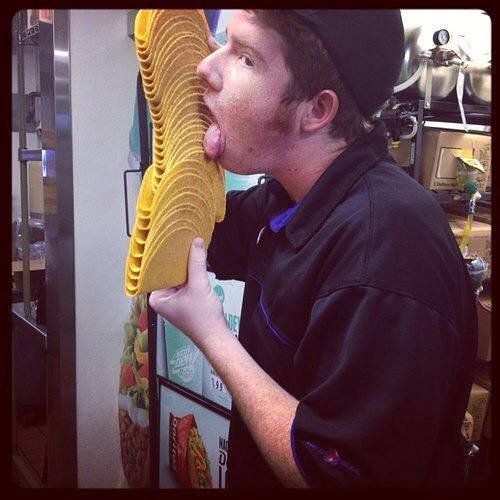
Taco Bell, the largest U.S. Mexican fast food chain and host of several E. coli O157:H7 outbreaks via lettuce, said that a franchisee has suspended — and “is in the process of terminating” — the restaurant employee whose photo taco-bell-lickingshowing him licking a stack of empty taco shells went viral earlier this week. The person who took the photo no longer works for Taco Bell.

According to USA Today, red-faced Taco Bell executives had to try to explain to a skeptical public the circumstances behind the embarrassing photo. On Monday, the franchisee informed Taco Bell corporate that both employees were no longer with Taco Bell.

Never mind that the shells were never sold, but were only provided for workers to practice making the new line of Cool Ranch Doritos Locos Tacos. The shells were thrown out after use. “This is standard operating procedure and our franchisee confirmed this protocol,” says Taco Bell’s statement.

But many consumers viewing the photo had to think otherwise. So Taco Bell had to act quickly. “One of the smartest things a brand can do is to respond as quickly and intelligently as possible,” says Erika Napoletano, a brand strategy consultant.

The photo was taken way back in March at a Taco Bell restaurant in Ridgecrest, Calif., north of Los Angeles It was taken for an internal contest to supposedly show employees enjoying their first bite of the new product. Things went haywire when the photo, which was never submitted for the contest, ending up being posted on the employee’s Facebook page.

Not only was this a violation of company policy, but the worker also violated Taco Bell’s food handling procedures, the company says.

Ignore Dick: Portland posts all restaurant inspection reports online

There’s no one need to wait for the magical impacteur of government sanction to provide safe food.

Just do it.

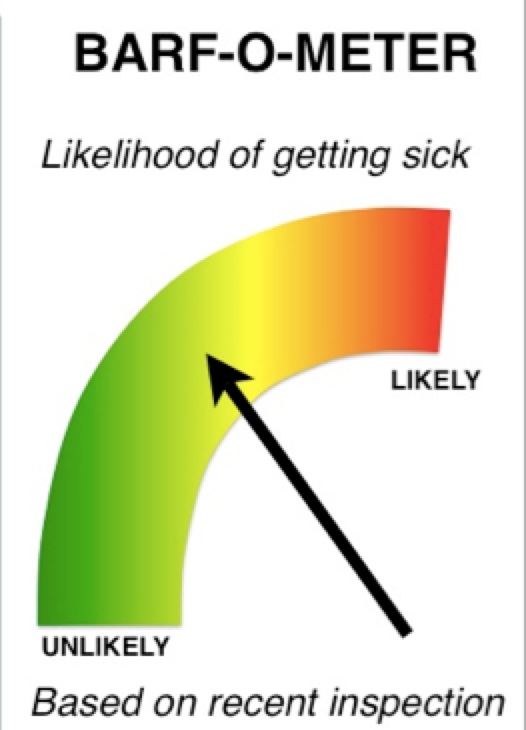
While the U.S. state of Maine drags on restaurant inspection disclosure, the biggest city, Portland, has gone ahead and decided to post restaurant barf.o.meter.dec.12inspection reports online.

The change, announced Tuesday, follows a series of articles by the Portland Press Herald about the shortcomings of restaurant inspection programs in Portland and statewide.

Maine was one of just a few states where no state or local government agency put restaurant inspection information online for the public to review. The state’s requirement for each restaurant to be inspected once every two years is one of the least rigorous in the country; many states require two or more inspections a year.

Dick Grotton, president and chief executive officer of the Maine Restaurant Association, said posting inspection records online is a “bad idea,” because a restaurant can fail an inspection for a variety of reasons, many of which don’t directly affect food safety.

“If the public knew what the actual infraction was, they would laugh,” he said.

Grotton also said databases are difficult and expensive to maintain, which could leave a poor inspection result hanging over a restaurant even after the problems have been corrected.

I don’t laugh over people barfing.

The best restaurants in Maine, the ones that want consumers to knowingly spend their money at their establishment, will ignore Dick and publicize and promote their awesome food safety standards.

In August 2011, Portland hired Michele Sturgeon as its first full-time health inspector for the city’s restaurants. The city has since beefed up its inspection restaurant_food_crap_garbage_10program further, adding two part-time inspectors and more than doubling its budget, from $75,000 in 2011-12 to $154,000 in this fiscal year.

Portland’s inspection reports are available at pressherald.com andhttp://www.portlandmaine.gov/hhs/foodserviceinspections.asp

11 sick; when public health sucks; food outlet will remain anonymous in NZ Salmonella outbreak

Eleven people were sickened with Salmonella last month linked to a northern New Zealand food outlet.

And that outlet will remain a mystery.

Dr Andrew Lindsay, spokesman for the Northland District Health Board says they’ve investigated claims from nine people who say they ate at the same place in Whangarei and came away with food poisoning.

Dr Andrew Lindsay says, as there is no on-going risk, it is not in the public barf.o.meter.dec.12interest to reveal which outlet was under scrutiny.

Bullshit.

It is most certainly in the public interest to know what caused the outbreak, where it happened and what has been done to prevent future outbreaks.

As a consumer, why would I spend money at a place that didn’t practice proper food safety? How would I know? Faith-based food safety rules.

Public health is supposed to help the public, not industry or any other group.

And for the mysterious food outlet, rather than hide behind anonymity or the magic drape of government inspection, the outlet should declare itself, or others will do it for you.

Eleven people were sickened; anyone want to step forward?

Daughters, whatever you post on social media stays somewhere; Taco Bell investigating taco-licking photo

Hours after many Consumerist readers woke up to the photo of a Taco Bell employee rubbing his tongue across a stack of taco shells, the fast food chain has released a statement regarding the caught-on-camera incident.

In a statement to Consumerist, a rep for the Bell writes:

Nothing is more important than the safety of our customers and team members, and we have strict food handling procedures and zero tolerance for taco-bell-lickingany violations. When we learned of the situation we immediately contacted this restaurant’s leadership and although we believe it is a prank and the food was not served to customers, we are conducting a full-scale investigation and will be taking swift action against those involved.

In the comments on the photo posted to the Taco Bell Facebook page, some are defending the employee in the photo, with one person saying he knows the employee and “I know that he is not dumb enough to lick a stack of taco shells and then serve them to the public… There is a 99% chance that that stack of Tacos was getting thrown out, as in: getting thrown away, so it’s not as if they were going to be served to anyone.”

Another woman claims to be the photographer of the image, writing — in all caps so you know she’s serious — “we weren’t even in the food area! If you can see in the back it’s the soda machines!…You’re opinion doesn’t even matter because this happened a long time ago! Dammit!”


‘Score-on-the-door’ food hygiene rating for SA cafes and restaurants

The state of South Australia is introducing a new “score-on-the-door” food hygiene safety rating for cafes and restaurants as the State Government overhauls the Public Health Act.

Scores on doors sounds better.

Adelaide Now reports the Government wants food businesses to adopt the system, with a score out of five displayed on a shop’s door according to its level of food-safety scores_doors_featurecompliance.

It is also planning to adopt a new statewide food safety standard and introduce a registration system for food outlets as part of the reforms.

Hundreds of outlets are caught each year for serious breaches of food hygiene standards.

Health inspectors found rotten meat, maggots in chicken stuffing, puddings with listeria and mice in pantries at cafes, restaurants and takeaway food outlets last financial year.

A parliamentary committee investigation into food safety programs last September recommended the introduction of a statewide score-on-the-door rating system.

Health Minister Jack Snelling said SA Health would work with other jurisdictions, including NSW and with local government and industry, during the development of the system.

A pilot “scores on doors” project is expected to be introduced on a voluntary basis next year. Similar schemes are running in London, Los Angeles, Singapore, Brisbane and Sydney.

But the best ones, like Los Angeles, New York City and Toronto are not voluntary; sorta defeats the purpose.

The Restaurant and Catering SA association said the score system would mean more red tape to businesses. “We would prefer to see a policy which endorses training of staff (in larry.the.cable.guy.health.inspectorfood safety),” chief executive Sally Neville said.

Why not both?

We have some experience with restaurant inspection disclosure systems.

Filion, K. and Powell, D.A. 2009. The use of restaurant inspection disclosure systems as a means of communicating food safety information. Journal of Foodservice 20: 287-297.

The World Health Organization estimates that up to 30% of individuals in developed countries become ill from food or water each year. Up to 70% of these illnesses are estimated to be linked to food prepared at foodservice establishments. Consumer confidence in the safety of food prepared in restaurants isfragile, varying significantly from year to year, with many consumers attributing foodborne illness to foodservice. One of the key drivers of restaurant choice is consumer perception of the hygiene of a restaurant. Restaurant hygiene information is something consumers desire, and when available, may use to make dining decisions.

Filion, K. and Powell, D.A. 2011. Designing a national restaurant inspection disclosure system for New Zealand.
 
Journal of Food Protection 74(11): 1869-1874
.

The World Health Organization estimates that up to 30% of individuals in developed countries become ill from contaminated food or water each year, and up to 70% of these illnesses are estimated to be linked to food service facilities. The aim of restaurant inspections is to reduce foodborne outbreaks and enhance consumer confidence in food service. Inspection disclosure systems have been developed as tools for consumers and incentives for food service operators. Disclosure systems are common in developed ny_rest_inspect_disclosure_0_storycountries but are inconsistently used, possibly because previous research has not determined the best format for disclosing inspection results. This study was conducted to develop a consistent, compelling, and trusted inspection disclosure system for New Zealand. Existing international and national disclosure systems were evaluated. Two cards, a letter grade (A, B, C, or F) and a gauge (speedometer style), were designed to represent a restaurant’s inspection result and were provided to 371 premises in six districts for 3 months. Operators (n = 269) and consumers (n = 991) were interviewed to determine which card design best communicated inspection results. Less than half of the consumers noticed cards before entering the premises; these data indicated that the letter attracted more initial attention (78%) than the gauge (45%). Fifty-eight percent (38) of the operators with the gauge preferred the letter; and 79% (47) of the operators with letter preferred the letter. Eighty-eight percent (133) of the consumers in gauge districts preferred the letter, and 72% (161) of those in letter districts preferring the letter. Based on these data, the letter method was recommended for a national disclosure system for New Zealand.

‘Great pride’ Pittsburgh Airport restaurants short on food safety

A Pittsburgh Post-Gazette review of inspection reports for 19 restaurants at the Pittsburgh International Airport found that together they racked up some 270 critical violations over the past two years. Critical violations are the most serious types of problems that put people at risk for foodborne illnesses. The restaurants also accumulated roughly 230 lesser infractions.

Patricia Sabatini of the Pittsburgh Post-Gazette writes the reports by the Allegheny County Health Department also showed seven “administrative” actions, a fairly rare occurrence in which persistent problems trigger a visit Pittsburgh International Airport.foodfrom a health department supervisor to press the need for corrective action.

“It sounds like more violations than we want to have,” interim health department director Ronald Voorhees said when asked about the newspaper’s findings.

The Airport Group, a policy group affiliated with the labor union Unite Here, last month expressed concerns about food safety conditions at the airport during a board meeting for the Allegheny County Airport Authority. (Unite Here does not represent workers at food concessions at the Pittsburgh airport.)

The group presented board members with an analysis identifying 271 violations at airport restaurants since the beginning of 2012, a shorter period of time than the newspaper’s review, including 132 critical violations.

By comparison, inspection reports for the similarly sized Mineta San Jose International Airport showed 146 violations at a nearly identical number of facilities over roughly the same time frame, with just two violations termed “major” by inspectors there, Airport Group analyst Ian Mikusko said.

“We wanted to alert the Allegheny County Airport Authority about the number of violations so it could take positive action to ensure the safety of food available to the airport’s passengers,” Mr. Mikusko said.

When asked about the newspaper’s findings and the concerns of the Airport Group, the airport authority issued an email statement saying it was “proud of the track record of Airmall’s food and beverage operators and of the hardworking food service workers who make the program a success.”

Airmall USA, which manages the retail space at the airport, also released a statement via email saying it “takes great pride in managing and maintaining a clean, safe food and beverage operation.”

Both the airport authority and Airmall emphasized that “no airport eatery has any outstanding issues” with the health department.

Inspection reports for Allegheny County restaurants are available online at http://webapps.achd.net/Restaurant. After locating a particular restaurant, click on the restaurant’s name to see inspection reports going back two years.

PR amateurs: DC restaurant, closed with 17 health violations, forbids reporter to look under its tables

After being cited for rodent droppings and 16 other health violations, the Cosi at Metro Center in Washington, D.C., has forbidden WUSA9’s Russ Ptacek from looking under its tables, calling the inquiry “unwarranted” and accusing the investigative reporter of causing “a great deal of distress.”

As summarized by Lucia Graves of The Huffington Post, the incident comes shortly after D.C. Health inspectors deemed the restaurant an images“imminent health hazard,” with violations ranging from undersized sinks to chicken and other comestibles being stored at improperly high temperatures.

Upon visiting the establishment with a videographer in tow, Ptacek was told to leave the premises immediately. Later a regional manager followed up with an indignant email, which went viral after Ptacek posted it to Facebook.

“We would appreciate it if you do not disturb our customers, partners and management team with unwarranted investigations,” wrote regional manager Yasmin Contreras in an email that was later shared on Facebook 140 times and reached an audience of 20,000. “Actions such as looking under our furniture or asking questions aggressively do a great deal of distress towards our customers and our Cosi team.”

A part-owner of Cosi has since apologized for the letter, and a brief Friday visit from The Huffington Post was handled very differently. “Feel free to take a look around,” local manager Lu Story said upon HuffPost’s arrival. “The Health Department came in. They inspected us. They gave us a clean bill of health. We were able to satisfy any of the violations they saw previously.”

He declined to allow the Huffington Post to take pictures of him or interview customers, things which he claimed as a franchise he was not licensed to allow. He did, however, invite HuffPost to look for mouse droppings under his tables.

“Help yourself,” he said with a wave of his hand.

If Michigan can track cattle birth to plate, why not add food safety info?

Cattle in Michigan have been electronically tagged and tracked since 2010 in a bid to control bovine tuberculosis.

According to NPR, whenever a steer or cow leaves a farm in Michigan, or goes to a slaughterhouse, it passes by a tag reader, and its ID number goes to a central computer that keeps track of every animal’s location.

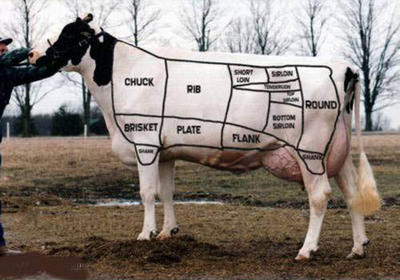
If an animal is discovered to be sick, “we can track that animal all the way back, through every herd that it’s been in, through any sale yard it’s been cow-meatthrough, back to the farm of origin,” said Steve Halstead, Michigan’s state veterinarian.

“There’s a large number of people that would like to know where their food comes from, just understand that better,” says Daniel Buskirk, an expert on the beef industry at Michigan State University.

He’s using the university’s own herd of cattle to experiment with ways to track those animals and then make information about them available to shoppers in the store.

“This is one way that we can hopefully kind of connect the story of how this food is being produced with the consumers who are consuming it,” Buskirk says.

Last year, when 72 of the university’s steers went to the slaughterhouse, Buskirk set up a system that transferred the identity of each animal from its electronic ID tag to a new set of tags — little square bar codes.

Those bar codes were pinned to the carcass. And as butchers went to work on it, cutting it into smaller pieces, they used a little handheld device to scan that first bar code and print new ones for each new cut of meat. In this case, the meat just went to the university’s food service, not a grocery store.

But the same system eventually could produce a label that would go on a package of meat in the store. “Then if you have a smartphone,” Buskirk says, “I can scan that two-dimensional bar code, and it will give information about the origin of that beef.”

In the case of the meat that went to Michigan’s food service, it showed an aerial picture of the farm. But in theory, the label could link to any qr.code.rest.inspection.gradeinformation at all. It could tell consumers “what goes on at the farm, how the animals might be cared for, how they might be fed,” Buskirk says.

Even better, microbial food safety data and interventions used to reduce the risk of dangerous pathogens.

Technology is also changing the business of restaurant inspection disclosure

Government Technology reports that a new national open data standard, called the Local Inspector Value-Entry Specification, was created. To enable any city to voluntarily share restaurant inspection scores on Yelp or other websites to make that data more transparent.


On the mobile app front, Sacramento County, Calif., and other municipalities are releasing smartphone apps that will make looking up inspection scores easier.


Launched in late 2011, the Sacramento County Food Facilities Inspections app shows a person’s current location in the county and nearby retail food facilities, which are marked on a map and on a list. The color of the markers on the map indicate the most recent food inspection result, inspection date and links to more detailed information.

Food inspection data refreshes daily and is complete for all food facilities in the county, including restaurants, bars, grocery stories, convenience stores, school cafeterias and most facilities that dispense food to the public.