Plan to reduce pig pollution by potty training

Environmental authorities in Taiwan say they are planning to promote potty training for pigs to help curb water and waste pollution.

The Environmental Protection Administration made the pledge following the success of a pig farm in southern Taiwan, where the breeder started to potty-train his 10,000 pigs in late 2009, it said.

To keep his animals from defecating in nearby rivers, the breeder has established special "toilets" smeared with faeces and urine to attract the pigs, it said.

This reduced the amount of waste water by up to 80 per cent. As well as making the farm cleaner and less smelly, it also helped reduce illness among the pigs and boosted their fertility by 20 per cent, it added.

Taiwan has about six million pigs, most of them raised on farms in the centre and the south of the island.

Restaurant inspection page a boon to dining public

Eric Lewis, a reporter with the Times & Transcript in New Brunswick (that’s in Canada), writes in this opinion piece:

Any time I hear of a restaurant shut down for health violations, I can’t wait to read what they did wrong so I can gauge whether or not I want to ever try go there in the first place or go back if I’ve been there already. Luckily, none of the places I frequent have violated any major rules or been shut down, far as I can recall.

Just prior to Christmas, it was reported that one local restaurant had been fined for continuing to serve customers after a health inspector ordered it closed, violating the Food Premises Regulation of the Public Health Act.

The restaurant in question has since passed another inspection and all previous non-compliances have been corrected, which is great. Accidents happen, mistakes can be made but – especially in an area such as food preparation – they absolutely must be corrected.

I worked for a few years as a teen in a fast-food restaurant. Say what you will about the ‘quality’ of food you get in most fast-food places, but they have to follow the same regulations other restaurants do.

I remember well having to store food a certain number of inches off the floor, having to check temperatures of coolers and warmers and having to wash your hands so frequently that your hands nearly screamed for a bit of moisturizer by the end of the shift.

I’m a big fan of the provincial Department of Health’s restaurant inspection page it launched a few years ago.

Located at http://www1.gnb.ca/0601/fseinspectresults.asp , the site allows anyone to view the results of the most recent inspections completed for every restaurant in the province. Any violations, major or minor, are right there for you to read all about. Restaurants are rated using a colour-coded system that gives you an idea how they’re faring.

Green means the restaurant has a high standard of compliance with no more than five minor violations. There are five levels in total, with a solid red meaning a restaurant’s licence has been revoked for non-compliance.

It’s an interesting tool. Upon a quick search this week, it appears most restaurants in the province are green, while there are a few yellows and the odd restaurant in the red.
 

Grocery store caught giving fish new best-before date in BC

CTV News reports that during an early morning undercover visit to the Real Canadian Superstore at 3000 Lougheed Highway in Coquitlam, British Columbia (that’s in Canada) a CTV News camera captured footage of an employee in the fish section selecting salmon steaks from the display and putting them behind the counter, where she wrapped them in new plastic.

But the fish didn’t just get a new wrapper — it also received a new label. Minutes earlier, the salmon had been displayed with a best-before date of Dec. 5, but when it was re-wrapped, the new best-before date was Dec. 9.

On Dec. 8 — one day before the new best-before date — CTV News took the salmon to Kevin Allen (left, exactly as shown, on a different network), a microbiologist at the University of B.C. The verdict was already clear.

"That meat is unquestionably spoiled. The smell is quite strong and rather unpleasant," he said.

Allen warns that what the store has done could allow dangerous pathogens more time to grow.

"As a consumer and a food microbiologist, this isn’t what we want to see," he said. "Without doubt, at this point, in my opinion, this is meat that shouldn’t be consumed."

Superstore declined an interview, but issued a statement explaining their policy is: "that when modification to packaging is required the original best-before dates are maintained. We have reinforced this policy with the pertinent store…. We apologize if there is any concern on the part of our customers."

Other grocery stores in Metro Vancouver told CTV News they don’t re-wrap food or change the best-before date.

A video is available at http://www.ctvbc.ctv.ca/servlet/an/local/CTVNews/20110104/bc_fishy_fish_110104/20110104?hub=BritishColumbiaHome
but it doesn’t seem to be working at the moment.

Will fewer people barf after Obama signs food safety bill? No

Maybe? Who knows? But with all the gushing —"The Food Safety Modernization Act is the most significant food safety law of the past 100 years" – Debora MacKenzie of New Scientist presents me as food safety grump.

It’s accurate.

Margaret Hamburg, head of the FDA, said at a press conference on 3 January that the law will shift the FDA’s approach to food safety "from a reactive to a preventive mode", regardless of funding.

Didn’t that happen years ago?

On 15 December the US Centers for Disease Control and Prevention issued its first estimate since 1999 of the toll of food-borne diseases in the US: 48 million people sick each year, 128,000 hospitalized and 3000 deaths.

This is down from 5,000 deaths in 1999, but it could be even lower if the FDA inspected food producers more often, says Michael Jacobson, head of the Center for Science in the Public Interest, a food-safety pressure group in Washington DC. The FDA, which regulates all foods except meat and eggs in the US, normally inspects producers once every five or 10 years.

The new law gives the FDA more inspectors and mandates more inspections. It also requires producers to have written risk-management plans, requires importers to check the safety of imported products, and excludes foreign producers who refuse FDA inspections. In a food-poisoning emergency it gives the FDA power to inspect producers’ records and to order a recall if a producer refuses to do it voluntarily.

The last measure "is a red herring", says Powell: faced with a public relations disaster, no producer ever refuses to recall suspect food.

The bill gives the FDA the money to do its extra inspections by allowing it to charge for them. The expected bill, $1.4 billion over five years, is far less, the FDA argues, than the cost of poisoning incidents to the food industry.

The most effective way forward, Powell believes, is to make producers list safety procedures and track records on food packaging, and compete for buyers on the basis of safety.

Study looks at enhancing food safety culture to reduce foodborne illness

If providing safe food is a priority, why do large outbreaks of foodborne illness keep happening? Incidents like 2010’s salmonella-in-eggs outbreak sickened more than 1,900 across the U.S. and led to the recall of 500 million eggs.

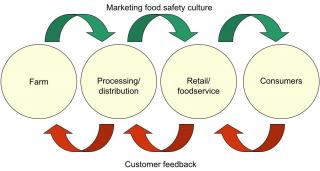
A new study by a Kansas State University professor and colleagues finds how the culture of food safety is practiced within an organization can be a significant risk factor in foodborne illness.

Doug Powell, associate professor of food safety at K-State, said how businesses and organizations operate above and beyond minimal food safety regulations and inspections, or their food safety culture, is often overlooked.

"You’d think making customers sick is bad for business, yet some firms go out of their way to ignore food safety," Powell said. "Some places are motivated by money and efficiencies. The amount of regulation, inspection and audits just doesn’t seem to matter. And those ‘Employees Must Wash Hands’ signs don’t really work."

Powell, along with Casey Jacob, a former K-State research assistant, and Ben Chapman, an assistant professor at North Carolina State University, examined three food safety failures: an E. coli O157:H7 outbreak in Wales in 2005 that sickened 157 and killed one; a listeria outbreak in Canada in 2008 that sickened 57 and killed 23; and a salmonella outbreak in the U.S. in 2009 linked to peanut paste that killed nine and sickened 691.

Their study "Enhancing Food Safety Culture to Reduce Rates of Foodborne Illness" is being published by the journal Food Control and is available in advance online at http://bit.ly/hDh9EE.

"Creating a culture of food safety requires application of the best science with the best management and communication systems," Chapman said. "Operators should know the risks associated with their products, how to manage them, and most important, how to communicate with and compel their staff to employ good practices — it’s a package deal."

According to the researchers, individuals focusing on food safety risks within an organization with a good food safety culture do the following:

* know the risks associated with the foods they handle and how those should be managed;

* dedicate resources to evaluate supplier practices;

* stay up-to-date on emerging food safety issues;

* foster a value system within the organization that focuses on avoiding illnesses;

* communicate compelling and relevant messages about risk reduction activities, and empower others to put them into practice;

* promote effective food safety systems before an incident occurs; and,

• don’t blame customers, including commercial buyers and consumers, when illnesses are linked to their products.

Source: Doug Powell, 785-317-0560, dpowell@k-state.edu

Seek and ye shall find salmonella in sprouts

I don’t know why Jimmy John’s continues to serve raw sprouts on its sandwiches, continues to make people sick, and continues to get sued.

The Oregon Department of Human Services reported yesterday that clover sprouts produced by Sprouters Northwest, Inc. of Kent, Wash. have been fingered as the source of a separate salmonella outbreak that has sickened three in Oregon and four in Washington. Reported illnesses began between Dec. 4 and Dec. 17. No hospitalizations or deaths have been reported.

The Oregonian reports the Northwest sprout outbreak dates to Dec. 4 when a woman in Bend was sickened by salmonella. In a routine food survey, she told Deschutes County health authorities she had eaten sprouts from Jimmy John’s.

In the past two years, the sandwich chain has been linked to four sprout outbreaks, including one at the end of 2010. Nearly 100 people were sickened by alfalfa sprouts sold by Jimmy John’s in the Midwest.

But the Jimmy John’s store in Bend only uses clover sprouts from Sprouters Northwest, and that company was not implicated in the Midwest outbreak.

Initially, the woman appeared to be a solitary case. Then on Dec. 17, a 3-year-old boy in Bend got sick after munching on a sandwich from Jimmy John’s.

That prompted William E. Keene, a senior epidemiologist at Oregon Public Health Division and his colleagues to whirl into action. They contacted the FDA and Washington state authorities, which in turn found four more cases linked to Sprouters Northwest clover sprouts.

Then on Monday, Keene learned that a woman in Multnomah County had been sickened, hours after the recall was announced.

Keene was quoted as saying, “This is at least the 13th sprout-caused outbreak that has sickened Oregonians since 1995, when we first started warning consumers about the risks of eating sprouts. Anyone concerned about foodborne disease should consider this before eating sprouts.”

This is the fourth time since 1997 that Sprouters Northwest sprouts have been cited as a source of salmonella contamination, Keene said.

Sprouters Northwest owner Bill Jones said Monday the brand is widely sold in major retail chains, including Albertsons and Safeway.

So I’m sure Albertson’s and Safeway will be forthcoming with the food safety audit reports of Sprouters Northwest as a supplier, to convince consumers that food safety is job one.

Said Keene, "This is a food to avoid. If you’re concerned about getting sick, I wouldn’t eat sprouts."

The original table of North American raw sprout-related outbreaks is available at:
http://bites.ksu.edu/sprout-associated-outbreaks-north-america-1990-2009

Who didn’t wash their hands while preparing communion in NY?

Hepatitis A is one of those human-only diseases that spreads when virus particles are shed in poop, and get into dirty water, or onto hands that are not effectively washed.

Health officials on Long Island say hundreds of people may have been exposed to hepatitis A while receiving communion on Christmas Day.

The Nassau County Health Department said Monday that anyone who received communion at either the 10:30 a.m. or noon Masses at Our Lady of Lourdes Church in Massapequa Park on Dec. 25 may have been exposed.

A spokesman declined to provide details, citing privacy concerns.

Salmonella and sprouts again – but just a few sickies

Clover and clover mix products from Sprouters Northwest Inc. of Kent, Wash., have been recalled because they have the potential to be contaminated with salmonella. The company reports that a few cases of salmonella might be linked to sprouts.

Is that like saying monkeys might fly out of my butt? Sprouters Northwest does offer this mission statement on its website:

“To provide our customers and the public with the freshest, healthiest, and best tasting sprouts available. We pride ourselves in the quality of our product while strictly adhering to all local, state, and federal regulations and guidelines.”

And only a few will get salmonella.

This is the problem with setting standards with everything. The growers say, “we meet all stringent standards,” without bothering to go above and beyond. Ford may have once said the Pinto met all federal standards.

The recall includes the following products, all with a "best by" date of 1/16/11 and earlier:
—4 oz. (UPC 8 15098 00201 6) and 5 oz. (UPC 0 33383 70235 3) containers of Clover sprouts.
—1-lb. bags of Clover (UPC 0 79566 12351 5), and 2-lb. trays of Clover (UPC 0 79566 12362 1).
—Clover Onion sprouts in 4 oz. (UPC 0 79566 12361 4) and 5 oz. (UPC 0 79566 12361 4) containers.
—Deli sprouts in 4 oz. (UPC 8 79566 12305 4) and 5 oz. (UPC 0 33383 70267 4) containers.
—Spicy sprouts in 4 oz. (UPC 8 15098 00202 3) containers.
—Brocco sandwich sprouts in 4 oz. (UPC 8 15098 00028 9) containers.
For more information: Call the company at 253-872-0577.


6 killed, 5 injured by New Year mochi rice cakes in Tokyo

Apparently it’s a choking thing.

Six people have choked to death and five others are in a serious condition after eating traditional glutinous "mochi" rice cakes to celebrate the New Year in Tokyo.

The victims, in their 70s or older, died of suffocation over the weekend after eating the New Year delicacy, fire department officials said today.

During the New Year period, one of Japan’s biggest holidays, families traditionally cook "ozouni" soup and put the sticky rice cakes in the vegetable broth.

"Please be aware that mochi, which is so sticky, may cause suffocation if you swallow mochi without chewing it well," the fire department said.

It is advising people, especially the elderly and infants – several of whom die each year from choking on mochi – to cut it into small pieces before eating it.
 

Farms closed, 8,000 layers slaughtered in Germany over heightened dioxin levels in eggs

The discovery of animal feed laced with dioxin has forced the closure of countless farms and the slaughter of at least 8,000 egg-laying chickens, as German officials on Monday reacted to a widening agriculture scandal.

The state of Lower Saxony said it would temporarily quarantine 1,000 farms with egg hens, pigs and turkeys until the Agricultural Ministry could ensure their products were safe for consumption.

Gert Hahne, a ministry spokesman in Hannover, said

“We’re shutting everything down first. Consumer protection takes priority.”

The toxic substance, first found last month, is thought to have made its way to Germany’s farms via feed contaminated by a fatty acids mixture from a Dutch distributor.

The animals in the county of Soest will be burned, according to local veterinarian Wilfriend Hopp. He estimated 120,000 eggs contaminated with dioxin had already been sold to the public.

“We’re getting several thousand back from retailers,” he said.

North German animal feed manufacturer Harles & Jentzsch said a Dutch supplier had delivered contaminated fat, which in turn had emanated from a bio-diesel plant run by Petrotech AG in Germany.

Petrotech AG produce the plant-based fatty acid as a by-product in the manufacture of bio-diesel from palm, soya and rapeseed oil. The corporation refused to comment.

Last year, we published case studies examining two incidents of dioxin contamination of food in Belgium and the Republic of Ireland in 1999 and 2008, respectively. In both cases, dioxins reached the food supply through the contamination of fat used for animal feed. The food and agricultural industries connected to each incident relied on crisis management activities of federal governments to limit adverse public reaction.

In 1999, the Belgian government delayed communicating with the public and other European agencies about possible risks, failed to acknowledge perceived risks with dioxin-laden feed, and ultimately suffered huge economic losses, a damaged food industry and deterioration in public confidence.

In the winter of 2008, the Republic of Ireland faced a similar dioxin-in-animal-feed crisis and, unlike the Belgian response, promptly communicated with the public, and acknowledged perceived risks by mandating that all pork products released for sale were to carry a special label to indicate they had no association with the potentially contaminated feed.

“Prompt communications with the public, acknowledgement of both real and perceived risks, and control of stigma surrounding a hazardous incident are important factors in effective crisis management,” said me. “The Irish government succeeded by not only saying the right things, but by removing potentially contaminated product from commerce in a timely manner. Actions and words must be consistent to manage any crisis and garner public support.”

Government management of two media-facilitated crises involving dioxin contamination of food

?Public Understanding of Science?

Casey J. Jacob, Corie Lok, Katija Morley, and Douglas A. Powell
?http://pus.sagepub.com/cgi/content/abstract/0963662509355737v1?
Abstract
Incidents become crises through a constant and intense public scrutiny facilitated by the media. Two incidents involving dioxin contamination of food led to crises in Belgium and the Republic of Ireland in 1999 and 2008, respectively. Thought to cause cancer in humans, dioxins reached the food supply in both incidents through the contamination of fat used for animal feed. The food and agricultural industries connected to each incident relied on crisis management activities of federal governments to limit adverse public reaction. Analysis of the management of the two crises by their respective federal governments, and a subsequent review of crisis management literature, led to the development of an effective crisis management model. Such a model, appropriately employed, may insulate industries associated with a crisis against damaged reputations and financial loss.?First published on February 5, 2010?Public Understanding of Science 2010