Micro-pig the new porcine pocket pet

British celebrities Katie Price, Victoria and David Beckham, and Rupert Grint (the Ginge in those terrible Harry Potter movies) have fallen for the charms of the micro-pig, which can sell for thousands of dollars.

But the New Zealand Herald reports parents in Britain have been urged not to buy the miniature porcine pets for Christmas, with the Government set to warn this week that they risk spreading dangerous diseases.
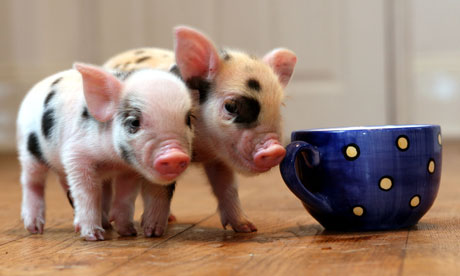
Ministers are so nervous about the craze, which has led to several owners being mis-sold regular piglets which grow into full-size sows, that guidance is to be rushed out next week specifically targeting prospective keepers of the pocket-sized creatures.

The agency responsible for ensuring farm animals are healthy, disease-free and well looked after, will raise serious concerns about the hygiene threat posed by the animals.

It will warn: "Before buying a pig, hobby keepers and owners of pet pigs or ‘micro’ pigs must make sure they are aware of, and understand their obligations, so they can keep their animals fit, healthy and legally compliant and help them to avoid unwittingly spreading disease."

Sick pigs can pass on zoonotic diseases to humans, which can include the skin condition erysipeloid and the bacterium Streptococcus suis, which can lead to illness including meningitis and deafness in humans.

Jim Paice, the British farming minister, said: "A pig is a farm animal, not a pet for Christmas. A micro-pig may sound like a popular gift idea – but beware the pig that grows too big. This year already I’ve heard some interesting stories about micro-pigs becoming bigger and outgrowing their homes. So if you’d like to see pigs this festive season, pop along to your local petting farm."

Just not one of those E. coli petting farms.

If only laws were like sausages

It’s a tired analogy, but given the fantastical failings of the feds to pass the most basic food safety rules, sausage makers are fighting back.

Robert Pear writes in Sunday’s New York Times that, in defending their work, members of Congress love to repeat a quotation attributed to Otto von Bismarck: “If you like laws and sausages, you should never watch either one being made.”

In other words, the legislative process, though messy and sometimes unappetizing, can produce healthy, wholesome results.

But a visit to a sausage factory here, about 10 miles from the Capitol, suggests that Bismarck and today’s politicians are mistaken. In many ways, that quotation is offensive to sausage makers; their process is better controlled and more predictable.

“I’m so insulted when people say that lawmaking is like sausage making,” said Stanley A. Feder, president of Simply Sausage, whose plant here turns out 60,000 pounds of links a year.

“With legislation, you can have hundreds of cooks — members of Congress, lobbyists, federal agency officials, state officials,” Mr. Feder said. “In sausage making, you generally have one person, the wurstmeister, who runs the business and makes the decisions.”

Sausages are produced according to a recipe. And while plenty of pork goes into many sausages and laws, the ingredients of the edible product are specified in advance, carefully measured out and accurately identified on a label. An inspector from the United States Department of Agriculture visits the plant every day.

Granted, Simply Sausage is a small, artisanal sausage maker, not an industrial-scale slaughterhouse. But the comparison is still faulty, said Mr. Feder, a political scientist who took up sausage making after retiring from the Central Intelligence Agency.

The food (safety) cycle: recall, forget, repeat

Memories can be short when it comes to food recalls.

Amy Schoenfeld writes in Sunday’s New York Times that while Americans are concerned about food contamination, experts say that recalls have only a short-term effect on consumers.

When spinach was recalled in 2006, consumers took over a year to return to previous spending patterns. But after recent recalls of peanut butter, beef and eggs, customers came back in a matter of weeks.

One explanation for this is that eggs are a staple; nearly 9 in 10 Americans say they eat them. By contrast, only 5 in 10 Americans say they are spinach eaters. After the spinach recall, 10 percent of spinach eaters said they were unlikely to eat spinach again. In contrast, 3 percent of egg eaters said they would stop purchasing eggs.

Rather than waiting to sue after sickness, consumers could use their buying power to demand microbiologically safer food, if someone would start marketing at retail.

Orlando Magic players sent home with GI virus; player vomits in hallway

In addition to fantasy football and rotisserie baseball, I used to play fantasy basketball. Our league only lasted a year (we made the rules somewhat complicated with daily player substitutions) and there were only 6 of us. When I was playing, info like the below from ESPN would have been awesome to know and maybe would have led to a win for me. Sucks for the Magic players though.

A Magic spokesman said Jameer Nelson and J.J. Redick took a flight back to Orlando before Saturday’s game at Milwaukee because of the illness. Dwight Howard and Mickael Pietrus came back before the team’s game at Detroit on Friday night.

The Magic have won six straight games. They still managed to beat Detroit despite playing short-handed. During a win at Chicago on Wednesday, Pietrus vomited in the hallway at one point in the first half.

If the virus is noro, that hallway vomiting event might have been the tigger for some of the other ill players. And maybe for some Chicago or other visiting teams as well if the vomit wasn’t cleaned up well.

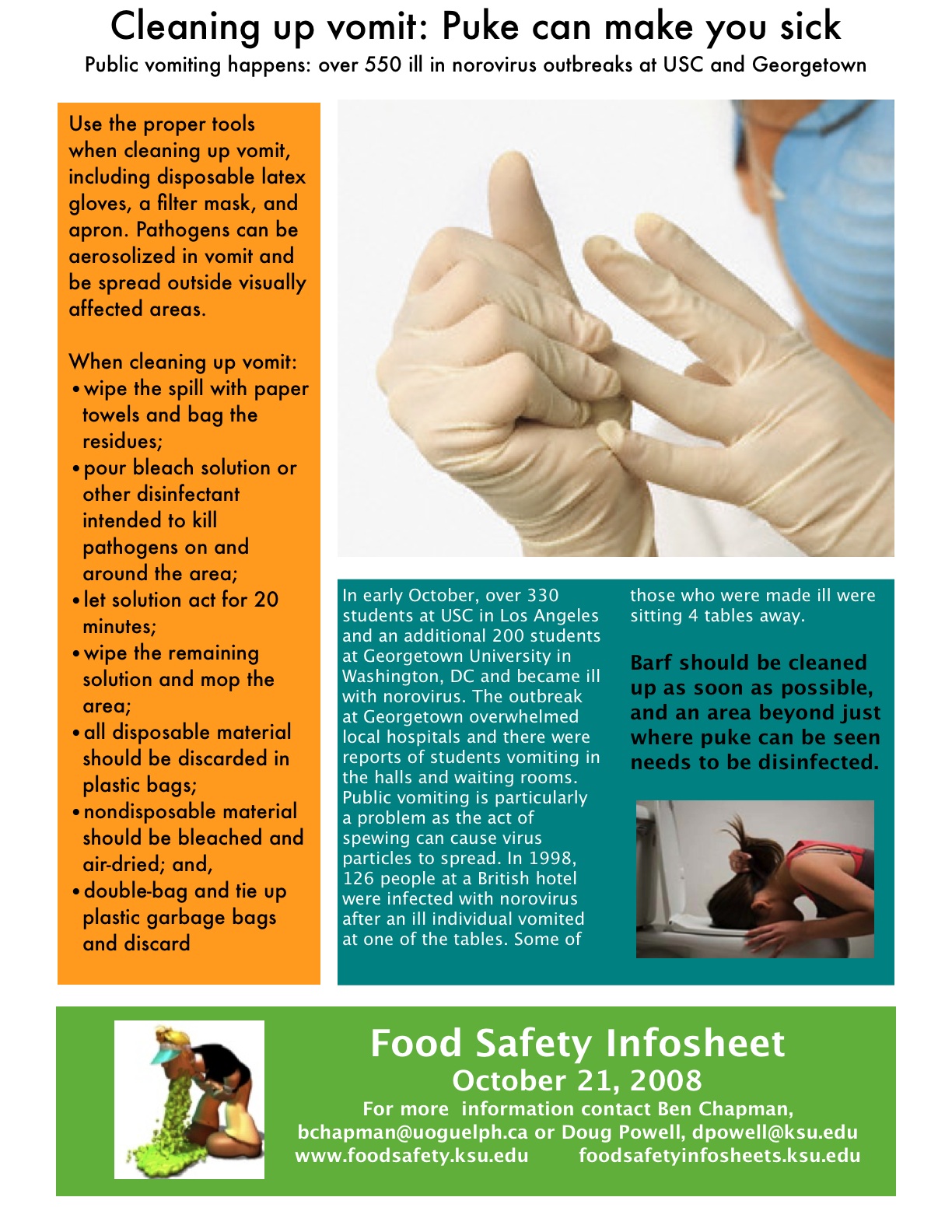
Click here for a cleaning up vomit infosheet.

Holiday Heston still don’t know noro

My friend Roy, who knows a lot more about food safety than I do, lamented on a mailing list for food safety nerds today that food safety doesn’t resonate in Washington, D.C., and doesn’t resonate in the public health community, falling somewhere in importance between “cross-gendered health, and sleep disorders.”

He’s right. Food safety stuff is completely overwhelmed by food porn – like this puff piece in today’s N.Y. Times, which gushes,

“Heston Blumenthal is one of the most forward-thinking chefs in the world.”

So forward thinking that he managed to sicken 529 diners at his flagship Fat Duck restaurant in the U.K., in part by letting sick workers work, spreading things around. And he still hasn’t accepted responsibility.

“For Christmas at home, Blumenthal — no stranger to creating a life-size gingerbread house with praline rose marshmallow bricks and white chocolate mortar — usually cooks goose or a Bresse capon. But for the last two years the family has gone skiing in Courmayeur, Italy. ‘There’s a restaurant near the top of the mountain, where we’ll have a Tuscan roast stuffed turkey dish, spaghetti with white truffle and a bottle of Guado al Tasso — and ski in the afternoon. Just fantastic.’”

That’s nice, but Heston will always be noro-boy to me.
 

Food inspectors: do not grope owners

The Los Angeles Times reports a surveillance tape shows some curious embracing between an L.A. County health inspector and the owner of a Pomona doughnut shop.

The health inspector was charged with misdemeanor sexual battery, but this week, a judge declared a mistrial. According to the San Gabriel Valley Tribune: "Judge David Brougham said the trial could not continue after Deputy District Attorney Lauren Guber failed to give [the inspector’s] defense attorney an audio recording she made during interviews with the alleged victim and her husband."

 It takes about a minute for the groping to begin, but what’s with the repeats?

E. coli O157:H7 survives long past 60 days in manufacture and aging of gouda; more evidence

D’Amico et al., report in the current Journal of Food Protection “that the 60-day aging requirement alone is insufficient to completely eliminate levels of viable E. coli O157:H7 in Gouda or stirred-curd Cheddar cheese manufactured from raw milk contaminated with low levels of this pathogen.”

Bet Costco would have liked to know that before the outbreak linked to Gouda that has sickened at least 37 people in five U.S. states.

The complete abstract is below.

Behavior of Escherichia coli O157:H7 during the manufacture and aging of gouda and stirred-curd cheddar cheeses manufactured from raw milk
01.dec.10
Journal of Food Protection
D’Amico, Dennis J.; Druart, Marc J.; Donnelly, Catherine W.
http://www.ingentaconnect.com/content/iafp/jfp/2010/00000073/00000012/art00009
Abstract:
This study was conducted to examine the fate of Escherichia coli O157:H7 during the manufacture and aging of Gouda and stirred-curd Cheddar cheeses made from raw milk. Cheeses were manufactured from unpasteurized milk experimentally contaminated with one of three strains of E. coli O157:H7 at an approximate population level of 20 CFU/ml. Samples of milk, whey, curd, and cheese were collected for enumeration of bacteria throughout the manufacturing and aging process. Overall, bacterial counts in both cheese types increased almost 10-fold from initial inoculation levels in milk to approximately 145 CFU/g found in cheeses on day 1. From this point, counts dropped significantly over 60 days to mean levels of 25 and 5 CFU/g in Cheddar and Gouda, respectively. Levels of E. coli O157:H7 fell and stayed below 5 CFU/g after an average of 94 and 108 days in Gouda and Cheddar, respectively, yet remained detectable after selective enrichment for more than 270 days in both cheese types. Changes in pathogen levels observed throughout manufacture and aging did not significantly differ by cheese type. In agreement with results of previous studies, our results suggest that the 60-day aging requirement alone is insufficient to completely eliminate levels of viable E. coli O157:H7 in Gouda or stirred-curd Cheddar cheese manufactured from raw milk contaminated with low levels of this pathogen.
 

OMG, Brits recommend time and temp to control campy in chicken liver, piping hot not enough

A month after Eurosurveillance reported on an outbreak of campylobacter associated with chicken liver parfait served in Scotland in June, the U.K. Food Standards Agency is reminding caterers to make sure chicken liver is cooked thoroughly.

Data provided by the Health Protection Agency shows that 11 of the 15 outbreaks of campylobacter recorded this year at catering premises (such as restaurants and hotels) were linked to consuming poultry liver parfait or pâté.

The majority of the outbreaks associated with pâté or parfait, products between 2005 and 2010, have been at catering establishments and involved products prepared on-site as opposed to purchased ready-made.

FSA says that poultry liver carries a high risk of campylobacter contamination if not cooked enough as the bacteria can be present throughout the liver. The Food Standards Agency is therefore reminding caterers to make sure chicken livers are handled hygienically and cooked thoroughly when used in products such as pâté or parfait.

Some recipes indicate that searing chicken liver is enough to kill any bacteria. However, food safety experts at the Agency advise that chicken liver must be cooked all the way through and not just seared. Campylobacter can be present throughout the liver, not just on the surface.

The Agency advises that liver, kidneys, and other types of offal should be handled hygienically to avoid cross-contamination and cooked thoroughly until they are steaming hot all the way through. The centre should reach a temperature of 70°C for two minutes or the equivalent time and temperature.

The equivalent heat treatments are:

* 65°C for 10 minutes
* 70°C for 2 minutes
* 75°C for 30 seconds
* 80°C for 6 seconds.

FSA couldn’t help itself, reverting to old habits by referring to ‘steaming hot,’ but at least they published some times and temperatures. But with all those PhDs, FSA can do better. Recommend using a tip-sensitive digital thermometer, publish pictures showing how to temp a liver parfait, and tell everyone, Stick It In.

Acuff speaks, over and over and over (because it’s on video at bites.ksu.edu)***

Dr. Gary Acuff game a seminar at Kansas State University on Nov. 9, 2010, entitled, The End Game: What is Really Achievable in Pathogen Reduction.

The slides for Acuff’s talk are available at: http://bites.ksu.edu/ksu-seminar

The video is available at: http://bites.ksu.edu/sites/default/files/Gary-Acuff-Guest-Lecture-Nov-2010_0.mp4

Or under the video section on the front page of bites.ksu.edu.

Texas A&M University announced last month that Acuff was going to become director for the Center for Food Safety, and will lead expanded food safety efforts.

Prior to his appointment as Director of the Center for Food Safety, Acuff served as interim head and then head of the department of animal science from 2004 to 2010. And before that he taught undergraduate and graduate level courses and laboratories in food microbiology for 20 years and conducted research on the microbiological quality and safety of foods through his appointment with Texas AgriLife Research.

A past-president of the International Association of Food Protection, Acuff currently is chairman of a 10-member committee for the National Research Council, which evaluates food safety requirements for the Federal Purchase Ground Beef Program.
 

JBS adopts video auditing at US beef plants

In April 2009, Cargill Beef announced it had implemented a third-party video-auditing system that would operate 24 hours a day at its U.S. beef plants to enhance the company’s animal welfare protection systems. All of Cargill’s U.S. plants were expected to have the program in place by the end of 2009.

In Feb. 2010, Cargill announced its expanded remote video auditing program will monitor food-safety procedures within its 10 beef-harvest facilities in North America.

Angie Siemens, Cargill technical services vice president for food safety and quality, said,

“We’re working to eliminate the opportunity for cross-contamination. We want to have the right steps at the beginning of our process to enhance the efficacy of our intervention technologies later in the process. The major objective of the video auditing application is to design a ground-breaking program that can further reduce the E. coli and Salmonella contamination.”

Yesterday, Meatingplace.com reported that JBS USA’s beef division is installing remote video-surveillance camera systems at all of its eight beef plants to enhance food safety, product quality and animal handling.

John Ruby, head of technical services for JBS USA’s beef division, said in a news release the system helped the company improve the accuracy of its auditing within weeks of implementation. JBS uses the system to measure the performance of its workers and give them immediate feedback, ultimately helping to improve its food safety systems.