Water, hands and poop: produce production practices under study in NZ

The New Zealand Food Safety Authority (NZFSA) is conducting a new study into how water and natural fertilisers – such as manures, biosolids and compost – are used by the horticultural industry.

NZFSA specialist advisor Marion Castle says the study will help growers continue to produce safe fruits and vegetables and avoid problems that have hit the fresh produce industry overseas. The study will also look at how contaminants from these sources that might be introduced to fresh produce are currently controlled.

Internationally, outbreaks of foodborne illness have resulted from contaminated irrigation water, contaminated water used to wash fresh produce, improperly treated manures, animals defecating on fresh produce, and poor personal hygiene practices.

NZFSA’s new study will look at organic and conventionally grown fresh produce. It will focus on fresh produce intended to be consumed raw, or as a raw dried or semi-dried product.

In 2009 NZFSA conducted a survey of illness-causing bacteria in fresh ready-to-eat fruit and vegetables at retail. The survey indicated a very low level of contamination in New Zealand produce, and pathogens were only detected in two of 900 samples. Both were Salmonella-contaminated lettuces from the same grower.

Reported produce-related food safety outbreaks in New Zealand are rare. Instances include an outbreak of Hepatitis A associated with raw blueberries in 2002. In 2005 consumption of raw carrots was identified as the probable cause of an outbreak of Salmonella Saintpaul.

As part of this new study NZFSA will be talking with growers about their current practices.

Holiday from hell; barfs from holiday buffet, loses job

Biscuit factory worker Martin Ormiston, 48, went on his first overseas holiday to Tunisia with his partner Janet Horan to celebrate her 60th birthday but fell ill after eating food from the hotel buffet.

He was diagnosed with salmonella, and after a six-week recovery, was dismissed from his job.

The Scotsman reports he is now considering taking legal action against tour company Thomas Cook.

The couple travelled to the four-star Chich Khan Hotel in Yasmine Hammamet in April for the celebration holiday.

He said the couple’s initial impressions of the hotel were good but they grew concerned when they visited the hotel buffet.

Mr Ormiston said: "I saw a cat wandering about, not going into the kitchen but near the buffet, which was a bit unhygienic. I think maybe twice I saw it in the week that we were there.

"Cats can’t be near food like that, especially when the food is uncovered. There were birds coming in and out a couple of times as well."

Mr Ormiston said he had also seen food brought out to replenish the buffet and put straight on top of food that had been sitting out for some time. On his return home, medical staff told him the most likely cause of the salmonella was scrambled egg from the buffet.

Pot-laced candy packaged like Halloween candy

“Halloween is the one night a year when girls can dress like a total slut and no other girls can say anything about it.”

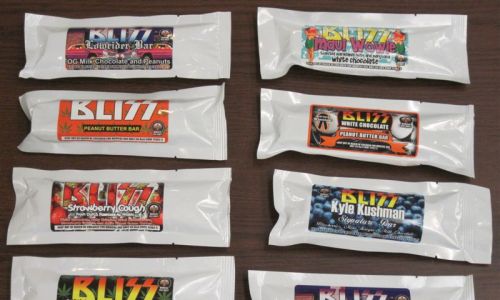
Those words of wisdom from Lindsay Lohan as Cady in the movie Mean Girls ring true, like the warning from the Los Angeles County Sheriff’s Department, which recently identified thousands of illicit edible products have been seized in the form of candies, cookies, cereal snacks, and bottled soda, all containing varying amounts of concentrated tetrahydrocannabinol (THC), the main psychoactive substance found in the marijuana plant. ?

According to the Sheriff’s Department, these items, packaged to resemble licensed commercial candy and snacks, are being produced locally in clandestine labs and residential kitchens. The items are packaged to be attractive to children and teens. Some items have no label to warn the consumer of their content, and many that are labeled do not contain a reasonable indication of drug content, recommended dosage, or instructions for use. Because their makers intend to remain anonymous, no contact information is listed.?

Some of the processes used to extract and concentrate the THC for the manufacture of these items include the use of chemical solvents, such as liquid butane, to extract THC from the plant material. We are concerned that the methods used to extract the drug may also extract any pesticide or fertilizer residue as well, carrying those potentially toxic chemicals into the items. We are currently pursuing additional testing of these items to better determine this possibility.

?Sheriffs Narcotics Detectives found that the places in which these items were manufactured were highly unsanitary, bringing the potential of other health hazards to users as well. It is the intent of the Sheriffs Department to seek and prosecute similar crimes in the Los Angeles area.

Jonathan E. Fielding, MD, MPH, Director of Public Health and Health Officer, said,

“There are too many unknowns regarding the preparation and the amount of marijuana contained in these products. They can be easily mistaken for common foods due to improper labeling and packaging, leading to cases of intoxication from accidental ingestion of ‘pot cookies’ and ‘pot brownies’ that were thought to be ordinary, drug-free snacks. During the coming holiday, we urge parents to carefully screen their children’s treats to ensure that they are properly packaged and labeled, and are from trusted sources.”

Fancy food does not mean safe food, Sydney edition

Sydney’s wealthiest area, Mosman, ranked among the riskiest places to eat in New South Wales according to the Food Authority’s annual report card, obtained by The Sun-Herald.

Overall, cafes, restaurants and takeaway shops in NSW received more than 2000 fines for hygiene offences over the past year.

Although NSW has established Australia’s toughest hygiene compliance regime, one-fifth of the state’s 20,000 registered food sellers continue to put the health of their customers at risk.

The NSW, shows food sellers failed more than 13,000 random inspections. That represents 26.3 per cent of the 50,005 inspections carried out in the 12 months to June 30, with some premises inspected three times or more.

More than 8000 warning letters were sent to restaurants and cafes by 153 local authorities. Improvement notices were sent to 1399 businesses and 2049 penalty notices issued.

The number of court prosecutions more than halved from 48 to 22 in 2009-10.

There are now nearly 1800 businesses on the state government’s ”name and shame” list.

Mosman – where the average annual income is $131,606 – ranks among the poorest for food hygiene.

Primary Industries Minister Steve Whan said he was pleased that fewer businesses had required re-inspection in the past year. The purpose of the report was ”so we can be alerted to where the problems lie and fix them’.’

A ”scores-on-doors” scheme, revealed by The Sun-Herald in April, is being trialled in 20 council areas until Christmas. Participating restaurants display a simple A, B or C rating. It is hoped the prospect of a poor rating will drive owners to maintain high standards of cleanliness.

Honolulu restaurant closes for good after E. coli outbreak

Making people barf can be bad for business.

KITV4 News reports a Korean restaurant that the health department temporarily shut down this spring because of an E. coli bacteria outbreak has closed for good.

Peppa’s Korean Barbeque on King Street closed Friday because its business never returned after bad publicity from an E. coli incident there, according to its owner.

Owner Chong Kim told KITV 4 News the Korean restaurant lost a lot of business after the E. coli outbreak in April, so it had to shut down.

“The people, they stopped coming,” Kim said.

On April 1, the state health department temporarily suspended Peppa’s permit, shutting it down after four people who had eaten there were sickened with E. coli infections.

An investigation found the restaurant’s kitchen staff mixed raw meat with vegetables, which can spread bacteria.
 

Keeping Food Safe from Farm to Table: A report from the American Academy of Microbiology

A new report from the American Academy of Microbiology provides a thorough overview of food safety from farm-to-fork, highlighting the many opportunities for disease-causing organisms and other food safety hazards to enter the food supply.

Global Food Safety: Keeping Food Safe from Farm to Table is based on a colloquium convened by the Academy in 2009, reviews the current state of affairs in microbiological food safety around the world.

An essential take-home message is that most foodborne illness is not recognized or reported. Unless the illness is severe enough to require a visit to the doctor or hospital, it is unlikely that the source and identity of the pathogen will be determined. Only if many people are severely sickened by a single product are breaches in food safety likely to be detected. It is virtually impossible to know how many people are made sick by food, which foods are at fault, which pathogens are most widespread or dangerous, and where those pathogens entered the food production system. In such a situation, where should research, prevention and education efforts be directed?

In this report, each step in our complicated food production and supply system is described, making it clear that providing safe food is a shared responsibility. Food safety is complex, and a perfectly safe food supply is an unrealistic goal. However, as this report explains, there are opportunities for improving food safety at each step of the production and consumption process and many areas where further research could help identify and quantify risks and generate solutions. The report also identifies food safety vulnerabilities that might be addressed through investments in new technologies or more effective education.

Here’s a suggestion: drop the education bit and strive for food safety information that is compelling, based on stories, and is rapid, reliable, repeated and relevant.

The full report is available at
http://academy.asm.org/images/stories/documents/Global_Food_Safety.pdf.
 

New egg safety plans unveiled by industry and government

Philip Brasher of the Des Moines Register reports exclusively this morning that egg producers and government regulators are separately taking steps to improve egg safety in the wake of a nationwide salmonella outbreak that was tied to farms in Iowa.

Producers "want nothing else to happen like what happened in Iowa," said Howard Magwire, vice president of government relations for the United Egg Producers. The trade group is developing safety standards for the industry that would go beyond federal regulations.

Good. Because government sets minimal standards that repeatedly cannot even catch the food safety outliers. Consumers, the ones who buy eggs, and producers, the ones who sell eggs and all suffer during an outbreak, deserve better, and the best way to do that is take charge and stop waiting for Godot or government.

The United Egg Producers is developing industry standards that will mirror the agency’s production rules and go a step further by requiring participating producers to vaccinate all hens against salmonella. Because of contamination that the food agency found in feed at one of the Iowa operations, the producers’ group also is considering writing sanitation standards for feed mills, Magwire said.

The U.S. Food and Drug Administration has announced plans to inspect every major farm in the nation, starting with operations that have had past trouble with government officials, and it is working on coordinating oversight with the U.S. Department of Agriculture. Sixteen inspections had been carried out by midmonth. The agency expects to conduct about 600 inspections in the next 14 months.

Meanwhile, the USDA and FDA have given themselves until Nov. 30 to come up with a plan for training employees to spot food-safety problems, according to a Sept. 15 letter. "It is imperative that field employees are properly educated as to these responsibilities," Agriculture Secretary Tom Vilsack wrote in the letter. Vilsack told The Des Moines Register that the food agency will train USDA egg inspectors to spot problems on egg farms.

About time.
 

A 20-year battle sparked by E. coli; after fighting for life, she died on own terms

Alisha Lewis died in June 2010.

The 22-year-old spent her final week on Earth paying a matter-of-fact visit to a funeral home to pick out a casket, choosing the white lilies that would rest atop it, and setting aside the hoodie and sweatpants she’d wear as mourners said their last goodbyes.

It was abject fear that coursed through her mother’s veins in early June 1990 when she raced to the Alberta Children’s Hospital, her sick twin toddlers crying in their baby seats. The week before, she had stopped at a fast-food drive-thru and picked up fries and a cheeseburger, which she split in two and handed to her daughters in response to their pleading.

Valerie Fortney of the Calgary Herald (that’s in Canada) writes this morning that after being diagnosed with what was then called "hamburger disease" — referred to today as E. coli infection– Alisha and Aimee Lewis became little celebrities in the city.

The Herald ran stories and photos of their plight, and they were featured on several TV news broadcasts, mainly because the girls were said to have possibly contracted the disease from the fast-food establishment, although the Calgary medical examiner at that time expressed concern that the contamination might have occurred outside of the disease’s normal incubation period.

Quickly, though, they slipped from the public eye. But the struggle had only just begun.

While Aimee quickly recovered, Alisha continued to suffer, and later went into complete renal, or kidney, failure.

When she was finally released from hospital six agonizing weeks later, her mother, Amanda Lewis, was told she’d suffered permanent kidney damage and might need a kidney transplant. "They first told me both of them might not make it," recalls Lewis, who not long after the crisis married her partner, Roger McLaren, who with their mom raised her two girls and boys, along with his two boys from a previous relationship.

Alisha later developed diabetic and autonomic neuropathy — a nerve disorder that can cause intense pain — and also had to have a feeding tube installed to keep nutrients in her body after being diagnosed with gastroparesis, a condition that affects the ability of the stomach to empty its contents.

Knowing all of her young life that she wasn’t likely to live to see age 25, Alisha made the difficult decision at the end of 2009 to end treatment. "She was sick of hospitals," says Lewis, "and she was sick and tired of always being sick and tired." Alisha gave up the painful tube feed, and began eating food again, although she often wasn’t strong enough to keep it in.

On June 8, 2010 — almost 20 years to the exact day of her contracting E. coli– Alisha died surrounded by her family, and cradled in the arms of her younger, by 12 minutes, twin sister. Thanks to accelerated osteoporosis and other life-threatening ailments, she was, says her mother, a young woman with the body of an 80-year-old.

Going public: People have a right to know about outbreaks

Some public health types have long argued there is no point in making outbreaks of foodborne illness public – through media disclosure, for example – when the outbreak has passed or the food is gone and there is no on-going threat to public health.

I disagree.

Even if the threat has passed, public discussion of foodborne outbreaks enhances awareness, holds operators accountable, and builds trust and credibility for the investigating outfit (usually the local health department).

Oh, and as I told Jonathon Sher of the London Free Press (that’s in Canada) people have a right to know about events where people got sick.

Sher reports this morning that Londoners were kept in the dark about a viral outbreak at the London Hunt and Country Club after at least 25 people were stricken with suspected norovirus after a Thanksgiving buffet Oct. 11 and at least four more became ill after attending an event for medical residents on the 13th.

Cathie Walker of the Middlesex-London Health Unit said,

“We were notified Oct. 14 by an attendee who was ill.”

Public health officials didn’t reported the outbreaks to the general public and instead relied on the Hunt Club, which had e-mailed a newsletter to its members about the incident, and the organizer of the event for medical residents.

Walker defends the lack of public notification, saying people who didn’t attend the events weren’t at risk and that the private club had taken over the task of notifying those who attended.

“Health Units are loathe to report it because it creates more work but there’s value to reporting and the public has a right to know,” said Doug Powell, an associate professor of food safety at Kansas State University.

In outbreaks such as these the cause is most often a food handler who is already sick, Powell said.

Barbara Kowalcyk, director of food safety for the U.S.-based Center for Foodborne Illness Research & Prevention said, “(A worker) would be the logical place to look.”

While kitchen staff worked at both events and some later reported be stricken with illness, it’s not clear if any of the diners attending both events — health investigators never asked to compare the lists, the Hunt Club says.
The health unit instead interviewed 29 ill people, some who responded to the Hunt Club email and others mentioned by the initial people interviewed. But health investigators didn’t speak to the roughly 370 other people who attended, Walker said.

That’s a significant oversight, said Kowalcyk, who is a statistician completing a doctorate in Environmental Health with a focus in Epidemiology.

“If they don’t even talk to people who weren’t sick, I don’t know how they can say they did an investigation,” she said.

If a sick worker was the source it’s possible he or she doesn’t know it and may be still infecting people, she said.

“(The public) may want to know that,” Kowalcyk said. “I’d think public health official would want that worker not to handle food.”
 

Dirty dining in Vegas: Hot N Juicy Crawfish

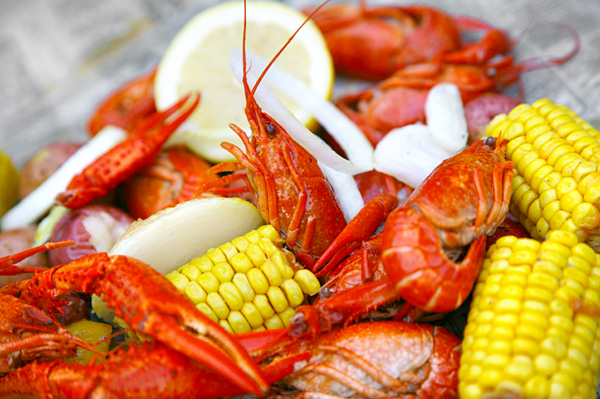
I’m not sure I understand the difference between crayfish and crawfish (wiki gives it a shot) but after posting about vibrio from crayfish, a devoted barfblogger sent this story from Las Vegas about the Hot and Juicy Crawfish.

KTNV reports the Southern Nevada Health District recently paid a visit to the restaurant and slapped it with 49 demerits, prompting its closure.

Inspectors found cooked crawfish being stored at the wrong temperature, live crawfish in a sink next to dirty dishes, dirty floors – including dead crawfish on the floor of a walk-in freezer – and dried food debris caked to shelves and "clean" kitchen knives.

Inspectors also say three employees were working without valid health cards, a requirement for anyone working with or around food, and a kitchen worker was cited for not properly washing his hands after handling the trash.

Open once again with an "A" grade after re-inspection, Channel 13 Action News stopped by Hot and Juicy Crawfish to speak with the manager about the restaurant’s high number of demerits.

An employee interviewed by KTNV — Channel 13 Action News — said the owner was not available but subsequently added, “We’re not the dirtiest restaurant in Las Vegas. It was a lot of little technicalities. “