Stephen Colbert to testify at House hearing on farm labor this morning

Real farming is not like Facebook’s Farmville. It requires work – and a lot of it. Then nerds like me come along and say – hey, while you’re doing that minimum-wage piece work that Americans won’t do, make sure you stay healthy and be aware of all the food safety risks associated with fresh produce.

The Packer reports Stephen Colbert, star of The Colbert Report on Comedy Central, is scheduled to testify at the “Protecting America’s Harvest,” House Judiciary Subcommittee on Immigration, Citizenship, Refugees, Border Security and International Law.

Part II of Colbert’s stint as a farm worker is below.
 

The Colbert Report Mon – Thurs 11:30pm / 10:30c
Fallback Position – Migrant Worker Pt. 2
www.colbertnation.com
Colbert Report Full Episodes 2010 Election Fox News

Food safety auditors can suck: Salmonella-in-egg producer got A-OK from same auditor that OKed salmonella in peanut paste

The same third-party auditor that approved salmonella-tainted peanut paste that killed nine and sickened 600 also gave DeCoster egg operations a “superior” rating and “recognition of achievement” in June 2010, just as thousands of Americans began barfing from salmonella in DeCoster eggs.
Beyond the theatre of yesterday’s House hearing about the salmonella-in-eggs outbreak that has sickened well over 1,600 was the revelation that DeCoster’s Iowa egg operations had been audited by the American Institute of Baking based in Manhattan (Kansas).

The N.Y. Times reports that documents released by the committee showed that Wright County Egg achieved a “superior” rating and “recognition of achievement” from AIB International, a private inspection company based in Manhattan, Kan., after a June inspection of its processing facility. That came just as the company was causing thousands of illnesses from contaminated eggs.

In 2008, AIB gave a “superior” rating to a Peanut Corporation of America plant in Blakely, Ga., that was later found to be riddled with salmonella that caused a nationwide outbreak and the largest food recall in American history. A spokesman for AIB could not be reached.

Elizabeth Weise of USA Today reported today that Wright County Egg, one of the Iowa farms at the center of this summer’s recall of 550 million eggs, earned "superior" ratings for its facilities from a third-party auditor the past three years.

But the auditor was the same one that gave a superior rating to the Peanut Corp. of America, whose shipments were linked to a salmonella outbreak that sickened hundreds a few years ago.

AIB International, of Manhattan, Kan., audited Wright’s egg-packing plant twice in 2008, four times in 2009 and at least once in 2010, and every time found it to be "superior," Rep. Diana DeGette, D-Colo., said during the hearing. … Calls to AIB were not returned Wednesday.

AIB International also gave the Peanut Corp. of America’s Plainview, Texas, plant a "superior" rating. An outbreak of salmonella linked to some peanut products shipped from that plant and another PCA plant in 2007 and 2008 sickened as many as 600 people and may have contributed to nine deaths.

This is beyond embarrassing. It’s criminal.

A Kansas State student wrote in 2009 that after a March 6, 2009 article in the N.Y. Times sorta shattered the myth of third-party food safety audits, he couldn’t get anyone at AIB to talk.

Since the release of the Times article, AIB now requires a minimum of two days or longer to complete an inspection at a food processing facility. AIB has also announced it will change the name of its Good Manufacturing Practices inspection certificates from “Certificate of Achievement” to “Recognition of Achievement.”

Is that like Homer Simpson winning the First Annual Montgomery Burns Award for Outstanding Achievement in the Field of Excellence?

Apparently, the answer is yes, given the salmonella-in-eggs poopfest.

Third-party food audits, like restaurant inspection, are a snapshot in time. Given the international sourcing of ingredients, audits are a requirement, but so is internal food safety intelligence to make sense of audits that are useful and audits that are chicken poop.

The third-party food safety audit scheme that processors and retailers insisted upon is no better than a financial Ponzi scheme. The vast number of facilities and suppliers means audits are required, but people have been replaced by paper.

Audits, inspections, training and systems are no substitute for developing a strong food safety culture, farm-to-fork, and marketing food safety directly to consumers rather than the local/natural/organic hucksterism is a way to further reinforce the food safety culture.

After the salmonella-in-peanut paste crap, Costco, a retail store, which previously limited AIB’s inspections to its bakery vendors, has now instructed suppliers to not use AIB at all.

“The American Institute of Baking is bakery experts,” said R. Craig Wilson, the top safety official at Costco. “But you stick them in a peanut butter plant or in a beef plant, they are stuffed.”

Or as Mansour Samadpour of Seattle said at the time,

“The contributions of third-party audits to food safety is the same as the contribution of mail-order diploma mills to education.”

Who were the buyers of DeCoster eggs who used AIB audits to justify putting salmonella on grocery store shelves? Any retailers want to step forward?

Coincidentally, Enreco Inc., a maker of flaxseed flours, bragged in a press release yesterday they had earned a “superior" rating from a recent AIB inspection at its Wisconsin production facility.

Enreco president Sean Moriarty said, “We are absolutely pleased to have achieved AIB’s highest rating for four consecutive years now, even while incidents of food product recalls in the last two years have caused AIB to toughen their inspections considerably."

Sean, you may want to rethink that PR.

Montana woman fends off bear with zucchini

Finally, a use for all that zucchini rather than dumping it on unsuspecting friends and neighbors.

When a 90-kilogram black bear attacked a Missoula County woman’s dogs just after midnight on Wednesday on the back porch of her home, she tried to separate the animals, and was bit in the leg by the bear.

Lieutenant Rich Maricelli, from the sheriff’s department said the woman reached for the nearest object at hand on the porch’s railing – a large zucchini she had harvested from her garden.

She flung the vegetable at the bear, striking it and forcing it to flee.
 

Staple found in M&M pretzel

Gonzalo Erdozain, a first-year veterinary student at Kansas State University, writes:

You may be familiar with stories about people – or aliens — wearing meat bikinis, chicken heads in McNuggets, flies in soup and even used tampons in food (which makes me want to barf just writing about it), but I have now joined the ranks of the bizarre when I discovered a staple in my Pretzel M&M.

The fact that it was a pretzel inside an M&M was edgy enough, but to my surprise, this one last M&M came with another treat inside, a staple. After chewing on something that at first felt like a plastic strip, I decided it was time to pull it out of my mouth, and to my amusement, and that of my lab mates, it was a regular, metal staple. I would rather take my chances with Salmonella or E. coli that I know I can cook to death rather than bleeding internally to death.
 

Getting more ‘granularity’ into San Francisco’s restaurant grades

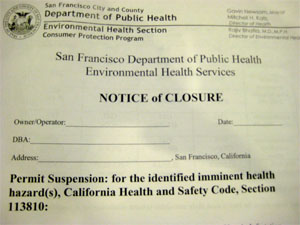
San Francisco is playing catch up with its California brethren and has finally decided to post closure notices on restaurants considered to be health hazards.

Mission Local reports the president of the Health Commission also promised to propose further policy changes to boost restaurant inspections and help diners more easily find a restaurant’s health score.

That don’t mean much.

Dr. Rajiv Bhatia, San Francisco’s director of occupational and environmental health, said,

“We serve the entire population of the city,” underscoring the need for information regarding health code compliance to be made publicly available.

After the meeting, Bhatia said he would advocate for more transparency within the food safety inspection program, including posting inspection scores within five feet of a restaurant’s entrance — which is the policy in cities such as Los Angeles and New York.

In 2004, Supervisor Chris Daly advocated a letter-grade system for restaurant inspections, which Los Angeles and now New York use. The system would have ranked restaurants by a series of letter grades from A to D, based on health code compliance, and would have required them to post that grade in plain view. The executive director of the Golden Gate Restaurant Association at the time called the grades “scarlet letters.”

The ordinance faced stiff opposition and was ultimately defeated. The present scoring system was a compromise resulting from that effort, Bhatia said. The system offers more granularity into a restaurant’s health code practices, he said, but conceded that “scores are imperfect.”
 

Salmonella bareilly in sprouts sickens 83 in UK?

The BBC reports that 68 people in England and 15 people in Scotland tested positive for salmonella bareilly in recent weeks.

The outbreak came to light after routine testing by a salad producer found the bacteria in bean sprouts.

The Food Standards Agency said the outbreak’s source was still unknown.

They have advised that anyone planning to eat bean sprouts should cook them until steaming hot before consumption.

Medical ID in foodservice kitchens: ankle and shoe alternatives

Terri Waller, a Master of Public Administration student at Troy University and a certified food safety manager and instructor, writes in this guest blog:

I come from a long line of diabetics, Type I and II. We hold the importance of medical identification jewelry close to our hearts — literally. Being a foodservice professional and having to wear medical identification jewelry myself, it’s sad that the only piece of jewelry approved to be worn by foodservice professionals working in kitchens is a plain band ring.
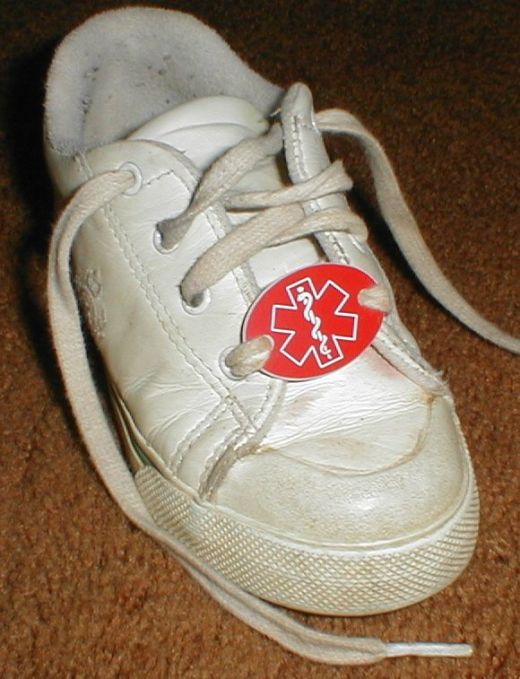
Foodservice professionals (owners, managers and policy makers) should be made aware of alternatives to medical identification wrist bracelets and medical identification necklaces. In a life or death situation it’s more important to me for my colleagues to know that I am diabetic or allergic to penicillin instead of them knowing that I am married or in a committed relationship.

Medical Identification started with military Dog Tags, which evolved into Medical Bracelets. The dog tags were primarily used for the identification of the dead and wounded along with providing essential basic medical information for treatment. During World War I an additional red tag with pertinent information was issued and worn with the dog tags to identify military members with medical conditions that required special attention.

Because foodservice professionals are not able to wear wrist bracelets or necklaces, here are two life-saving alternatives: ankle braclets or shoe tags.

If an individual is unconscious or otherwise unable to communicate, when an Emergency Medical Technicians (EMT) arrives on the scene they are trained to look for medical identification information to communicate to them any vital information when time is crucial. It is important that hiring/HR managers as well as employees are aware of these alternatives because they can be the difference between life and death. EMTs serve as a means for people to get access to medical care in times when they are in most desperate need for it—help them save a life by informing managers and employees on the alternatives.
 

Salmonella in eggs; DeCoster and Son go to DC

There’ll be the usual posturing, handwringing and contrition for the cameras at today’s Congressional hearing in Washington, D.C.

Philip Brasher of the Des Moines Register reports this morning that Jack DeCoster and his son, Peter, will apologize at a House Energy and Commerce subcommittee meeting today to the 1,608 confirmed victims of a salmonella outbreak and pledge not to resume selling fresh eggs until their farms are free from disease.
“While we always believed we were doing the right thing, it is now very clear that we must do more,” said Peter DeCoster, who is chief operating officer of the Wright County Egg operations, which his father owns.

In a 10-page statement obtained by The Des Moines Register, the men point to a feed ingredient purchased from an outside supplier as the likely source of the salmonella contamination. Federal investigators have reported finding salmonella in several areas of the farms in addition to the feed mill.

This is a terrible strategy. Blaming others and failing to outline what DeCoster and Son were actually doing in terms of testing and other steps to manage the risk of salmonella – before the outbreak — will be a rhetorical playground for even the most addle-minded Congressional-types.

It’ll be like angry parents scolding a teenager who says, sorry, I won’t do it again.

The accused is sorry he got caught.

Again.

The N.Y. Times documented this morning the 1987 salmonella-in-eggs outbreak that killed nine and sickened 500, linked to farms owned by … Austin Jack DeCoster.

Farms tied to Mr. DeCoster were a primary source of Salmonella enteritidis in the United States in the 1980s, when some of the first major outbreaks of human illness from the bacteria in eggs occurred, according to health officials and public records. At one point, New York and Maryland regulators believed DeCoster eggs were such a threat that they banned sales of the eggs in their states.

How many others were sickened by DeCoster and Son eggs over the intervening 23 years, in the absence of an outbreak?

Government’s hopeless.

Market microbial food safety at retail so I, as a consumer, have a choice, so I can reward those egg producers who effectively manage salmonella – before there’s an outbreak.
 

Central kitchen leads to 181 sick with salmonella at 16 nurseries in Hungary

A salmonella infection in 16 nurseries and primary schools in Szekesfehervar, central Hungary, has made 181 children ill, a local health authority official told MTI on Tuesday.

The infection was first reported on September 8 and developed sporadically rather than suddenly, said Gyongyi Lencses. "The curve is now on the down-slope," she added.

The affected institutions were all served by the same central kitchen. Three of the kitchen staff tested positively for the bacterium.

Bureaucrats babbling: Health Canada blames consumers

Health Canada said today while telling pregnant women to be especially careful about the 11 million cases of foodborne illness that strike Canadians each year that,

“Many of these illnesses could be prevented by following proper food handling and preparation techniques.”

Please, please, oh please. Show us mortals the data on which that statement is based?

And since Health Canada advises pregnant women to “make sure to cook hot dogs and deli meats until they are steaming hot before eating them,” please, please, oh please, stand up and say the advice provided by the Toronto Hospital for Sick Children Motherrisk program is complete nonsense.