The Winnipeg Regional Health Authority says the majority of 26 confirmed and suspected cases of E. coli have been linked to food eaten at the Russian pavilion of the annual Folklorama multicultural festivals.


The Winnipeg Regional Health Authority says the majority of 26 confirmed and suspected cases of E. coli have been linked to food eaten at the Russian pavilion of the annual Folklorama multicultural festivals.
Audrey Kreske, an N.C. State post-doc writes of a food safety blunder on morning television:
Today’s Today Show featured a segment with Martha Stewart discussing her top 50 tips for creating a kitchen that’s “not only beautiful but functional as well”. Viewers were definitely waiting with pens in their hands to discover the Domestic Diva’s secrets.
Some of the household tips included: how to avoid breaking dishes while washing them; putting liquid soap in easy-to-use decanters; and the essential nature of multiple little dishtowels.
Fascinating.
Then things got weird (see the video below, beginning at 3:55). Martha got a bit wacky with the eggs.
In attempt to show how nice eggs look on the counter as a decoration accessory, the Diva points to eggs in a basket and says, “We’re having a big problem with eggs so everybody better be very careful where their eggs come from. But organically grown eggs from the farm, you can keep out for a few days on the counter”
Matt Lauer, somewhat taken aback by the statement chimed in and asked “Oh really, that’s not a problem?”
Martha said, “Oh, no, no; not if they’re fresh”
The big problem Martha refers to is the over 1300 Salmonella Enteriditis illnesses linked to egg and egg products that have led to a recall of almost half a billion eggs.
The problem that Martha misses is that it doesn’t matter where eggs come from or the production practice, there is still a risk of Salmonella Enteriditis being present. Contamination comes from the environment, humans or rodents; multiplies within the flock; and, an infected hen can result in the pathogen inside the egg (infection occurs in the ovary).What is problematic about the pathogen is that while it may infect a hen or group of hens, it typically does not create any clinical signs. If Salmonella is in an egg sitting on the counter, even if Martha says it’s okay, the bacterium can grow and create a larger issue.
According to a 2005 USDA risk assessment, approximately 1 in 20,000 contains Salmonella; even if they appear to be clean and uncracked.
The best available evidence suggests that eggs should be stored in the refrigerator/cooler and held below 45°F. The U.S FDA recommends buying eggs only if sold from a refrigerator or refrigerated case, checking that the eggs are clean and the shells are not cracked, and, refrigerating promptly to prevent egg-related illness.
Visit msnbc.com for breaking news, world news, and news about the economy
Traducido por Gonzalo Erdozain
 Resumen del folleto informativo mas reciente:
– El brote, que causó cientos de enfermedades, empezó en Mayo y aún sigue vigente.
– Alrededor de 228 millones de huevos han sido retirados del Mercado por Wright County Egg de Galt, Iowa
– El retiro del mercado incluye huevos en sus cáscaras empacadas por Wright County Egg entre el 16 de Mayo y el 13 de Agosto.
– Los huevos pueden contener Salmonella y deben ser cocinados a 145°F por 15 segundos para reducir los riesgos.
– Los huevos deben ser almacenados en la heladera y mantenidos a temperaturas de 45°F
Los folletos informativos son creados semanalmente y puestos en restaurantes, tiendas y granjas, y son usados para entrenar y educar a través del mundo. Si usted quiere proponer un tema o mandar fotos para los folletos, contacte a Ben Chapman a benjamin_chapman@ncsu.edu.
Puede seguir las historias de los folletos informativos y barfblog en twitter
@benjaminchapman y @barfblog.
The companies that have recalled more than half a billion eggs following a salmonella outbreak fell short of safety standards at their farms, U.S. Food and Drug Administration Commissioner Margaret Hamburg told CNN Sunday, adding
"There’s no question these farms involved in the recall were not operating with the standards of practice we consider responsible.”
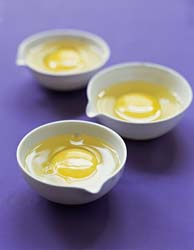 She said "about 1,000" people have been sickened by a salmonella outbreak that federal regulators have traced back to two Iowa egg producers. One of those companies said Sunday it is "devastated" by the possible connection between its product and salmonella.
Hillandale Farms said it shared "a number of common suppliers" with Wright County Egg, including a company called Quality Egg, which provided feed and young birds.
Both Wright County and Quality Egg are owned by the DeCoster family, which has a string of agribusiness interests in the Midwest and Northeast. Those companies’ records have come under new scrutiny since the recalls were announced earlier this month.
The Washington Post reports that in the past 20 years, according to the public record, the DeCoster family operation, one of the 10 largest egg producers in the country, has withstood a string of reprimands, penalties and complaints about its performance in several states.
In June, for instance, the family agreed to pay a $34,675 fine stemming from allegations of animal cruelty against hens in its 5 million-bird Maine facility. An animal rights group used a hidden camera to document hens suffocating in garbage cans, twirled by their necks , kicked into manure pits to drown and hanging by their feet over conveyer belts.
And today’s USA Today reports that to some experts, the huge recall of potentially contaminated eggs is a testament to how the industry has grown from many small producers to large industrial farms.
The problem, many food safety experts say, is that even as eggs moved to a very intense production method with enormous companies and huge flocks, regulation was almost entirely lacking.
In 1999, President Clinton vowed to increase regulation and wipe out the disease in eggs by 2010. Instead, the industry and FDA delayed the creation of the rules, finally written in 2004.
Abby Alford of The Western Mail reports that the effectiveness of a new scheme designed to reduce food poisoning outbreaks has been called into question a month before it is launched.
Sharon Mills, who lost her son Mason Jones during Wales’ largest E.coli O157 outbreak in 2005, said she  feared the food hygiene rating scheme lacked the teeth to make a difference.
And watchdog Consumer Focus Wales told the Western Mail a decision to keep food inspectors’ detailed findings out of the public domain would leave concerned customers with no other option than to request hygiene records under the Freedom of Information Act.
All 22 councils in Wales will begin awarding the country’s 26,000 food retailers, which include pubs, restaurants, hotels, takeaways and supermarkets, a score from 0 to 5 from October 1 (left, pretty much as shown).
The ratings will gradually be made available to the public on a single website from October 1. Businesses will not be forced to display their rating on their premises.
Rob Wilkins, team leader for enforcement at FSA Wales, said details of what inspectors found during their visits and the reasons for awarding a particular score would also be left off the website.
And wholesalers like Bridgend butcher William Tudor, the man responsible for the 2005 outbreak which affected almost 150 South Wales school pupils, will not be rated at all under the scheme because they do not sell directly to the public.
Ms Mills, from Deri, near Bargoed, said while she broadly supported the food hygiene rating scheme, believing 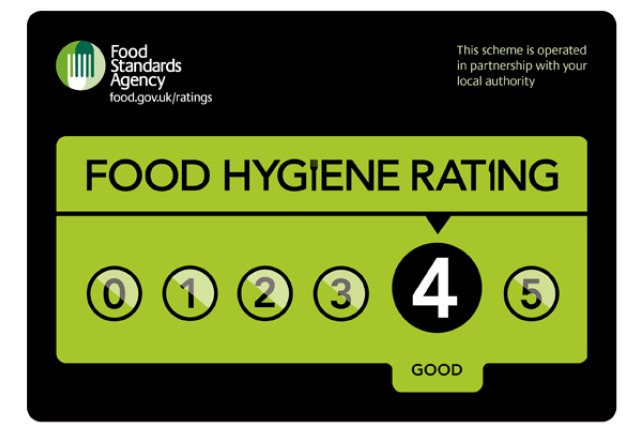 it to be an important step forward, she feared the lack of a mandatory display clause and a lack of detail scuppered any hope it could be truly effective.
“The public has a right to know how clean food retailers are and this scheme does not go far enough. I don’t know why they have chosen to hold back some of the vital information. I don’t really understand how this is going to work.”
Doesn’t make sense to me either. The attempt seems half-hearted and feeble.
New Zealand chef Peta Mathias has been criticized for the flashy jewelry she wears during her TV show, with critics saying the rings and other  jewellery would never be tolerated in a commercial kitchen because of the bacteria that gathers underneath.
Mathias agrees but says: "Hey, it’s for TV."
Food writer and columnist Julie Biuso said people had been talking about Mathias’ rings for years, adding,
"There’s a grubby look about it. It’s an act. She dresses up with all the jewellery … possibly she cooks like that at home. Of course, she’s over the top, she’s way over the top. But people love to criticise. She’s doing it her own way. If you don’t like it, switch off."
Biuso said Mathias would never be allowed to wear her rings while cooking in a commercial kitchen.
AUT senior lecturer in food safety Suzanne Bliss said Mathias’ rings were possibly sending the wrong message to the public and young people in the food industry.
But it was a TV show and, for that reason, hosts had licence to go outside the normal boundaries of food hygiene.
Mathiasen, L.A., Chapman, B.J., Lacroix, B.J. and Powell, D.A. 2004. Spot the mistake: Television cooking shows as a source of food safety information, Food Protection Trends 24(5): 328-334.
Consumers receive information on food preparation from a variety of sources. Numerous studies conducted over the past six years demonstrate that television is one of the primary sources for North Americans. This research reports on an examination and categorization of messages that television food and cooking programs provide to viewers about preparing food safely. During June 2002 and 2003, television food and cooking programs were recorded and reviewed, using a defined list of food safety practices based on criteria established by Food Safety Network researchers. Most surveyed programs were shown on Food Network Canada, a specialty cable channel. On average, 30 percent of the programs viewed were produced in Canada, with the remainder produced in the United States or United Kingdom. Sixty hours of content analysis revealed that the programs contained a total of 916 poor food-handling incidents. When negative food handling behaviors were compared to positive food handling behaviors, it was found that for each positive food handling behavior observed, 13 negative behaviors were observed. Common food safety errors included a lack of hand washing, cross-contamination and time-temperature violations. While television food and cooking programs are an entertainment source, there is an opportunity to improve their content so as to promote safe food handling.
Stephen Budiansky, the author of the blog liberalcurmudgeon.com, writes in the N.Y. Times today that the local food movement now threatens to devolve into another one of those self-indulgent — and self-defeating — do-gooder dogmas.
 Arbitrary rules, without any real scientific basis, are repeated as gospel by “locavores,” celebrity chefs and mainstream environmental organizations. Words like “sustainability” and “food-miles” are thrown around without any clear understanding of the larger picture of energy and land use.
The statistics brandished by local-food advocates to support such doctrinaire assertions are always selective, usually misleading and often bogus. This is particularly the case with respect to the energy costs of transporting food. One popular and oft-repeated statistic is that it takes 36 (sometimes it’s 97) calories of fossil fuel energy to bring one calorie of iceberg lettuce from California to the East Coast. That’s an apples and oranges (or maybe apples and rocks) comparison to begin with, because you can’t eat petroleum or burn iceberg lettuce.
It is also an almost complete misrepresentation of reality, as those numbers reflect the entire energy cost of producing lettuce from seed to dinner table, not just transportation. Studies have shown that whether it’s grown in California or Maine, or whether it’s organic or conventional, about 5,000 calories of energy go into one pound of lettuce. Given how efficient trains and tractor-trailers are, shipping a head of lettuce across the country actually adds next to nothing to the total energy bill.
It takes about a tablespoon of diesel fuel to move one pound of freight 3,000 miles by rail; that works out to about 100 calories of energy. If it goes by truck, it’s about 300 calories, still a negligible amount in the overall picture. (For those checking the calculations at home, these are “large calories,” or kilocalories, the units used for food value.) Overall, transportation accounts for about 14 percent of the total energy consumed by the American food system.
The real energy hog, it turns out, is not industrial agriculture at all, but you and me. Home preparation and storage account for 32 percent of all energy use in our food system, the largest component by far.
Toronto Public Health has identified a case of Hepatitis A in an employee at a Wendy’s restaurant located at 438 Nugget Avenue in Scarborough. Anyone  who consumed food purchased at this restaurant between July 26 and August 6 may have been exposed to the hepatitis A virus. The risk of getting the infection is very low.
Depends on how well the employee washed his or her hands and whether they were prepping salads or other fresh product. Don’t eat poop.
The Urban Dictionary defines beer goggles as the “phenomenon in which one’s consumption of alcohol makes physically unattractive persons appear beautiful.”
 A recent study in the journal Alcohol has found a reason why some of us might find people we normally would consider ugly to be handsome: we stop noticing facial symmetry.
In a new study, scientists went to bars near their university in England and asked students to participate in a small experiment. The students were given a breathalyzer test to determine whether or not they were drunk and then asked to determine which photo in a pair, repeated for 20 pairs, was the more attractive and which was the more symmetrical.
Students who were sober found symmetrical faces more attractive and were able to determine more readily which were the more symmetrical faces. But the drunk students lost both their preference for symmetry and their ability to detect it. Women more readily lost this ability than did men.
Depends on the state, according to Brian Palmer of Slate Magazine.
When police in Western New York pulled over Gary Korkuc for blowing off a stop sign on Sunday, they found a live cat in his trunk, covered in  cooking oil, peppers, and salt. Korkuc told authorities that his pet feline was "possessive, greedy, and wasteful" and that he intended to cook and eat it. Korkuc has been charged with animal cruelty. …
Few states have specific laws barring the use of pets for food. The ones that do typically ban the slaughter or sale of dog and cat meat. The state of New York expressly prohibits "any person to slaughter or butcher domesticated dog (canis familiaris) or domesticated cat (felis catus or domesticus) to create food, meat or meat products for human or animal consumption." It’s not clear whether the eating itself is outlawed or only the butchery. If you managed to buy dog or cat flesh from someone else who broke the anti-slaughter law, you might be OK. The law also doesn’t cover ferrets, gerbils, parakeets, or other less familiar pet species. (Although the general anti-cruelty law might protect exotics.)
California’s anti-pet-eating law has a broader reach. It bars possession of the carcass, so having bought your cat steaks from someone else wouldn’t be a useful alibi. The California law also protects "any animal traditionally or commonly kept as a pet or companion," rather than just Fido and Fluffy. The statute is somewhat untested, though, so no one really knows which animals are included.
Pigs are not, even though they are commonly kept as pets, because they are farm animals. Horses are specifically covered by a different section of the code. There’s no precedent on iguanas, goldfish, or boa constrictors. …
Authorities won’t have any trouble prosecuting Korkuc, the Western New Yorker who was marinating his cat in the trunk. Whether or not he really intended to eat his feline, keeping a companion animal in a motor vehicle without proper ventilation is illegal. Rubbing the cat with chili-infused oil, while not specifically addressed, is also a violation of the state’s general cruelty law, which prohibits torture.