The New York Times reports that since July 28, when the department rolled out its new letter-grade rating system, 48 percent of the 250 restaurants that have had an initial inspection and, when needed, a re-inspection, have earned an A grade.
Another 31 percent earned B grades. The C rating was given to 12 percent of restaurants, and 8 percent were closed until they could correct health hazards that would endanger the public.
Since the end of July, 1,825 food establishments in the five boroughs have received an initial inspection, the department said, but many have not completed the two-stage process.
Any restaurant not receiving an A gets a mandatory follow-up inspection within two to three weeks. If the grade still falls short of an A, the restaurant can challenge the grade at an administrative tribunal, but must prominently post a “grade pending” sign until the challenge is resolved.
Associated Press reports a California man who says he ordered French onion soup and bit into a condom instead of melted cheese has settled his lawsuit against the Claim Jumper restaurant chain.
The terms of today’s settlement were not disclosed.
Both sides say in a statement the deal indicates no admission of liability by either party.
Headline writers across the U.S. have been increasing their egg-related pun usage as coverage continues. According to headlines, many seem to be scrambling (yes, most had the same joke).
Here are some of the select words over the past 24 hours.
Foodservice reactions (from AP): "If someone asks for eggs over-easy, what do you do, put a skull and crossbones on their table?" said Louis Tricoli, who owns three Wisconsin restaurants with his family, including one where nearly two dozen people were sickened in late June after likely eating the now-recalled eggs. "Undercooked beef, undercooked pork, chicken, eggs, anything you ask to be undercooked, it’s at your own risk."
At Atlanta’s West Egg Cafe, business was brisk last weekend when customers chowed through nearly 2,900 eggs over the course of three days. Still, some diners made sure to ask whether the eggs were safe, said Chef Patric Bell. The restaurant’s eggs weren’t affected by the recall and he said so far no one was changing their breakfast orders. "If I couldn’t get eggs that were safe, I wouldn’t serve them at all," he said.
Safe is like a guarantee of risk-free, and raw/undercooked eggs are not — data shows that Salmonella Enteriditis is in or on 1 in 20,000 eggs in the U.S.. There is always a risk.
The harmful bacteria typically contaminate one out of every 10,000 to 20,000 eggs. That risk is always there for people who like eggs that aren’t cooked until the yolks are solid, said Benjamin Chapman, an assistant professor specializing in food safety at North Carolina State University. "It’s difficult to say if the risk is any different than it was two weeks ago or two years ago."
Food safety decisions are based on risk/benefit trade offs; and safety means a lot of things to folks (from AP):
The recall isn’t enough to scare off Charles Mettler, who ordered an eggs Benedict on Tuesday when he stopped by Drake Diner’s in Des Moines, Iowa. "I’m probably more worried about the Hollandaise sauce as far as cholesterol." Mettler said.
Risks aren’t just from undercooking or temperature abuse– cross-contamination is also a potential route to contaminate non-egg containing dishes (from the syndicated HealthDay):
During food preparation, take precautions by thoroughly washing your hands, countertops and utensils after handling raw eggs. "When you crack an egg, a little egg juice will usually get on your hands or countertop. You want to make sure you’ve washed that before you accidentally lay your toast on it," Chapman said.
An example of a restaurant operator evaluating risk/benefit of using eggs that were included in the recall, even with control measures such as cooking (from AP):
When Peggy Bevan, owner of the Egg Shell of Cherry Creek breakfast cafe in Denver , learned that the egg recall had expanded to Colorado, it was time to clear the decks. "We dumped everything we had prepped, from pancakes to French toast batters," she said. "We didn’t take a chance."
When John Lennon heard in 1967 that one of his former schools was making students deconstruct the lyrics to songs by the Beatles, he responded by writing the most nonsensical song he could come up with, combining the lyrics of 3 previously unfinished songs – two written on acid trips – and stated at the time about the result, I Am the Walrus, “Let the fu**ers work that one out.”
The Eggman in the song apparently referred to The Animals lead singer, Eric Burdon, who had a fondness for breaking eggs over the bodies of naked women.
This trivia is as useful as most of the information surrounding the salmonella-in-eggs outbreak that has sickened a thousand Americans.
There are hints of information but most public commenters are using the outbreak for political or legal opportunism.
Today’s USA Today reports that state and federal health agencies identified an Iowa egg company as a likely source of illness at least two weeks before the firm launched a massive egg recall Aug. 13 and the public got its first hint of a growing national salmonella outbreak.
In late July, the Centers for Disease Control and Prevention even considered reminding the public generally about the dangers of eating undercooked eggs, said Ian Williams, chief of the agency’s outbreak response branch. The CDC decided it would be more effective to wait until the Food and Drug Administration (FDA) completed its investigation of the firm, Wright County Egg in Galt, Iowa.
By late July, the California and Minnesota state health departments had identified several small restaurant outbreaks of salmonella with eggs as a likely culprit — and Wright County Egg as a common supplier, Williams said.
The FDA didn’t contact Wright County Egg until Aug. 10 and didn’t provide detailed information until Aug. 12, company spokeswoman Hinda Mitchell said. The recall decision was made after discussion with FDA officials the next morning, she said.
Jeff Farrar, FDA associate commissioner for food protection, said Wednesday that his agency was aware of the states’ findings in late July but needed to obtain detailed copies of invoices and other paperwork to further confirm that Wright County Egg was the supplier.
CNN also reports this morning the state of California believes it has identified its earliest cases related to the salmonella recall, and says its investigation helped tip off the rest of the country to the source of the problem.
On May 28 and 29, several people became sick after attending either a prom or a graduation party in Clara County, according to Joy Alexiou, a spokeswoman for the Santa Clara County Public Health Department. Tests on some of the victims, including a catering worker who nibbled on the food, determined that the culprit was salmonella, she said.
Three months later the state is bragging?
Sherri McGarry, a director at the F.D.A.’s Center for Food Safety and Applied Nutrition, told the N.Y. Times last week the Hillandale recall was prompted when Minnesota officials traced a cluster of illnesses in that state to the eggs from the company’s Iowa plants.
Doug Schultz, a spokesman for the Minnesota health department, said seven people had become ill with salmonella in mid-May after eating chile rellenos at a Mexican restaurant called Mi Rancho in Bemidji, Minn. He said that investigators established a connection to Hillandale eggs on May 24.
It was not clear why the F.D.A. did not act on the information sooner.
Why didn’t Minnesota go public if it had information that could limit future illnesses?
FDA and other federal agencies do themselves a tremendous disservice by failing to clearly articulate how and when the public (and industry) should be informed about potential health risks. No amount of federal legislation or lawsuits will fix this. Instead it requires a recommitment to having fewer people barf. And any company that wants to lead – especially with profits – will stop hiding behind the cloak of government inspection and will make test results public, market food safety at retail so consumers can choose, and if people get sick from your product, will be the first to tell the public.
The Wall Street Journal reports that the popularity of cooking shows, the eat-local movement and the growth of casual-dining restaurants are reshaping consumers’ views of what makes food look appealing. Where making food look perfect was once a primary task of food stylists and photographers, the new challenge is making messy food look appetizing.
Alison Attenborough, a New York-based food stylist who specializes in editorial work for clients, says, "People are interested in small butchers, artisan producers, farmer’s markets—a more handmade look."
At a recent Food & Wine photo shoot, Ms. Attenborough was making recipes by celebrity chef Tyler Florence for the magazine’s October issue. She carefully assembled a cheeseburger so that the bacon and red onions would look like they were erupting from the bun. With a heat gun, she melted the cheese to make a corner of the slice dribble down. For a scallop appetizer, Ms. Attenborough intentionally left one fleck of parsley on the table, as if the cook had just finished applying the garnish and hadn’t bothered to clean up.
Whether for editorial or advertising purposes, the point of making natural food look appealing is to get people to buy the product, go out to eat or make a recipe.
Brian Wansink, director of the Food and Brand Lab at Cornell University, says the effectiveness of the natural trend lies in its ability to invite the viewer in. "It might enable us more to put ourselves in the picture," he says.
CNBC reports that experts have some simple advice when it comes to eating runny eggs these days: Run away.
With salmonella concerns triggering the recall of more than a half-billion eggs in more than a dozen states, warnings are becoming more dire every day against eating undercooked yolks and translucent egg whites.
But what’s a home cook to do, especially when hit by cravings for eggs Benedict, pasta carbonara, homemade Caesar dressing or other dishes that call for raw or only slightly cooked eggs?
Drinking raw eggs for a protein boost? Even worse idea, given the risk of salmonella and its violent nausea, vomiting, abdominal pain and temporary residency in the bathroom.
"We’ve got enough issues. Who needs to be barfing because of raw eggs?" asked Douglas Powell, an associate professor of food safety at Kansas State University and author of BarfBlog.com, which highlights food-handling problems in the news and in popular culture.
He advises cooks to use a food thermometer in their frittatas, quiches and other egg dishes — and, in fact, when preparing meat or anything that poses dangers when undercooked.
Paul Stern, who cooks for the Hole in the Wall Gang Camp, an Ashford, Conn., camp for seriously ill children, many with compromised immune systems, said this year, the camp switched (before the recall) to pasteurized liquid egg product.
"I wouldn’t be consuming or serving raw eggs any more than I’d be eating or serving raw chicken."
Today, they put aside the pretentions and said this is why you should pay more – for crap.
“Well, our turkey standards prohibit animal by-products in feed and require space for normal turkey behavior. So isn’t it worth it that when a turkey is raised with these standards its meat costs more?”
I’m interested in turkey that doesn’t make me barf. Can you provide that?
Seeduction bread or whole wheat sandwich bread made without artificial dough conditioners and preservatives is about 14¢ more per sandwich compared to leading conventional brand whole wheat sandwich bread.
I’m a fan of chemistry, Is Whole Foods a fan of witchcraft?
Organic Mustard (and I have no idea why the ingredients are capitalized, must be that unique Whole Foods writing style) helps you avoid exposure to pesticides with your sandwich and is less than 2¢ more per serving.
Organic is a production standard that has huge tolerances for synthetic chemicals and any kind of so-called natural chemicals.
Organic Lettuce is another good choice for your health and that of the planet and costs about $1.00 more per head.
Why? Is it safer? No. Do the production methods extract less of a toll on the soil? No.
Tomatoes taste best (and have more nutrients) when they are picked ripe, so look for local and in season, as well as organic. Local may cost less, organic about 20% more.
Food porn, nothing to back this up.
Lunchmeat that doesn’t contain artificial colors, flavors or preservatives such as added synthetic nitrates or nitrites and from animals raised to meet our animal welfare standards- you get all that for about 25¢ more per slice.
This has nothing to do with food safety. Whole Foods is familiar with listeria?
I told a state-sponsored jazz radio station yesterday (NPR) and a few dozen other media outlets yesterday that as someone who shops a lot for groceries, I’d be really interested in eggs that were verified through some kind of testing to be salmonella-free. Or reduced levels. Anything but the marketing crap that currently dominates the nation’s grocery shelves.
People are clamoring for local, natural, sustainable eggs in the wake of a 500 million egg recall that has sickened about 1,000 Americans with salmonella, yet there is absolutely no evidence that other eggs have lower levels of salmonella.
Buying preferences may help some folks feel superior, but salmonella happens – and it happens a lot. So why is there not a single retailer who will demand salmonella testing and market those results at retail?
As a consumer, I’m helpless in my choices for reduced-salmonella eggs, unless I buy pasteurized eggs, and even they are not fail-safe. I spend a lot of money at the grocery store feeding the herd of children I seem to have accumulated – why can’t someone give me some microbiological data on which to make a purchasing decision? Having more government inspectors does nothing to assuage my food safety doubts.
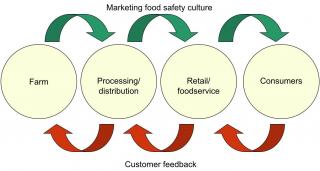
Marketing food safety at retail has the additional benefit of enhancing a food safety culture within an organization – if we’re boasting about this stuff I guess we really better wash our hands and keep the poop out of food. Maintaining a food safety culture means that operators and staff know the risks associated with the products or meals they produce, know why managing the risks is important, and effectively manage those risks in a demonstrable way. In an organization with a good food safety culture, individuals are expected to enact practices that represent the shared value system and point out where others may fail. By using a variety of tools, consequences and incentives, businesses can demonstrate to their staff and customers that they are aware of current food safety issues, that they can learn from others’ mistakes, and that food safety is important within the organization.
In the egg fiasco, no one is stepping up and saying, we know about salmonella, this is how we go above and beyond the minimal requirements of government, and this is why you should buy my eggs.
Traverse City, Michigan, is sorta famous in food safety circles because a 1982 outbreak of E. coli O157:H7 was the first time the bug was identified as a cause of human disease, after 47 people in and Traverse City and White City, Oregon, developed severe stomach disorders after eating hamburgers at McDonald’s outlets.
Reporting on E. coli O157:H7 in the New York Times began on 8 October 1982 with prompt coverage of this first known outbreak. Researchers at the U.S. Centres for Disease Control and Prevention (CDC) said the bacterium associated with the outbreaks was normally killed by cooking. The next day, federal epidemiologists characterized the disease as an intestinal ailment that had not proven fatal and was not a major public health hazard ; yet by Nov. 5, 1982 another 29 cases were reported.
In 1983, CDC issued a report on the Oregon and Michigan outbreaks and by 1984, the first report on the behavior of the organism and possible control measures appeared.
All cases were in children and all three attended the Northwestern Michigan Fair in Grand Traverse County between August 9 and August 13.
The onset of symptoms, including bloody diarrhea, were between August 15 and August 17.
Dr. Michael Collins, Medical Director for the Grand Traverse County Health Department said,
"Considering the number of animals in close proximity to people at that venue, it seems likely that their infections were contracted there. Though we will probably never know exactly which animal or animals were involved as sources.”
The water supply at the Fairgrounds was tested prior to the event and will be re-tested for possible contamination. Area physicians were also notified and encouraged to obtain stool cultures for individuals with severe or bloody diarrhea.
Le U.S. Centers of Disease Control and Prevention (CDC) est en train d’enquêter sur une éclosion à Salmonella Enteriditis liée aux œufs en coquilles. L’éclosion, qui a débuté en mai et qui est toujours en cours, a entraîné environ plusieurs centaines de malades.
Les enquêtes auprès de 250 malades en Californie, le Colorado et le Minnesota ont révélé plusieurs restaurants ou lieux où a mangé plus d’une personne malade avec la souche épidémique.
Les officiels de la santé de Californie ont confirmé que l’éclosion a été tracé jusqu’aux œufs de Wright County Egg à Galt dans l’Iowa, qui a procédé à un rappel estimé à 228 millions d’œufs le 13 août 2010.
Le rappel comprend des œufs en coquilles conditionnés par Wright County Egg entre le 16 mai et le 13 août 2010. Ils proviennent de caisses en cartons de six à 18 œufs et comprennent les numéros de site P-1026, P-1413 et P-1946.
•Les œufs peuvent héberger Salmonella et ont besoin d’être cuits à 63°C pendant 15 secondes pour réduire le risque.
•Les œufs doivent être conservés au réfrigérateur et maintenu en dessous de 7°C.
•Utiliser des œufs pasteurisés comme solution de remplacement pour des plats nécessitant des œufs crus.
Les œufs rappelés sont vendus sous de multiples noms de marque :
Lucerne, Albertson, Mountain Dairy, Ralph’s, Boomsma’s, Sunshine, Hillandale, Trafficanda, Farm Fresh, Shoreland, Lund, Dutch Farms et Kemps.
Pour plus d’information, contacter Ben Chapman,benjamin_chapman@ncsu.edu ou Doug Powell, dpowell@ksu.edu

 an A grade.
 his lawsuit against the Claim Jumper restaurant chain.
.jpg)
 previously unfinished songs – two written on acid trips – and stated at the time about the result,
 Sherri McGarry, a director at the F.D.A.’s Center for Food Safety and Applied Nutrition, told the
 once a primary task of food stylists and photographers, the new challenge is making messy food look appetizing.
 more than a dozen states, warnings are becoming more dire every day against eating undercooked yolks and translucent egg whites.
 The Whole Story blog of Whole Foods
 Why? Is it safer? No. Do the production methods extract less of a toll on the soil? No.
 coquilles. L’éclosion, qui a débuté en mai et qui est toujours en cours, a entraîné environ plusieurs centaines de malades.