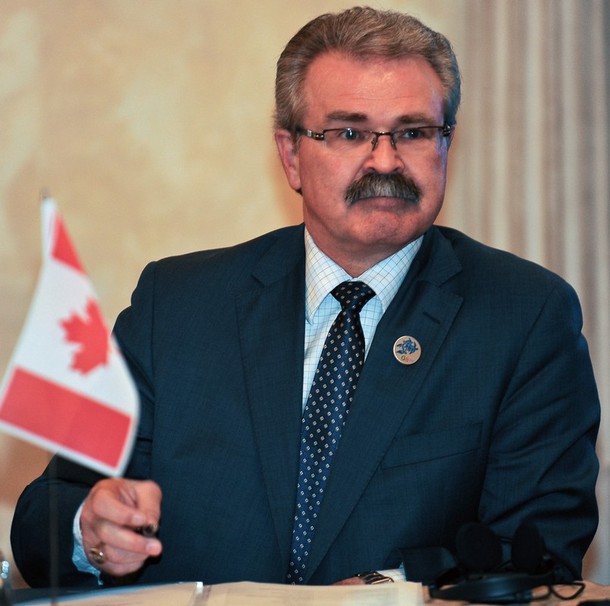
Canadian ag minister speaks about listeria outbreak report, CFIA

The unintentionally funny and still, inexplicably, Minister of Agriculture in Canada, Gerry-death-by-a-1,000-cold-cuts-and-isn’t-my-moustache-awesome Ritz, spoke at a press conference today. Macleans.ca has already published some of the Q&A, which I have edited here for brevity:

Q:  Do you now recognize that, that CFIA, both those inspectors were over, do you accept that they were stressed and they were stretched too thin and that, and maybe explain why the audits were conducted?

A:  Well as you know, I’m not involved in the day to day operations, so I can’t speak to the stress of the front line operators. 

Q: We talk a lot about what went wrong, where the failures were, but 22 people died here.  Where’s the accountability?  Has anyone been fired and are you willing to compensate the families that were so aversely affected by this clear failure of our system?

A: Well there was a lawsuit, as you know, and there were compensations paid out through McCain’s.  Other than that, as I said, it’s a very complex issue. 

Q: But Maple Leaf Foods took responsibility.  Why can’t the government take some sort of responsibility?  Clearly, there were breakdowns within the government and that’s acknowledged in this report.

A:  Well our, our responsibility is to move forward with a better, better food safety system and I pledge to the victims and the, you know, their families and friends that we will move forward.  That’s my responsibility, I accept it.

Q: So there’s no compensation to them?

A: No.

Q: There won’t be any?

Moderator: Okay, that was our last question.  Thank you Minister.

Where to get germs while on vacation

I’ve walked down Hollywood Boulevard in front of the Chinese Theatre. I bought a $2 map of the stars’ houses and photographed the "foot prints" of Star Wars’ R2D2 and C3PO in the cement. But I didn’t touch anything.

That sidewalk made the list of the five germiest tourist spots in the world as determined by editors at TripAdvisor.com this summer:

1. Blarney Stone in Blarney, Ireland – Last year, about 400,000 people hung upside down to kiss this stone in their quest for the gift of eloquence.

2. Market Theater Gum Wall in Seattle, Washington – This 15’x50′ wall of gum began as a few sticky pieces discarded by college students waiting in line for movie tickets fifteen years ago.

3. St. Mark’s Square in Venice, Italy – For some reason, people love feeding the pigeons here, though city officials have been cracking down on the pooping menaces in recent years.

4. Grauman’s Chinese Theatre in Hollywood, California – The celebrity handprints in the cement  out front encourage bare-hand contact with a city sidewalk, which, according to a Theatre tour guide, is mopped daily and pressure washed once a week to support the trend.

5. Oscar Wilde’s Tomb in Paris, France – Admirers of author and playwright Oscar Wilde don bright lipstick to kiss his tomb when they come to pay their respects.

CNN’s report of the list states,

"Though it is unlikely to get sick from visiting one of these places, health experts say germs are always a gamble. The more people who touch and visit a spot, the more germs there are in the mix, they say.

"Their traveling advice? Travelers should load up on hand sanitizers and wash their hands often on their trips."

Good advice, baseless assumptions. Now, what about the kissing? And the pigeons?

TripAdvisor travel expert Brooke Ferencsik was quoted as saying, "These places are great attractions regardless of the fact that they are germy."

I’d say they were good for a photo, maybe. But I’m passing on the hands-on (or mouth-on) participation.

Canadian listeriosis report released: tough questions unresolved

Beginning in Aug. 2008, an outbreak of listeriosis linked to Maple Leaf deli meats was identified in Canada; 22 people would eventually die and at least 53 sickened.

In addition to the already available myriad of reports and testimonials comes the 181-page final report of Sheila Weatherill (right, exactly as shown) who was appointed directly by the Canadian Prime Minister.

The Investigation identified four broad categories where improvements need to be made. There must be:

–  more focus on food safety among senior officials in both the public and private sectors;

–  better preparedness for dealing with a serious foodborne illness with more advance planning for an emergency response;

–  a greater sense of urgency if another foodborne emergency occurs; and,

–  clearer communications with the Canadian public about listeriosis and
other foodborne illnesses, especially at risk populations and health professionals.

zzzzzzzzzzzzzzzzzzzzzz

After in-depth analysis and advice from food safety and public health experts, the Weatherill made 57 recommendations for improvements to Canada’s food safety system. The recommendations address:

–  the safety culture of food processing companies;
–  the design of food processing equipment;
–  government rules and requirements for food safety;
–  the need for food service providers to adopt food safety practices aimed at vulnerable populations;
and
–  government’s capacity to manage national foodborne illness emergencies.

zzzzzzzzzzzzzzzzzzzzzzzzzz

Weatherill had a five-person advisory committee of food safety types including Bruce Tompkin, Mansel Griffiths and Michael Doyle. The full report is included below, but is painfully slow to scroll through, so these comments are based on a cursory reading; more details to follow. I did however find that Weatherill recommended precautionary labeling – warning labels – for vulnerable populations like pregnant women and old people. That’s a start.

Who knew what when?
The report presents a timeline of the listeria outbreak, but offers little in the way of analysis. In the past the Canadian Food Inspection Agency has placed import holds on fresh produce based on epidemiological and test results conducted in the U.S. But in the listeria outbreak of 2008 (if that’s what it’s going to be called) somehow, epidemiology and positive test results from an opened package of Maple Leaf deli meat weren’t sufficient to trigger a public health warning; CFIA argued the dead-or-dying person could have contaminated the unopened package of deli-meat, so they waited until the same DNA fingerprint was found in an unopened package, another three days of inaction. So why the different standards of proof for foreign and domestic foods? What exactly is CFIA’s policy on going public? CFIA could just publish something, rather than risk a full public inquiry to get answers; CFIA bureaucrats could just be accountable to the folks that pay their salaries.

The report also talks about the need to educate Canadians about listeria and food safety. I prefer inform to the indoctrination of education, but don’t let government types do it. David Butler-Jones (below, left), Canada’s chief medical officer of health, told Canadians at the height of the listeria outbreak,

“There are the usual things we should always be doing, like washing hands, storing and cooking food properly, washing fruits and vegetables well, and avoiding unpasteurized milk and milk products…”

No idea what this has to do with listeria and ready-to-eat foods.

Also, why long-term care facilities were feeding cold-cuts to a vulnerable population is baffling – unless food safety really isn’t taken seriously by all kinds of groups (gasp).

Finally, contrary to the complete bullshit statements of various politicians and bureaucrats in the early days of the outbreak, the system did not work.

Robert Clarke, the assistant deputy minister of the Public Health Agency of Canada, said Aug. 22, 2008, that the government’s actions in this case were quite rapid and an illustration of success.??????

“I’m glad we got hold of it early and now we’ll take serious steps working with the feds to put it behind us."??????

It was a disaster I’m sure you’d want to put in the past.

The issues raised are not going anywhere. And Maple Leaf, why wait for more government reports? Put warning labels on your products, make listeria test results public, and market your food safety efforts directly to consumers.

listeria.cdn.final.report.jul.09.pdf

Snails, cilantro and Salmonella

Look kids, the snails are back.

And with the rain in Kansas this year, they haven’t really left.

Amy took this picture of our cilantro yesterday afternoon in between thunderstorms. And snails can carry any number of diseases and pathogens.

That’s probably not what’s going on with the cilantro distributed by Sweet Superior Fruit LTD of McAllen, Texas, that was recalled on the weekend after U.S. Food and Drug Administration testing found Salmonella in cilantro sold from July 13 to 16 in 15-pound black plastic crates.

Initially announced Saturday night, company types weren’t answering the phone on Monday.

The Monitor reports that while the source of the cilantro has not been disclosed, the produce was most likely grown in Mexico. A sign above the company‘s facility advertises Mexican-grown products.

Just where the 104 15-pound crates of cilantro ended up remains unclear. The U.S. Food and Drug Administration said Monday that it could not provide a list of what restaurants or retailers might have bought the leafy green because most of the purchases at Sweet Superior Fruit LTD. were made with cash. It also did not say how much of the produce had been sold.
 

The rise of the space toilet

Neil Armstrong and Buzz Aldrin took one small step for man and one giant leap for mankind on the surface of the moon forty years ago.

On this special anniversary, Craig Nelson, author of Rocket Men, released ten little-known facts about the Apollo 11 mission that took Armstrong and Aldrin to the moon and back. 

The list highlights several aspects of space travel that have been updated and improved upon since that time, including restroom facilities.

Nelson writes that in 1969 "urinating and defecating in zero gravity…had not been figured out; the latter was so troublesome that at least one astronaut spent his entire mission on an anti-diarrhea drug to avoid it."

The waste ejection predicament of the Endevour at the international space station just seems to pale in comparison.

FDA’s food safety czar Acheson off to consulting

David, we hardly knew ye.

The U.S. Food and Drug Administration’s most public food safety face since the 2006 E. coli O157:H7 outbreak in spinach, assistant commissioner for foods and barfblog.com fan, David Acheson (right, exactly as shown), is leaving to join a new consulting firm, headed by former Health and Human Services Secretary Mike Leavitt.

Jane Zhang of the Wall Street Journal reported today that Acheson said, in an email to FDA employees,

“I wanted to let you know that Friday, July 31st will be my final day of service at the FDA. I have accepted a position with Leavitt Partners, a consulting firm, who are starting a new focus on food and import safety and have asked me to head the new activity.”

The firm, based in Salt Lake City, where Leavitt served as governor, already has hired a number of former HHS officials, including Medicaid chief Dennis Smith.

Acheson said in an interview he will remain in Washington and will use his “strong public-health perspective” to help food companies address food safety issues.

Acheson spoke in a July 2007 interview with the Washington Post about his passion for public education and his commitment to making the wobbly global food-safety system work better — even though he’s acutely aware that, in his new position, a food-related outbreak has as much potential to break his career as to make it.
 

Eating beach sand can be messy – at both ends

When it gets hot in Kansas, we go to Florida.

We’re leaving in a week, with a little work along the way before we settle into our rental on sexy Venice Beach, Florida. It’s the antithesis of places like South Beach, Miami, where celebrities flock and appearances rule. Venice – founded as a retirement community by the Brotherhood of Locomotive Engineers in the 1920s – is about as quiet as it gets.

With good beaches.

This year we’ll have 7-month-old Sorenne, and she’s starting to crawl (see below). If she can do this on hardwood, sand will be a breeze.

So we have to aware of sand in the mouth.

Besides the yuck factor, researchers at the University of North Carolina have found that digging in sand on beaches near water with high levels of fecal bacteria could be a risk factor for developing the drips.

For the study, reported in The American Journal of Epidemiology, researchers got contact information for more than 25,000 people visiting seven beaches within seven miles of sewage treatment plants.

About 10 days later, the researchers called and asked how they had spent their day at the beach and whether they had experienced problems like vomiting or diarrhea since then.

Those who dug in the sand, the study found, were significantly more likely to report having been sick — with those who had allowed themselves to be buried in the sand most affected. Children seemed to be at extra risk.

The best advice: wash your damn hands, especially before eating.

This isn’t the first time sand has been implicated in human illness.

In May, 2008, children’s playgrounds on Sydney’s northern beaches were closed after a rare form of salmonella normally linked to tropical fish made dozens of toddlers seriously ill.
 

Space toilet is plugged

The Associated Press reports today that one of the international space station’s toilets is out of order. As an often user of a plunger in my house, I know the embarrassment (or pride for some folks) that arises from plugging the commode.

While flight director Brian Smith declined to speculate whether overuse caused the toilet trouble, he was quoted as saying "We don’t yet know the extent of the problem. It may turn out to be of no consequence at all. It could turn out to be significant. It’s too early to tell right now."

The situation might get stickier as the space station guests, crew of the Endevour, are restricted to relieving themselves in their own vehicle. The AP says that the Endevour is parked next to the Japanese porch and can’t eject waste, Cousin Eddie-style, without spraying it all over the porch.

NASA, the food safety equivalent of the always-prepared Boy Scouts (without the funky green uniforms) was a catalyst in the creation of the modern food safety risk reduction system. In the 1960s NASA commissioned Pillsbury to rethink how to address risks in food processing and moved away from the use of end product testing as the only check. The result, hazard analysis critical control point (HACCP) was created and seen as the best way to keep astronauts from acquiring foodborne illness and the avoiding awkwardness that would be created by explosive diarrhea in weightlessness.

The toilet repair work reportedly fell to Belgian astronaut/plumber Frank De Winne who wore goggles, gloves and a mask.

Food porn or food art?

At the Manhattan, KS Farmer’s Market on Saturday, Chefs Bryan and Sarah Severns demonstrated cooking with local ingredients. At their cooking station, you could find an array of utensils, several cutting boards (separate ones for raw and cooked meats and vegetables—no cross-contamination), hand sanitizer, and a three-bucket washing station.

The purpose of their demonstration was to show a variety of recipes with ingredients found at the market. Samples were provided; they were delicious. Since it is recommended to wash your hands prior to eating, the chefs had hand sanitizer available for patrons.

Bryan commented on their cooking at the market as being more of food art than food porn. Both Bryan and Sarah will return to the market for another demonstration August 1.

Missouri: Don’t eat on the north side of town

In Springfield, MO, KY3 News investigators reviewed a year’s worth of restaurant inspection reports for the county, finding:

The Springfield-Greene County Health Department conducted nearly 2,800 inspections at restaurants and food service facilities between June 2008 and June 2009.  KY3 News spent weeks looking at all of them to see which ones are the worst offenders, whether there’s a part of Springfield with more at-risk establishments, and what violations are mostly likely to land a facility on an inspector’s radar.

Of the 20 restaurants with the most critical violations in the last year, 17 of them had problems keeping food hot enough or cold enough, a problem that can lead to salmonella, E. coli and other foodborne illnesses. 

Roxanne Sharp, a Greene County Health Inspector, said,

"If they have a lot of violations, we’re there six times a year; some are eight times a year, some are 12 times a year, depending on problems.”

Continuing,

"We don’t like to [close an establishment] but we know, if there’s something of imminent danger to someone and they can get sick, we want to close them so they understand what happened.”

Among KY3 News’ findings is proof that inspectors find more problems at restaurants in certain parts of town. Of the 20 restaurants with the most critical violations, 16 of them are on Springfield’s north side, including six on North Glenstone near Interstate 44, five on North Kansas, and five others spread throughout the north side

As far as the types of restaurants with the most critical violations, a vast majority are sit-down American-style, including three Ziggie’s locations. Four are Asian restaurants and just one is part of a national fast-food chain — the Braum’s Ice Cream and Dairy Store on North Kansas.