Salmonella increase in Ontario probably related to frozen chicken thingies, but no one will say

In the interest of open and transparent discussion, Ontario public health types are asking the public to sit quietly and obey food safety rules because they are the critical control point when it comes to raw, frozen chicken thingies.

Dr. Vera Etches, associate medical officer of health with.Ottawa Public Health (OPH, that’s in Canada) said,

"Since the first of June, 23 cases of salmonella have been reported to OPH, almost double the number of cases typically seen this time of year. A significant number of these cases appear to be related to undercooked or inappropriately stored processed chicken products."

OPH is reminding residents to use safe food handling and cooking practices when preparing all food, and specifically, processed chicken products such as chicken strips, nuggets and burgers.

I’m waiting for the day when a public health type will stop blaming consumers and ask the industry, why is their salmonella in your frozen, cooked product, and stop selling raw and cooked product side-by-side because they look the same.

Blame the consumer – Nebraska-style

Campylobacter is on the rise, so the Douglas County Health Department has decided to remind consumers they are the critical control point when it comes to food safety.

With 40 confirmed cases of campylobacter this year — 35 per cent of cases treated in an emergency department and 12 per cent requiring hospitalization – the health department reports 85 per cent of those who became ill had eaten poultry products and 32 per cent had handled raw meat. All of the cases have involved meals prepared in the home.

With 40 people, this percentage talk is fairly meaningless. The press release also does not state whether these campylobacter cases involved frozen chicken thingies. And yes, it’s important for consumers to handle any raw food like it’s toxic waste, but why isn’t the public health dude asking, why so much campylobacter in food?

Douglas County Health Director Dr. Adi Pour said,

“This illness can be prevented with just a little extra precaution. The cases range in age from less than one year to over 80 years of age.”

The release also states that,

“cooked food appears to have been contaminated when it was reintroduced to plates that previously held the meat which had dripped juice on the plate.”

If there are 40 cases of campylobacter in Nebraska that can be traced to cross-contamination via plates, this is a significant research finding and should be published immediately in a peer-reviewed journal. We have found in our own research that cross-contamination is much higher than anyone expects. But then the release goes into standard talk of “Clean, Separate, Cook, Chill,” so maybe this is speculation rather than a scientific assessment.

Don’t know, can’t tell. Maybe the people who write press releases should provide more information and be less patronizing.
 

Blame the consumer, Canadian-style; are frozen chicken thingies responsible for Salmonella rise in Ontario?

There has been a rise in the number of cases of Salmonella Enteritidis across Ontario, and although the source is still under investigation, a contributing factor is believed to be improper handling of food in the home, including inadequate cooking of breaded, processed chicken products, such as chicken strips, burgers and nuggets.

Ontario’s Chief Medical Officer of Health, Dr. Arlene King thought it prudent to remind Ontarians about the importance of properly handling and cooking processed chicken products.

She didn’t ask, WTF is salmonella doing in frozen chicken thingies that people cook in the microwave, she reminded consumers to properly handle and cook processed chicken products.

That was actually the title of her press release.

I’m all for the sensible tips like, follow cooking directions (if they’ve actually been verified and if they make sense) and treat uncooked processed chicken products as raw chicken, but why is a teenager popping a few chicken nuggets in the microwave after school the critical control point in the frozen chicken thingie food safety system?
 

Why do media care more about SpaghettiOs that haven’t made anyone sick than frozen chicken thingies that have sickened 30 with Salmonella?

SpaghettiOs have far greater cultural resonance than some fancy pants Marie Callender’s frozen dinner thingies. Who didin’t love SpaghettiOs as a kid, like Stay Puft Marshmallows (right, exactly as shown).

It’s the best explanation I have for why the SpaghettiOs story, involving a product which was recalled but has made no one sick, is getting far more media attention than the frozen food – which has made at least 30 people sick and highlights an on-going problem with the frozen, not-ready-to-eat products proliferating at grocery stores.

For Father’s Day, Amy went out for a couple of hours while Sorenne was sleeping and picked up a couple of those Marie Callender frozen pot pies; not the recalled ones but some others. It was a gift.

None of the material provided by ConAgra or state and federal health types has accurately described the product: do these pot pies contain raw ingredients and therefore need to be cooked to a temperature-verified 165 F, and if they do contain raw ingredients, why?

The label on Marie Callender’s Chicken Pot Pie says it’s made from scratch – does that mean all the salmonella and campylobacter is included – and to keep frozen and must be cooked thoroughly.

The box containing the fancy pants pot pie says to microwave in nothing less than an 1100W microwave (if you can figure out where to determine a microwave’s wattage) for a long time. And use a meat thermometer.

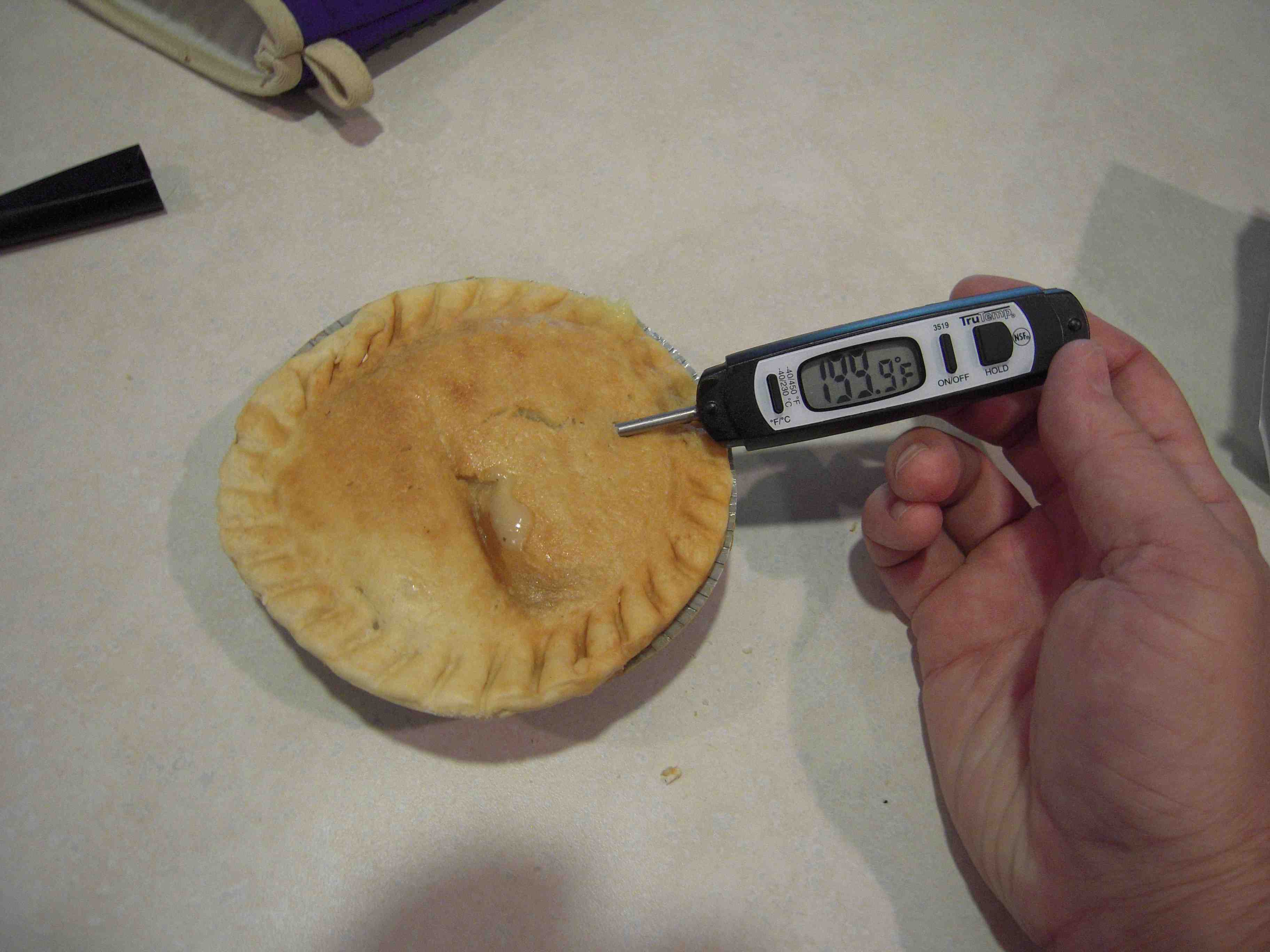
I look forward to the publication in a peer-reviewed journal regarding consumers’ response and understanding of the new groovy labels that say use a meat thermometer to verify a pot pie is cooked. I did it, but I’m a nerd (left).

ConAgra, are raw ingredients being used or was this another failure in your awesome HACCP program?

After ConAgra’s Banquet pot pie mess of 2007 which sickened 400, why are these companies still using raw salmonella-stained ingredients in their pot pies, regardless of the fancy pants label.

Politicians don’t help, somehow equating the two incidents and using them for political leverage. Congresswoman Rosa L. DeLauro said Friday, with a straight face.

“These recalls are very disturbing considering that the timeframe in which the SpaghettiOs were produced spans nearly two years. The volume of potentially dangerous products is significant, and it is frightening that millions of children may have unknowingly consumed these recalled products given the popularity of SpaghettiOs among kids. While these recalls and investigations are still ongoing, I look forward to learning from USDA about the circumstances that allowed two years of potentially dangerous foods to enter the market place.”

It was a manufacturing problem that was eventually caught, probably by the company and not the U.S. Department of Agriculture. No one is sick; it’s precautionary. But way to invoke kids and fear.

“This recall, combined with the recall of the Marie Callender’s frozen meals that have sickened over two dozen people in 14 states, serves as a reminder that after we must begin the process of reviewing how the food safety system at USDA should be reformed.”

Political opportunism. What must be reformed is the way companies – and it’s frequently ConAgra – process and produce these frozen chicken dinner thingies and they should stop blaming consumers. Lawsuits and embarrassment work far faster than political change.

We had roast chicken for dinner — the temp was at 165F by the time it was served.

Chickens banned in Calgary; food safety risk?

Chicken banned in the city sounds like the title of yet another bad Loverboy song (Canada has so much to apologize for in terms of bad music inflicted upon the world, see below; this song by Calgary’s Loverboy came on the radio while driving back from Nebraska and Phebus said he liked it; there’s no accounting for taste).

But that’s exactly what cow-town Calgary has done, and two local food activists who collect eggs from their pets responded Wednesday by vowing make it a human-rights issue in court.

A council committee voted 5-2 against allowing residential chicken coops, with members expressing concerns about everything from chicken-feline conflicts to livestock-borne disease.

Urban-hen advocates, picking up on a trend that’s spread throughout B.C. and gaining momentum elsewhere in Canada, have touted backyard egg-layers as a way to ensure food safety and nutrition.

Ald. John Mar rejected that notion, saying he’s fine buying quality fresh eggs — including free-range ones — at the supermarket.

Paul Hughes, longtime frontman for Calgary’s urban-chicken movement, said

"I don’t have salmonella. I don’t have avian flu. My eight-year-old handles these chickens every day of his life. You get chickenpox, but that doesn’t come from chickens."

Maybe. But I’m sure glad Hughes isn’t the medical officer of health for the entire city.

Why not barter a chicken for health care?

As issues like food safety, agricultural production and health care become increasingly intertwined, fake talk-show host Stephen Colbert took to the airwaves Monday night with a bold new proposal, and hopefully no salmonella or campylobacter from the creatures gathered on his desk.

Eat me daily wrote it up like this:

“The restaurant industry is rife with fully employed chefs and waiters, busboys and dishwashers lacking health insurance; now suddenly food professionals may have an edge. Sue Lowden, a Republican challenging Harry Reid for his Nevada Senate seat, recently suggested bartering for health care saying "in the old days [patients] would bring a chicken to the doctor." And she’s not the only one – Tennessee state representative Mike Bell suggested bartering with vegetables.

“If this is what Republicans are promising should they prove victorious in November’s mid-term elections, Dan Barber and Alice Waters may be all but guaranteed the best health coverage in America. Even Stephen Colbert’s on board, on last night’s Colbert Report the host suggested "just go for where they sell live chickens, they go for about $8… and when a doctor wants to charge $40,000 to put a stent in your heart, offer him the chicken."
 

The Colbert Report Mon – Thurs 11:30pm / 10:30c
Indecision 2010 Midterm Elections – Sue Lowden
www.colbertnation.com
Colbert Report Full Episodes Political Humor Fox News

Anyone can prepare food and make people barf in North Dakota

For the past week, people in Kansas have been asking me, did you love the Canadian men’s Olympic hockey victory?

I say, just glad it was a good game, great for hockey.

And then I say, the women’s hockey team really rocked.

Most people look at me and say, women play hockey?

The Canadian women defeated the U.S. for Olympic gold, 2-0, and then showed the men how to party.

I coached girls’ hockey for a number of years while my kids were growing up. To coach little girls playing ice hockey in Canada requires 16 hours of training. To coach kids on a travel team requires an additional 24 hours of training.

It seems reasonable to have some minimal training for those who prepare food for public consumption.

Not so in North Dakota, where the State Health Department says it will not seek charges against a rural Washburn woman for operating an unlicensed catering business linked to sickening 180 people last summer.

Aggie Jennings catered three separate events in June — two wedding receptions and a family reunion — that resulted in 76 people seeking medical attention with 10 hospitalized for salmonella Montevideo food poisoning.

A subsequent report found a total of 180 people met the case definition for Salmonella Montevideo.

The Bismark Tribune explains enforcement of regulations governing caterers falls under the jurisdiction of local health units.

Lisa Clute, executive officer for the First District Health Unit, said that board met Feb. 18 and voted not to recommend charges against Jennings, which would be Class B misdemeanors.

The strain of salmonella is one commonly associated with baby chickens, which Jennings raised on her rural residence.

The health department issued an order to Jennings to stop catering June 17, three days prior to the McClusky event, the report said.

The report also found there were four dishes that tested positive for salmonella and all had some type of preparation, storage or handling at Jennings’ residence.

It said several people assisting in food preparation at her home may have provided a source of cross contamination.

Clute said the First District Health Unit wants to be consistent in how it deals with such cases and in this instance, she thinks it has.

"We are confident she will never do this again. We stopped it quickly and efficiently and at this point there is no public health threat.”

These people wouldn’t be allowed to sit on the bench and open the door at a little girls’ hockey game. I don’t want them to make food either.

Food safety, D.C. style; hold the pea sprouts

Sorenne got to play with Marian Nestle’s hair while waiting to go to dinner, Amy talked to some dude from Switzerland and maybe arranged a trip to one of her favorite previous countries to live in, and I apparently pissed off everyone during my talk to 600-or-so delegates at the Global Food Safety Initiative meeting in Washington today.
Food safety auditors can sometimes suck. And I said so, with suggestions on how to make things better.

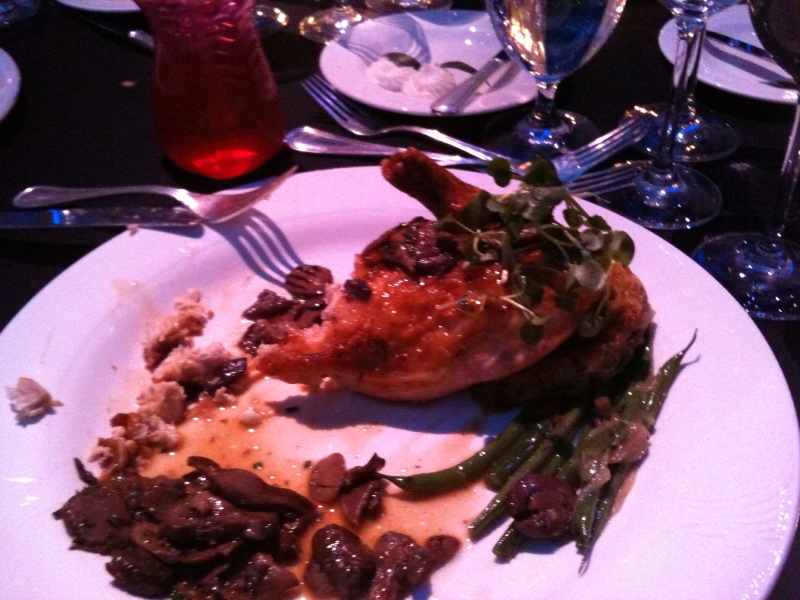
Dinner was served with pea sprouts (right, color isn’t great but they’re on top of the chicken), which I scraped to the side, as did Amy, and then the two people sitting on either side of us. Irony can be pretty ironic sometimes, especially at food safety meetings.

But we had fun, and I was grateful for the invitation.

UK takeaway boss fined ??7,000 for filthy premises

This Is South Wales reports that Hon Yip Hoh pleaded guilty to 14 counts of failing to meet regulations at Swansea Oriental, in Brynmor Road and was fined £7,000.

Inspectors found his premises in a "filthy" and unhygienic state, including:

• dirty and greasy cardboard and newspaper was used to line trays and to line shelves and also in the operating gas oven;

• cooked chicken placed on top of raw chicken left to defrost at room temperature;

• when asked, staff demonstrated they were not using cleaning materials with antibacterial properties; and,

• no hot water and inadequate drainage facilities.
 

Campbell, KFC won’t buy spent hens, but US school lunch program will

Colonel Sanders and KFC won’t buy them.

Campbell Soup stopped using them more than a decade ago because of "quality considerations."

Yet as reported in today’s USA Today, the U.S. National School Lunch Program is an awesome outlet for egg producers struggling to find a market for 100 million egg-laying hens culled each year.

From 2001 through the first half of 2009, USA TODAY found, the government spent more than $145 million on spent-hen meat for schools — a total of more than 77 million pounds served in chicken patties and salads. Since 2007, 13.6 million pounds were purchased.

Because the hens are usually restricted to tiny cages, they often suffer from osteoporosis and have especially brittle bones that easily splinter. When schools reported bones in the chicken, the government stopped purchases for school meals in April 2003. After new provisions aimed at preventing bone splinters — and lobbying by the trade group, United Egg Producers — purchases resumed that July.

Besides the bones issue, some scientists believe spent-hen meat is more likely to carry salmonella, which can be especially dangerous for children. A 2002 study by Washington State University’s Avian Health and Food Safety Laboratory found that spent-hen carcasses were four times more likely than broilers to be contaminated with salmonella. The spent hens in the study were from a single plant, so the results offer no proof that similar problems occur on a broader scale. …

Officials with the U.S. Department of Agriculture say spent-hen meat is safe and nutritious. "Mature hens must comply with the same safety standards as any other chicken processed and sold to consumers," says Rayne Pegg, head of the USDA’s Agricultural Marketing Service.

Still, the USDA is buying fewer spent hens today. In 2006, it purchased 30% of all spent hens processed nationwide; now, it buys less than 10%.

Craig Brooks, who oversees food distribution at the South Carolina education department, isn’t sorry to see fewer spent hens.

"The taste just didn’t go over."