Connecticut school cafeterias lack local health inspections

Nathan Hale School in New Haven had an inspection in March that found chicken was being served to children at a temperature that can carry bacteria. Inspectors did not go back to the school to re-inspect until December, when they found the same problem.

In October 2010, local health inspectors in Meriden found rodent droppings in the cafeteria of Maloney High School, as well as dirty cabinets and other health violations. Inspectors didn’t go back last year to check to see if the problems were remedied.

In Stamford last year, nine of 32 schools did not have their cafeterias inspected, with the remaining schools inspected fewer than the three times a year required under state regulations.

Those are the findings of a team of journalists and interns reporting for the New Haven Independent.

Paul Kowalski, New Haven’s environmental health director, said, “There is no way we are meeting the state mandate on inspections. I have three sanitarians and over 1,100 food establishments to inspect.”

A review of more than 1,700 inspection reports from 103 cities and towns in 2010 found that many local health agencies, responsible for ensuring that school cafeterias are safely preparing and serving food to children, are not meeting the state Public Health Code on mandated annual inspections. Of the 38 health agencies overseeing those towns, at least half were not meeting the state requirement, the review shows.

In addition to failing to meet the required number of inspections, the review found that timely re-inspections of cafeterias cited for violations were rare.

Sniffing uncooked chicken is not a safety measure; kebab shop source of salmonella outbreak in London

A kebab shop boss whose Shepherd’s Bush premises were the source of the worst salmonella outbreak in London for at least 15 years was spared jail on Tuesday.

Mohammed Shafique, 49, who ran the Shahi Nan shop in Uxbridge Road, admitted to food hygiene breaches which caused the poisoning of 72 people, aged between five and 72.

Isleworth Crown Court heard at least 22 victims had to be treated in hospital and were kept in for an average of four days.

Shafique, who took over the shop in 2001, told health inspectors he sniffed the uncooked chicken deliveries to check they were safe to eat.

His premises was first visited in September 2009 after reports emerged that 17 people had visited St Mary’s and Charing Cross Hospitals with food poisoning.

The numbers rose to 72 between September 9-18 – in the previous month there had been just 15 reported salmonella cases in the whole country.

Officials found traces of the bug on a light switch and in the fridge, where raw produce was stored next to cooked food, but the exact cause of the outbreak was never located.

Shafique, who admitted to four food hygiene breaches and failing to comply with EU regulations, was ordered to do 120 hours unpaid work and to pay £10,000 in fines, £1,000 costs and a £15 surcharge.


Fewer sick people? USDA sets new performance standards for salmonella and campylobacter in poultry

I’m a fan of performance standards, quality control, continuous improvement – all those things that can measure risk reduction.

(And why zero tolerances sorta suck.)

But keep it real.

“FSIS estimates that approximately 5,000 illnesses will be prevented each year under the new Campylobacter standards, and approximately 20,000 illnesses will be prevented under the revised Salmonella standards each year.”

Standards good, extrapolations based on … who knows what, bad.
Judge for yourselves. The press release is below. Full details have been published in the federal register and are available at
http://www.fsis.usda.gov/OPPDE/rdad/FRPubs/2009-0029.pdf

The U.S. Department of Agriculture’s (USDA) Food Safety and Inspection Service (FSIS) today announced implementation of revised and new performance standards aimed at reducing the prevalence of Salmonella and Campylobacter in young chickens and turkeys. The improved standards will become effective in July 2011. With the new standards, FSIS is encouraging establishments slaughtering chicken and turkey to make continued reductions in the occurrence of pathogens – namely Salmonella and Campylobacter – in the products they produce.

After two years of enforcing the new standards, FSIS estimates that approximately 5,000 illnesses will be prevented each year under the new Campylobacter standards, and approximately 20,000 illnesses will be prevented under the revised Salmonella standards each year.

"These improved standards are a stronger buffer between foodborne illnesses and our consumers, especially our most vulnerable consumers – children, the elderly and those with weakened immune systems," said Agriculture Secretary Tom Vilsack. "There is no more important mission at USDA than ensuring the safety of our food, and we are working every day to lower the danger of foodborne illness. The new standards announced today mark an important step in our efforts to protect consumers by further reducing the incidence of Salmonella and opening a new front in the fight against Campylobacter."

FSIS developed stricter performance standards using recently completed nationwide studies that measure the baseline prevalence of Salmonella and Campylobacter in young chickens and turkeys prepared for market. The studies indicated that, despite improvements, there was still a risk of consumers being exposed to these pathogens through poultry.

"While the industry has made significant strides in recent years, far too many Americans continue to fall victim to these foodborne illnesses," said Under Secretary for Food Safety Dr. Elisabeth Hagen. "These improved standards will drive the industry to do better. They are tough but achievable. And when fully implemented, they will prevent tens of thousands of Americans from getting sick."

President Obama’s Food Safety Working Group (FSWG) developed three core principles to help guide food safety in the United States: prioritizing prevention, strengthening surveillance and enforcement, and improving response and recovery. In its overall mission to ensure a safe food supply for the public, and in response to the FSWG, FSIS developed the stricter performance standards to cut the Salmonella risk in poultry products.

Coles cashes in on chicken myth; responding to consumer perceptions rather than leading

An Australian supermarket campaign promoting hormone-free chicken has been called dodgy by a leading consumer watchdog.

In-the-better-late-than-never category, Australians are finally speaking out about a Coles Supermarkets advertising promo that markets fear rather than food safety.

According to industry groups and consumer watchdog Choice the supermarket giant is trying to capitalize on the urban myth that chickens are given hormones to speed growth.

Adding hormones to Australian poultry was outlawed in the early 1960s but the myth of pumped-up chickens has persisted, said Dr Andreas Dubs, the executive director of the Australian Chicken Meat Federation.

Choice spokesman Christopher Zinn said,

"You can’t have hormone-free chicken unless there are chickens that are pumped up on hormones. I think it’s a little dodgy. It’s true, but it’s like saying it’s plutonium-free or cyanide-free because it’s suggesting that anything that doesn’t have that label on it might have that."

A Coles spokesman said the supermarket was just countering the myth.

"Chicken in Australia has not been treated with hormones for over 40 years. However, there is still a widespread misconception among customers that they do. In fact in July last year, chicken producer Steggles commissioned a Newspoll study among 1000 people that showed that 76 per cent still believed that hormones and/or steroids were used in chicken production."

So why isn’t Coles leading the formation of public perception instead of blindly following? Because there’s a buck to be made.

Colbert battles to boost plunging Food Network ratings with recall

Last week, Stephen Colbert announced a recall of his fictional cookbook, "I Eat America (And So Can You!)" due to a production error beyond his control (right).

Apparently drawing on outbreaks of salmonella and campylobacter involving raw, frozen, breaded chicken thingies, Colbert said his recipe for Chicken Col-Don Bleu may actually need to be cooked.

He might as well be on the Food Network, what with it’s terrible food safety, is finally reaching the outer limits of food porn – ratings are going down.

Food Network and sister network HGTV — Scripps Networks’ two biggest money-makers — are seeing troubling signs that their core female fans are starting to look elsewhere for entertaining fare. After years of growth, both networks experienced their first major ratings falloff at the end of last year.

In the fourth quarter, Food Network, which helped launch the careers of celebrity chefs Sandra Lee and Rachael Ray, posted a 10.3 percent drop among viewers ages 25 to 54, considered a key category for advertisers.

Most troubling, primetime ratings for women — the primary audience for both channels — were down in December. Food Network ratings among women ages 18 to 49, and 25 to 54, fell 9 percent last month.

Part of the challenge for the food-focused channel is shifting tastes, with viewers going for edgier culinary "reality" competition shows.

I suggest a reality food safety show where the barfing and crapping and sometimes life-long gifts of foodborne illness are displayed in their glory. Would probably work on youtube.

The Colbert Report Mon – Thurs 11:30pm / 10:30c
Sign Off – I Eat America (And So Can You!) Recall
www.colbertnation.com
Colbert Report Full Episodes Political Humor & Satire Blog Video Archive

Bon Appetit and simplistic food safety

Bon Appetit is a food porn magazine meant to titillate (it’s even in it’s name) and stimulate rather than inform, like most of what passes for food journalism.

This month, the so-called Conscious Cook has a brief piece, 5 Reasons You Shouldn’t Hate On Microwaves.

Hate is a strong word. I like my microwave, especially for reheating, not cooking.

The author maintains that microwave defrosting reduces the risk of foodborne illness and that “defrosting frozen food by using hot water or leaving it in the sink can increase bad bacteria. To defrost fast, microwave food on low heat, then cook immediately. Stir contents halfway through heating for even warming.”

I cook a whole chicken about once a week. It’s inexpensive, and provides leftovers and stock for subsequent meals. If I’m defrosting a whole chicken in a microwave, I’m not going to stir it “halfway through heating for even warming.”

The U.S. Department of Agriculture and Health Canada recommend thawing poultry by sealing in a waterproof bag and immersing in cold water. These same groups also used to recommend washing chicken bits, but decided the microbiological splash fest created by running water over raw poultry was a bad idea. To me, immersing in cold water and changing that water every 30 minutes is an additional route to microbial cross-contamination. The Aussies and the Brits agree, and do not recommend water immersion.

Depending on my planning, I use a combination of the counter and the refrigerator for thawing the bird. American and Canadian science-types say this is awful, and I’ll make everyone barf. The Aussies and Brits say counter-top thawing is fine, as long as it’s monitored – a week may be too long.

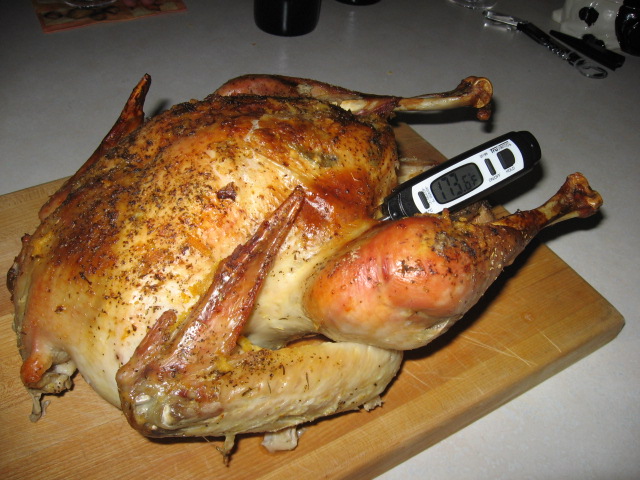
We have previously reviewed various thawing techniques and government recommendations. Whatever technique is used, be the bug, thinking in terms of cross contamination and growth, and use a damn thermometer to ensure the food has reached a safe internal temperature. Color is a lousy indicator and piping hot is just weird (so is Canada’s Mrs. Cookwell).
 

‘Sedation stunning’ or ‘slow induction anesthesia’ for slaughtered chickens; why not microbiologically safer

Why are production standards marketed in grocery stores, but microbiological safety isn’t?

As reported by William Neuman of the New York Times, “shoppers in the supermarket today can buy chicken free of nearly everything but adjectives. It comes free-range, cage-free, antibiotic-free, raised on vegetarian feed, organic, even air-chilled.

“Coming soon: stress-free?

“Two premium chicken producers, Bell & Evans in Pennsylvania and Mary’s Chickens in California, are preparing to switch to a system of killing their birds that they consider more humane. The new system uses carbon dioxide gas to gently render the birds unconscious before they are hung by their feet to have their throats slit, sparing them the potential suffering associated with conventional slaughter methods.”

With so many options, why isn’t someone marketing microbiologically safer chicken – chicken with fewer of the bugs that make people barf?

With the slaughter system, David Pitman, whose family owns Mary’s Chickens, said,

“Most of the time, people don’t want to think about how the animal was killed.”

And retailers will say, you can’t market food safety because that would imply other foods are unsafe.

But as a shopper, I want to reward companies that pay attention to microbial food safety issues, and shun companies that are sloppy.

Americans are good at marketing, so why not get the Mad Men geniuses on the case and figure out how to brag about microbiologically safer food.

Anglia Autoflow, the company that is building the knock-out systems for the two processors, calls the process “controlled atmosphere stunning,” but Mr. Pitman said his company was considering the phrase “sedation stunning” for use on its packages. Also on the short-list: “humanely slaughtered,” “humanely processed” or “humanely handled.”

The trick, he said, is to communicate the goal of the new system, which is to ensure that the birds “not have any extra pain or discomfort in the last few minutes of their lives.”

Temple Grandin, a professor of animal science at Colorado State University and a prominent livestock expert, consulted with Bell & Evans as the company worked with Anglia to design its system. She said it was better because the chickens were not aware of what was happening to them. “Birds don’t like being hung upside down,” Dr. Grandin said. “They get really stressed out by that.”

Scott Sechler, the owner of Bell & Evans, said the system was designed to put birds to sleep gently, in the same way that a person undergoes anesthesia before surgery.

To evoke that image, he wants to put the words “slow induction anesthesia” on his packages and advertising, which already tell customers that the birds are raised in roomy conditions with natural light and given feed free of antibiotics or animal byproducts. Customers who want to know more will be able to go to the company’s Web site.

Food poisoning strikes 100 at policing meet in Guyana

Health officials in Berbice, Guyana (that’s on the northern coast of South America) told Stabroek News last night that approximately 100 people attending a police retreat were treated at the New Amsterdam Hospital shortly after lunch was served.

Home Affairs Minister Clement Rohee, who was present at the event yesterday, told this newspaper last evening that the police were investigating the incident and several persons were questioned.

According to reports, sometime around 1 pm yesterday lunch, which consisted of fried rice and pot roast chicken, was served and shortly after, persons began to complain of abdominal pains while some began to vomit.

Persons at the New Amsterdam Hospital told Stabroek News that the hospital was filled with patients seeking treatment, many persons lay on the floors at the hospital crying out in pain. It was noted that residents in the area had already departed the venue for their homes when they began to experience pains about their bodies.

UK consumers still washing whole chicken –they shouldn’t, cross-contamination risk

An estimated three quarters of consumers who buy whole chickens wash them, potentially spreading bacteria on to work surfaces for up to a 3ft radius, research by Which? has revealed.

The Telegraph reports the most recent figures from the Food Standards Agency (FSA) suggest that 65% of raw shop-bought chicken is contaminated with campylobacter.

And while most government agencies now advise against washing chickens, cookbooks and Internet recipes are full of it (bad advice and poop).

An FSA spokeswoman said,

”Washing raw poultry is a common kitchen mistake, and it simply isn’t necessary. … By washing your raw bird, you’re actually more likely to spread the germs around the kitchen than get rid of them.”

Here’s another common kitchen mistake, courtesy of the FSA: piping hot is not a food safety indicator and color is a lousy indicator. Use a tip-sensitive digital thermometer.