Dutch food safety inspectors enforce meat and water regulations

A professor once told this nubile food science graduate student that it was all about adding water and salt to protein and charging more.

FunkyChickenHiHe was right.

The Dutch food safety authority NNWA has made ‘several enforcement visits’ to Dutch factories where meat is tumbled with water to increase its weight in recent months, the Guardian newspaper reported on Saturday.

The aim of the visits was to stop the practice of adding water to imported chicken destined for resale as raw meat, the paper said. The NVWA told the paper chicken produced in this way is illegal.

Glass Onion Catering products sold at Trader Joe’s (and elsewhere) recalled after link to E. coli O157 Illnesses

According to USDA FSIS, 26 people in three states suffering from E. coli O157 have  been linked together as a cluster of related illnesses. Investigators have identified pre-packaged salads containing grilled chicken produced by Glass Onion Catering as the likely source. Screen Shot 2013-11-10 at 2.51.01 PM

According to a USDA FSIS press release, Glass Onion Catering is recalling 181,620 pounds of ready-to-eat salads and sandwich wrap products associated with outbreak. From the press release:

FSIS began monitoring a cluster of E. coli O157:H7 illnesses on Oct. 29, 2013 then was notified by FDA on Nov. 6, 2013 that California authorities had reported case-patients consuming pre-packaged salads with grilled chicken. Working in conjunction with the Centers for Disease Control and Prevention (CDC), FDA, the California Department of Public Health, the Washington State Department of Health, and the Arizona Department of Health Services, FSIS has determined that there is a link between the grilled chicken salads and the illness cluster. Twenty-six case-patients have been identified in three states with indistinguishable E. coli O157:H7 PFGE (genetic fingerprint) patterns with illness onset dates ranging from Sept 29, 2013 to Oct. 26, 2013. Based on epidemiological information, 15 case-patients reported consumption of ready-to-eat pre-packaged salads prior to illness onset. A traceback investigation determined Glass Onion Catering was the supplier of the products implicated in the outbreak.   

While uncommon to find E. coli O157:H7 in a poultry product, FSIS will continue its investigation in conjunction with the FDA to identify the source of the contamination. FSIS continues to work with the CDC, FDA and state public health partners on this investigation and will provide updated information as it becomes available.

A list and pictures of the affected product labels, including many branded as Trader Joe’s private label is found here.

According to their website, Glass Onion Catering and Gourmet Foods, “is a rising force in the prepackaged, grab and go gourmet food industry. A trusted source for several top retail brands, Glass Onion was envisioned and created by Tom, a Northern California native.”

Nothing related to what they do to address food safety is listed on the site. Listing their systems would make them a more trusted source for me.

317 sick in Foster Farms Salmonella outbreak; just cook it still doesn’t cut it; skating, hockey, Thanksgiving turkey

Amy, Sorenne and I began eight weeks of skating lessons at the local arena Satuday (I suck after seven years of no ice, thank you Kansas), started cooking the Canadian Thanksgiving feast at 3 a.m Sunday, and have had hockey on in the background since 4 a.m.

I try to be super-extra careful when cooking a big bird because of the potential for cross-contamination, and the potential of sickening a bunch therm.turkey.oct.13of what-would-become former friends.
But in some cases, extra care is not enough.

As the Salmonella Heidelberg outbreak linked to Foster Farms hits 317 sick, Costco has ordered a recall of nearly 40,000 pounds of rotisserie chickens after one tested positive for Salmonella on Friday.

That’s a cooked chicken. To paraphrase Bill Marler, if Costco can’t cook the poop out of a bird, why are consumers expected to?

Still, company types, many government types and other types, insist all will be well if the chicken is just cooked properly.

This is a terrible message, and not scientifically accurate.

Chapman at least got a few correct points in when he told Live Science cross-contamination can happen at any point in the cooking and handling process, starting at the grocery store, don’t wash the bird, and use a damn thermometer.

(I gave one to an IT friend here for the Thanksgiving food orgy.)

After threatening Monday to close three Foster Farms processing plants, the U.S. Department of Agriculture agreed on Thursday to allow the plants to continue operating with advanced, super-secret safety procedures.

Neither the company nor USDA will say what these procedures are. Doesn’t build confidence.

Which would be an additional reason the list of retailers recalling Fosters products is growing.

Lynne Terry of the Oregonian writes that Costco’s El Camino Real store in San Francisco, Calif., is pulling and products over Salmonella contamination. The recall includes nearly 8,800 Kirkland Signature Foster Farms rotisserie chickens and more than 310 units of Kirkland Farm rotisserie chicken soup, rotisserie chicken leg quarters and rotisserie chicken salad.

The products were sold to Costco customers at the El Camino Real store between Sept. 11 and Sept. 23, the notice said. The chickens were processed at three Foster Farms plants in central California.

Fred Meyer and QFC stores have withdrawn chicken from the same plants. They were sold under the brand names of Simple Truth Organic and Kroger Value. The voluntary withdrawal also includes deli chicken and rotisserie chickens.

Melinda Merrill, Fred Meyer spokeswoman, said the stores are still selling the Foster Farms labeled poultry that came from a plant that’s not been implicated in the outbreak.

This outbreak differs in that the variety of salmonella is especially virulent.

There are seven strains of salmonella Heidelberg involved in the outbreak. Several of them are antibiotic-resistant and “one of the strains that we’ve tested is resistant to seven antibiotics,” said Christopher Braden, director of the Centers for Disease Control and Prevention division of foodborne diseases.

Of the people infected, 42% have been hospitalized — an unusually high percentage, according to the CDC.

“That’s about twice what we would normally see for a salmonella outbreak,” Braden said. “We think that’s at least in part due to the fact that a number of these strains have resistance to one or more antibiotics.”

Thirteen percent of those sickened have salmonella septicemia, a serious, life-threatening, whole-body inflammation, Braden said. Normal for salmonella would be “just a few percent,” he said.

In a statement, Foster Farms CEO Ron Foster said “we have worked relentlessly to address these issues and will continue to do so as we work to regain consumer trust and confidence in the Foster Farms brand.”

Those comments do not bolster consumer confidence.

If you’ve got a good food safety system, brag about it. Because some companies are better.

 

Second major outbreak this year; Foster Farms chicken sickens nearly 300 with Salmonella

Foster Farms raw chicken products made at three California sites may have sickened nearly 300 people in 18 states, according to a public health alert issued Monday by U.S. Department of Agriculture officials.

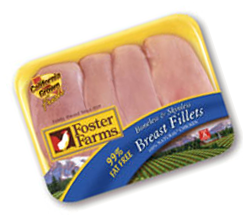
JoNel Aleccia of NBC News and Lynne Terry of The Oregonian report that at least 278 illnesses caused by salmonella Heidelberg linked to the chicken brand have been reported, mostly in California, according to the USDA’s Food Foster-Farms-Chicken-BreastSafety and Inspection Service. The products were distributed mainly to outlets in California, Oregon and Washington state. 

The notice follows an outbreak earlier this year traced to Foster Farms raw chicken in which 134 people in 13 states became ill, but it appears to be a separate, new incident, said Barbara Reynolds, a spokeswoman for the Centers for Disease Control and Prevention. That outbreak, which was declared over in July, sickened 40 people in Oregon and 57 in Washington state and sent 33 patients to the hospital.

Neither agency could provide many details about the latest outbreak because of limited staffing caused by a week-long government shutdown.

Illnesses were linked to the Foster Farm brand through epidemiologic, laboratory and trace-back methods, FSIS said. But health officials were unable to tie the illnesses to a specific product or a specific production period. They said that the products bear one of three establishment numbers inside a USDA mark of inspection or elsewhere on the package. The numbers are: P6137, P6137A and P7632.

The USDA allows producers to sell raw poultry with a nearly 10 percent incidence rate of salmonella. Foster Farms says it’s always met that standard. It is not issuing a recall.

Foster Farms officials said in a statement that the company has been collaborating with FSIS and CDC to eradicate salmonella Heidelberg at its sites and has retained national experts to “assess current practices and identify opportunities for further improvement.”

Follow the bug, collect the evidence: washing poultry not worth it

The food safety family’s curmudgeonly uncle, Pete Snyder (who really isn’t) would be happy that the don’t-wash-poultry crowd is gaining some traction.

Medical Daily writes that everyone should stop rinsing raw chicken under the faucet. Rather than reducing foodborne bacteria, rinsing poultry spreads pathogens to other surfaces in your kitchen via Dan Aykroyd Plays Julia Childwater splatter, exacerbating contamination rather than preventing it. Now, a new campaign urges the public to drop the habit, as it increases the risk of serious foodborne illnesses like those caused by Salmonella and Campylobacter bacteria. 

“There’s no reason, from a scientific point of view, to think you’re making it any safer, and in fact, you’re making it less safe,” said researcher Jennifer Quinlan, speaking to NPR. Quinlan is a food safety researcher at Drexel University in Philadelphia, and a spokesperson for “Don’t Wash Your Chicken” –– a university-backed public health campaign educating informing home cooks with video simulations and “photonovellas.”

“You should assume that if you have chicken, you have either Salmonella or Campylobacter bacteria on it, if not both,” said Quinlan. “If you wash it, you’re more likely to spray bacteria all over the kitchen and yourself.”

Concomitant focus-group studies funded by the U.S. Department of Agriculture (USDA) indicate that 90 per cent of the population washes their poultry before cooking it. After all, washing usually makes things both cleaner and safer. 

If you, like the majority of Americans, have been washing your chicken until now, campaign officials urge you to peruse the new reports, as well as the educational photonovellas. 

In addition, their “Germ-Vision” animation helps visualize the disconcerting spread of pathogens in your kitchen. 

Can diapers really control Salmonella in lap chickens?

With 271 sick in 37 states from urban poultry, a Denver woman named Mary has launched a business selling chicken diapers to somehow contain the Salmonella.

Faith-based safety

“They’re just really, really tame, and they want to be near humans,” said Mary, petting her two chickens, Henny and Penny. “I wouldn’t have them borat.chickenin the house all the time, but once in a while it’s nice to let them in.”

According to Centers for Disease Control investigators, some of those sick people were reportedly “kissing or cuddling with” the birds, and poultry that appears healthy and clean can still be shedding germs that make people sick, and chickens should not be allowed inside people’s homes.

Candice Burns Hoffman, a spokeswoman for the National Center for Emerging and Zoonotic Infectious Diseases with the CDC, said an email to 7NEWS: “Just like you wouldn’t walk around your house and touch surfaces with raw, uncooked chicken, you also shouldn’t allow your live poultry to have contact with surfaces in your home.”

In 2012 alone, public health officials uncovered eight outbreaks in which people got sick with germs spread from contact with poultry in backyard flocks.  These outbreaks caused at least 517 illnesses, 93 hospitalizations and fours deaths, according to the CDC. 

Health officials said that for every case of Salmonella illness reported to the CDC, there are about 30 more that don’t get reported. 

“I never had a problem, and I don’t think most people would,” said Mary. 

Fail; Campylobacter increases in UK despite warnings

Doing the same thing and expecting different results is crazy.

But that’s exactly what the UK’s Food Standards Agency is doing, and more people are getting sick.

The same unfounded risk messages (piping/steaming hot), bad surveys to inform policy, blind faith in occasional audits, and an utter lack of FunkyChickenHicreativity or urgency combine to produce a culture of complacency, from farm-to-fork.

The Daily Mail reports that cases of camplobacteriosis continue to rise, despite FSA targeting Campylobacter as its top priority in 2008.

New figures published by the Food Standards Agency (FSA) reveal the number of cases has been rising every year for the past four years.

The FSA and its advisers had hoped that putting in place improved hygiene controls, so-called biosecurity measures, on chicken farms would reduce the number of infected birds.

However its strategy, which was designed to reduce the number of contaminated chicken on farms by 50per cent by 2010, has been a hopeless failure.

Successive chief executives at the FSA have lambasted supermarkets for not doing enough to cut campylobacter contamination in the chicken they sell.

In 2010, the then chief executive, Tim Smith, wrote to the chief executives of all the supermarkets demanding action. This failed to bring about the desired result and Mr Smith is now the group technical director at Tesco.

Following a failure to improve the situation, his successor, Catherine Brown, issued a new call for action in January this year, saying tackling chicken.cook.thermometercampylobacter in chicken was her top priority.

Miss Brown called supermarket bosses to a meeting to thrash out plans to tackle the menace, while she has even hinted that stores might be required to remove chicken from sale unless they can guarantee the bug has been removed.

She said it ‘unacceptable’ that two-thirds of chicken carry the disease, while a fifth are ‘highly contaminated’ at the time of purchase.

However, yet again there is no evidence of any major drive by the supermarkets to protect customers, beyond introducing new non-drip packaging.

The Government watchdog is now considering drastic measures to clean up chicken and protect consumers. These include killing the bugs by either washing the meat with lactic acid or the use of blast freezing.

Using a lactic acid wash to disinfect the birds has its own difficulties with evidence that many consumers have an instinctive dislike of the idea.

Pathogens on farmers’ market and grocery store whole chickens: does location matter?

We eat a lot of chicken. I either stuff a whole chicken with lemons or onions and oven-roast (in the winter) or use indirect heat outside with a 3/4 full beer can stuck into the bird’s, uh, cavity (in the summer). Regardless of where we happen to be shopping (farmers market or a grocery store), I pick one up pretty much every week. I assume that the raw product is covered in Salmonella and Campylobacter so I try not to cross-contaminate and use a digital tip-sensitive thermometer to ensure my chicken has reached a safe temp. I’m doing what I can to reduce risk of illness. Bringing less pathogens into my kitchen would further reduce that risk.BLTYrMoCEAIRhgT

Joshua Scheinberg, Stephanie Doores and friend of barfblog Cathy Cutter published a study in Journal of Food Safety detailing a study they conducted looking at pathogen presence and prevalence on whole chickens purchased from farmers markets or grocery stores as well as produced conventionally or under organic certification. They found (not surprisingly) that there’s a bunch of Campy and Salmonella on chickens, but that there were differences between retail types.

From the article:

Chicken obtained from farmers’ markets were positive for Salmonella spp., at a prevalence rate of 28%, which was not significantly different than the prevalence of 20% found in organically processed chicken. Salmonella spp. prevalence in both farmers’ market and organic chicken however, were found to be significantly higher than that of conventional chicken. Campylobacter spp. contamination rate was found to be high in farmers’ market whole chicken, with a positive prevalence of 90%. The prevalence of Campylobacter spp. in farmers’ market chicken was significantly higher than both conventionally and organically processed chicken, while organic chicken exhibited the lowest prevalence of 28%. Within the 90 Campylobacter spp.-positive farmers’ market whole chickens, 67% were found to harbor enumerable Campylobacter spp. populations compared with 52 and 22% of conventional and organic chicken enumerable populations, respectively.

Scheinberg et al. also looked at whether pathogens recovered from farmers’ markets chickens differed whether they were frozen or fresh – as campy is pretty delicate and has been shown to be affected by freezing.

Also from the article:

To evaluate whether freezing may be beneficial for farmers’ market vendors in reducing potential pathogen load on raw whole chicken, both fresh and frozen chicken were purchased from farmers’ markets. All chicken obtained from supermarkets were purchased as fresh. In this study, Campylobacter spp. and Salmonella spp. prevalence between farmers’ market, fresh and frozen chicken were not significantly different from one another, suggesting that freezing may not reduce either pathogen to nondetectable levels. Significant differ- ences were found between the number of chickens contain- ing enumerable Campylobacter spp. concentrations above 1.0 log10 cfu/mL in frozen versus fresh chicken. This obser- vation may suggest that freezing raw chicken may not reduce Campylobacter spp. to undetectable levels; yet the lower storage temperatures may reduce higher populations of Campylobacter spp. present on the raw chicken.

This data helps farmers’ market folks make risk management decisions: While freezing isn’t going to eliminate the pathogen, it is an added step that a vendor can take to reduce how much campy makes it in to kitchens. The location doesn’t matter as much as the practices of the vendor.

The article, A microbial comparison of poultry products obtained from farmers’ markets and supermarkets in Pennsylvania can be found as an early view article at the Journal of Food Safety website.

Rampart. Stat. Start an IV and get me some thermometers. Emergency

I still feel naked cooking without a thermometer.

emergency.rampart.statA tip-sensitive digital thermometer.

I usually pack one for travel, but forgot on this latest retreat to Manhattan (the one in Kansas).

Sometimes I’m terrible when I travel: I love and miss my wife, my daughter, am resentful about wasted time and it’s really boring.

Sometimes I suck it up and say what Amy says, it is what it is, and am cheery about it.

This time in the Little Apple, a friend has loaned me his house while he’s away, so I don’t bug the student and his family living in mine.

I’m adjusting well, lotsa sleep, exercise and good food. This is dinner for me, tonight. A whole roast chicken at $0.99/pound, flavored with lime, garlic, mint, rosemary, salt and pepper. Oven roasted corn in the husk (really concentrates the flavors). A non-fat amy.thermometer.05mushroom gravy. Baked potato. Green beans. Amy the Frenchy would say the brie and roasted garlic is dessert (roast about 40 gloves of garlic in the chicken), but I’ll go with the fruit for dessert.

The chicken stock that will be ready tomorrow will be an ideal foundation for a potato-leek soup, I nibble on raw vegetables all day, these leftovers will last days, my farts are outstanding.

At least I’m here alone.

But paranoia made me overcook the chicken (that’s what the gravy is for).

No thermometer.

Bob, your fridge is too cold; my strawberries froze. I adjusted the temperature, and you can make it ridiculously cold again when you return to apparently compensate for the 8,352 times you must open the fridge door daily to keep food from freezing.

And, in addition to the herbs I’ve potted for you, because I like cooking with fresh herbs, you will be left with the best tip-sensitive digital thermometer out there.

As soon as they arrive from Chapman.

Manhattan. Stat. Thermometer.

thermometer.chicken.bob.apr.13

Campylobacter in the kitchen: observational trial of safe food handling behavior during food preparation

Austrian researchers report on an observational trial of safe food handling behavior during food preparation using the example of Campylobacter spp.

chicken.thermJournal of Food Protection®, Number 3, March 2013, pp. 376-551 , pp. 482-489(8)

Hoelzl, C.; Mayerhofer, U.; Steininger, M.; Brüller, W.; Hofstädter, D.; Aldrian, U.

Abstract:

Campylobacter infections are one of the most prominent worldwide food-related diseases. The primary cause of these infections is reported to be improper food handling, in particular cross-contamination during domestic preparation of raw chicken products. In the present study, food handling behaviors in Austria were surveyed and monitored, with special emphasis on Campylobacter cross-contamination. Forty participants (25 mothers or fathers with at least one child ≤10 years of age and 15 elderly persons ≥60 years of age) were observed during the preparation of a chicken salad (chicken slices plus lettuce, tomato, and cucumber) using a direct structured observational scoring system. The raw chicken carcasses and the vegetable part of the salad were analyzed for Campylobacter. A questionnaire concerning knowledge, attitudes, and interests related to food safety issues was filled out by the participants. Only 57% of formerly identified important hygiene measures were used by the participants. Deficits were found in effective hand washing after contact with raw chicken meat, but proper changing and cleaning of the cutting board was noted. Campylobacter was present in 80% of raw chicken carcasses, albeit the contamination rate was generally lower than the limit of quantification (10 CFU/g). In the vegetable part of the prepared product, no Campylobacter was found. This finding could be due to the rather low Campylobacter icarly.chicken.cell.handscontamination rate in the raw materials and the participants’ use of some important food handling behaviors to prevent cross-contamination. However, if the initial contamination had been higher, the monitored deficits in safe food handling could lead to quantifiable risks, as indicated in other published studies. The results of the observational trial and the questionnaire indicated knowledge gaps in the food safety sector, suggesting that further education of the population is needed to prevent the onset of foodborne diseases.