With six outbreaks now associated with Chipotle since July, the burrito chain is under scrutiny from the public and food safety folks for being heavy on promises to be 20 years ahead of everyone else and light on details. A couple of weeks ago they talked about switching their tomato handling from largely an in-store process to a centralized commissary with controls.
Onions will be dipped in boiling water to kill germs before they’re chopped. Raw chicken will be marinated in re-sealable plastic bags, rather than in bowls. Cilantro will be added to freshly cooked rice so the heat gets rid of microbes in the garnish.
“When you’re given a project like this, you look at the universe of hazards,” said Mansour Samadpour, CEO of IEH Laboratories, which was hired by Chipotle to tighten its procedures.
Chipotle spokesman Chris Arnold said many of changes will be implemented in coming weeks, but that the company doesn’t expect the taste of its food to suffer. Among the tweaks the company is making:
—Cheese will now arrive in restaurants shredded.
—Ingredients like onions will be macerated with lemon or lime juice to kill germs.
—60 samples of every 2,000 pounds of steak will be tested before it’s sent to stores. A similar testing program will be implemented for chicken in coming weeks. Pork and barbacoa beef are already delivered cooked in sealed bags.
—Tomatoes, cilantro and other ingredients will be chopped in centralized locations, rather than in stores, so they can be tested. Chipotle has said in the past that tomatoes taste better when freshly diced in restaurants. After the outbreak, Chipotle co-CEO Steve Ells changed tunes: “If I’m eating a burrito that had tomatoes that were chopped in a central kitchen in the salsa or one that was chopped in house, I probably couldn’t tell the difference,” he said in an interview on CNBC last week.
Not all chopping will be moved to centralized locations. Onions, for instance, would oxidize and smell bad if they were chopped days in advance, Samadpour said. So they will remain chopped in restaurants, along with lemons, limes and jalapenos. All will now be blanched to kill germs.
These are some good steps, I’d love to see the validation data that shows onions macerated with high-acid juice will take care of pathogens. Salmonella has been shown to be pretty hardy in the ceviche-type setting (resulting in a 1-2 log reduction according to some work done by barfblog friend and podcast buddy Don Schaffner).
I’d love to see the data associated with adding-cilantro-to-hot-rice – sounds like a good idea, but what is the heat transfer like and what does it do to the pathogens?
Sealed bags vs open bowls for marination is good – but those bags still need to be opened and the juices controlled.
He and his wife are conscientious about their food: They eat organic, local produce and ethically raised animals. Collins liked to have a meal at Chipotle once a week. On Friday evening, Oct. 23, he ordered his regular chicken bowl at his usual Chipotle in Lake Oswego. His dinner was made of 21 ingredients, including toasted cumin, sautéed garlic, fresh organic cilantro, finely diced tomatoes, two kinds of onion, romaine lettuce, and kosher salt. It tasted as good as always.
By the next night, Collins’s body was aching and his stomach was upset. Then he began experiencing cramping and diarrhea. His stomach bloated. “Moving gave me excruciating pain,” he says, “and anytime I ate or drank it got worse.” His diarrhea turned bloody. “All I was doing was pooping blood. It was incredibly scary.” After five days, he went to an urgent-care clinic near his home; the nurse sent him to an emergency room. He feared he might have colon cancer.
On Halloween, the ER doctor called him at home: Collins had Shiga-toxin-producing E. coli 026, and he’d likely gotten it from one of those 21 ingredients in his meal at Chipotle. (This was later confirmed by public-health officials.) The doctor warned him that kidney failure was possible; intensive treatment, including dialysis, could be necessary. His kidneys held up, but it took an additional five days for the worst of Collins’s symptoms to ease and nearly six weeks for him to recover. He still doesn’t have as much physical strength as he used to, and he feels emotionally shaky, too. “Before, I was doing the P90X workouts. For a long time after, I couldn’t even walk a few blocks,” he says. “It made me feel old and weak and anxious.” On Nov. 6, Collins sued Chipotle, seeking unspecified damages.
Collins was among 53 people in nine states who were sickened with the same strain of E. coli. “I trusted they were providing me with ‘food with integrity,’ ” Collins says, sarcastically repeating the company motto. “We fell for their branding.” Chipotle’s public stance during the outbreak irritated him, too. The company closed all 43 of its restaurants in Oregon and Washington in early November to try to identify the source of the E. coli and sanitize the spaces. Notices on restaurant doors generally referred to problems with the supply chain or equipment. But local media reported that at least one restaurant in Portland put up a note that said, “Don’t panic … order should be restored to the universe in the very near future.” “That felt so snarky,” Collins says. “People could die from this, and they were so smug.”
For a long time, smug worked pretty well for Chipotle Mexican Grill. It’s grown into a chain of more than 1,900 locations, thanks in part to marketing—including short animated films about the evils of industrial agriculture—that reminds customers that its fresh ingredients and naturally raised meat are better than rivals’ and better for the world. The implication: If you eat Chipotle, you’re doing the right thing, and maybe you’re better, too. It helped the company, charging about $7 for a burrito, reach a market valuation of nearly $24 billion. Its executives seemed to have done the impossible and made a national fast-food chain feel healthy.
Fewer people associate Chipotle with “healthy” now. Three months before Collins was infected with E. coli, five people fell ill eating at a Seattle-area restaurant. By the time local health officials had confirmed a link, the outbreak was over, so no one said anything. In August, 234 customers and employees contracted norovirus at a Chipotle in Simi Valley, Calif., where another worker was infected. Salmonella-tainted tomatoes at 22 outlets in Minnesota sickened 64 people in August and September; nine had to be hospitalized. Norovirus struck again in late November: More than 140 Boston College students picked up the highly contagious virus from a nearby Chipotle, including half of the men’s basketball team. An additional 16 students and three health-care staff picked it up from the victims. The source? A sick worker who wasn’t sent home although Chipotle began offering paid sick leave in June. In the second week of December, when Chipotle should have been on highest alert, a Seattle restaurant had to be briefly shut down after a health inspection found that cooked meat on the takeout line wasn’t being kept at a high enough temperature. And in the most recent case, on Dec. 21, the CDC announced it was investigating an outbreak of what seems to be a different and rare version of E. coli 026 that’s sickened five people in two states who ate at Chipotle in mid-November. The company says it had expected to see additional cases. It still doesn’t know which ingredients made people ill.
Almost 500 people around the country have become sick from Chipotle food since July, according to public-health officials. And those are just the ones who went to a doctor, gave a stool sample, and were properly diagnosed. Food-safety experts say they believe with any outbreak the total number of people affected is at least 10 times the reported number. The CDC estimates that 48 million Americans get sick from contaminated food every year.
At Chipotle, three different pathogens caused the five known outbreaks. That wasn’t inevitable or coincidental. “There’s a problem within the company,” says Michael Doyle, the director of the center for food safety at the University of Georgia. Chipotle has gotten big selling food that’s unprocessed, free of antibiotics and GMOs, sometimes organic, sometimes local. “Blah, blah, blah,” says Doug Powell, a retired (I’m not dead yet) food-safety professor and the publisher of barfblog.com. “They were paying attention to all that stuff, but they weren’t paying attention to microbial safety.” Whatever its provenance, if food is contaminated it can still make us sick—or even kill. Millennials may discriminate when they eat, but bacteria are agnostic.
“Food with integrity,” a promise to Chipotle’s customers and a rebuke to its competitors, has become the source of much schadenfreude among both. Chipotle’s stock has lost about 30 percent of its value since August. Sales at established stores dropped 16 percent in November, and executives expect a decline of 8 percent to 11 percent in comparable-store sales for the last three months of the year. That would be the first quarterly decline for Chipotle as a public company.
Steve Ells, Chipotle’s founder and co-chief executive, went on the Today show on Dec. 10, apologized to everyone who’d fallen ill, and announced a comprehensive food-safety program that he said would far exceed industry norms. He didn’t address why a company that had challenged quality standards with such gusto hadn’t taken on safety standards as well.
On Dec. 17, speaking by phone in New York, he’s still on message, describing the Seattle restaurants he visited as clean and organized. “I ate delicious food there,” he says. “Traffic was slow, but we’re ready for people to come back. There is no E. coli in Chipotle. ” To hear Ells tell it, the company is witnessing an outbreak of excitement. He says the chain’s suppliers are excited to participate in the new safety programs; employees at headquarters in Denver are excited to contribute however they can; it’s “a very, very exciting time for us to be pushing the boundaries” on food safety. “We’re embracing this as an opportunity.”
Ells studied art history in college, trained as a chef at the Culinary Institute of America, and opened the first Chipotle in Denver in 1993 with a loan from his father. He set up a model—open kitchen, fresh ingredients, real cooking in the back, and an assembly line in front, allowing customization and speed—that’s become its own industry standard. Chipotle grew from 489 restaurants and revenue of $628 million in 2006, when it went public, to about 1,800 restaurants and $4.1 billion in revenue in 2014. Net profit increased 60 percent from 2012 to 2014. Ells and his co-CEO, Montgomery Moran, together earned more than $140 million in total compensation during that time. And Michael Pollan, the good-food arbiter, said that Chipotle was his favorite fast-food chain and that he didn’t have a second.
The company was influenced in ways it doesn’t always admit by the biggest, most industrialized chain of them all: McDonald’s. The company invested about $340 million in Chipotle from 1998, when it had 13 restaurants in Colorado, until 2006, when the two parted ways. McDonald’s taught Chipotle supply-chain economics. Chipotle often derides fast-food chains and their factory farms, enlisting the likes of Willie Nelson to make plaintive music videos about crop chemicals and steroidal cattle. But Ells respects McDonald’s size. In an interview with Bloomberg in 2014, he said Chipotle could one day be “bigger than McDonald’s in the U.S. I mean, that’s not an unreasonable way to think about this.”
With a possible second E. coli O26 outbreak, a plummeting stock price and no answers, it’s a lousy winter solstice for Chipotle.
The U.S. Centers for Disease Control is investigating another, more recent outbreak of a different, rare DNA fingerprint of Shiga toxin-producing E. coli O26 (STEC O26) linked to Chipotle Mexican Grill. Because it is not known if these infections are related to the larger, previously reported outbreak of STEC O26 infections, these illnesses are not being included in the case count for that outbreak. This investigation is ongoing.
Five ill people have been identified in Kansas (1), North Dakota (1), and Oklahoma (3).
The illnesses started on dates ranging from November 18, 2015 to November 26, 2015.
All five (100%) reported eating at a Chipotle Mexican Grill in the week before illness started.
The CDC does not know yet if they are linked to a larger outbreak that began at the end of October.
And as Chipotle chief Steve Ells continues his apology tour, The Denver Post editorial board asks, will Ells take a pay cut?
Ells made $25 million in 2013 and $28.9 million in 2014 — way more than CEOs at peer companies and more than 1,000 times the median Chipotle worker. Anything even approaching those figures for 2015 would be scandalous.
Finally, there’s me telling Lexi Sutter of 41 Action News KSHB in Kansas City this morning that Chipotle “is a company focused on marketing of what I call, ‘food porn.’ That is, it’s easy on the eyes, not a lot of depth to it. What I’ve found in the past is that companies whofocus so much on the adjectives may not pay as much attention as the things that make people barf.”
Powell writes about food safety on his blog, barfblog.com.
Last week Chipotle CEO Steve Ells said ‘we can assure you today that there is no E. coli in Chipotle.’ CDC is saying not so fast. According to an update, they are apparently investigating another O26 outbreak linked to Chipotle. CDC is investigating another, more recent outbreak of a different, rare DNA fingerprint of Shiga toxin-producing E. coli O26 (STEC O26) linked to Chipotle Mexican Grill. Because it is not known if these infections are related to the larger, previously reported outbreak of STEC O26 infections, these illnesses are not being included in the case count for that outbreak. This investigation is ongoing.
‘Infamous is when you’re more than famous. As in, this man El Guapo is not just famous, he’s infamous.’
Sorta like when your buzz goes down.
According to CNBC, Chipotle’s buzz is on the negative scale (whatever that means).
YouGov BrandIndex said its “buzz” score plummeted to -39.4 on Tuesday from 7.4 on October 30 before an E. coli outbreak came to light. This is the lowest level YouGov has ever measured for the chain since it began tracking it in mid-2007.
Purchase consideration has also plummeted. About 13 percent of respondents said they would consider Chipotle the next time they ate at a restaurant, its lowest level since February 2014. Since the year began, YouGov interviewed 25,000 adults about Chipotle for its surveys.
“I think it’s going to be a while before consumers shake this off and get it out of their mind,” said YouGov BrandIndex CEO Ted Marzilli, in a phone interview.
“When two happen so close together, it does have a magnification impact,” he added.
In the summer of 1994, Intel types discovered a flaw with their Pentium computer chip, but thought the matter trivial; it was not publicly disclosed until Oct. 30, 1994, when a mathematician at Lynchburg College in Virginia, Thomas Nicely, posted a warning on the Internet.
As perceived problems and complaints rose through the weekend Andrew S. Grove, Intel’s chairman and CEO, composed an apology to be posted on an Internet bulletin board—actually a web, but because he was at home with no direct Internet access, he asked Intel scientist Richard Wirt to post the message from his home account; But because it bore Mr. Wirt’s electronic address, the note’s authenticity was challenged, which only added to the fury of the Internet attacks on Intel.
At 8 a.m. the following Monday inside the company’s Santa Clara, Calif. headquarters, Intel officials set to work on the crisis the way they attacked a large problems—like an engineering problem. Said Paul Otellini, senior vice-president for worldwide sales, “It was a classic Intellian approach to solving any big problem. We broke it down into smaller parts; that was comforting.”
By the end of week two, the crisis looked to be subsiding; Then on Monday, Nov. 12, 1994, the International Business Machines Corp. abruptly announced that its own researchers had determined that the Pentium flaw would lead to division errors much more frequently than Intel said. IBM said it was suspending shipments of personal computers containing the Pentium chip
Mr. Grove was stunned. The head of IBM’s PC division, Richard Thoman, had given no advance warning. A fax from Thoman arrived at Intel’s HQ on Monday morning after the IBM announcement, saying he had been unable to find Grove’s number during the weekend. Mr. Grove, whose number is listed, called directory assistance twice to ask for his own number to ensure he was listed.
After the IBM announcement, the number of calls to Santa Clara overwhelmed the capacity of AT&T’s West Coast long-distance telephone switching centres, blocking calls. Intel stock fell 6.5 per cent.
As John Markoff of the N.Y. Times wrote on the front-page in Dec. 1994, the reluctance of Intel to act earlier, according to Wall Street analysts, was the result of a corporate culture accustomed to handling technical issues rather than addressing customers’ hopes and fears.
Only then, Mr. Grove said, did he begin to realize that an engineer’s approach was inappropriate for a consumer problem.
According to one op-ed writer, Intel’s initial approach to the problem—prove you are doing sophisticated calculations if you want a replacement chip—was like saying “until you get to be cardinal, any internal doubts about the meaning of life are your own problem, a debate tha has been going on since before Martin Luther.
Intel’s doctrine of infallibility was facing an old-fashioned Protestant revolt.” (John Hockenberry, Pentium and our Crisis of Faith, N.Y. Times, Dec. 28, 1994, A11; this is how things were referenced before hot links)
Why and how did Intel go wrong? The answer is rooted in Intel’s distinctive corporate culture, and suggests that Intel went wrong in much the same way as other big and unresponsive companies before it.
Intel has traditionally valued engineering over product marketing. Inward-looking and wary of competitors (from experience with the Japanese) it developed a bunker mentality, a go-for-the-juglar attitude and reputation for arrogance.
According to one former engineer, Federico Faggin, a co-inventor of Intel’s first microprocessor, “The attitude at Intel is, ‘We’re better than everyone else and what we do is right and we never make mistakes.’”
Finally, on Dec. 20, Grove apparently realized that he and his company were standing at Ground Zero for an incoming consumer relations meteor. Intel announced that it would replace the defective chips—and pay for the labor—no questions asked, for the life of the original PC.
Discussing Intel’s previous position, Grove said, “To some people, this seemed arrogant and uncaring. We apologize for that.”
So what does a consumer with a Pentium do? Teach Intel that this isn’t about white paper. It’s about green paper—the money you paid and the performance you didn’t get. Replace that chip. After all, consumers deserve to be treated with respect, courtesy and a little common sense.
Now apply all of that Intel stuff to Chipotle.
They even took out a full-page ad to apologize, just like Intel, but people still read newspapers 20 years ago. Today, the strategy seems hopelessly out of touch for a tragically hipster company.
Chipotle is the opposite, focusing too much on consumer whims and not enough on food science, and now it’s going to get worse.
The County’s chronology includes detailed tracking of the complaints as they came in and as the illnesses were confirmed as Norovirus victims. From that first report through Sept. 25, 2015, the chronology comes to this conclusion: ”the total number of reportedly ill customers and employees at this Chipotle outbreak investigation is 234.”
The number of victims was being reported in other media as recently as this week as just 98.
And, the internal document says the real number of victims of Chipotle’s Simi Valley outbreak could be higher still. “In reviewing the food logs provided by Chipotle for both 8/18/15 and 8/19/15, it is estimated at least 1500+ entrees were sold each day.” Sandy Murray, who did the analysis for the division, wrote: “Thus, the actual number of customers and employees ill from this outbreak is likely to be substantially higher than the reported number of 234.”
This week Chipotle ran print advertisements in 60 newspaper markets Wednesday with an apology from Steve Ells, the burrito chain’s founder and co-chief executive. His apology though only went to the victims of the current nine state E. coli 026 outbreak and the Boston College outbreak.
“From the beginning, all of our food safety programs have met or exceeded industry standards, “ Ells says (Pinto defense). “But recent incidents, an E. coli outbreak that sickened 52 people and a Norovirus outbreak that sickened approximately 140 people at a single Chipotle restaurant in Boston, have shown us that we need to do better, much better.”
No mention was made of the other foodborne outbreaks.
The publicly traded Chipotle also had one of its better days since its troubles began. CMG stock was up 2.49 percent or $13.79 per share, closing at $568.65 per share.
CNBC, where business analysts who look like Louis C.K. like to yell like Lewis Black, asked Chipotle executives how they will change their business after five recent outbreaks. Their answer was: food safety is really, really important to us now.
“We want to show all of our customers that the industry standards that we had been employing before — which are considered great standards — were not good enough. They were not good enough because something like this could happen,” said founder and co-CEO Steve Ells.
“I will say though, that we can assure you today that there is no E. coli in Chipotle,” Ells said. “We have thoroughly tested our food, we have thoroughly tested our surfaces and we are confident that Chipotle is a safe place to eat.” He also confirmed that the company’s new safety measures will put Chipotle well ahead of industry standards.
To find out of the company has been punished enough, Cramer spoke with Ells and co-CEO Monty Moran.
To implement a rigorous safety protocol, the executive said the company is working with a leading epidemiology team to develop new safety systems. Chipotle is widely known for its integrity in food selection and culture. Cramer asked the Chipotle leaders whether eating with integrity comes at the price of safety?
“We do not believe there is anything less safe about eating that way, and we believe that what we need to do now is put that same innovation that we put toward food with integrity and that we put toward our very special people culture — we’ve got to put that same kind of innovation into food safety now,” Moran said.
There are three important things in my life: my family and friends, hockey, and food safety.
In that order.
A few weeks ago Doug and I had a conversation about the hockey rink being our church; we share fellowship, care about our community and want to share our joy with others; the hours we spend on the ice playing, coaching and skating are unlike anything else we do.
Or as one of my friends put it, ‘The nice thing about hockey is for an hour I tend to forget about all the other crap that’s going on and hang out with folks that share my passion for the game.’
And enjoy the company of people we care about.
A teammate had a shocking tragedy in his family this week and while our team debated cancelling our game, we decided to play tonight. It gives us a place to go to talk about how our community can support our close friend.
I guess that’s what church is all about, too.
Some people have that same feeling about food brands, I guess.
Jack Stalling of the Longview News-Journal writes, Blue Bell Ice Cream is sort of a church and he’s rejoicing that it is back on the market.
Shortly after I married my lovely wife back in February of 1998, Rachel and I treated ourselves to a night out that included dinner and a movie.
Dinner was outstanding, and both of us claimed to be way too stuffed to even consider having dessert.
When I noticed that the restaurant offered Blue Bell homemade vanilla ice cream on apple pie as one of its dessert choices, I undid another notch on my belt and asked the nice waitress to bring it as fast as her tired legs would carry her.
I could tell Rachel was confused, so I explained one of my fundamental beliefs to my new bride.
“Never pass up the opportunity to eat Blue Bell,” I told her. “Even if you don’t want it right then, some day you might really want some Blue Bell, and if it’s not available, you will remember the time you passed up the opportunity to eat Blue Bell. Do you want that sort of thing creeping into your dreams at night and haunting you?”
As I was deciding what to order, Depeche Mode’s cover of Route 66 came on the radio. This turned out to the absolute perfect soundtrack for my experience. Its cold, clean synth beat was a perfect match for the sterile and antiseptic decor, while David Gahan’s slightly evil baritone voice spoke of infection and the dangers of travel in our modern age – of the danger of seeking “kicks”, and a deal with the devil. Was I gambling with my life, with my eternal soul, by eating Chipotle?
I went ahead anyway, and ordered a barbacoa steak bowl, with white cilantro/lime rice, black beans, sour cream and lettuce. (Guacamole was extra, and I don’t appreciate when restaurants charge extra for things that other restaurants provide gratis, so I skipped it.) I asked for the hottest salsa available, imagining the acid in the habanero peppers might kill any virus or bacteria hiding in my food. Also, I like spicy food.
At the cash register, I found an even better safety precaution. Chipotle serves margaritas! This was a surprise. It felt like going to a McDonald’s and getting to order a martini with your Happy Meal. Whatever E coli or salmonella or norovirus the salsa didn’t burn into oblivion, I figured, would be pickled to anodyne by tequila.
The lady at the cash register was friendly. I asked her if she’d noticed a drop-off in business in the wake of the outbreaks.
“Oh, yeah,” she said. “There are way less people coming in lately.”
“But then we’ve got our regulars,” she added, nodding to the people at the tables. “We got people that come every day. They say, ‘I don’t care!’”
“This is a cost that we will bear,” Ells told The Associated Press at the beginning of a day stopping by Seattle restaurants to talk to employees about new food safety rules.
Suppliers who are unwilling to meet the new “high resolution testing” requirements, which Ells said are years ahead of testing procedures at other restaurant chains, will no longer do business with Chipotle.
Um, McDonald’s has been imposing such food safety metrics on its suppliers since the mid-1980s.
Ells said the company’s approach to food safety is similar to its focus on food quality and none of the new procedures are impossible or very difficult to follow. It’s easier at some other chains to meet the highest food safety standards because everything is cooked, processed or frozen, which Ells said is not the Chipotle way.
Ells doesn’t understand food safety.
Chipotle is now focused on getting the chance of foodborne illness as close to zero percent as possible, Ells said. But, he added, “it is impossible to insure that there is a zero percent chance of any kind of foodborne illness anytime anyone eats anywhere.”
Um, I wrote a book in 1996 that said zero-risk was a food safety fallacy, echoing the work of many before me.
It would be better to say, this is how we’re reducing the risk, Mr.-5-outbreaks-in-6-months Ells, explain it, and then when ready, market it.
Henry I. Miller wrote in Forbes yesterday — The long defeat of doing nothing well — inspired by a line from poet John Masefield, seems apt: Chipotle, the once-popular Mexican restaurant chain, is experiencing a well-deserved downward spiral.
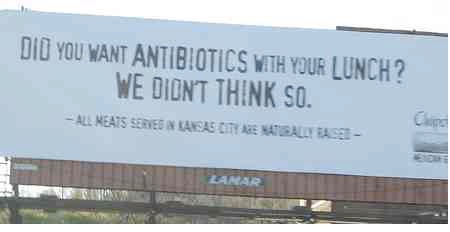
The company found it could pass off a fast-food menu stacked with high-calorie, sodium-rich options as higher quality and more nutritious because the meals were made with locally grown, genetic engineering-free ingredients. And to set the tone for the kind of New Age-y image the company wanted, Chipotle adopted slogans like, “We source from farms rather than factories” and, “With every burrito we roll or bowl we fill, we’re working to cultivate a better world.”
Outbreaks of food poisoning have become something of a Chipotle trademark; the recent ones are the fourth and fifth this year, one of which was not disclosed to the public. A particularly worrisome aspect of the company’s serial deficiencies is that there have been at least three unrelated pathogens in the outbreaks–Salmonella and E. coli bacteria and norovirus. In other words, there has been more than a single glitch; suppliers and employees have found a variety of ways to contaminate what Chipotle cavalierly sells (at premium prices) to its customers.
Brian Sozzi of Real Money writes that from blasting McDonald’s and the fast-food industry on earnings calls, to a company spokesman e-mailing me all of the harmful ingredients that McDonald’s uses to giving a figurative middle finger to competitors in online marketing videos, members of Chipotle’s top brass have gotten a big head.
I believe they have lost their sense of humility.
I encourage them to take a trip to Starbucks (SBUX) in Seattle and sitdown with CEO Howard Schultz. That guy exudes humility. Sure, Schultz is known to get riled up on earnings calls when his baby is criticized by a stock analyst, but I have not once heard him disparage competitors on earnings calls or take success for granted. When that humility is lost among executives, it puts the company in a position to be attacked when times get tough — as they are at Chipotle now. Frankly, it just leads to operational miscues.
Each and every Chipotle leader needs to look within today and reassess their attitudes — the CFO, for example, should be embarrassed by how he handled himself at this week’s investor’s conference. The guy made it sound as if the media secretly planted E. coli at Chipotle locations across the country to cook up desktop and mobile traffic in the last month of the year.
Even Steve Ells’ performance on the “Today” show Thursday lacked authenticity. I watched that appearance 11 times. The stock may have rallied on the apology, but if you bought Chipotle’s stock on the news, I encourage going back to watch the footage: The culture of arrogance is still there, and it has to be eradicated at a chain growing as quickly as Chipotle.
Norovirus in Boston because of a sick worker? Operational neglect. Closing a Seattle restaurant Thursday due to food not being kept hot enough? Operational neglect.
Five outbreaks in six months?
Seattle suffered the first E. coli cases in July, followed by almost 100 cases of norovirus in California’s Simi Valley the following month.
Chipotle restaurants in Minnesota infected around 70 people with Salmonella in September, and over 140 Boston College students were confirmed with norovirus earlier this week. And there was another outbreak of E. coli that was not publicly known until recently. The Centers for Disease Control and Prevention in its latest count cited 52 cases of E. coli in nine states, the majority of which were reported in Washington and Oregon.
Chipotle, which has 1,900 locations nationwide, closed 43 stores in the two states before reopening them following deep cleaning and inspections by local health officials. The Brighton, Mass., restaurant near the B.C. campus also shuttered as local health agencies investigate the outbreak, The Boston Globe reported.
Chipotle’s stock dropped nearly 30% from August to December, according to CNN Money. But the shares gained some ground back after Chipotle founder and co-CEO Steve Ells pledged to make the restaurant “the safest place to eat” Thursday on NBC’s “Today” show.
Darin Detwiler, senior policy coordinator at STOP Foodborne Illness and an adjunct professor in the regulatory affairs of food and the food industry department at Boston’s Northeastern University, said cooking fresh ingredients in traditional ways is no excuse. “Don’t you and I do that at home?” he asks. “If I am cooking for my family, I’m responsible.”
While it’s clear that using canned and frozen foods could make it easier for Chipotle to meet food safety standards, a diverse supply chain shouldn’t stop the company from meeting regulatoryrequirements. “It may be more challenging that you have to tell more people to pay attention, but that’s really not that much of a challenge,” says Doug Powell, a former food safety professor and the publisher of the food-safety-focused Barf Blog. “You put in place your standard operating procedures, you have your plans, you go ahead and do it.”
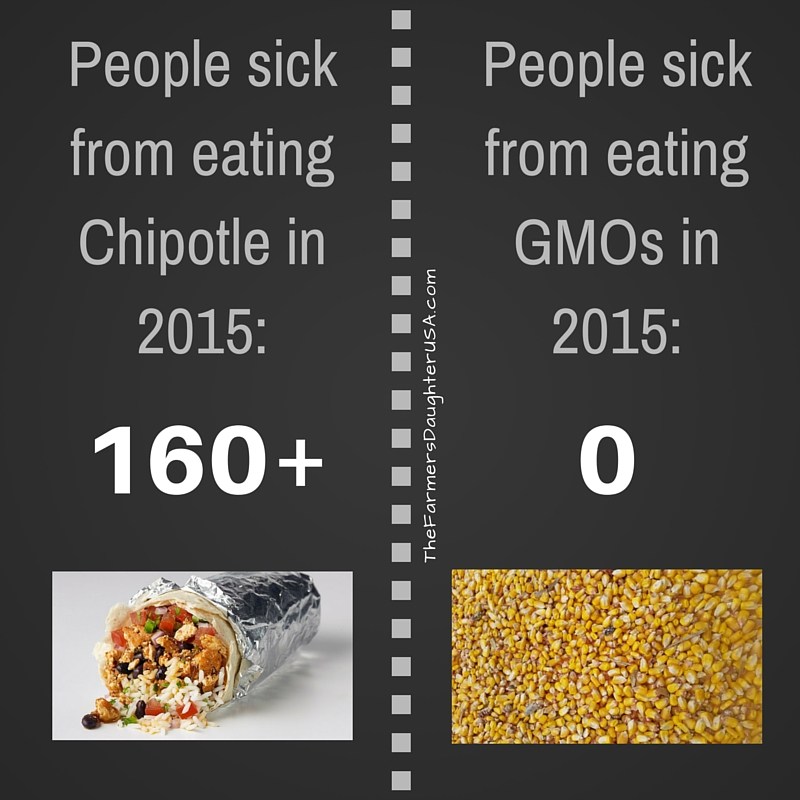
Timothy B. Lee of Vox writes that rather than pandering to groundless fears about GMO safety, Chipotle would have served its customers better by focusing on the very real dangers of food tainted with E. coli, norovirus, or salmonella. Theoretically, it should be able to do both, of course, but like any organization Chipotle has limited resources. A dollar it spends guarding against the overblown threat of GMOs is a dollar it can’t devote to preventing actual health problems.