Brazil quarantines cruise ship over ‘some kind of food poisoning’

My parents are set to return today from their latest cruise out of Florida.

Hopefully their experience was better than that of the 1,987 passengers and 765 crew members aboard the Vision of the Seas, operated by Royal Caribbean International, who were ordered by health officials in Brazil to remain aboard after some 310 people suffered "some kind of food poisoning.”

The ship was allowed to leave Buzios Thursday afternoon and was expected to arrive in Santos around midnight. An agency spokeswoman said passengers who showed no symptoms would be free to leave. Those still ill would be taken to hospitals for treatment, with expenses paid by Royal Caribbean.

Piles of vomit in restaurant and cockroaches in bedrooms on Dominican Republic ‘holiday from Hell’

One of my daughters is planning a trip to the Dominican Republic with a bunch of her friends to celebrate the end of high school.

I told her she had to get vaccinated for hepatitis A, and to be careful with what she ate.

The Northampton Chronicle & Echo reports this morning that piles of vomit, cockroaches in bedrooms and inedible food are among a litany of allegations raised by a group of Northampton (U.K.) holidaymakers in a High Court claim against tour operators First Choice.

Five groups from the town are suing the firm over an alleged "holiday from Hell" in the Dominican Republic, which they say led to them suffering food poisoning.

More than 400 holidaymakers are claiming about £3 million in damages in total, with allegations including faeces in the swimming pool, "stone-cold" food, flies and birds being allowed to pick at the buffet, and a hotel which smelt of sewage.

Claimants allege they suffered acute gastroenteritis following their stay at the all-inclusive four-star Bahia Principe Hotel in San Juan in the summer of 2007.
 

Recipe for cat, the other white meat, gets cooking show host suspended

What better way to celebrate World Cat Day on Feb. 17 (tomorrow, who knew?) than to suggest recipes to prepare the other white meat for deliciousness.

ANSA.it is reporting that the co-host of a popular Italian daytime cooking show was suspended on Monday for extolling the delights of cat meat during an episode last week.

Beppe Bigazzi, a food expert on La Prova del Cuoco (The Cooks’ Challenge), enraged animal rights experts around the country when he gave advice on preparing ”tender, white cat meat” in a portion of the show usually reserved for advice about nutrition.

The Italian Animal Protection Agency said they were ”satisfied” with the timeliness of Bigazzi’s suspension in view of World Cat Day on February 17.

While cat meat is illegal in Italy, it is a popular winter dish throughout China and much of Southeast Asia.
 

Food on pins and needles

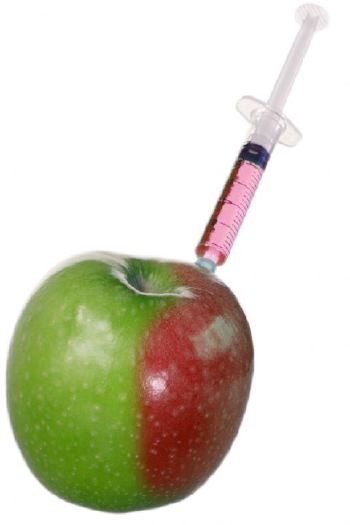
Some punk in Calgary may be running around with, as the Edmonton Sun says, “a box of pins and a brain half as sharp” after the Calgary Co-op brought in police for the second time in a month over what appears to be food tampering.

Oscar Chaves of New Bedford, Mass., claims he ended up in hospital after allegedly biting into a metal needle in the middle of his Burger King Double Whopper.

Food service and retail is a tough business, one that is prone to fraud, allegations and errors.

The man with the Whopper called Burger King to ask them to pick up the more than $15,000 in medical bills that he accrued. He says someone told him that they’d get back to him in two days. That was more than a year ago, and he’s still waiting.

In mid-Jan., the Co-op found sewing needles, pins and buttons found in juice bottles, cheese and bread. This time, it’s a tub of margarine with a pin-sized hole pierced straight through the lid, plastic safety film and deep into the food inside.

Rigorous food safety programs, verification and even video documentation can help anyone in the farm-to-fork food safety system improve their operations and defend against malicious attacks.
 

Anthony Bourdain, Bill Murray and taking food porn to the radio masses

Celebrity chef, author and TV host Anthony Bourdain is sorta interesting, but then gets sorta boring — Hunter S. Thompson-lite.

Everyone’s gaga that he got thespian Bill Murray to sit down for lunch in front of the cameras in a show broadcast last week (I didn’t see it). The promo below has enough teasers.

But what’s really got the foodies going is that Bourdain is launching a setellite radio show Sirius XM’s Martha Stewart Living Radio, with one of the stated goals to see how uncomfortable he can make co-host and chef friend Eric Ripert, all while expanding America’s notion of food porn.

"We’re going to be doing a segment that we call food porn," he said in a telephone interview, referring to the excessively sumptuous and sometimes sexualized words and photography often used in food media.

"We’re going to challenge each other to describe in as purple a language as possible some food we’ve had. I’m trying to see whether we can expand the food porn genre into radio. And I think we can do it."
 

Does my food make you randy? Valentine’s edition

Dr. Ruth once famously said, “The most important sex organ lies between the ears.”

Yet people continue to look for a push, pharmaceutically through Viagra and numerous spam e-mail spin-offs, and, with Valentine’s Day approaching, through food.

Sarah Kershaw of the New York Times writes that certain foods with aphrodisiac status, like basil, rosemary, saffron, honey, grapes and pine nuts, were coveted for their great libidinal powers by ancient Greeks and Romans and medieval Europeans. Or, like foie gras, caviar, truffles and Champagne, they were exalted as romantic gifts because of their rarity and luxury.

Others, like figs, asparagus and cucumbers, have long been seen as erotic because of their resemblance to the male and female sex organs (we had asparagus, salmon and sweet potato for lunch yesterday; made Amy a sald with salmon, pine nuts, walnuts and strawberries for lunch today).

Foods with nutrients that could potentially enhance fertility and virility have drawn more interest from researchers, cooks and practitioners of alternative medicine in recent years. Among them is, again, the oyster, which contains zinc, linked to increased sperm production. (However, a zinc-deficient person would have to mow down enormous quantities of oysters before he noticed a difference.) Garlic contains an amino acid that enhances blood flow and could augment erections, according to Meryl S. Rosofsky, a doctor and adjunct professor in the department of nutrition, food studies and public health at New York University.

Rachel S. Herz, an expert in the psychology of smell, wrote in her book “The Scent of Desire” (William Morrow, 2007) that “Asians consider the smell of cheese to be hideous, yet westerners regard it as anything from comfort food to sumptuous indulgence.”

Researchers have uncovered strong links between scent, emotion and sexual attraction. Smell can induce emotion that then triggers neurochemical changes, Dr. Herz said. Of all the senses, she said, it is the only one that bypasses the conscious parts of the brain and goes directly to the limbic system, the region responsible for basic memory, motivation and emotion.

Smell evolved for finding both food and mates, and much research has found that body odor plays a powerful role in human attraction.

This is why I should shower more often.

The nostalgic recall triggered by odors, known as the Proustian Effect, has been embraced by some chefs who believe that eating should be a full-sensory experience, involving taste, smell and even sound.

Heston Blumenthal, of the Fat Duck in Bray, England, invites diners to write down childhood food recollections and uses those musings for inspiration for future dishes.

I’m sure the over 500 people who barfed from norovirus after dining at Blumenthal’s Fat Duck will want to recreate that, especially the sounds, at their next meal.

Leg of lamb from the cheap meat section at the supermarket tonight for dinner, with lots of rosemary. Maybe even some champagne.

But, as Kershaw notes, Shakespeare warned in Macbeth: Alcohol “provokes the desire, but it takes away the performance.”

 

Iguana for you? The biological risks of eating reptiles

A study published last year in the International Journal of Food Microbiology shows that people can catch certain diseases (trichinosis, pentastomiasis, gnathostomiasis and sparganosis) by eating the meat of reptiles such as crocodiles, turtles, lizards or snakes (or iguanas, right).

Simone Magnino, lead author of the study and a researcher for the World Health Organization (WHO), told the Spanish Foundation for Science and Technology that,

"The clearest microbiological risk comes from the possible presence of pathogenic bacteria, especially Salmonella, and also Shigella, Escherichia coli, Yersinia enterolitica, Campylobacter, Clostridium and Staphylococcus aureus, which can cause illnesses of varying degrees of severity."

This expert says the data about risks to public health are still inconclusive, since there is no comparative information about consuming this meat and the prevalence of pathogens. Also, there are few published research articles about cases of illness associated with consuming reptile meat.

The experts advise people to freeze the meat, just as they would with other foods from animal sources, since this deactivates parasites. Industrial processing and proper cooking (not leaving the meat raw) can also kill off pathogens.

Citation: Simone Magnino, Pierre Colin, Eduardo Dei-Cas, Mogens Madsen, Jim McLauchlin, Karsten Nöckler, Miguel Prieto Maradona, Eirini Tsigarida, Emmanuel Vanopdenbosch and Carlos Van Peteghem. "Biological risks associated with consumption of reptile products." International Journal of Food Microbiology 134 (2009) 163, September 2009.
 

Capitals win streak set to end at 13, and 13 grossest food stories of all time

The sun is out in Washington, D.C., as the city begins to dig out from record snowfall and even worse television commentary (why do so many people in D.C. apparently own cross-country skis when it rarely snows enough to use them?).
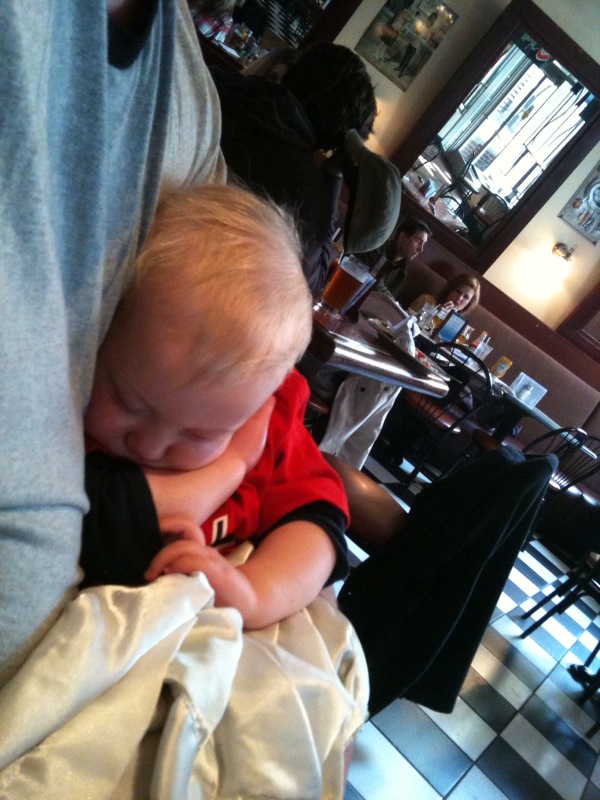
The Capitals-Pens hockey game was sold out, the teenager was asleep, and after a walk we soon found ourselves in a bar to watch the hyped pre-Super Bowl noontime game showcased on national TV. The Caps 13-game winning streak is in danger with the Pens leading 4-2 after 2 periods. Sorenne in her Ovechkin shirt fell asleep in my arms, although her eyes briefly opened for this pic (right). 

The Consumerist just published its top 13 grossest food stories of all time – or from the past 4 years or so. I’ll just run the headlines here.

Customer Claims There Was Human Blood in Her Taco Bell

This Kmart Bacon Is Excellent, But Could Use Some More Fat

Applebee’s Apple Walnut Chicken Salad, Now With Free Insect Leg

Reader Says He Found Brains In His KFC

Dead Bugs Found In Health Valley Soup

Customer Claims McDonald’s Gave Her Mucus-Filled Iced Tea

Snakehead Found In T.G.I.F. Sandwich

Pardon Me, But There Is A Mouse In This Can Of Diet Pepsi Good News,That Dead Mouse In Your Diet Pepsi Was Actually A Toad

Man Claims To Have Found Condom In Soup

Loaf Of Bread Comes With Baked-In Rodent Goodness

This Weight Watchers Meal Includes A Free Frozen Frog
(Addendum: I suck at this prediction thing; Caps win 5-4 in OT)

Ireland reports 17% increase in food safety enforcement orders in 2009

The Food Safety Authority of Ireland (FSAI) today stated that there were a total of 54 Enforcement Orders – including 34 Closure Orders — served for breaches in food safety legislation in 2009 compared with 46 in 2008, an increase totaling 17%.

The FSAI today re-emphasized that it is unacceptable that food businesses were continuing to breach food safety laws and warned all food business operators to place robust food safety measures and hygiene practices top of their agenda for the new decade or face the full rigors of the law being imposed.

Prof Alan Reilly, Chief Executive, FSAI, said,

“Consumers have to be confident that the food they are eating is safe to eat and the FSAI will continue to take a zero tolerance policy to breaches of food safety legislation. Food business operators should take full advantage of the information and support made available by the FSAI and its official agencies to ensure a basic and consistent food safety management plan is developed and put in place in line with legislation.”