
Talk less, do more.
That’s what I’m telling 5-year-old Sorenne as she explains for the eighth time she’s about to go get her shoes on, so we can walk to school.
And after 20 years of food safety stuff, it’s my go-to response to any corporate head of  food safety.
I understand that talking has a role, that meetings have a role, but only if they translate into tangible outcomes. With food safety, for me, that has always meant, will fewer people barf?
A month ago, Amy proclaimed, based on her acquired food safety knowledge, that she may have sickened Sorenne after a serving of frozen chicken thingies from Coles (that’s a supermarket chain in Australia).
The label did not indicate whether they were fully cooked and frozen, or frozen raw.
Raw, frozen not-ready-to-eat entrees purchased in retail and prepared in the home have been identified as a significant risk factor for salmonellosis. From 1998 to 2008, eight separate outbreaks have implicated undercooked chicken nuggets, chicken strips, and stuffed chicken entrees.
I guess someone other than my mother and Ben and Amy read what I write, because someone from Coles e-mailed me in response to the Jan. post to say: “Kansas State’s loss is Australia’s gain and it would be great to talk to you to 1) answer your query on nuggets (apologies it took so long, that’s not acceptable and we will put that right) and 2) to explore opportunities to get your unique insight into Australian retail and your experience’s so far.”
We talked.
He said him and Jackie Healing, who spoke today at the Global Food Safety Initiative shindig in California, would love to come and visit with me and go through a local Coles on a food safety tour.
Those chicken nuggets? Flash fried so the breading sticks, but not cooked to a microbiologically safe temperature. Nothing on the label, no cooking instructions for microbiological safety. How would a consumer know?
I never heard back.
That’s normal; lots of talk, little action. I’ll go hang out with my 5-year-old.
Self-reported and observed behavior of primary meal preparers and adolescents during preparation of frozen, uncooked, breaded chicken products
01.nov.09
British Food Journal, Vol 111, Issue 9, p 915-929
Sarah DeDonder, Casey J. Jacob, Brae V. Surgeoner, Benjamin Chapman, Randall Phebus, Douglas A. Powell
Abstract:
Purpose – The purpose of the present study was to observe the preparation practices of both adult and young consumers using frozen, uncooked, breaded chicken products,  which were previously involved in outbreaks linked to consumer mishandling. The study also sought to observe behaviors of adolescents as home food preparers. Finally, the study aimed to compare food handler behaviors with those prescribed on product labels.
Design/methodology/approach – The study sought, through video observation and self-report surveys, to determine if differences exist between consumers’ intent and actual behavior.
Findings – A survey study of consumer reactions to safe food-handling labels on raw meat and poultry products suggested that instructions for safe handling found on labels had only limited influence on consumer practices. The labels studied by these researchers were found on the packaging of chicken products examined in the current study alongside step-by-step cooking instructions. Observational techniques, as mentioned above, provide a different perception of consumer behaviors.
Originality/value – This paper finds areas that have not been studied in previous observational research and is an excellent addition to existing literature.
Mathiasen, L.A., Chapman, B.J., Lacroix, B.J. and Powell, D.A. 2004. Spot the mistake: Television cooking shows as a source of food safety information, Food Protection Trends 24(5): 328-334.
Consumers receive information on food preparation from a variety of sources. Numerous studies conducted over the past six years demonstrate that television is one of the primary sources for North Americans. This research reports on an examination and categorization of messages that television food and cooking programs provide to viewers about preparing food safely. During June 2002 and 2003, television food and cooking programs were recorded and reviewed, using a defined list of food safety practices based on criteria  established by Food Safety Network researchers. Most surveyed programs were shown on Food Network Canada, a specialty cable channel. On average, 30 percent of the programs viewed were produced in Canada, with the remainder produced in the United States or United Kingdom. Sixty hours of content analysis revealed that the programs contained a total of 916 poor food-handling incidents. When negative food handling behaviors were compared to positive food handling behaviors, it was found that for each positive food handling behavior observed, 13 negative behaviors were observed. Common food safety errors included a lack of hand washing, cross-contamination and time-temperature violations. While television food and cooking programs are an entertainment source, there is an opportunity to improve their content so as to promote safe food handling.
 the liar really care about the facts but the bullshitter isn’t concerned with the facts except insofar as they may be pertinent to his interest in getting away with what he says: “He does not care whether the things he says describe reality correctly. He just picks them up, or makes them up, to suit his purposes.”
 sustainable — it is not), brown eggs (trying to create the impression they are different nutritionally from white eggs — they are not), and non-GMO (trying to create the impression the product is safer — it is not).
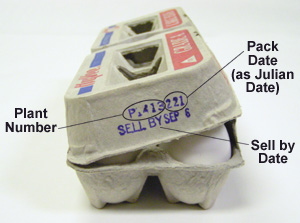 Yet last week, Approved Foods, announced that its sales for the final week of December were up a staggering 500 per cent year on year. At sites such as Approved Foods and Bargainfoods.co.uk, you can pick up four tins of pinto beans for £1, or a can of tuna for 59p. Or how about four Toblerones for 99p? There’s nothing wrong with the foods. They’re just coming up to their "use-by" dates or have gone beyond their "best before" dates.
 Two lasagnas were required to feed the crew, and were cooked in the oven at the same time.
 I attempted to call the Stouffer’s consumer hotline , but it’s only open Monday to Friday, because people don’t eat frozen entrees on the weekend.
.jpg) "The owner of Mona Lisa pasta says his kitchen is not to blame for six central Virginia dinner guests coming down with salmonella. While he says he sold the frozen lasagna, it was not his kitchen that was responsible for cooking it to code.
"The owner of Mona Lisa pasta says his kitchen is not to blame for six central Virginia dinner guests coming down with salmonella. While he says he sold the frozen lasagna, it was not his kitchen that was responsible for cooking it to code.
 Thanksgiving was a decidedly low-key affair this year. As the parents of a soon-to-be 1-year-old, we’re just tired. We’ve been to a baby shower, hosted a birthday party with too much good scotch (and turkey) and are driving to Missouri on Saturday, so we were all happy to hang out in our PJs.
.jpg) Sarah Wilson, my composed colleague from the Guelph days, drafted the proposal and it got funded by the American Meat Institute.
Sarah Wilson, my composed colleague from the Guelph days, drafted the proposal and it got funded by the American Meat Institute. .jpg) As the number and type of convenience meal solutions increases — check out the frozen food section of a local supermarket — the researchers found a need to understand how both adults and adolescents are preparing these products and what can be done to enhance the safety of frozen foods.
As the number and type of convenience meal solutions increases — check out the frozen food section of a local supermarket — the researchers found a need to understand how both adults and adolescents are preparing these products and what can be done to enhance the safety of frozen foods. .jpg) Faith-based food safety systems are prevalent from the farmer’s market to the supermarket, especially in the produce section. And almost anything can, and is, claimed on food labels – except microbial food safety.
Faith-based food safety systems are prevalent from the farmer’s market to the supermarket, especially in the produce section. And almost anything can, and is, claimed on food labels – except microbial food safety..jpg) Maple Leaf Foods, whose listeria-laden cold-cuts killed 22 Canadians last year, is continuing on its bad
Maple Leaf Foods, whose listeria-laden cold-cuts killed 22 Canadians last year, is continuing on its bad .jpeg)
 Simon Simpkins, a Pontefract, West Yorkshire, U.K. father of two, says
 The impact of the infection has been especially severe for Rivera and nine other victims who developed a life-threatening complication known as hemolytic uremic syndrome. One, a 4-year-old girl from South Carolina, had a stroke and is partially paralyzed.
 Labeling is a lousy way to provide information about food safety risks, but better than nothing. I’m sure Nestle and ConAgra, in the best interests of their consumers, will publicly release the evaluative data they (probably? maybe?) acquired to show that these particular labels have a positive impact on consumer food safety behavior.
 Another outlet, Calicut Paragon in Karama, invested their resources in stickers for take-out bags that advise consumers to eat their food within two hours of purchase—a step that suggests a shared responsibility for the safety of food and that I find a little more palatable.