Campy in NZ: Just cook it still don’t cut it

The New Zealand Government is, according to the Herald, reviewing what a public health expert calls disgraceful levels of a dangerous bacteria in chicken.

campy.chickenNearly a third of carcasses examined as part of the Ministry of Primary Industries’ testing regime in the first half of last year were contaminated by campylobacter, the most common cause of foodborne illness in New Zealand, documents released under the Official Information Act reveal.

That is down from almost half of those tested in 2007, when new regulations were introduced to control the bug. But Otago University Public Health professor Michael Baker said the contamination levels were unacceptable.

“The industry has always argued that, ‘well, the consumer’s got to be responsible and cook it properly’, but most people don’t realize that raw chicken is about the most hazardous thing you can bring into your kitchen,” he told the Herald on Sunday.

“Most foods have bacteria on them, that’s just a fact of life. But there are some pathogens that we can’t cope with and campylobacter is one of them.”

Health ministry figures showed at least 6,837 people suffered from the illness in 2013. It also results in several deaths most years.

Former Green Party co-leader Rod Donald died in November 2005 of a heart infection after a bout of campylobacter. The source of the food poisoning was never proven.

Ministry for Primary Industries’ production and processing manager Sharon Wagener confirmed the department was reviewing chicken processing regulations to see what improvements could be made.

Wagener pointed out that the bacteria were easily killed by correct cooking so people had nothing to worry about if they cooked the meat properly.

“We’re not putting the onus totally on the consumer, we’re working with the producers to try to get [campylobacter levels] as low as possible,” she said.

Baker said it was disgraceful that campylobacter was still able to cause such mayhem. The main issue was cross-contamination, for which there were multiple opportunities from slaughter to the dinner table.

“Every week there are thousands of people making mistakes and there will be dozens of cases,” he said.

Although it was impossible to eliminate campylobacter from chicken, there needed to be far lower limits on the number of contaminated chickens and the levels of contamination, Baker said.

It’s in poop: Campylobacter jejuni in urban wild birds and pets in New Zealand

Greater attention has been given to Campylobacter jejuni (C. jejuni) prevalence in poultry and ruminants as they are regarded as the major contributing reservoirs of human campylobacteriosis.

sadie.dog.powellHowever, relatively little work has been done to assess the prevalence in urban wild birds and pets in New Zealand, a country with the highest campylobacteriosis notification rates. Therefore, the aim of the study was to assess the faeco-prevalence of C. jejuni in urban wild birds and pets and its temporal trend in the Manawatu region of New Zealand.

Findings: A repeated cross-sectional study was conducted from April 2008 to July 2009, where faecal samples were collected from 906 ducks, 835 starlings, 23 Canadian goose, 2 swans, 2 pied stilts, 498 dogs and 82 cats. The faeco-prevalence of C. jejuni was 20% in ducks, 18% in starlings, 9% in Canadian goose, 5% in dogs and 7% in cats. The faeco-prevalence of C. jejuni was relatively higher during warmer months of the year in ducks, starlings and dogs while starlings showed increased winter prevalence. No such trend could be assessed in Canadian goose, swans, pied stilts and cats as samples could not be collected for the entire study period from these species.

Conclusions: This study estimated the faeco-prevalence of C. jejuni in different animal species where the prevalence was relatively high during warmer months in general. However, there was relative increase in winter prevalence in starlings.

The urban wild bird species and pets may be considered potential risk factors for human campylobacteriosis in New Zealand, particularly in small children.

Faeco-prevalence of Campylobacter jejuni in urban wild birds and pets in New Zealand

BMC Research Notes 2015, 8:1


Botulism: Rice snack shuts down New Zealand man’s organs

A spicy rice snack pack very nearly turned into the last meal Richard Strang ate.

IMG_8529It left him in a four-day induced coma in Wellington Hospital, his stay due to a toxin not seen in New Zealand for more than 30 years.

Strang, who had been living in Japan, was visiting his mother in Wellington last month when he ate a pack of pre-cooked “heat and eat” organic risotto that was probably well past its best-before date.

He was struck down by botulism, a rare and potentially fatal illness caused by a toxin that attacks the nervous system.

His lungs and other organs began shutting down, and “it was all pretty much touch and go”, he said.

The last – and only – suspected case was that of two Rotorua sisters thought to have contracted botulism from watercress and boiled mussels in 1984.

Botulism was also the toxin wrongly thought to have been present in a batch of whey sent to China by Fonterra in 2013.

Strang is still going through rehabilitation, and needs to stay in New Zealand until he regains enough strength to return to Japan.

The Ministry for Primary Industries said the rice snack he ate contained no preservatives, and “incorrect handling” was thought to be the cause of his illness.

The meal had been made following appropriate regulations, but MPI understood it was not refrigerated, as instructed, and was eaten “well after its likely best-before date”.

Food complaints on NZ menu

A burger containing live maggots, premium angus mince containing a piece of glass and juice with a cockroach in it were among 15 Napier-based food safety complaints made to the New Zealand Ministry of Primary Industries in the past three years.

napier.foodThere were eight complaints last year and four as of November this year.

Some cases were referred to local authorities, others required the ministry to send an educational letter.

The good news for Napier was annual inspections of commercial food premises generally reflected a high standard of hygiene, Napier City Council regulatory services manager Mike Webster said.

“Napier City and Hastings District have consistently been in the top 10 performing territorial authorities when it comes to food premises adopting the new more rigorous food control plans which should hopefully assure a high standard of food safety,” he said.

Food-borne illness struck about 200,000 New Zealanders every year, according to the Ministry of Primary Industries (MPI).

Nearly half of these were attributed to food handling, preparation or storage in the home.

“I would like to see the numbers for food-borne illness reduced substantially but part of that will rely on improving our education of the general public safe food handling practices especially ‘clean, cover, cook, chill’,” Mr Webster said.

“If these four things were done thoroughly in every home and business, foodborne illness would drop dramatically in New Zealand.”

Uh-huh. Unimaginative messages from unimaginative people.

C.J. Jacob and D.A. Powell. 2009. Where does foodborne illness happen—in the home, at foodservice, or elsewhere—and does it matter? Foodborne Pathogens and Disease. November 2009, 6(9): 1121-1123

Foodservice professionals, politicians, and the media are often cited making claims as to which locations most often expose consumers to foodborne pathogens. Many times, it is implied that most foodborne illnesses originate from food consumed where dishes are prepared to order, such as restaurants or in private homes. The manner in which the question is posed and answered frequently reveals a speculative bias that either favors homemade or foodservice meals as the most common source of foodborne pathogens. Many answers have little or no scientific grounding, while others use data compiled by passive surveillance systems. Current surveillance systems focus on the place where food is consumed rather than the point where food is contaminated. Rather than focusing on the location of consumption—and blaming consumers and others—analysis of the steps leading to foodborne illness should center on the causes of contamination in a complex farm-to-fork food safety system.

Maybe it was the sheep and pigs hanging in trees: NZ warning over illegal home-kill

Officials are warning people about the food safety risk of buying illegal home-kill meat for Christmas after a Far North man was nabbed for selling sheep and pigs.

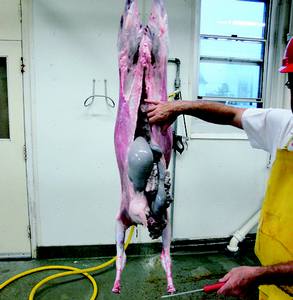
home-butchering-eviscerationMinistry for Primary Industries compliance officers shut down an illegal home-kill operation in Kaitaia in September, but fear it may be the tip of the iceberg in the Far North. The man was issued with a written warning after reports of sheep and pig carcasses hanging in trees. Officials said it was at the lower end of offending but posed a serious health risk. Illegal home-kill includes meat bought direct from a stock owner, animals bought and slaughtered on site and animals bought and taken home for immediate slaughter.

MPI Northland District Compliance Manager Steve Rudsdale said illegal home-kill was not inspected for disease and consumers had no guarantee it had been processed hygienically.

Vomit cruise hits New Zealand; infection control steps shared

I’ve never been on a cruise vacation. The closest I’ve been is a river boat dinner voyage in New Orleans. Not quite the same thing. I can’t think of too many better places to conduct some reality research though. With the increased media scrutiny of infection control measures the cruise folks have had to step up their game and respond when an incident happens – and share what they are doing to keep an outbreak from spreading. That helps build trust (if they can verify that steps are correctly being followed).pr_dawn

According to the Otago Daily Times (NZ), when the Princess Cruise Lines’ Dawn Princess docked in Port Chalmers any affected passengers were not able to come in contact with others (on and off the ship – which was a concern for the kiwi media).

About 200 passengers have been confined to their cabins after the norovirus bug spread through the cruise ship while on a trip around New Zealand.

Canterbury Medical Officer of Health Dr Alistair Humphrey said Dawn Princess had its own doctor on board and the ship’s crew were confident they could control the situation.

The cruise line spokesman said most passengers were unaffected by the outbreak and it took relatively few cases for stringent sanitation levels to be implemented to contain any spread of the illness.

The proactive onboard response included disinfecting high-touch surfaces such as railings, door handles and lift buttons; isolating ill passengers in their cabins; closing all self-service food areas; and encouraging passengers to use their own cabin bathroom facilities, he said.

Although he would not confirm if any passengers visiting Dunedin had norovirus, if they did it was standard protocol for the relevant public health authorities to be notified and those passengers would remain isolated in their cabins.

27 sickened with Salmonella in New Zealand linked to consumption of contaminated tahini imported from Turkey

A widespread salmonellosis outbreak linked to consumption of hummus made from contaminated tahini imported from Turkey occurred in New Zealand in November 2012.

tahiniThis article summarizes the outbreak detection, investigation, and control. The New Zealand Enteric Reference Laboratory alerted public health units regarding a cluster of 11 persons with Salmonella Montevideo infection identified from different regions of the North Island of New Zealand.

A multiagency outbreak investigation commenced to determine the source of illness and prevent further transmission. Salmonellosis is a notifiable disease in New Zealand. Outbreak cases were identified through routine salmonellosis notifications, and interviewed using a standardized questionnaire to identify common exposures. Clinical and food isolates were initially characterized by serotyping and then further typed by pulsed-field gel electrophoresis (PFGE). PFGE profiles were sent to PulseNet and international alerts were posted. The scope of the investigation widened to include persons with either Salmonella Maastricht and Salmonella Mbandaka infection following detection of these serotypes in tahini epidemiologically linked to laboratory-confirmed cases. All three of the tahini-associated serotypes were detected in people who had consumed tahini, and these were found to have PFGE profiles indistinguishable from the tahini isolates.

Twenty-seven salmonellosis cases infected with at least one of the three tahini-associated Salmonella serotypes were detected between September 1 and December 31, 2012; of these, 16 (59%) cases (12 with Salmonella Montevideo, 3 with Salmonella Mbandaka, and 1 with Salmonella Maastricht infection) had PFGE patterns indistinguishable from the outbreak profile.

The investigation led to a trade withdrawal and consumer recall for tahini sesame paste from the consignment and products containing this tahini. The outbreak ceased following the recall. The importer of the implicated tahini was reminded of his duties as a food importer, including ensuring appropriate product testing. Changes to New Zealand legislation strengthened food safety responsibilities of food importers.

Foodborne Pathogens and Disease, November 2014, 11(11): 887-892

Paine Shevaun, Thornley Craig, Wilson Maurice, Dufour Muriel, Sexton Kerry, Miller Jim, King Grant, Bell Stephen, Bandaranayake Don, and Mackereth Graham

http://online.liebertpub.com/doi/abs/10.1089/fpd.2014.1773

New Zealand to help Chinese food giant in safety

Xinhua reports that China National Cereals, Oils and Foodstuffs Corporation (COFCO), the country’s largest agricultural and food products supplier, has signed an agreement with a New Zealand government-owned food safety firm and a multinational business consultancy to improve China’s food safety and quality.

AsureQuality_logo_737x160COFCO signed the agreement with food safety service firm AsureQuality and PricewaterhouseCoopers (PwC) on the sidelines of the APEC (Asia Pacific Economic Cooperation) leaders meeting in Beijing, said a statement from PwC’s New Zealand office on Monday.

Drawing on leading New Zealand and international food and agricultural models, AsureQuality and PwC would support COFCO in embedding best practice in food safety and quality across the food and agriculture industries.

AsureQuality claims to have 1,700 experts working in 60 locations in Australia, China and Singapore. 

Rodents rife in Wellington eateries

Wellington, NZ, is one of my favorite towns.

But they’ve got some sanitation problems.

doug.powell.new.zealand.musselsRodents and droppings are among cleaning failures found in more than 30 Wellington restaurants, eight of which were forced to close in the past year.

The annual list of city cafes and restaurants issued with cleaning and closures notices in the 2013-14 year has been released to The Dominion Post by Wellington City Council.

It shows a slight improvement on last year, with 31 notices compared to 38.

But more premises were forced to shut: seven businesses received closure notices, compared with four the previous year.

Wellington has about 1300 eating premises. Each is given a rating of excellent, very good or ungraded, depending on how well they comply with health standards.