Australia has a food safety problem; eateries in Capital ignoring hygiene standards

Maybe it’s payback to the federal politicians in Australia who are utterly clueless about basic food safety and steps to improve public accountability, but Canberra food businesses are flouting food safety laws such as installing a wash basin and cleaning the kitchen, according to the territory’s chief health officer.

The number of improvement notices issued to restaurants, cafes and food stalls in the second half of last year  was more than double  the canberranumber for the same period in 2012.

While some of the 163 notices  were for minor infringements, chief health officer Dr Paul Kelly said “we’re still finding significant problems” with general hygiene standards in some premises.

Among the problems were business owners failing to install a basin for hand washing in food-preparation areas.

Others did not maintain clean kitchens or had been caught out

not storing food at correct temperatures.

“It’s pretty standard infrastructure that you’d think would just be second nature,” Dr Kelly said.

“We’re trying … to work with industry to get them to fix their act by themselves.”

“I think we’ve got a way to go still.’’ he said.

‘‘People who don’t have somewhere to wash their hands in a food-preparation area, with running water and soap – that sort of thing is still there,” he said.

Mr. Heavyfoot goes to buy milk (M. Piedlourd va achete(r) du lait)

Mr. Heavyfoot was a recurring character on the Canadian sketch rest.inspection.mr.heavy.foot.jan.14comedy, Kids in the Hall, 20 years ago, featuring Dave Foley.

His daughter, 10-year-old Alina, has employed her father for a new take that she wrote and directed.

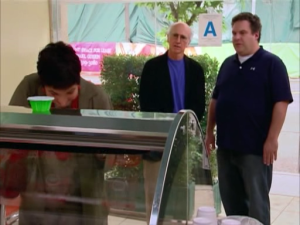
But that’s not France, the A grade in the window makes me think Los Angeles.


Water? We don’t need no stinkin’ water, we’ve got gloves; Subway in Maryland

Russ Ptacek of WUSA CBS Channel 9 reports that armed guards at Beltway Plaza Mall prevented our camera crew from recording video of restaurants cited and closed for operating without running water, but a producer managed to take iPhone photos before STINKINGBADGES-1ebeing escorted out.

In Greenbelt, citing operating without running water during a water main break, health inspectors temporarily closed: Subway, Beltway Plaza Mall, 6000 Greenbelt Road; Three Brothers, Beltway Plaza Mall, 6000 Greenbelt Road; Kalpena Dip-N-Depot, Beltway Plaza Mall, 6000 Greenbelt Road; and Heaven Bakery, Beltway Plaza Mall, 6000 Greenbelt Road.

All the restaurants passed re-inspection and are back in business.

At the Beltway Plaza Mall Subway, a manager told us he didn’t believe operating during the water outage was a problem because workers wear gloves.

Health experts say contaminated hands can contaminate clean gloves and workers should wash hands every time they change tasks, especially after using the restroom.

When a restaurant review turns to barf, it’s time to rethink restaurant inspections

Brad A. Johnson of the Orange County Register in California was planning to review a restaurant in Newport Beach this week. Instead, he got food poisoning there. Everyone at his table got sick. Unspeakably sick. For days. It was awful.

As the sickness intensified, Johnson went online and looked up health inspection reports for the restaurant. Inspections are a matter of public record, but nobody ever looks at larry.david.rest.inspecthem. This place has received a serious violation on every one of its inspections since opening two years ago. Coincidence?
Johnson  writes, If this restaurant had opened in Los Angeles instead of Newport Beach, it would have to display a letter grade of C, or possibly B, in the front window – and I never would have dined there. But because it is in Orange County, there’s no indication whatsoever that this place has been cited repeatedly for problems that pose very serious and immediate health risks to its customers.

It’s time to restart the debate about letter grades for restaurant health inspections in Orange County.

I’ve been reviewing restaurants in Orange County for a little more than a year now, and I’ve been poisoned on four separate occasions. This most recent case was by far the worst.

I worked as a restaurant critic in Los Angeles for 10 years. I always made a point of not reviewing restaurants with a grade lower than A. And I got sick only twice. Another coincidence?

Restaurants in Orange County are allowed to repeatedly fail their inspections without any consequences. They can “fix” the problem – but not the underlying behavior or lackadaisical mentality – and be back in business in a matter of minutes. Even in instances where the health department shuts down a restaurant and revokes its permit, the restaurant can go buy a new one and be right back in business, sometimes the same day.

The placards currently displayed in restaurant windows in Orange County are useless. A restaurant might pass inspection by the skin of its teeth, with serious repeat violations, yet it gets the exact same placard as a restaurant that receives a near-perfect score. That’s messed up. That’s why I got sick.

In 2008, Orange County came close to adapting a letter-grade system similar to the ones used effectively in Los Angeles, San Francisco, San Diego, Riverside, New York, Philadelphia and many other places. The Orange County Grand Jury looked into the matter and, after hearing extensive testimony from consumers and restaurateurs, strongly jake.gyllenhaal.rest.inspection.disclosurerecommended adapting a letter-grade or color-coded system that would give consumers a clearer picture of every restaurant’s health score. County health inspectors backed the idea. This paper wrote extensively about the process and determined that if Orange County were to institute a letter-grade system, roughly 40 percent of the restaurants here would fail to score an A.

Meanwhile in Pennsylvania, the Allegheny County Health Department soon will roll out the A, B, C and Ds of a new restaurant grading program, officials said.

Critics, though, worry that a letter grade could misinform diners and unfairly hurt businesses. 

Getting caught altering an inspection report probably isn’t great for business

Posting restaurant inspection results on regulatory websites and on media sites are a good exercise in public engagement, can increase discussion and sometimes lead to eating decisions. I like to read through the restaurant inspection report summaries we pick up through Google Alerts to see what’s going on. Sometimes the reports are all yuck and no risk factor – as they are often handpicked by media outlets. Often there are some decent examples of that can be used to show folks what not to do.sunday-brunch-tho

Like changing the date on a good inspection and replacing your current report with the old one.

According to the Dacula Patch, that’s exactly what Peking Chinese Restaurant was caught doing last week (amongst other stuff including some repeat violations).


Peking Chinese Restaurant
831 Auburn Road, Suite 610
Score: 90
Last Inspection: 12/26/13
Click here for report.

Observations and corrective actions:

  • Violation of Code: [.07(6)(l) ] Observed can of Raid and Home Defense bug spray being stored in facility. Both labeled for home use only. Only pesticided indicated to be used in food service establishments may be used. Both were discarded during inspection.  Corrected On-Site.  New Violation.
  • Violation of Code: [.10(2)(g) ] Inspection report from 12/14/11 posted. Inspection report had been altered to say 12/14/13. Most recent inspection must be posted at all times. Previous inspection report was voided.  New Violation.
  • Violation of Code: [.05(6)(r) ] Soy sauce buckets being reused for food storage. Single use items may not be reused for food storage. **PLEASE NOTE THIS IS A REPEAT VIOLATION**  Repeat Violation.
  • Violation of Code: [.05(10)(g)(1)&(3) ] Single use containers stored out of protective sleeve with food surface up. Single use items must be protected from contamination by being inverted or stored in protective sleeve received in. All were inverted during inspection.  Corrected On-Site.  New Violation.
  • Violation of Code: [.05(7)(a)2,3 ] Sides of fryers and wok station observed with accumulation of grease. Equipment must be cleaned at a frequency to prevent accumulations.  New Violation.
  • Violation of Code: [.07(5)(d) ] Hood filters observed with dripping oil. Ventilation system must be cleaned at a frequency to prevent accumulations. Increase cleaning frequency. **PLEASE NOTE THIS IS A REPEAT VIOLATION**  Repeat Violation.

Pretty shifty stuff.

Food safety breaches worse than ever in Irish restaurants

This year has proven the worst ever for food safety breaches, with a record 118 businesses receiving closure orders. These are only issued when there is deemed likely to be a “grave and immediate danger to public health”.

This year’s grim tally is up 30 per cent on the 2012 closure rate and there are now four Irish-Pubtimes as many closures as there were in 2006.

However, in the vast majority of cases, the orders were lifted within days or weeks, showing that major structural changes were not required to comply with food safety requirements.

FSAI chief executive Prof Alan Reilly warned this month that health inspectors would continue to operate a zero-tolerance policy to food safety breaches, with extra vigilance needed during the busy Christmas period when increased volumes of food were being supplied.

Shanghai restaurant inspection notices to provide more info via smartphones

Shanghai’s food safety watchdog will, according to The Global Times, add two-dimensional barcodes to its ubiquitous restaurant inspection notices so diners can have more information about an eatery’s sanitary conditions, local media reported.

The barcodes, which can be scanned with a smartphone, will give diners access to a restaurant’s inspection records for the past year and discourage it from falsifying the shanghai.rest.inspect.notices.

Scanning the barcode will provide diners with information such as the date of the restaurant’s last inspection, a list of reasons why it failed an inspection and the identity of its food supplier, according to the Shanghai Morning Post.

The Shanghai Food and Drug Administration did not disclose when it will start updating the inspection notices.

The notices are known for their smiley face grading system. According to the three-tiered system, a green smiley face means a restaurant has exceeded inspection requirements. A yellow face means the restaurant passed the inspection and a red frowny face means it failed.

Restaurants are required to post the notices in a visible location so customers can easily scan the barcodes, according to the report.

The administration plans to launch its own smartphone application so diners can review a restaurant’s inspection results before they even set foot inside.

Restaurant food safety in US

There’s a lot of talking in the four papers about restaurant food safety sponsored by the U.S Centers for Disease Control in the latest issue of the Journal of Food Protection, but not a lot of solutions.

Doug Powell 007 Policies need to be developed and workers trained.

Uh-huh.

We’ve developed on-farm food safety programs for fresh produce when it wasn’t fashionable; we’ve examined whether worker training strategies work; we’ve developed training tools like food safety infosheets, we’ve watched a lot of video.

These findings indicate that restaurant chicken preparation and cooking practices and manager food safety knowledge need improvement. “

Some useful research would be, how best to improve restaurant practices?

How Chinese will be able to sue over bad food

I like the cash prizes part in the story below from the China Post, building on other initiatives, like Chapman’s #citizenfoodsafety effort. We all eat.

A panel discussion at the 2013 National Food Safety Meeting earlier in Dec.  focused on how Chinese consumers could better be compensated if they are negatively affected by doug.ben.13food products with mislabeled ingredients or tainted with illegal additives.

Chairing the panel, Professor Huang Li of National Chengchi University said that consumers have been put at a disadvantage when involved in food safety incidents. For instance, they are required to show invoices to claim compensation. “This means ‘no invoice, no compensation,’ in sharp contrast to big-name vendors, who are able to retrieve tens of millions of New Taiwan dollars in compensation if they suffer losses from selling falsified food products,” Huang said.

A representative of the Consumers’ Foundation at the panel discussion suggested that the government should impose large sum punitive fines on firms which violate the Food Sanitation Act so that consumers can enjoy more compensation.

Meanwhile, Tsai Hong-chih, chairman of the Changhua Medical Alliance for Public Affairs, said that a significant portion of proposed food safety funds should be used to encourage locals to report violations of the Food Sanitation Act, with cash prizes given to informants to be boosted to 30 to 50 percent of fines collected.

19 sick, including 4 UK health inspectors at restaurant featured on Hairy Bikers’ show

It’s ironical that food safety meetings often feature meals of risky foods – like the bowl of raw sprouts in Taiwan last month.

But enacting scientific knowledge in a public setting makes people squirm. Especially if you’re a polite Canadian.

Didn’t work out so well for 10 public health inspectors in the UK after hairy.bikersfour of them fell ill after a night out.

The south Indian restaurant has been closed until further notice until tests confirm the source of an outbreak which has claimed 19 victims in total.

The restaurant, in Leicester, has received five-star ratings in its last three council inspections – the most recent of which was just last month. It has also won awards for its service and standards and has featured on Hairy Bikers’ Best Of British BBC2 show.

I have no idea what the Hairy Bikers show is, but from the title, I can imagine myself yelling at the TV, get a muffler.