Hawaiian bakery fined $20,000 for food safety violations

The Hawaii Department of Health announced Friday that it has reached a $20,000 settlement with Kanemitsu Bakery, which is known for its Molokai sweet bread, over violations related to food being sold under Kanemitsu Bakerypoor sanitary conditions.

Kanemitsu Bakery’s health violations date back to 2000.

More recently, the Department of Health suspended the bakery’s food establishment permit in April 2012 for numerous health code violations and for not complying with orders to stop all sales of products produced at the bakery. The department then closed the bakery after finding serious deficiencies in its maintenance and manufacturing practices, until a plan to correct the conditions was put in place. After failing multiple health inspections, it reopened in November 2012.

$20,000 fine for Gold Coast eatery after health inspectors find roach ridden kitchen

With temperatures heading to 95F (35C), Sorenne is off to the beach today with a friend, before hockey (the ice kind) later this afternoon. I told this to daughter Braunwynn yesterday, who is ordering boat drinks in the 16F (-9C) London, Ontario, and she told me to go f*** myself.

They grow up so fast.

The Sai Tandoori Indian restaurant in up-market Main Beach was first slapped with a clean-up compliance order in March last year after a The Sai Tandoori Indian restaurantroutine inspection from Gold Coast City Council health inspectors uncovered grease, grime and cockroach remains in the food preparation area.

When they came back on July 3, the problem was worse.

A surprise inspection a week later led to owner Sandeep Kumar Soni being charged with two counts of breaching basic food standards under the Food Act.

Photographs were tendered in the Southport Magistrates Court Friday showing live and dead cockroaches littering the restaurant’s kitchen floor, storage areas and above the stovetop, where food was cooking in uncovered pots.

Prosecutor Nick Hatcher, for the council, said when inspectors shifted the deep freezer unit they found a nest of cockroach eggs and numerous live cockroaches.

They also found food waste, grime, grease and dust encrusted on cooking equipment and on the handwashing station, and human hair in the cutlery storage area.

However Mr Hatcher said the restaurant had since been given a clean bill of health.

Magistrate Paul Johnstone ordered him to pay a $20,000 fine, $1500 in professional costs and $83.90 in court costs.

$104K fine for repeat Chinese restaurant failure in Australia

This sounds about right for Australian time.

But at least they have decent penalties.

The Imperial Peking restaurant at Saint Peters in Adelaide was visited by health-types 12 times between 2006 and 2013 and served warning notices on each occasion. The Chinese takeaway was closed for eight Imperial Pekingdays in December 2012.

Prosecutor Paul Kelly told Magistrates Court that failures included insufficient hygiene training of staff.

“This is a significant food business over a number of years. The offending has occurred over a sustained period against a backdrop of warnings … and it continued after the business reopened in December 2012.”

He said the restaurant closure in 2012 saw a sign put up saying it was closed ‘due to a gas leak’.

He fined the company, MustWin Investments Pty Ltd, its cook manager Joel Zhuo Bin Guan, and one of its directors, Di Fei Huang, a total of $104,000 plus costs.

Doing more to make an A; internal inspections, consistency key to good restaurant grades

One busy evening at the Flatiron Room on West 26th Street, a man walked in and announced to a restaurant’s staff that he was there to do a health inspection.

He surveyed every corner of the restaurant, from liquor bottles to egg cartons, and cjake.gyllenhaal.rest.inspection.disclosurehecked the temperature of refrigerators and dishes on the line.

The man, though, according to the Wall Street Journal, wasn’t a city Health Department inspector whose report determines the letter grade plastered in a restaurant’s windows. He was a restaurant consultant performing a mock inspection so that the eatery would be ready for the real thing.

Flatiron Room owner Tommy Tardie has an inspector from Letter Grade Consulting come once a month because he believes a lot rides on what grade his year-old restaurant gets.

“I’m guilty of it. I definitely use [letter grades] as a deciding factor,” said Mr. Tardie, whose restaurant has an A and has been using the consultants for four months. “If I’m walking somewhere and I’m looking for a quick bite to eat, and one is a B and one is an A. It’s a no brainer. I’m going to go to the A.”

The New York City public grade program was introduced in 2010, and in early 2012, the Health Department introduced a smartphone application, which searches all 24,000 restaurants it inspects for letter grades, scores, and all health violations. The app has been downloaded 44,000 times, according to the Health Department.

The business review site Yelp plans to shine even more light on the process by introducing inspection results along with reviews in New York City.

The pressure to pass the inspections leads restaurant owners to seek out restaurant consultants, who can charge $250 for a one-time mock inspection or thousands of dollars for yearly contracts with larger restaurants—including representation at hearings where violations can be contested.

At the Pad Restaurant in Topeka, Kansas, cleaning the walls is a family tradition. Scrubbing down table legs is a rite of passage.

Cleanliness, co-owner Troy Mentzer said, is one of the founding principles of the family business, dating back to when his father started it in 1973.

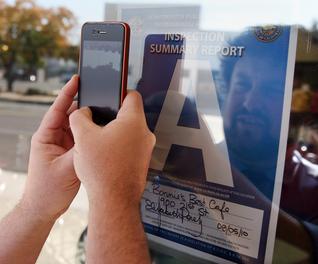
Last year, the restaurant had just three food safety violations. As such, it ranks among 39 Shawnee County restaurants to boast no more than three violations and no follow up visits qr.code.rest.inspection.gradein all of 2013.
For the Pad, that is a complete turnaround from 2012. That year, the restaurant had 31 total violations, earning a place among the county’s worst 20 restaurants for violations.

Mentzer credited the shift to listening to state inspectors, offering consistent food safety training to managers and staff, and a new internal inspection schedule.

“Two years ago, we took a hit and had some violations,” he said. “Now, we self-inspect weekly.”

Washington woman on mission for restaurant grading system

It’s deeply weird or deeply hypocritical that Seattle, self-proclaimed home to many things food and Super Bowl champs, doesn’t have a decent restaurant inspection disclosure system.

Sarah Schaht, a longtime Seattle resident, who had been stricken with E. coli previously, said, “I had internal bleeding and stomach cramps that were debilitating.”

Ambassel Ethiopian Restaurant was closed down by King County health inspectors last jake.gyllenhaal.rest.inspection.disclosureyear.  But the owners have since reopened with a new name: Laco Melza.

Schaht chose the Ethiopian restaurant because customers on Yelp gave it nearly four stars.  What she didn’t know was the restaurant had failed six health inspections since 2010 and had one of the worst inspection scores of any Seattle restaurant last year.

Among the violations on March 6:

-Ready-to-eat food surfaces were being used to prepare raw meat.

-Workers weren’t washing their hands.

-There were insects and rodents in the restaurant.

“You have to be an expert to understand the scoring system,” said Schaht, because there are “red scores, blue scores, unsatisfactory, satisfactory.”

Schaht has started a petition to pressure King County health officials to adopt a simple letter grade system, in which restaurants are required to post an A, B, C or F grade in their front window so diners know how the establishment performed on its latest inspection. Cities in nine states have letter grade requirements, including Los Angeles, San Francisco and New York City.

KIRO 7 took the data from other cities to officials at Public Health–Seattle & King County to ask why they’ve opposed switching to a letter grade system. But they refused our requests for an interview.

Instead, we were given a statement that said the health department is currently looking into the letter grade system, after 1,768 people signed Schaht’s petition.

Eating poop? Make sure it’s cooked; Calgary sushi joint reopens after mouse-poop discovery

Sushi and mouse poop really don’t go together; if you’re going to eat poop, make sure it’s cooked.

Health inspectors shut down a Calgary sushi restaurant last week – because when I think fresh, raw fish, I think Calgary — after finding a “significant amount of mouse droppings,” a Fuji Yama.calgarylive critter in the bar and other upkeep issues.

Fuji Yama on 17th, a late-night hangout for sushi buffs, re-opened 24 hours after being ordered to close by provincial authorities on Jan. 27.

Alberta Health Services spokesman Bruce Conway acknowledged the findings would likely invoke squeamishness for some, but contended it’s not unheard of in the industry.

Six critical health code violations and three others were reported on Jan. 24 during a routine inspection.

Rodent excrement was found in “several areas” of the restaurant such as the pop dispenser closet, dry storage shelving and bar area.

Other critical violations cited included sanitizer without chlorine, no paper towels in the staff washroom, and raw frozen meat refrigerated in containers without lids. Non-critical offences consisted of rusty shelving, missing tiles and an “extreme build up” of food debris on the rice cooker.

On Monday, owner and head chef Francis Tam denied knowledge of the closure and told Metro he was “busy for now” before declining to answer further questions.

Bahrain temporary restaurant source of Salmonella outbreak

Food samples taken from a restaurant following an outbreak of a mass food poisoning have tested positive for Salmonella (no word on how many sickened or source).

Food Control and Diseases Control Section inspectors collected samples from restaurant food and swabs from staff in the aftermath of the food poisoning outbreak. The food control inspectors shut down the main restaurant, which is suspected of causing the food bahrain.autumn.fairpoisoning outbreak, as well as two affiliated branches.

The staff have been suspended from work, administered proper medication and given health tips to avert any future incidence of food poisoning. In another precautionary measure, the stocks of food suspected of being infected with salmonellosis bacteria have also been destroyed.

The inspectors found serious irregularities in storing food at the temporary restaurant branch located at the Autumn Fair. 

Failing food hygiene standards in Welsh primary schools, playgroups and after schools clubs

Hundreds of children and elderly people are being served “substandard” food from kitchens which have failed food hygiene inspections.

Eight primary schools, three after school clubs, four playgroups, and 10 nursery and pre-schools across Wales scored just one or two on the 0-5 rating system in the last 12 months.

Elderly people have also been affected as 30 care homes, three day centres and one wales.food.hygine.grade.feb.14supported living complex were also given hygiene ratings of just one or two.

If a premises drops below a rating of three, their hygiene standards are considered inadequate.

All the inspections were carried out in the last year and are the most recent published on the FSA website – but some schools may have been re-inspected since.

Maine legislators want more than eleven health inspectors

Local and state public health inspectors are some of the most important folks in the food safety world. Especially in places where the philosophy has moved from traditional sanitation observations to risk-based inspections. They are individuals who see what is really going on in kitchens, are often the technical experts for independent restaurants, and are integral in solving outbreaks. welcome_to_maine_sign

In the entire state of Maine, there are 11 of them. According to the Portland Press Herald, this is a problem for some Maine legislators.

The Maine Restaurant Association, the Maine Innkeepers Association and the Maine Tourism Association opposed the bill during a public hearing before the Legislature’s Health and Human Services Committee, which oversees the restaurant inspection program. The industry groups said they fear the bill would confuse restaurant owners with inconsistent rules. 

The state now employs 11 inspectors, each of whom is responsible for inspecting 600 to 800 establishments a year, including restaurants, tattoo parlors, summer camps and inns. 

Cooper’s bill, L.D. 1592, was submitted shortly after the Portland Press Herald/Maine Sunday Telegram exposed weaknesses in state and local inspection programs, including less frequent inspections and less public access to inspection results than all but two other states. The newspaper found that lawmakers reduced the mandated frequency of inspections even as complaints about sanitation or food-borne illnesses increased.

The number of restaurant-related complaints continued to rise through the fall of 2013, according to the latest records provided by the state, as the state inspectors worked to inspect restaurants once every two years. The failure rate of restaurants varied greatly by county.

Testifying for the restaurant association, Richard Grotton, the group’s former chief executive officer, said millions of people eat in Maine restaurants every year, and very few have gotten seriously ill. He urged the committee to maintain the status quo, which he called “a good system.”

The state’s illness rate for pathogens doesn’t suggest that there is anything special going on – and there’s lots of room for improvement. Maine Department of Health and Human Services reports a Salmonella incidence rate of 12.1 per 100,000 in 2012 – which is just under the national average.

14K fine; Australian noodle bar fined for ‘putrid’ conditions

A cockroach-infested noodle bar operating in Tuggeranong Hyperdome has been fined almost $14,000 for potentially dangerous food safety breaches.

Health inspectors showed up at the BNL Noodle Bar, owned by Taku and Mars Monkey Pty Ltd, about 2pm in April 2011, just after the lunch rush.

What they found at the eatery had the potential to cause a public health emergency, a BNL.uggeranongcourt heard on Thursday.

Prosecutor Anthony Williamson described the scene as “putrid”, with inspectors finding significant volumes of cockroaches, alive and dead.

They found dirt, grime, food debris, inadequate washing facilities, and the walls and floor had not been cleaned for “a considerable amount of time”.

No action had been taken to control the entry of the pests, the court heard.

The noodle bar was shut down temporarily by the health inspectors, and its parent company, consisting only of one individual, was taken to court for multiple breaches of food safety laws.

The company was sentenced in the ACT Magistrates Court on Thursday by Magistrate Bernadette Boss.

The company’s lawyer said the owner of the business was struggling financially, having bought the company for $130,000 in 2010, and now finding it difficult to make a profit.

The owner has since taken action to fix the problems, completing a $100,000 renovation, which now made it fully compliant with food safety laws.