Stop blaming consumers: be the bug, food safety is farm-to-fork

It’s the first day of spring in Australia, which means daughter Courtlynn is heading back to the Northern Hemisphere to start school, the temperature is soaring, and an entire month awaits of unverified, repetitious and banal food safety messages aimed at consumers.

The Brits got an early start about a week ago.

The Food Standards Agency published a review of existing studies that explore how people manage food safety in their homes.

The report found that, although they are often aware of good food hygiene practices, many people are failing to chill foods properly, aren’t following advice on food labels and aren’t sticking to simple hygiene practices that would help them avoid spreading harmful bacteria around their kitchens. People often know what they should be doing, but they don’t put this knowledge into practice, believing they are not vulnerable to food poisoning.

Yes, individuals are impervious to risk; been known for decades.

There’s oodles of material to pick through in the full report, but my favorite is this: people have a low level of awareness of recommended good practice with respect to cooking (correct final cooked temperature).

Maybe FSA should stop telling people to cook things until they are ‘piping hot.’

Food safety isn’t just a consumer thing – it’s an everybody thing. Forget the farm groups and industries that fund the blame-consumers approach. What did consumers have to do with outbreaks involving peanut butter, pizza, pot pies, pet food, pepper and produce (washing don’t do much). That’s just the Ps.

Reciting prescriptive instructions – cook, clean, chill, separate – like some fascist country line dancing instructor benefits no one. Food safety is complex, and it takes effort.
 

New South Wales Food Authority uses real examples to tell folks how to handle food correctly

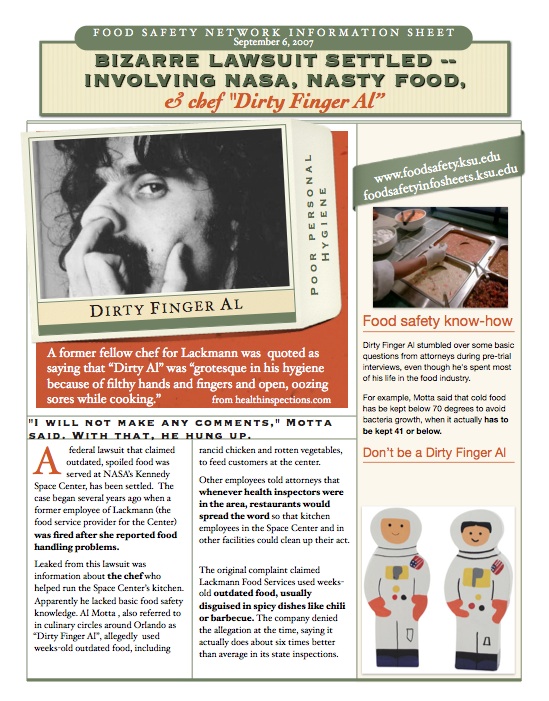
As food safety month kicks off in parts of North America tomorrow, the Aussies, always ahead (where it’s already September) push out cool food safety information for food handlers that’s more than just prescriptive. Taking a page from our food safety infosheets, New South Wales Food Authority has three case studies of actual (semi) recent outbreaks that put food safety into context for businesses. These case studies tell the story of an outbreak; focus on what was found during the investigation; and, what the business could do to avoid it. All they are missing are pictures of Dirty Finger Al or toilets.

Check out the three case studies here:

   * aioli prepared from raw eggs: Salmonella Typhimurium
   * fried ice cream using raw egg: Salmonella
   * pre cooked meats: Clostridium perfringens

One of the criticisms I’ve had in the past around social marketing campaigns around food safety is the generic, sanitized nature of the messages. These case studies do a great job telling folks what the specific consequences are if things go wrong and how to reduce risks.
 

New South Wales Food Authority uses real examples to tell folks how to handle food correctly

As food safety month kicks off in parts of North America tomorrow, the Aussies, always ahead (where it’s already September) push out cool food safety information for food handlers that’s more than just prescriptive. Taking a page from our food safety infosheets, New South Wales Food Authority has three case studies of actual (semi) recent outbreaks that put food safety into context for businesses. These case studies tell the story of an outbreak; focus on what was found during the investigation; and, what the business could do to avoid it. All they are missing are pictures of Dirty Finger Al or toilets.

Check out the three case studies here:

   * aioli prepared from raw eggs: Salmonella Typhimurium
   * fried ice cream using raw egg: Salmonella
   * pre cooked meats: Clostridium perfringens

One of the criticisms I’ve had in the past around social marketing campaigns around food safety is the generic, sanitized nature of the messages. These case studies do a great job telling folks what the specific consequences are if things go wrong and how to reduce risks.
 

New podcast, Food Safety Talk: Two guys, two mics, talking microbes, Episode 1 (sort of)

In an attempt to be topical and current, I’m getting together every couple of weeks with Don Schaffner via Skype to talk about what strikes our food safety fancy.

The tagline is: Don and Ben on the interwebs and talk food safety. Sometimes there are guests (we’ll get Doug on to talk about throwing up before hockey games and stealing toilet paper in a few weeks).

In this episode, which is sort of the pilot for this experiment, we discover that we can indeed talk about food safety for an hour, figure out how to record our ramblings and post the podcast to the magnificent Internet. This episode we talk about why they decided to do a podcast and about restaurant inspection. And the utility of Peter Frampton’s vocoder when interviewing public health and regulatory folks.

Direct link to the podcast.

Show notes (some of the things we talked up) :

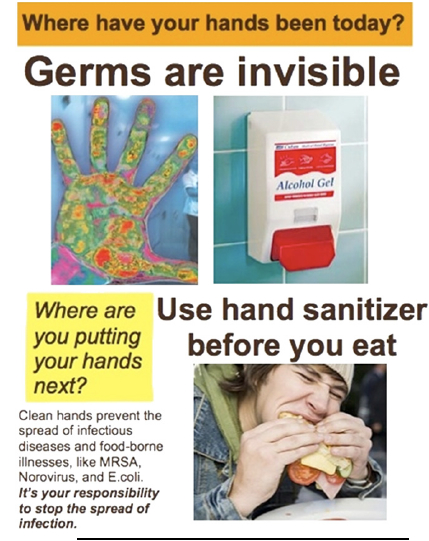
Handwashing motivator: Study shows posters can help increase hand hygiene practices

A study by Kansas State University shows posters can make a difference when it comes to hand hygiene in a health care setting.

The research, based on observations of more than 5,000 patrons at a hospital-based cafeteria, shows that an evidence-based informational poster can increase attempts at hand hygiene. The study appears in the current issue of the American Journal of Infection Control, and was funded by One Health Kansas, a project supported by the Kansas Health Foundation.

The research team included K-State’s Katie Filion, a December 2010 master’s graduate in biomedical science; Kate KuKanich, assistant professor of clinical sciences; Megan Hardigree, a 2008 master’s graduate in kinesiology; and Doug Powell, professor of food safety. Also on the team was Ben Chapman, assistant professor in the department of 4-H youth development and family and consumer sciences at North Carolina State University.

Hand hygiene is important before meals, especially in a hospital cafeteria where patrons may have had recent contact with infectious agents, KuKanich said.

"Few interventions to improve hand hygiene have had measurable success. This study was designed to use a poster intervention to encourage hand hygiene among health care workers and hospital visitors upon entry to a hospital cafeteria," she said.

Over a five-week period, a poster intervention with an accessible hand-sanitizer unit was deployed to improve hand hygiene at the entrance to a hospital cafeteria. An anonymous researcher was able to observe hand hygiene attempts from the adjacent dining area. The study included baseline, intervention and follow-up phases, with each consisting of three randomized days of observation for three hours at lunchtime.

Gains were modest, Powell said. During the 27 hours of observation, 5,551 participants were observed, with hand hygiene attempts increasing from 3.16 per cent to 6.17 per cent.

Hand washing compliance efforts have focused on increasing availability of proper tools for hand hygiene, education and training, and use of prompts such as visual reminders or peer pressure and the presence of others, according to Powell and KuKanich.

"Hand hygiene is still the best way to prevent the spread of infectious diseases. Unfortunately, many of us don’t wash our hands as often as we should," KuKanich said.

"Those ‘Employees Must Wash Hands’ signs in bathrooms may not be the most effective reminder," Powell said. "While improvements in this study were modest, we have set an evaluation framework to work with informational posters that use more graphical messages and reminders that use a shock-and-shame approach."

An abstract of "Observation-based evaluation of hand hygiene practices and the effects of an intervention at a public hospital cafeteria" is available at http://www.ajicjournal.org/article/S0196-6553%2810%2900986-7/abstract
 

Kangaroo zoonoses?

This was Sorenne and sister Courtlynn at the Lone Pine Koala Sanctuary outside Brisbane last Sunday, which included a large field with about 100 kangaroos. And endless piles of ‘roo poop the kids were stomping through and perhaps sitting in.

I looked up kangaroo zoonoses but didn’t find much. Any concerns?

Toddler recovering from E. coli illness at Cowans Gap lake

An outbreak of E. coli O157 sickened at least 15 people who swam in Cowans Gap State Park lake in Pennsylvania in mid- to late-July.

Among them was 2-year-old Madisyn Myers, whose mother said she received a clean bill of health Monday after three weeks of illness. The child had diarrhea and a urinary tract infection.

"It’s hard to see your child go through that," said Michelle Myers of Hagerstown.

The state closed Cowans Gap State Park’s lake to all activities on Aug. 9. It reopened the Fulton County, Pa., lake to boating and fishing last week, but swimming continues to be prohibited.

Michelle Myers said she’s leery of visiting the lake in the future.

"It was horrible," she said of her daughter’s illness.

Madisyn Myers visited the park with her father and about 20 other people in the last weekend of July, according to her mother. The child was the only person from that group who was sickened.

Madisyn underwent stool and urine samples, catheterization and a day in the hospital. She lost four pounds, but the bacteria did not damage her kidneys as her mother feared.

"Monday was like a celebration for us," Michelle Myers said of receiving good test results.

Will Del Monte’s lawsuit against Oregon health succeed in setting poisonous tone for outbreak investigations?

Del Monte Fresh Produce, a company that recalled its cantaloupes in March after health investigators in several states linked them to a Salmonella Panama outbreak, said yesterday that is plans to sue Oregon Health Authority and, Dr William Keene, one of the nation’s most well-known disease outbreak investigators (right, exactly as shown), claiming that the company’s products were wrongly singled out.

Lisa Schnirring of CIDRAP news at the University of Minnesota interviewed several public health types, who say the company’s suit is unprecedented, and some worry that it may inhibit future foodborne illness investigations.

Lon Kightlinger, MPH, PhD, state epidemiologist with the South Dakota Department of Health, said some of his department’s disease investigations have involved legal tug-of-wars. "Although we do have some worries of legal threats, that does not drive our investigation, but causes us to do a better job," he said.

In Iowa, laws require public health officials to treat the names of entities such as restaurants or companies the same as people, said Patricia Quinlisk, MD, MPH, medical director and state epidemiologist for the Iowa Department of Public Health.

She said that, before going public with names, health officials must discuss the issue with the state attorney general’s office to make sure the action complies with a "necessary for public health" clause. "Thus something like this might have more scrutiny here than other places," she said, adding that she’s never seen a legal threat like Del Monte’s.

Tim Jones, MD, MPH, state epidemiologist for the Tennessee Department of Health, said he’s been bullied and subjected to implied threats in the course of epidemiologic investigations. "I’ve never taken them seriously, and legally I’ve never been worried," he said.

Though Del Monte’s legal threat could create an inhibitory effect, epidemiologists take pride in being able to respond to outbreaks faster and freer than federal agencies, which are often bound by legal restrictions, Jones said.

"Our job is to protect people."

Some measure of immunity is needed for investigators, Jones said. "If anyone in public health is nervous about getting sued, it could be dangerously inhibitory."

Food poisoning forces withdrawal at US Open

The first Irishman to play at the U.S. Open, Conor Niland, withdrew during his first-round match against Novak Djokovic after suffering food poisoning following a meal of pork and salad at a fancy Manhattan restaurant.

"I got sick everywhere after my 30-minute warm-up. I thought I could bluff my way through but you can’t do that against the number one in the world, I just found out. I thought I was going to vomit after long points. I just felt really, really rotten out there."
 

New guidelines in Ireland for ready-to-eat sprouted seeds

The Food Safety Authority of Ireland (FSAI) has published guidelines for the safe production of sprouted seeds to be consumed raw, following the recent outbreaks of E. coli O104:H4 in Germany and France linked to the consumption of these seeds.

These guidelines introduce pathogen control measures for seed suppliers and sprouted seed producers. These include testing and certification requirements for seeds and a disinfection step and testing for sprouted seeds. The measures are being introduced to reduce risks to consumers’ health.

Most sprouted seed outbreaks have been attributed to contamination of the seeds used for sprouting. The moist, warm conditions of sprouting can allow small numbers of pathogens present on seeds to multiply by several orders of magnitude during the sprouting period.

To avoid confusion among consumers, the FSAI is advising producers of sprouted seeds who are using these guidelines; to label their products as ‘ready-to-eat’. Sprouted seed producers who cannot implement the control measures specified in the new guidelines should continue to ensure that their products are labelled as ‘cook before consumption’. Retailers and caterers should check that their suppliers of ready-to-eat sprouted seeds are following these FSAI guidelines.

The FSAI is advising members of the public who choose to sprout seeds at home, that they should continue to cook these products before consumption. This is because seeds certified free of pathogenic bacteria are unlikely to be widely available for some time. These guidelines can be accessed on our website on the following link http://bit.ly/o9VWuW.

Unfortunately, no one knows if any particular sprouter is following the guidelines.

A table of sprout-related outbreaks is available at http://bites.ksu.edu/sprouts-associated-outbreaks.