Post-Hurricane Irene response resources

Hurricane Irene hit most of the east coast  of the U.S. and Canada with high winds and rain Saturday and Sunday. Despite the Internet clamor of over-hyping the storm, hundreds of thousands of of folks lost power or experienced flooding. There have been multiple boil water advisories issued and reports of waste water system breaches. After speaking with a few North Carolina Extension Agents over the past couple of days it looks as though some of the state’s Eastern counties will be without electricity for at least a few days, maybe more.

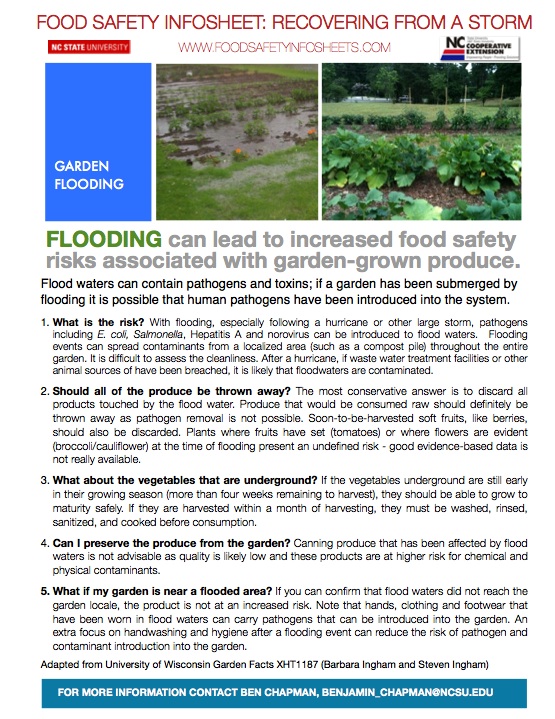
Last week I put out a pre-hurricane preparation infosheet; here’s a follow-up of three others for post-storm food safety issues. The first two, adapted from USDA files, detail in-home decision making for discarding and keeping food that might have been temperature abused while the power was out. The final infosheet focuses on the risks associated with eating fresh produce from flooded gardens (adapted from Barb Ingham and Steven Ingham from U Wisconsin.
 

Click here to download the frozen foods/power outage food safety infosheet.

Click here to download the refrigerated foods/power outage food safety infosheet.

Click here to download the garden flooding food safety infosheet.

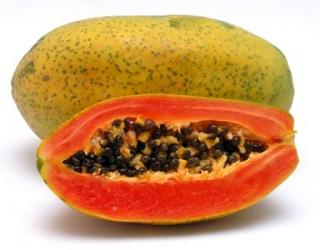
That’s a lot of salmonella; 15% of Mexican papayas salmonella-positive

U.S. and Mexican officials have been working closely together to find the source or sources of contamination of Salmonella in fresh papayas entering the U.S. from Mexico. From May 12, 2011, to August 18, 2011, FDA analysis found a 15.6 percent Salmonella contamination rate. The positive samples were from 28 different firms and include nearly all the major papaya producing regions in Mexico.

Papayas from Mexico have been linked to approximately 100 cases of Salmonella Agona in 23 U.S. states.

Under a U.S. Food and Drug Administration (FDA) Import Alert issued today, papayas from each source in Mexico may be denied admission into the United States unless the importer shows they are not contaminated with Salmonella, such as by using private laboratories to test the papayas. FDA may consider five consecutive commercial shipments over a period of time, analyzed from a validated laboratory, as being adequate for removal from the Import Alert.

Simultaneously, FDA and Mexican officials are stepping up their joint effort to trace recent contamination incidents back to their source and discover their cause or causes, in order to inform future prevention strategies. FDA and Mexican officials also are collaborating on laboratory methodologies used in Mexico for testing fresh papayas for Salmonella.

Beyond these immediate steps, the Mexican government and papaya industry have agreed to a longer range action plan that will define proper food safety procedures throughout the chain of production and distribution in Mexico and verify that the procedures are working effectively through product testing and other government oversight. Mexican officials are overseeing the industry’s implementation of the action plan and the FDA is collaborating with the Mexican government in this effort.

Fancy food isn’t safe food: Nino’s of New York edition

DNAinfo reports that celebrity-heavy Nino’s on the Upper East Side of New York City was hit with a whopping 56 points during an inspection on Monday, according to the health department’s website.

A grade higher than 27 points would merit hanging a C in the window, but the restaurant’s grade is pending as the department gives it some time to clean up their act. Restaurants with violations under 13 points get As.

The health department found a range of violations, including evidence of rats and mice, roaches present in the food or non food areas, flies, cold food not stored properly and food surfaces improperly washed. Also, the inspector found the supervisor of food operations did not hold a Food Protection Certificate, which is required by the health department.

At Nino’s Positano in Midtown, Selimaj named a chicken special after regular customer Derek Jeter, after the Yankees shortstop reached his 3,000th hit. That restaurant, at 890 Second Ave., was briefly closed by the health department after a June 22 inspection tallied 72 violation points. The restaurant currently has a letter B grade.

Nino Selimaj didn’t return calls.
 

E coli in the UK countryside: whose problem is it?

Reducing the risks of catching E. coli O157 in the countryside is everyone’s problem, but it’s someone else’s problem according to individuals questioned by researchers.

In one-to-one interviews conducted by the Research Councils UK Rural Economy and Land Use Programme (RELU), researchers found that people believed others should do more to reduce the risk of infection. While farmers thought that abattoirs should do more to prevent outbreaks, abattoir owners said that farmers should do more through better cleaning of livestock before slaughter, and butchers claimed that meat inspectors could be more effective.

In a survey of over two thousand rural residents and visitors, around 45 per cent of all respondents thought that health authorities as well as central and local government should be taking more action to protect the public. But the researchers say that E. coli O157 infection isn’t a problem that is easily solved, and the most effective way of addressing it would be for everyone to adopt behaviors and strategies to reduce risks.

It’s that farm-to-fork thing.
 

Victims of IHOP salmonella outbreak win $1.4M

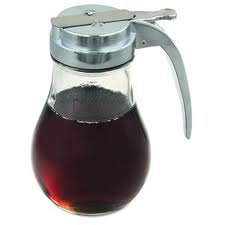
Rinse the damn syrup containers.

That’s the lesson as victims of a 2008 salmonella outbreak at the International House of Pancakes left a Potter County courtroom with more than $1.4 million in damages.

The jury, which included eight men and four women, deliberated for more than three hours before returning a verdict of $140,000 for each of the 10 plaintiffs.

Dean Boyd, one of the victims’ attorneys, said in closing arguments that the compelling, graphic testimony should be a warning for other Amarillo restaurants to keep their facilities clean.

“Two of the clients seriously came very close to death,” Boyd said. “Others’ injuries were very bad and their tear-filled testimony proved that.”

The case stems from three separate salmonella outbreaks that sickened the restaurant’s patrons, starting in June 2008.

From the first known poisoning case in June to a city health review in September, more than 125 people who ate at the IHOP location were victims of salmonella poisoning, according to court records.

Interviews with IHOP employees revealed the syrup pitchers were not washed or sanitized before they were refilled, according to the initial civil complaint.

During that time, the restaurant closed its doors three times in response to potential salmonella outbreaks. The closures were prompted by a June 2008 city review in which 11 IHOP employees tested positive for the salmonella toxin.

In the last case, which prompted the September 2008 closure, city officials determined the cause was an infected water bath used to warm bottles of syrup.
 

Texas toddler stricken with salmonella and E coli, prompts restaurant investigation

KRISTV.com of Corpus Christi, Texas, reports the Nueces County Health Department is now investigating a refrigeration problem at a local wing restaurant, after a 2-year old girl spent the last week in the hospital after her mother says she contracted salmonella and E. coli.

The girl’s mother said at first, doctors weren’t exactly sure what was wrong with Ava. After subjecting her to a myriad of tests, she was found to have E. coli and salmonella. Her mother said she was then placed in isolation at Driscoll Children’s Hospital for three more days.

Her mother said the last meal Ava ate was chicken strips from Wings-N-More.

She contacted the health department, who soon launched in an investigation.

According to a health inspection report, the raw chicken strips being stored in the deli case were at 68-degrees. That’s almost 30 degrees above the maximum recommended temperature.

We tried to contact Wings-N-More for a comment on the investigation, but our calls were not returned.
 

11 sick after meal at UK racetrack

Gambling can be dangerous to your health.

Health chiefs are investigating a possible food poisoning incident after 11 people fell ill at a racecourse.

Three people needed hospital treatment after visiting Hamilton Park racecourse in South Lanarkshire on Monday.

They have since been discharged and are recovering well, as are the other eight people, NHS Lanarkshire said.

Dr David Cromie, consultant in public health medicine at NHS Lanarkshire, said, "A number of people became ill yesterday whilst at Hamilton races. Our initial investigations would suggest this was linked to the food they ate. No organism has been positively identified, as yet.”

British diner threatened to use knife on pub staff over ‘below par’ sandwich

A diner threatened to return to an English pub armed with a knife after being served a "below par" beef and onion sandwich, a court has heard.

Clive Davies, 54, left the White Horse pub in Cambridge and showed employees at a nearby grocery store a seven-inch blade he said he planned to use on the staff who had served him the unsatisfactory sandwich, the Cambridge News reported today.

Employees at the store called police and Davies, who has a previous conviction for manslaughter, was apprehended in another local pub, the Lion and Lamb.

He pleaded guilty to threatening and abusive language, possessing a bladed article in a public place, and possession of cannabis.

28 sick, E. coli cases on rise at Playdays nursery

More cases of E. coli O157 are being confirmed at James Cook University Hospital in Middlesbrough, U.K., with 27 children and one adult now affected.

Three of the children were admitted to hospital with the potentially lethal bug, which can lead to kidney failure. One child is still being treated at the Royal Victoria Infirmary in Newcastle.

Stock on the counter invites microbiological trouble

I’m in Brisbane one day and I cook a whole chicken and then make stock.

It’s my go-to food.

Back in Manhattan I had a groovy measuring cup similar to the one, right, that easily separates the fat. Overnight in the refrigerator also works (I have 3 containers biding their time in the fridge).

A well-flavored – careful not to over-salt — chicken stock is a key ingredient, not just for soups and stews, but a meal of shrimp and red pepper over rotini, stir-fried veggies, even some kinds of bread.

So when Michael Ruhlman, some sort of cookbook author, said on his blog that he likes to make chicken stock and leave it out on the stovetop all week, using portions day to day to make quick soups and sauces, Harold McGee of The New York Times decided to check with a real expert: O. Peter Snyder, a food scientist and veteran educator and consultant to the food-service industry, who has at times taken issue with government guidelines he considers unnecessarily conservative.

“The process described by Mr. Ruhlman is a very high-risk procedure,” wrote Dr. Snyder. “It depends totally on reheating the stock before it is used to be sure that it doesn’t make anyone ill or possibly kill them.”

Boiling does kill any bacteria active at the time, including E. coli and salmonella. But a number of survivalist species of bacteria are able to form inactive seedlike spores. These dormant spores are commonly found in farmland soils, in dust, on animals and field-grown vegetables and grains. And the spores can survive boiling temperatures.

After a food is cooked and its temperature drops below 130 degrees, these spores germinate and begin to grow, multiply and produce toxins. One such spore-forming bacterium is Clostridium botulinum, which can grow in the oxygen-poor depths of a stockpot, and whose neurotoxin causes botulism.

Once they’ve germinated, bacteria multiply quickly in nourishing stock. They can double their numbers every 90 minutes at room temperature, every 15 minutes at body temperature. A single germinated spore can become 1,000 bacteria in a matter of hours, a billion in a few days.

As Dr. Snyder put it, “After sitting on the stove and growing bacteria for two or three days, Mr. Ruhlman’s stock almost certainly has high levels of infectious Clostridium perfringens cells, or Clostridium botulinum or Bacillus cereus cells and their toxins, or some combination thereof.”

Why has the Ruhlman family survived? Because Mr. Ruhlman boils the stock before he serves it, Dr. Snyder wrote. Any active bacteria are killed by holding the stock for a minute at 150 degrees or above, and botulism toxin is inactivated by 10 minutes at the boil.

But quickly reheating a contaminated stock just up to serving temperature won’t destroy its active bacteria and toxins, and the stock will make people sick.

In 2008, a 26-year-old Japanese mother in the Osaka region shared a meal of leftover fried rice with her two children, ages 1 and 2. She had prepared and served the rice the day before and kept it at room temperature.

All three became ill 30 minutes after eating the leftovers, and were hospitalized. Both children lost consciousness, and the youngest died seven hours after the meal. Pathologists later reported in the journal Pediatrics that the rice contained a very common spore-forming bacterium, Bacillus cereus, along with a heat-resistant toxin that the bacterium tends to make on starchy foods, and that can cause vomiting even after being heated to the boil.

Dr. Snyder agreed that official pronouncements on food safety can be inconsistent and self-defeating. “The F.D.A. Food Code is very conservatively written,” he wrote. “Four hours after it’s cooked is plenty fast enough to get food into the refrigerator.” And slow enough to relax and enjoy the meal.

I’m with Pete.