About Douglas Powell

A former professor of food safety and the publisher of barfblog.com, Powell is passionate about food, has five daughters, and is an OK goaltender in pickup hockey. Download Doug’s CV here. Dr. Douglas Powell editor, barfblog.com retired professor, food safety 3/289 Annerley Rd Annerley, Queensland 4103 dpowell29@gmail.com 61478222221 I am based in Brisbane, Australia, 15 hours ahead of Eastern Standard Time

Raw isn’t rad, it’s risky: Radagast Pet Food, Inc. voluntarily recalls three lots of rad cat raw diet free-range chicken recipe and one lot of pasture-raised venison recipe because of possible health risk

Radagast Pet Food, Inc. of Portland, OR is recalling three lots of Rad Cat Raw Diet Free-Range Chicken Recipe because testing results indicate they have the potential to be contaminated with Listeria monocytogenes.

The Company is also recalling one lot of Rad Cat Raw Diet Pasture-Raised Venison Recipe because testing results indicate it has the potential to be contaminated with Shiga Toxin producing E. coli O121.  This recall is being conducted out of an abundance of caution.  Due to Radagast Pet Food’s commitment to food safety and quality, The Company is conducting this voluntary recall.

Uh-huh.

Victims blame FDA for food-recall failures

I don’t blame any regulatory type for going early or going late in a foodborne disease outbreak.

There’s lots of armchair quarterbacks out there, and we’ve tried to present the various viewpoints on many an outbreak.

There’s also a lot people out there with nothing but a personal agenda, based on profit rather than peer review.

Christine Haughney of Politico reports that people had been getting sick from eating I.M. Healthy Original Creamy SoyNut Butter for more than two months when Peter Ebb, a 59-year-old Boston lawyer and health enthusiast, went for a run and then ate his usual gluten-free English muffin smeared with soy nut butter.

Later that morning — March 6, 2017 — Ebb saw a message from Amazon, which had sold him the nut butter, that the manufacturer had recalled it for contamination by E. coli bacteria. Ebb threw away a protein drink he had made with the soy nut butter, but didn’t worry too much. The Food and Drug Administration warning that was linked to the email was worded very cautiously: Though serious illnesses might result, even potentially leading to death, “most healthy adults can recover completely within a week.”

Six days later, Ebb was hospitalized and developed a deadly type of kidney failure. Within days, doctors told his wife to send for their children in case they needed to bid him a last goodbye. He survived, but remains unable to work full time and has trouble climbing the stairs. Now, he’s joining with 18 other victims to file claims against the companies responsible and call attention to the inadequacy of the nation’s recall system.

“If I had heard about the problem even one week earlier and stopped then, I might have been able to avoid the disease completely, and life today would be very different,” Ebb said.

A POLITICO investigation found that the I.M. Healthy SoyNut Butter case — which officials at the FDA and the Centers for Disease Control and Prevention have hailed as an improvement over past failures — was nonetheless emblematic of persistent weaknesses in the nation’s food-safety system, some of which haven’t been corrected for two years after being flagged by the agency’s inspector general.

Two months elapsed between the first person sickened by eating I.M. Healthy SoyNut Butter on Jan. 4 and the recall orders that began on March 3 and expanded three more times until March 10. The FDA, working through a national network of labs that identifies outbreaks, pinpointed the contamination on Feb. 22. The nine-day lag time in persuading the manufacturer to begin recalling the tainted products was a significant improvement over previous lag times — which were as high as 165 days in one infamous case, according to the inspector general. But victims maintain that the FDA should have ordered a recall on its own authority, given that a few days or even hours can make a difference in a deadly outbreak.

Going public: Early disclosure of food risks for the benefit of public health

Mar.17

NEHA, Volume 79.7, Pages 8-14

Benjamin Chapman, Maria Sol Erdozaim, Douglas Powell

http://www.neha.org/node/58904

Often during an outbreak of foodborne illness, there are health officials who have data indicating that there is a risk prior to notifying the public. During the lag period between the first public health signal and some release of public information, there are decision makers who are weighing evidence with the impacts of going public. Multiple agencies and analysts have lamented that there is not a common playbook or decision tree for how public health agencies determine what information to release and when. Regularly, health authorities suggest that how and when public information is released is evaluated on a case-by-case basis without sharing the steps and criteria used to make decisions. Information provision on its own is not enough. Risk communication, to be effective and grounded in behavior theory, should provide control measure options for risk management decisions. There is no indication in the literature that consumers benefit from paternalistic protection decisions to guard against information overload. A review of the risk communication literature related to outbreaks, as well as case studies of actual incidents, are explored and a blueprint for health authorities to follow is provided.

Food safety and tourism are mutually dependent: Vibrio in conch in Bahamas

Morgan Adderley of Tribune 242 reports there have been four confirmed cases of conch poisoning and as many as six unconfirmed cases, Bahamas Health Minister Duane Sands announced yesterday.

According to Dr Sands, the exposure took place in the previous 72 to 96 hours with a number of the patients affected having eaten at Potter’s Cay.

Noting that an outbreak of conch poisoning is something the country can “ill afford” right now, Dr Sands was adamant the issue can be easily mitigated if proper hygiene is maintained.

Four cases have been confirmed via laboratory testing but Dr Sands said there are a number of unconfirmed cases – “possibly as many as six” awaiting laboratory results. He added the affected people are being treated at both Doctors Hospital and Princess Margaret Hospital, and so far, all the self-identified patients are Bahamian.

Dr Sands said the steps to controlling the outbreak lie in proper hygiene and public and vendor awareness.

“Environmental Health teams (are speaking) directly with the vendors, not only at Potter’s Cay but throughout New Providence and anywhere else that we may have reason to suspect possibility of exposure,” Dr Sands said.

“We learned back in the 1990s that this is easily controlled if people practice very simple techniques of washing conch with fresh water. And that minimises, if not eliminates the possibility of transmission.

If it’s so simple, why do so many people get sick?

‘We’re trying to stay healthy and look good on stage and everyone’s throwing up around us’ (Probably) Norovirus spreads at Miss Nevada pageant

Faith Tanner of Fox 5 reports that health officials have been investigating a suspected norovirus outbreak at Westgate Las Vegas Resort and Casino.

At the end of June, families from across the state stayed at Westgate for the Miss Nevada pageant. 

Contestants said several people got sick during and after the competition. 

“It’s terrifying, because we’re all trying to stay healthy and look good on stage and everyone’s throwing up around us,” Macie Tuell said. 

It was a week Miss Lake Tahoe, Macie Tuell, prepared all year for, to compete in Miss Nevada at the Westgate in Las Vegas. 

But Tuell and the other contestants weren’t prepared for so many people to get sick. 

“The first girl in our group that got sick, it happened Wednesday night and then each day a couple more girls got sick and a couple more got sick the day after that. I know one girl actually got sick while she was on stage and had to run off,” Tuell said. 

She said the show went on and contestants pulled through. Tuell ended up getting first runner up. It wasn’t until the end of the pageant that most contestants learned how widespread the illness was. 

“A couple of the employees were getting sick, so that’s when we stared to figure out it wasn’t just our group. Even our family members who we had not seen at that point they were getting sick.”

The Southern Nevada Health District has been investigating. 

Their information so far suggested a gastrointestinal illness. Consistent with norovirus or the stomach flu. Health officials couldn’t confirm how many people got sick. 

Officials said they’ve surveyed the Westgate’s kitchens and on July 4, the resort agreed to close the buffet for an additional health assessment. 

621 inmates suffer food poisoning at Kyoto prison

When I was in prison 37 years ago, it had its own canning unit. Prisons have always been de facto work camps, and food is where the laborers were needed. Lotsa rumors about saltpeter, the daily horse chestnuts (canned plums) and whatever else could be thrown in a minimal cost.

It’s only gotten worse as privitization has taken over.

Fyodor Dostoyevsky said: “The degree of civilisation in a society is revealed by entering its prisons.”

According to Yusuke Kaite of The Mainichi 621 inmates recently suffered food poisoning at Kyoto Prison, the municipal government announced on July 4.

Although the exact cause was not identified, the city declared the outbreak a case of mass food poisoning, and banned the use of food facilities at the prison for three days.

Men from the ages of 26 to 76 suffered symptoms such as diarrhea and stomachaches from the morning of June 28 after food was cooked in the kitchen by 24 inmates. A total of 1,132 inmates and others had meals made at the kitchen at the time.

Patterns of crypto in Australia

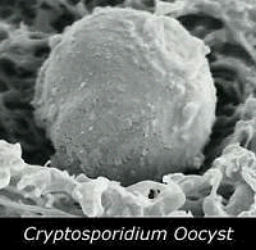
Cryptosporidium is a protozoan parasite that causes the diarrheal disease, cryptosporidiosis. Although many species have been identified, the majority of human disease worldwide is caused by two species; Cryptosporidium parvum and Cryptosporidium hominis. 

In Australia, data from the National Notifiable Diseases Surveillance System (NNDSS) show that cryptosporidiosis outbreaks occur every few years. To better understand the transmission, trends and nature of cryptosporidiosis outbreaks in Western Australia, epidemiological and genomic data from three cryptosporidiosis outbreaks in 2003, 2007 and 2011 were reviewed.

The 2007 outbreak was the largest (n = 607) compared with the outbreaks in 2003 (n = 404) and 2011 (n = 355). All three outbreaks appeared to have occurred predominantly in the urban metropolitan area (Perth), which reported the highest number of case notifications; increases in case notifications were also observed in rural and remote areas. Children aged 0–4 years and non-Aboriginal people comprised the majority of notifications in all outbreaks. However, in the 2003 and 2007 outbreaks, a higher proportion of cases from Aboriginal people was observed in the remote areas. Molecular data were only available for the 2007 (n = 126) and 2011 (n = 42) outbreaks, with C. hominis the main species identified in both outbreaks. Subtyping at the glycoprotein 60 (gp60) locus identified subtype IbA10G2 in 46.3% and 89.5% of C. hominis isolates typed, respectively, in the 2007 and 2011 outbreaks, with the IdA15G1 subtype was identified in 33.3% of C. hominis isolates typed in the 2007 outbreak. The clustering of cases with the IdA15G1 subtype in the remote areas suggests the occurrence of a concurrent outbreak in remote areas during the 2007 outbreak, which primarily affected Aboriginal people.

Both the C. hominis IbA10G2 and IdA15G1 subtypes have been implicated in cryptosporidiosis outbreaks worldwide; its occurrence indicates that the mode of transmission in both the 2007 and 2011 outbreaks was anthroponotic. To better understand the epidemiology, sources and transmission of cryptosporidiosis in Australia, genotyping data should routinely be incorporated into national surveillance programmes.

Comparison of three cryptosporidiosis outbreaks in Western Australia: 2003, 2007 and 2011

05 July 2018

Epidemiology & Infection

S. Y. Ng-Hublin(a1)B. Combs(a2)S. Reid (a3) and U. Ryan (a1) 

https://doi.org/10.1017/S0950268818001607

https://www.cambridge.org/core/journals/epidemiology-and-infection/article/comparison-of-three-cryptosporidiosis-outbreaks-in-western-australia-2003-2007-and-2011/4B7491E4CB498D3E20E0E4B1B275BEF6

Staff at UK food place put food gnawed by mice back on shelves

Martin Elvery of Get West London reports that rat droppings hanging from the ceilings of rooms where fruit and vegetables were stored, products being repackaged and sold after being gnawed by mice and a cement mixer allegedly being used to mix marinated chicken are just some of the horrors Ealing’s food safety officers have uncovered over the past year.

The council carries out thorough, regular checks of all premises serving and selling food in the borough which are categorised for their level of risk on a sliding scale of A to E.

Whilst the vast majority – 82% this year – complied fully with food standards, they have had to take swift action to deal with a few. A report summarising them was presented to the council’s general purpose committee on Tuesday, June 26.

When officers visited food store rooms used to keep fruit and vegetables based at a store in The Green, in Southall, they were found to be riddled with rat droppings.

The report states rat and mouse droppings were found throughout at wall and floor junctions, and on high level shelving. They were also found hanging from the ceiling and on the door leading to the rear store room.

Salmonella in pesto triggers Irish recall

Brisbane has fabulous produce and seafood, befitting a costal sub-tropical town.

Sure, it’s way too hot for three months in the summer, but the weather is ideal the rest of the year.

A friend of mine – a food safety professional — was telling me yesterday about this snapper he got, straight of the trawler, and the pesto sauce he made to go with it.

I really try not to be Debbie/Dougie downer when people tell me their proud achievements, so I didn’t go into all the outbreaks on pesto from uncooked basil.

Usually it’s cyclospora, but the Food Safety Authority of Ireland has issued a public notification that Dunnes Stores and Spar are initiating a recall of their own brand pestos, due to the possible presence of Salmonella. Consumers who have bought the implicated batches should dispose of the product or return it to the place of purchase.

At least 40 sick with Shigella after ‘eating food contaminated with feces at potluck birthday party’ in North Carolina

I’m not a big fan of the potluck.

Sure I get social aspect, the trying different foods and experiencing different cultures.

But do I trust the different food prep places, proper temperatures, storage and cleanliness.

Jane Wester of the Charlotte Observer reports at least 40 people are sick after eating contaminated food at a potluck birthday party in east Charlotte Saturday, Mecklenburg County health department officials said Monday.

Someone who prepared food for the party did not wash their hands well enough, Health Director Gibbie Harris said. Some partygoers are infected with a “highly contagious” disease called shigella, which causes diarrhea and is spread through feces, Harris said.

About 100 people attended the birthday party, and more may still get sick, as symptoms of shigella can take one to three days to show up after someone is infected, Communicable Disease Control director Carmel Clements said. It’s possible, however, for some people to get sick a whole week later, Clements said.

Most patients called 911 from the Forest Hills apartment complex, near where the party was held, according to Medic.

Health officials are sure that the contaminated dish was prepared in someone’s home rather than a restaurant, Harris said, because the only outside food at the party was the birthday cake.

Vets have the best drugs: Minneapolis investigates police use of ketamine on suspects

The veterinarian’s choice of drug – the horse sedative, ketamine – has been used by Minnesota police types to sedate people in custody, according to NPR.

I was married to a vet for 16 years and she had lots of tales about ketamine, but no evidence she used it herself, but I’ve met a few vets in rehab, and they liked their ketamine.

Ketamine, a powerful sedative is used in hospitals as an anesthetic and more recently, to treat depression. It’s also been called the date-rape drug. And now, city investigators in Minneapolis have found that police officers there directed paramedics to inject the drug into people on the street to subdue them. This, according to a draft report that was obtained by the Star Tribune. Andy Mannix is the reporter at the Star Tribune who broke the story, and he’s with us now. Andy Mannix, welcome. Thanks so much for speaking to us

MARTIN: What did we find from this report? I mean, for example, how do we know that the police were directing the paramedics to use the powerful sedative? And were there some other patterns that emerged when they reviewed all this information?

MANNIX: One of the issues that’s been alarming to a lot of people is just like how casually police and paramedics talk about this drug. So, we have one example where there’s a person who’s sort of being combative. The police officer is talking about ketamine. Give him a shot of ketamine – stuff like that. And then they give him two shots and then the guy sort of starts coming out of it and so they give him another shot. And the police officer – he says, he just hit the K-hole. So, they’re talking about in a way that’s almost like joking about it. There’s other examples of people saying, you know, calling a paramedic and saying bring ketamine, bring ketamine.

MARTIN: So tell us, who was being injected with this drug and what happened to them?

MANNIX: So most of the time they are – they’re calls dealing with someone who may be intoxicated or in a mental health crisis, you know, sort of like a minor nuisance crime – if a crime has been committed. So, in terms of what happens to these people, almost all of them – actually I think all of them get taken to the hospital.

MARTIN: The reports suggest that there was a large increase in the use of ketamine in recent years. There were reported of 3 incidents in 2012 and then there were 62 last year. Does the report offer any insight into why?

MANNIX: We have, in interviews with medical staff, asked that question many times and they say that there are more – there’s been a record amount of incidents involving severely agitated people. Paramedics and doctors would say that’s when someone is so agitated that they may hurt themselves or hurt somebody else. So they’re saying they’re running into more examples of this kind of behavior on the street.

MARTIN: On the other hand, though, the county hospital where the EMTs work was conducting studies on ketamine. The question arises, were they being sort of pressured?

MANNIX: You know, the scope of the oversight report is mostly police, but they do touch on this a little bit. There’s one case in particular where someone, you know, being recorded on police body camera asks why they sedated somebody and the paramedic talks about the study and says well, you know, we’re doing this study and so we needed to give them ketamine. There was one woman we talked to who had relapsed on alcohol and she was in her apartment and her sponsor, an AA, called and said can you just do a welfare check on my friend. I just want to make sure she’s OK. They ended up coming into her apartment – said she didn’t want this drug, they gave it to her anyway.

She wakes up 24 hours later with a breathing tube down her throat. And then on her way out, they hand her this form that says, by the way, you know, you’re enrolled in this study. And that’s pretty common, that’s a pretty typical story. There are several investigations going on right now including one with former acting U.S. Attorney General Sally Yates. She’s been appointed by the mayor, here, to come in and do an independent investigation. So obviously they’re very concerned.

MARTIN: That’s Andy Mannix. He’s a reporter at the Star Tribune in Minneapolis. Andy, thanks so much for speaking to us.

MANNIX: Hey, thanks for having me.