Hef, get the grudge out of there; Playboy Legionnairy-type outbreak grows like spa fungus to 170

Los Angeles County health officials said Monday that 170 people have fallen ill after attending or working at a fundraiser at the Playboy Mansion, but they do not believe the outbreak has spread beyond those associated with the event.

The possible outbreak of legionellosis, or Pontiac fever, affected people connected with the Feb. 3 DOMAINfest Global Conference in Santa Monica, "with symptoms mostly consisting of fever, chills, general discomfort (malaise) and some cough," according to a statement Monday by the county Department of Public Health.

The department was notified last Friday of a "suspected respiratory infection outbreak" among those associated with the conference, and officials were still identifying and contacting possible victims Monday, according to the statement.

Spokeswomen for Playboy and the Fairmont Miramar Hotel in Santa Monica, where the conference was held, did not return phone calls Monday.
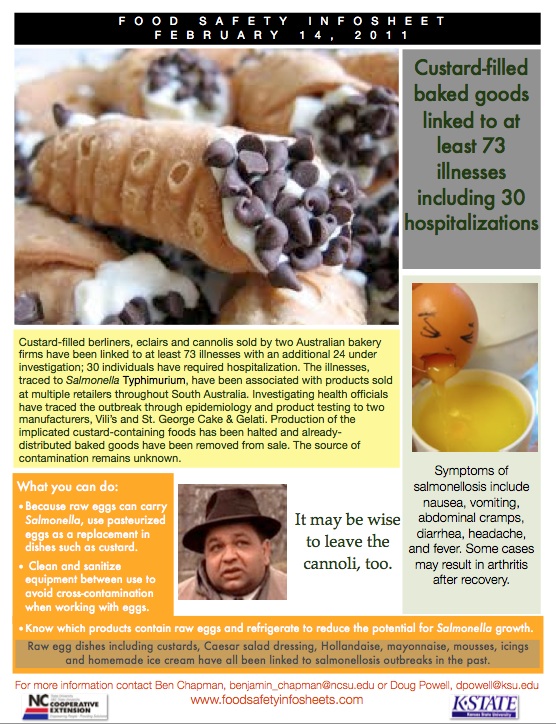

New Food Safety Infosheet: Custard-filled baked goods linked to at least 73 illnesses including 30 hospitalizations

The newest food safety infosheet, a graphical one-page food safety-related story directed at food businesses, is now available.

Food Safety Infosheet Highlights:
– Because raw eggs can carry Salmonella, use pasteurized eggs as a replacement in dishes such as custard.
– Clean and sanitize equipment between use to avoid cross-contamination when working with eggs.
– Know which products contain raw eggs and refrigerate to reduce the potential for Salmonella growth.
Food safety infosheets are created weekly and are posted in restaurants, retail stores, on farms and used in training throughout the world. If you have any infosheet topic requests, or photos, please contact Ben Chapman at benjamin_chapman@ncsu.edu.
You can follow food safety infosheets stories and barfblog on twitter @benjaminchapman and @barfblog.

Click here to download the newest food safety infosheet

Welsh doctors ask, why should I wash my hands?***

Almost half of doctors in south Wales fail to wash their hands properly.

When health council member Alison Morgan claimed to have noticed staff not washing their hands and challenging doctors, they asked "why?"

Mrs Morgan described the situation as abysmal.

Latest figures from a spot check in December showed that only 58 per cent of doctors were complying with guidelines.

Victoria Franklin, Abertawe Bro Morgannwg University Health Board’s director of nursing, confirmed 42 per cent of doctors and consultants had failed to ensure their hands were cleaned properly.

Mrs Franklin said she had heard the issue discussed in a talk and said she believed it was important to ensure that the culture of not washing hands was completely unacceptable.

Food safety education: child-to-parent instruction in an immigrant population

Food safety training programs must take into consideration language barriers in order to be effective. I further believe that unless these training courses provide some sort of demonstration and not just regurgitation of information and facts, retention will be minimized. 
 
2011 Journal of Environmental Health Abstracts
Dhitinut Ratnapradipa, PhD, CHES | Daniela Quilliam, MPH, REHS | Lauren Wier, MPH, PhD (c) | Darson L. Rhodes, PhD, CHES
 
Abstract: A quasi-experimental pretest-posttest design was used to examine increases in food handling knowledge among eastern European refugee restaurant candidates as a result of educational material taught either by the employee’s child or the Salt Lake Valley Health Department. Participants were nonrandomly assigned to a study (n = 15) or control group (n = 17). The study group was taught by their children in their native language. The control group was taught by an SLVHD instructor in English. All participants completed pre- and posttests that measured four areas of food handling knowledge: personal hygiene and hand washing (PHHW), cooking and holding time/temperature (COOKTT), cooling and holding time/temperature (COOLTT), and cross-contamination (CC). Both groups demonstrated a significant increase in knowledge of PHHW, but only the study group demonstrated significant improvements in COOKTT and CC knowledge. These study results suggest that food handling education programs are effective in increasing knowledge and mode of delivery may be an important factor.
 
Mode of delivery is an important factor in health education programs. The nature of training itself involves not only the dissemination of food safety messaging in the hopes of achieving a high grade; rather it involves demonstrating the principles.   I have seen this multiple times; people retain more if they are shown what to do and why it is important. For instance, it is one thing to inform operators to use a digital tip sensitive thermometer and another to show how to use one. Often times, through routine observations, this practice has been done incorrectly thereby increasing the probability of a food borne illness. Physically demonstrating the proper use of the thermometer, including calibration, engages the operator and helps in retention. This works for any food safety practice.

Watch found in bag of sugar?

I’m not sure who buys 20 kg of sugar “for coffee and things” but Nubarak Nubarak, 46, of Mississauga, Ontario (that’s in Canada, and 44 pounds of sugar) found a watch in a 20-kg bag of Redpath sugar he bought Jan. 26 in west-end Toronto.

He called Peel Regional Police to find out who he should turn to for help.

On the advice of police, he called Peel’s public health officials who referred him to their counterparts in Toronto, where he purchased the sugar.

Gerry Lawrence of Toronto Public health said Nubarak was referred to the Canadian Food Inspection Agency, which has contacted him.

Nice run around.

Nancy Gavin, manager of brand development at Redpath Sugar Ltd., said the company adheres to strict quality guidelines (do they ever say anything else?).

"We have metal detectors on the line that would have or should have gone off.”
 

Seafood safety: It’s easy to manufacture fear, hard to manufacture test results

The Ragin’ Cajun, politico-type James Carville, once said, “It’s easy to manufacture fear. It’s hard to manufacture test results.”

So while some 300,000 seafood samples from the Gulf of Mexico have been tested by U.S. Food and Drug Administration and National Oceanic and Atmospheric Administration labs – with almost every sample showing no trace of oil or dispersant – some individuals claim that “independent” tests reveal toxins in the local catch.
Don Kraemer,FDA’s deputy director in the Office of Food Safety, says the agency has been surprised by the number of media stories that give credibility to “junk science” and questionable lab tests.

“We‘ve learned some things through this process about public messaging, there were some environmental groups that we didn’t cater to, with our communications, and in retrospect, maybe we should have.

“We’re working now to address independent reports that aren’t scientifically sound. And we’ll continue to test seafood in the Gulf to demonstrate its safety.

“Oil spills have been around for a long time, so we know which markers are the right ones to test for to determine whether toxins are present. In this case, we knew which PAHs would be good markers and would clearly tell us whether oil was present.”

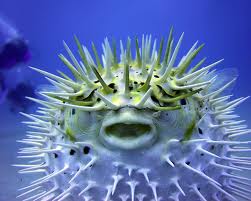
Puffer fish fells 7 in Philippines

Seven Badjao natives were rushed to hospital after eating puffer fish that they caught during the weekend.

Rosenda Kaluman said her husband, Mejame, started vomiting and contracted diarrhea last night after he and his neighbors ate 2 kilos of puffer fish that they caught at Matina Aplaya in Davao City.

Doctors said all 7 patients were poisoned after ingesting tetrodotoxin from the fish, which is more dangerous than cyanide.
 

Hef, clean the fog machine; Playboy Mansion investigated after 75 guests fall ill in apparent outbreak of Legionaires disease

Health officials are investigating the Playboy Mansion over fears Hugh Hefner’s famed property is the source of a recent disease outbreak.

More than 75 conference guests who attended a fundraiser at the Los Angeles residence were reportedly struck down by a respiratory infection.

Four Swedish men who attended the event were diagnosed with Legionellosis or pontiac fever, a milder form of Legionnaires disease caused by bacteria that thrives in warm air-conditioning systems.

A fog machine used at the bash could have spread the illness.

Over 700 guests were attending an event on February 3 as part of the annual DOMAINfest Global conference.

Many of the victims started tweeting and posting their symptoms on Facebook and that’s when organizers of the conference noticed a trend.
 

Aussie hotel staff fed up with Valentine’s stains

Valentine’s Day is a time for love, but Melbourne hotel workers say they are fed up with cleaning rooms covered in fruits, chocolates and other things.

"For us, Valentine’s Day means flower petals scattered all over the floors, spilt champagne everywhere and some very questionable stains all over the beds, but no extra time to clean," said one Hilton Hotel room attendant.

"We see exotic fruits and chocolates ground into the carpets, bubble bath all over the bathroom and massage oils all over the bed. And don’t even ask me about the whipped cream.”

The Liquor, Hospitality and Miscellaneous Union (LHMU) has planned a protest outside the Hilton South Wharf Hotel in Melbourne, where they will be handing out cleaning wipes and asking for a hand.

The union said cleaners get as little as 15 minutes to tidy a room, a job staff say requires about 45 minutes to do properly.

Melbourne was in the grip of a hygiene crisis because of the insufficient cleaning time, which was putting guests’ health at risk, the LHMU said.

Hilton South Wharf general manager Michael Bourne said the LHMU had been making allegations concerning the hotel for quite a while, but had refused to discuss the claims.

BARF diet for pets endangers species

The BARF diet is rooted in the philosophy that all things natural are good, and that science or human experience cannot improve on nature.

The Biologically Appropriate Raw Food, or Bones And Raw Food, diet, also known as the "prey model," in which owners try to feed their pets critters similar to what they’d hunt in the wild, has resulted in a surge in illegal sales of raw wild game online, Florida wildlife investigators say.

USA Today reports that in 2010, its first year, Florida Fish and Wildlife’s Internet Crimes Unit logged 177 arrests and 92 warnings for cases involving illegally buying or selling wildlife or raw game meat online, some of it for pets.

Pet owners go on Craigslist and eBay, asking where they can score a squirrel, pheasant, rabbit, goose, duck, chicken, just about any game to feed their cats and dogs. Some seek raw fish, meaty bones and organs such as hearts, livers and kidneys — everything a growing carnivore needs.

"It’s happening nationwide," said Lt. George Wilson, head of the Internet Crimes Unit. "The philosophy behind it is feeding your pet a hormone-free, naturally grazed diet.

"We’re seeing solicitations for wild ducks, anything wild."

The Internet provides a way around having to pay taxes or pay for licenses to sell wild game, investigators say.

But these Internet outlaws skirt regulations that ensure meat is sanitary and comes from game hunted in-season. They threaten to create black markets for wildlife similar to what existed for alligators 50 years ago, Wilson said.

"It’s the unlicensed people that would be trafficking them," said Jim Deason, owner of Sweetwater Plantation, a farm in Bristol, Fla., that sells live deer for breeding. "Any of the people that I know, they’re pretty above board on things like that. If there’s anybody selling game, it’s probably going to be backwoodsy folks."