
Hillandale Farms can sell eggs again after salmonella outbreak and recall

With the latest confirmed salmonella count topping 1,800 victims, the producer that provided the contaminated eggs has been cleared to resume sales.

Elizabeth Weise USA Today reports the Food and Drug Administration has given Hillandale Farms, one of two Midwest egg producers at the center of this summer’s massive egg recall, the go-ahead to sell shell eggs again. But the other, Wright County Egg, instead got a scathing warning letter threatening that if corrective action is not taken, the FDA could seize company assets.

The warning letter sent on Friday said FDA inspectors had found "serious deviations" from salmonella regulations at the company’s plants in Galt, Clarion and Dows, Iowa, including:

•Failure "to eliminate rodent hiding places and nesting sites," and failure to properly seal its henhouses.

•Failure to eliminate sources of water in the manure pits below the henhouses.

•Failure to require employees to "change protective clothing when moving from house to house."

•Failure to keep uncaged chickens out of the egg-laying operation.

•Findings of live mice, live and dead flies and live and dead maggots "too numerous to count" in the henhouses.

The Centers for Disease Control reported yesterday that from May 1 to October 15, 2010, approximately 1,813 illnesses were reported that are likely to be associated with this outbreak.
 

If FedEx can track letters, can growers track lettuce?

Inside a Silicon Valley company’s windowless vault, massive servers silently monitor millions of heads of lettuce from the time they are plucked from the dirt to the moment the bagged salad is scanned at the grocery checkout counter.

That trail can be traced in seconds, thanks to tiny high-tech labels, software programs and hand-held hardware. Such tools make it easier for farmers to locate possible problems — a leaky fertilizer bin, an unexpected pathogen in the water, unwashed hands on a factory floor — and more quickly halt the spread of contaminated food.

The Los Angeles Times reports this Dole Food Co. project and similar efforts across the country represent a fundamental shift in the way that food is tracked from field to table. The change is slow but steady as a number of industry leaders and smaller players adopt these tools.

Much of the farming community has yet to follow suit, and federal food-safety legislation is stalled in Congress. But proponents of this digital transformation said it was inevitable given public outrage over the recent egg contamination scandal. They said technology could simplify the nation’s complex food-safety system, helping prevent or contain the harm caused by recalled food.

Trace-back systems are similar to how FedEx tracks its packages. On the farm, animals and crop sections are given a "smart" label with a unique identifying number. The label is attached to a bin, crate or container used for transport.

Workers then use a hand-held computer or smart phone to scan the labels and record key information, such as date, time, location, workplace temperature and which truck hauled the food. The information is usually uploaded to a database, where it is stored and can be accessed via the Web.

Each time the food moves or is handled by someone new, the data can be updated.
 

No health scores on window cards, but a better website for San Francisco diners

Mission Local reports members of the San Francisco Health Commission unanimously approved a resolution yesterday to hire more health inspectors and make the health inspection process itself less mysterious.

Notably absent from the resolution was a recommendation that president James Illig proposed an hour before to the Community and Public Health Committee: to require food establishments to “post the most current inspection scorecard in a window or other locations visible to the public.”

Instead, the resolution included a request for bi-annual reports outlining the progress of the city’s goal to routinely inspect restaurants twice per year, another request for more comprehensive cost reports (there’s some uncertainty as to whether the fees gathered by health inspections cover the cost of running the department), an urging to fill health inspector positions that have been vacant for months and an overhaul of the Department of Public Health’s web site to allow the public easy access to current and past restaurant inspection reports.

Restaurants are already required to post their health inspection reports, said Richard Lee, the Department of Public Health’s Director of Environmental Health and Regulatory Programs. But the report is often posted in hard to find places, if at all. And there is no requirement that they post the green card accompanying the report that shows the restaurant’s most recent inspection score.
 

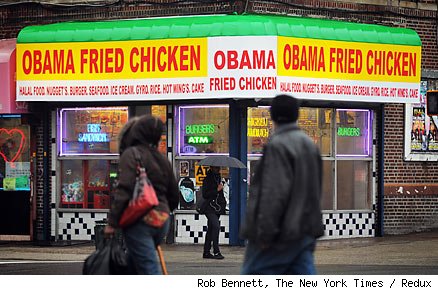
NYC’s ‘Obama fried chicken’ fails at food safety

Forget the name: Obama Fried Chicken sucks at food safety.

In 2009, two New York City fast-food joints started calling themselves Obama Fried Chicken, raising concerns about old racial stereotypes. Last week, according to Grub Street, the Harlem Obama Fried Chicken was closed by the Health Department after scoring 115 violation points, almost 100 points past the C grade.
This is how bad a restaurant can do on an inspection:

1) Hot food item not held at or above 140º F.
2) Cold food item held above 41º F (smoked fish and reduced oxygen packaged foods above 38 ºF) except during necessary preparation.
3) Food Protection Certificate not held by supervisor of food operations.
4) Appropriately scaled metal stem-type thermometer or thermocouple not provided or used to evaluate temperatures of potentially hazardous foods during cooking, cooling, reheating and holding.
5) Evidence of rats or live rats present in facility’s food and/or non-food areas.
6) Live roaches present in facility’s food and/or non-food areas.
7) Filth flies or food/refuse/sewage-associated (FRSA) flies present in facility’s food and/or non-food areas. Filth flies include house flies, little house flies, blow flies, bottle flies and flesh flies. Food/refuse/sewage-associated flies include fruit flies, drain flies and Phorid flies.
8) Hand washing facility not provided in or near food preparation area and toilet room. Hot and cold running water at adequate pressure to enable cleanliness of employees not provided at facility. Soap and an acceptable hand-drying device not provided.
9) Personal cleanliness inadequate. Outer garment soiled with possible contaminant. Effective hair restraint not worn in an area where food is prepared.
10) Food not protected from potential source of contamination during storage, preparation, transportation, display or service.
11) Food contact surface not properly washed, rinsed and sanitized after each use and following any activity when contamination may have occurred.
12) Sanitized equipment or utensil, including in-use food dispensing utensil, improperly used or stored.
13) Facility not vermin proof. Harborage or conditions conducive to attracting vermin to the premises and/or allowing vermin to exist.
14) Covered garbage receptacle not provided or inadequate, except that garbage receptacle may be uncovered during active use. Garbage storage area not properly constructed or maintained; grinder or compactor dirty.
15) Pesticide use not in accordance with label or applicable laws. Prohibited chemical used/stored. Open bait station used.
16) Canned food product observed dented and not segregated from other consumable food items.
17) Non-food contact surface improperly constructed. Unacceptable material used. Non-food contact surface or equipment improperly maintained and/or not properly sealed, raised, spaced or movable to allow accessibility for cleaning on all sides, above and underneath the unit.
18) Food service operation occurring in room used as living or sleeping quarters.
19) Proper sanitization not provided for utensil ware washing operation.


Four children sick with salmonella at UK nursery

Another salmonella outbreak at another nursery, this time in the U.K.

Dunfermline Press reports four children who attend a West Fife nursery have been confirmed as suffering from Salmonella group B infection.

NHS Fife said that the cases were identified in early October and none of the children are seriously ill.

NHS Fife said that washing hands is an important way to avoid spreading the infection.
 

Salmonella strikes 13 preschoolers in Estonia

Estonian Public Broadcasting reports an outbreak of salmonella at a nursery school in Tabasalu, a small town just outside Tallinn, caused illness among 13 children and one assistant teacher last week. Five of the children had to be hospitalized.

Health Board Public Relations Manager Iris Saluri told the Delfi news service that though laboratory tests had not yet confirmed the source of the outbreak, it probably originated in a batch of scrambled eggs. However, because some of the children fell ill later than others, it was possible that the disease was also spread person to person, she said.
 

Decision reserved in Ontario E. coli restaurant appeal

Exactly how long it takes for E. coli bacteria to make a person sick is the central issue at an appeals hearing launched by two men trying to overturn their 2009 conviction for serving dangerous food.

The St. Catharines Standard reports Senan Daoud and Mahmoud Asaad. who operated the Yaman Restaurant, were in a St. Catharines court Monday to appeal their conviction for serving food unfit for human consumption that resulted in a fine of $7,500 each.

Their lawyer, Chris Bittle, argued testimony during their 2009 trial about the incubation period of the E. coli that made several people sick after eating at the Yaman left reasonable doubt about the source of the bacteria.

The pair were convicted on five counts of selling unfit food, Justice Ann Watson heard Monday, after a 2007 incident in which the water to the restaurant had been cut off due to a watermain break. Asaad and Daoud kept their restaurant open and served food. Several people who ate there later fell violently ill and tests confirmed they had contracted E. coli, with most contracting the same strain of the bacteria public health inspectors later found on chicken and a knife in the Yaman’s kitchen.
 

Food poisoning strikes 100 at policing meet in Guyana

Health officials in Berbice, Guyana (that’s on the northern coast of South America) told Stabroek News last night that approximately 100 people attending a police retreat were treated at the New Amsterdam Hospital shortly after lunch was served.

Home Affairs Minister Clement Rohee, who was present at the event yesterday, told this newspaper last evening that the police were investigating the incident and several persons were questioned.

According to reports, sometime around 1 pm yesterday lunch, which consisted of fried rice and pot roast chicken, was served and shortly after, persons began to complain of abdominal pains while some began to vomit.

Persons at the New Amsterdam Hospital told Stabroek News that the hospital was filled with patients seeking treatment, many persons lay on the floors at the hospital crying out in pain. It was noted that residents in the area had already departed the venue for their homes when they began to experience pains about their bodies.

Phillies fan pukes on the field; caught on Fox broadcast

Baseball is one of my guilty pleasures (along with Pearl Jam, taking baths and walking around malls). Fantasy baseball (known to nerds like me as Rotisserie baseball and to my wife as fake baseball) is an even guiltier pleasure. I started playing about 10 years ago with a bunch of guys I didn’t know and have continued to get together in-person and online with them to talk trash about players who we "manage".

A few years ago I came close to winning the league (but it all fell apart in the last two weeks of the season; I ended up in third place). That year I had Freddy Sanchez on my team (then of the Pittsburgh Pirates, now of the San Francisco Giants) for a couple of months. Last night, playing in the National League Championship Series vs the Phillies, Freddy fouled a ball towards the stands near 3rd base. As Fox’s cameras panned to follow the ball, they caught a fan in the first row throwing up on the field (see below, exactly as shown).

There’s something about puke at Phillies games: earlier this year another fan was charged with assault, reckless endangerment, and disorderly conduct after allegedly intentionally vomiting on an 11-year-old girl and her father during a game.

Gonzalo Erdozain: Immediate, clear response to food safety incident restores my trust

Two weeks ago I blogged about finding a staple in my pretzel M&M.

I dug some more into the issue after being contacted by Mars representatives and found out Mars has strict safety measures in all their factories. The use of any staple is forbidden at their factories just for this very reason. They also told me they have metal detectors throughout the manufacturing line to pick up any metal items that could have somehow made it into their product.

It was reassuring to hear from Mars time and again they take these matters seriously and that they will investigate the matter. They sent me a letter and 4 coupons for $5 each and things are golden. The take-home message is, when faced with a crisis, don’t run, hide or deny it (like Maple Leaf, Heston Blumenthal and the like), but face it, show consumers you are sorry and you are on top of it. That is the only way to regain their trust. And mine.