Nikki Marcotte: Some Manhattan restaurants sloppy with food safety

In the month of September, there were three Manhattan (Kansas) restaurants that received five critical violations or more during routine food safety inspections by the state.

On September 20, 2010. HuHot Mongolian Barbecue in the Manhattan Town Center received nine critical violations for issues such as employees not properly washing their hands, bare hand contact with ready-to-eat food during preparation, improperly sanitizing food contact and preparation areas, and improper cold holding temperatures.

On September 22, Chili’s Bar & Grill received eight critical violations for things like employees improperly washing their hands, improperly sanitizing food contact and preparation areas, improper cold holding temperatures, and failing to post their license within the establishment.

On September 28, Pat’s Blue Ribbon Barbecue in Aggieville received nine critical violations for employees not properly washing their hands, improperly sanitizing food contact and preparation areas, and not marking correct dates on food storage containers.

Follow-up inspections have been or will be conducted sometime this month.
 

Summertime Blues: lowering bacterial loads from farm-to-fork means fewer sick people

Every summer, government agencies at the local state and federal level in Western countries around the world warn consumers to be extra super-duper careful when barbecuing, because the incidence of foodborne illness, especially E. coli O157:H7, goes up in the warm summer months, and this is because consumers are doing dumb things at the grill.

I never believed it – consumers, food service workers, humans are capable of doing dumb things wherever they are cooking – but it was another standard line in the blame-the-consumer approach to food safety risk reduction.

There has been plenty of evidence over the years to show that the increase in human illnesses in summer months is strongly correlated to overall increases in E. coli O157:H7 loads in cattle in summer months.

Lower the loads, reduce the risk.

Most food safety interventions are designed to reduce or eliminate pathogen loads – to lower the number of harmful bugs from farm-to-fork. A piece of highly-contaminated meat can wreck cross-contamination havoc in a food service or home kitchen.

A new paper in Foodborne Pathogens and Disease by researchers from the U.S. Department of Agriculture and the University of Nebraska-Lincoln uses models representing seasonal variation in E. coli O157:H7 loads in the farm-to-fork continuum, and concludes that summertime cooking is as risky as the rest of the year.

The authors write:

“A plausible explanation for the increase in E. coli O157:H7 illness during the summer is poor consumer storage and cooking practices associated with meals prepared and cooked outdoors (e.g., picnics and barbeques). If these practices are major contributors to human illness, then an effective mitigation strategy could be additional labeling and consumer education regarding the need to maintain meat products at temperatures sufficiently low to avoid bacterial growth during transportation to outdoor venues and to cook products to a sufficient temperature when grilling. Conversely, if summer storage and cooking practices are not responsible for a large proportion of summer illnesses, a more effective mitigation strategy would reduce the seasonal effect of E. coli O157:H7 contamination at the preharvest stage or during the production and processing of beef. …

“The seasonal change in the probability of exposure to a contaminated serving is the primary driver of the season pattern in illnesses, rather than any seasonal changes in consumer storage and handling.”

The complete abstract is below.

Determining relationships between the seasonal occurrence of Escherichia coli O157:H7 in live cattle, ground beef, and humans
Foodborne Pathogens and Disease. October 2010, 7(10): 1247-1254
Michael S. Williams, James L. Withee, Eric D. Ebel, Nathan E. Bauer, Wayne D. Schlosser, William T. Disney, David R. Smith, Rodney A. Moxley
http://www.liebertonline.com/doi/abs/10.1089/fpd.2010.0576
Abstract
The prevalence and concentration of many foodborne pathogens exhibit seasonal patterns at different stages of the farm-to-table continuum. Escherichia coli O157:H7 is one such pathogen. While numerous studies have described the seasonal trend of E. coli O157:H7 in live cattle, ground beef, and human cases, it is difficult to relate the results from these different studies and determine the interrelationships that drive the seasonal pattern of beef-related human illnesses. This study uses a common modeling approach, which facilitates the comparisons across data sets, to relate prevalence in live cattle to raw ground beef and human illness. The results support an intuitive model where a seasonal rise of E. coli O157:H7 in cattle drives increased ground beef prevalence and a corresponding rise in the human case rate. We also demonstrate the use of these models to assess the public health impact of consumer behaviors. We present an example that suggests that the probability of illness, associated with summertime cooking and handling practices, is not substantially higher than the baseline probability associated with more conventional cooking and handling practices during the remainder of the year.

Nuevo Folleto Informativo: Jugo de compota de 
fruta relacionado con el brote 
de E. coli O157 en Winnipeg

Traducido por Gonzalo Erdozain
Resumen del folleto informativo mas reciente:
– Jugos han sido relacionados con brotes en el pasado
– Preparadores de alimentos deben tener cuidado para no contaminar alimentos
y bebidas listas para consumir.
Lávese y séquese las manos con jabón, agua potable y toallas de papel antes de tocar alimentos.
– Cuando almacene alimentos en conservadoras o heladeras, ponga los alimentos listos para consumir (envueltos) encima de los alimentos crudos.
Los folletos informativos son creados semanalmente y puestos en restaurantes, tiendas y granjas, y son usados para entrenar y educar a través del mundo. Si usted quiere proponer un tema o mandar fotos para los folletos, contacte a Ben Chapman a benjamin_chapman@ncsu.edu.
Puede seguir las historias de los folletos informativos y barfblog en twitter
@benjaminchapman y @barfblog.

The four-star roach

A cockroach appeared on the table of five diners at the super snazzy New York eatery, Jean Georges, Jean-Georges Vongerichten’s four-star kitchen and dining room on the first floor of 1 Central Park West.

“A woman at the table screamed and the whole restaurant went quiet,” said Lois Freedman, a spokeswoman for Mr. Vongerichten, who was not in the restaurant at the time.

Sam Sifton of the N.Y. Times reports that waiters and captains moved to the table with grim alacrity, said people who saw them whisk the aggrieved customers to a new table. … Champagne was brought to the table of the woman who had screamed, and further treats after that: an additional course was added to the restaurant’s three-course, $98 prix fixe dinner, and desserts, and dessert wine. The restaurant’s captain kept a close eye on the table. At least one other table received a round of free drinks as a way of thanking them for their forbearance.

Bring your own cockroach, although I would never recommend that, especially when Jean Georges received an inspection score of 23 from the city’s Department of Health and Mental Hygiene, which translates to a B.
 

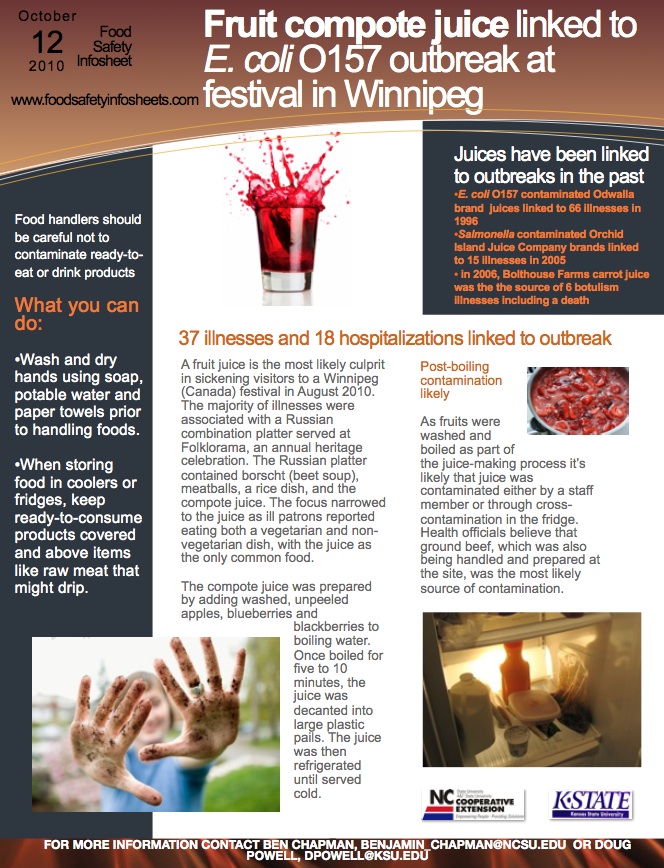
New Food Safety Infosheet: Fruit compote juice linked to E. coli O157 outbreak at festival in Winnipeg

The newest food safety infosheet, a graphical one-page food safety-related story directed at food businesses, is now available at www.foodsafetyinfosheets.com
Food Safety Infosheet Highlights:
– Juices have been linked to outbreaks in the past.
– Food handlers should be careful not to contaminate ready-to-eat or drink products.
– Wash and dry hands using soap, potable water and paper towels prior to handling foods.
– When storing food in coolers or fridges, keep ready-to-consume products covered and above items like raw meat that might drip.
Food safety infosheets are created weekly and are posted in restaurants, retail stores, on farms and used in training throughout the world. If you have any infosheet topic requests, or photos, please contact Ben Chapman atbenjamin_chapman@ncsu.edu.

You can download the infosheet here.

Most Philadelphia school cafeterias flunk – Health Dept

More than half of the schools in the Philadelphia School District – 53 percent – failed their most recent health inspection, according to state Department of Agriculture records, while a staggering 66 percent of charter schools were out of compliance.

The Philadelphia Daily News reports that of the 40 schools in the Archdiocese of Philadelphia that were inspected last school year, 35 percent were out of compliance.

Some schools on the list were hit with as many as 20 risk-factor violations, ranging from mouse feces found on cooking utensils to food being stored next to chemicals.

Justin Carter, a recent West Philadelphia High School graduate, said he gave up eating school lunches long before he graduated. He said the news doesn’t come as a surprise.

"It’s atrocious," he said, recalling his food woes at his alma mater, which was hit with 10 violations last spring.

"They served chicken twice a week, and it wouldn’t be cooked all the way through – it was soft and pink in the middle. The food worker would put it in a microwave for five minutes like that would make it better. It would be the same way every time."

Letter grades for LA food trucks

Los Angeles County is, according to the N.Y. Times, moving to submit its flock of 9,500 food trucks and carts to the same health department rules as restaurants — including requiring them to prominently post a letter grade based on food inspections — in what may be the ultimate sign that this faddiest of food fads is going mainstream.

And if that is not establishment enough, food trucks, whose allure has been enhanced by their mysterious comings and goings, some signaled by puffs of Twitter postings, will have to file route maps with the health department, to facilitate at least one field inspection a year, beyond the single annual inspection now required.

As with restaurants, health inspectors will be empowered to shut down a truck that scores less than a C for not enough attention to basic safety and food hygiene practices — for example, dirty counters, food left out, unwashed hands.

Jonathan E. Fielding, director of the Los Angeles County Department of Public Health, said

“People are saying, ‘I see A, B, C’s at restaurants, but not trucks: Why not? … We changed the incentives, and that’s what this is all about,” he said. “We want protecting consumers against foodborne illness to be top-of-mind all the time.”
 

UK food bureaucrat whines that communicating is tough

Try harder.

Because when communicating about science with the public, the U.K. Food Standards Agency really sucks.

So when some FSA-type (right, not exactly as shown) writes,

“We pride ourselves on being a science-based organisation and on putting the consumer first, so the big question we deal with on a daily basis is: how do you maintain scientific accuracy while making the science easy for people to understand?”

I may have just thrown up a little.

This science-based organization has apparently decided – against all available scientific evidence – that the best advice for cooking whole poultry is until it is “piping hot.”

This is scientifically inaccurate, and as a lowly member of the public, I don’t know what it means.

The FSA-type further writes:

“Effective communication is about thinking how messages are received rather than how they are sent out.”

Awesome. Can you provide the research which shows actual consumer behavior interpreting the message of piping hot?

And he further writes:

“To be heard and heeded, too, our advice needs to be succinct and easy to understand but also accurate. So, over to you, how do we get the balance right?”

FSA advice to cook poultry until piping hot is inaccurate – color is a lousy indicator, a tip-sensitive thermometer is required to ensure the bird has reach an internal temperature of at least 165F or 74C, and piping hot may be meaningful in a Mary Poppin’s movie but not in a microbiologically safe kitchen. There is no balance to strive for when the information is wrong.

Get the science right, then work on the flair.
 

UK regulator wants cameras in slaughterhouses to curb animal abuse, industry says, hang on mate

In Feb. 2008, the U.S. Department of Agriculture shut down a meat processing company after concluding workers committed egregious acts of animal cruelty, about a week after the Humane Society of the United States released video showing employees of the Hallmark/Westland Meat Packing Co. of Chino, Calif., tormenting cows that were too injured or weak to stand.

That $100-million-a-year company does not exist anymore – brought down by someone using an over-the-counter video recording device.

An employee of the Humane Society of the United States worked undercover inside the company for about six weeks in the fall, secretly recording what went on.

His video shows what appear to be crippled cows dragged with forklifts, sprayed in the face with a high-pressure water hose and poked in the eye with a stick.

The images sparked concern not only from animal-welfare advocates, but from food-safety experts, who feared the company might have used the tactic to prod sick animals to slaughter in violation of state and federal regulations.

At the time I said maybe it was time for USDA to adopt some new inspection and investigative techniques if the HSUS can so easily document such grotesquely poor treatment of animals.

In April, 2008, Dr. Richard Raymond of USDA said the department needed neither video cameras nor more inspectors to police slaughterhouses after the country’s largest beef recall earlier this year.

Everything was just fine.

In March 2009, Cargill Beef decided to do their own thing – probably because when an outbreak or outrage happens, the USDA or any other regulatory types, don’t lose their jobs, it’s the producers, processors and employees who lose money and their jobs — and implemented a third-party video-auditing system that would operate 24 hours a day at its U.S. beef slaughter plants to enhance the company’s animal welfare protection systems.

A year later, Cargill announced it was expanding its remote video auditing program to monitor food-safety procedures within processing plants.

Mike Siemens, Cargill leader of animal welfare and husbandry, said at the time,

“The early results with our animal welfare program have been terrific … In addition to the positive results on compliance rates, we have observed healthy competition among plants on performance scores, as well as a general theme of collaboration among plants on how to attack specific operational challenges. The ability to share data and video easily is extremely valuable.”

If the U.S. regulators aren’t listening, the Brits are.

The U.K. Food Standards Agency tabled a proposal last week to introduce CCTV (closed circuit television) cameras into slaughterhouses in a bid to tackle animal welfare abuse.

Food Production Daily cited FSA director of operations Andrew Rhodes as saying the agency is calling for the voluntary introduction of surveillance cameras after undercover filming by animal rights group Animal Aid in the last year had highlighted abuses in U.K. slaughterhouses. The proposal is due to go before agency chiefs next week for approval.

The report said that while there is no legal requirement to fit CCTV, food business operators (FBOs) may come under pressure from retailers to install systems. The FSA acknowledged there were practical issues – such as how the footage in monitored, who has access to it and how long film is kept – that must be addressed.

Agreed. There are lots of issues involved. So figure them out. What slaughterhouse or processor wants to be held hostage by each new hire that may be carrying a video device.

Today, Food Production Daily cited Stephen Rossides, head of the British Meat Processors Association (BMPA), as saying that proposals to fit surveillance cameras in UK slaughterhouses to combat animal welfare abuses must remain voluntary as violations are relatively rare.

I don’t know about the U.K., but at the time of the Westland mess, Julie Schmit of USA Today reported that newly released government records show such animal mishandling in past years was more than a rare occurrence.

The Animal Welfare Institute, an animal-protection group, said that more than 10% of the humane-slaughter violations issued by the U.S. Department of Agriculture for the 18 months ended March 2004 detailed improper treatment of animals that couldn’t walk — mostly cattle.

USDA records obtained by the Animal Welfare Institute describe 501 humane-handling or slaughter violations that occurred at other slaughter plants. At one plant, a downed cow was pushed 15 feet with a forklift. Other companies were cited for dragging downed but conscious animals, letting downed cattle be trampled and stood on by others and, in one case, using "excessive force" with a rope and an electric prod to get a downed cow to stand, the enforcement records say.

Beyond reaction and regulation, producers and processors who say their food is safe should be able to prove it. Producers and processors who say they treat animals humanely should be able to prove it.

Kiwi drinking games at Oktoberfest include drinking vomit and urine; feces not allowed

As Oktoberfest festivities wrap-up in Germany (and begin in Kitchener-Waterloo, Ontario, which used to be known as Berlin), the New Zealand Herald reports that a group of Kiwis traveling around Europe have appalled the locals in Munich by participating in a drinking game that involves drinking urine and vomit as a penalty. The travel group, known as Van Tour, has been described by participants as a three-month unorganised drinking trip around Europe which involves visiting bars every night with a bit of sightseeing thrown in during the day. Culminating, ironically (and messily), at Oktoberfest.

The Kiwis’ behaviour, which disgusted some Germans, was performed by a group called the 100 Club.

About 40 people, both men and women, took part in 100 Club at Oktoberfest. Each had to drink a 35ml shot of beer every minute for 100 minutes. They weren’t allowed to wear underwear or have toilet breaks.

If a player vomits or urinates they have to drink it, or get someone else to, through a funnel or muddy gumboot.

According to participant Tim Russell, of Napier (that’s in New Zealand) "Feces are not allowed as you can get really sick from it … rumour has it someone got TB from it few years back. Other bodily fluids such as blood are also not allowed."

I’ve attended the Kitchener-Waterloo Oktoberfest a couple of times and it was pretty tame next to what folks have told me about the German originator. Although I’ve never been there with a Kiwi.

While I’m glad that the 100 Club has removed feces from their list of consumables, participants are still susceptable to a whole bunch of other infectious diseases and it’s not all that likely that they’ve reduced TB risks all that much (as TB is primarily a respiratory disease). Don’t eat poop; don’t drink vomit (unless you want to catch something).