Raw egg aioli promoted for Ocean’s Eleven screening

Dinner and a Movie on TBS is incredibly hokey and contrived, which makes it perfect entertainment fare along with trashy magazines and Tom Robbins novels while recharging at the beach.

During a (probably repeat) screening of the George Clooney Ocean’s Eleven remake on Friday night, the recipe to accompany the movie was ‘Risky Aioli;’ risky because, as the hosts said, the recipe included raw egg.

The host did say that if you didn’t feel up to it (were a wus) a tablespoon of commercial mayo could be substituted instead. They went ahead with the raw egg.

I’m guessing the egg-of-course-we-only-promote-the-cooked-kind industry didn’t register any health objections when the episode originally aired.

Porcupine health reports salmonella outbreak in Moose listening area

Moose FM 100.9 in Kapuskasing (that’s in Ontario, Canada) reports the Porcupine Health Unit continues to investigate a cluster of salmonella cases in the Cochrane district.

No specific cause has been found yet. The investigation was prompted by a number of cases in Cochrane where seven cases of salmonella have now been confirmed.

It really is Moose FM and it really is the Porcupine Health Unit.

One star sucks in restaurant inspection; I want 5 on my forehead

Sewage backups in food storage areas. Restaurants with sleeping quarters. Unclean staff members. Unsanitary premises.

Windsor-area food establishments have now been busted — publicly — by the Windsor-Essex County Health Unit for food safety infractions.

Food safety ratings of hundreds of establishments are officially available online for the first time today. The ratings use a star system to denote the level of food safety witnessed by health unit inspectors at the time of inspection. A rating of five stars reflects excellent compliance with the province’s food regulations, while fewer stars reflects a lower degree of compliance.

Of the 1,806 establishments rated on the Safe Food Counts website Thursday, seven establishments got a one-star rating, which is classified as “needs improvement” by the health unit.

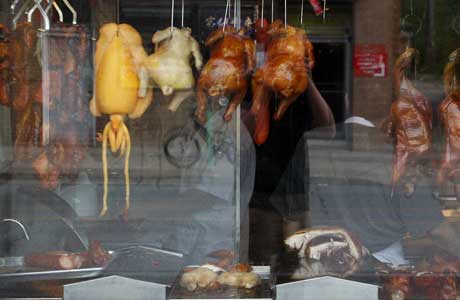
The Sun Hong Restaurant on 2045 Wyandotte Street West in Windsor, Ontario (that’s in Canada) on September 9. and a handful of others around the city, received a one-star health inspection rating by the Windsor-Essex County Health Unit (left, photo by Ben Nelms, The Windsor Star).

Eight establishments received a two-star rating, described as “fair,” 39 got three stars, or a “good” rating, and the remainder received four or five stars, classified as “very good” and “excellent.”

The Royal Pita Bakery at 701 Wyandotte St. E., was closed by the health unit in June after inspectors deemed it an “immediate health hazard.”

In 2008, the Ontario Public Health Standards mandated all health units to publicly disclose food safety inspection results. The local health unit began its Safe Food Counts program in 2009. The health unit website states that though the scores are reflective of food safety conditions at the time of the inspection, "the score may not reflect the overall, long-term standards of the business. It also does not represent the quality (e.g., taste, nutrition, customer service, etc.) of the food served at the premises."

The food safety ratings can be viewed online at www.safefoodcounts.ca.

Egg inspectors failed to raise alarms; government sucks, market microbial food safety at retail

As the number of salmonella-in-eggs illnesses climbed to 1,519, the Wall Street Journal reported last night that U.S. Department of Agriculture experts found growing sanitary problems including bugs and overflowing trash earlier this year on the Iowa farm at the center of the national egg recall, but didn’t notify health authorities.

The problems laid out in USDA daily sanitation reports viewed by The Wall Street Journal underscore the regulatory gaps that may have contributed to delays in discovering salmonella contamination.

USDA was the only federal body with a regular presence at Wright, but it says it wasn’t responsible for safety. USDA graders were at a Wright egg-packing plant seven days a week to oversee designations such as "Grade A" on egg cartons.

The report validates concerns raised by Alison Young of USA Today last week.

Sen. Charles Grassley, Republican of Iowa, said he had raised questions with Agriculture Secretary (and former Iowa governor – dp) Tom Vilsack about how his department forwards food-safety concerns, adding,

"In my oversight work, I’ve seen far too many federal agencies working in silos, failing to communicate with each other. … Just because food safety isn’t ‘my job’ doesn’t mean it should be ignored."

Would a single-food inspection agency or some federal legislation have empowered the egg graders or the FDAers to do more to limit the salmonella outbreak? Doubtful.

The comments echo those of Craig Wilson, head of food safety at Costco, who told Philip Brasher of the Des Moines Register that Costco had auditors at Wright farms to evaluate animal-welfare condition, adding, "There are a lot of guys going, ‘Hey, wait a minute. They’re finding stuff and our guys were there and they didn’t see it.’ "

In an outbreak situation, especially one with over 1,500 confirmed illnesses, people pay attention to food safety basics. The challenge is to get everyone to pay attention in the absence of an outbreak – it’s that prevention thing.

Which goes to food safety culture and marketing at retail.

David LaCrone of KC Free Press and I chatted about this a couple of weeks ago while a bunch of my kids were with us on the Island. I sound particularly deranged. I blame teenagers.

Dave LaCrone: What do you think the point of the egg recall issue is? I’ve heard people decrying factory farming and mass distribution; some people say “I’m glad I eat organic eggs.” What is your perspective?

Douglas Powell: That has nothing to do with food safety and things that make people barf. Your backyard eggs are going to have salmonella just as much as your factory farm does. All I’ve seen is political and legal opportunism at this point. People take whatever they see and use it to fit their political lens, whether it’s “I want federal legislation passed,” or “I want organic food,” and there’s really not a whole lot of discussion of biology.

DL: In other words, these kinds of risks are inherent pretty much in any kind of egg all the time.

DP: Yeah, and they always have been. Since the recall, you have all these consumer warnings that say you should always eat fully cooked eggs. But you look at the egg people’s literature and they have loving pictures of hollandaise sauce and poached eggs that are barely cooked. They come out now and say “no we’ve always said that” and I’m like “bullshit, you did!”

DL: Is there anything we or the government can do?

DP: I have low expectations of government. I find it amusing that people want to give government more authority, the same people who screwed up Katrina, screwed up the oil well. Why is that a solution? I don’t get it.

DL: Well then, do you think corporate self-regulation is a solution?

DP: No, it’s not an either/or. My solution would be the buying power of individual consumers. What I would like to see is these egg companies or spinach producers, whoever … advertise their microbial food safety record right there on the package. I don’t care if it’s natural, if there’s a picture of a farm or if it was lovingly raised. I want to know if it’s gonna make me barf.

There are billions of meals served every year where people don’t get sick, so obviously they are doing something right. Why not market it? But they won’t because that would imply that other food is unsafe. Well guess what? Other food is unsafe. The best way the consumers can act is through their buying power. Right now they are doing it through the B.S. organic stuff. They are being held hostage by people who don’t make direct claims about food safety but hint at it. Why else do you think they buy natural or local?

DL: Well, I think there are a lot of reasons but I do think it’s a burgeoning thing with parents of young children, especially upper middle-class parents that think that it’s more healthy and safer to eat organic.

DP: Yeah, I have a 20-month-old, does that mean I’m a bad parent for shopping at a grocery store?

DL: I have to ask if your knowledge bleeds over into your choice of where you eat and what to eat? Are there foods you won’t buy or you won’t eat when you go out?

DP: Not much. I have five kids so I have been doing this for a while. I go to the biggest supermarkets I can find because they usually have the quality assurance programs that are demanding of their suppliers: “If you’re gonna sell food in my Wal-Mart you have to meet these microbial standards.” I know the head of food safety at Wal-Mart, they have a very good program. Does anyone who goes to Wal-Mart know that? No.

 

Egg recall: Mouse, fly infestations date back 10 years, workers say

Just like with the salmonella outbreak involving Peanut Corporation of America, employees of DeCoster egg operations in Iowa are now coming forward to say problems with mice, filth and flies go back at least 10 years.

Past and present workers at Wright County Egg said mouse and fly infestations cited in a federal report stretch back at least a decade.?? The workers also reported ammonia levels high enough to cause chronic health problems, and inconsistent availability of safety equipment such as face masks and gloves.

Dozens of chickens died daily, their bodies lying undiscovered in cages for days, and perhaps weeks, at a time, they said.?? "There’s always been mice," former worker Lucas Garcias said through an interpreter. "I saw maggots and sometimes mice on the conveyor belt.”

And who was governor of Iowa during those years? Step forward current U.S. Department of Agriculture Secretary, Tom Vilsack.

Philip Brasher of the DesMoinesRegister.com also writes today the Iowa Department of Agriculture and Land Stewardship is taking a second look at its authority over the Galt feed mill that supplied the DeCoster egg operations. The state agency had decided before the massive egg recall linked to the DeCoster farms that the feed mill was exempt from state oversight. Company officials told inspectors that the DeCoster-owned mill only supplied the company’s hens. That exemption has been called into question by news that the mill was supplying feed to a second company, Hillandale Farms of Iowa, that was also involved in the recall.

Food poisoners: deliberate or negligent, send them to jail

I’ve screwed up. I’ve done time. Maybe not enough, that’s another discussion.

With Peanut Corporation of America CEO Stewart Parnell back in the nut business after killing 9 and sickening 700, there’s a move afoot for stricter penalties for those who knowingly market unsafe food.

BBC News reports that Ramazan Aslan, the former owner of some hole-in0the-wall takeaway in Walse that was the likely source of an E. coli outbreak that sickened four, will face charges in court.

He will face a number of food hygiene offences.

The National Public Health Service for Wales said in 2009 that the Llay Fish Bar, Llay – now operating under new ownership – was the likely source.

Four people, including a three-year-old girl, had the same strain of E.coli after buying food from the premises in July last year.

Washing pre-washed lettuce, trying saying that 10 times

The public seems to be bombarded with a myriad of confusing mixed food safety messages. This is to be expected as food safety is a technical discipline that is rather complicated. Let’s take lettuce for instance, should one wash pre-washed lettuce in their sink or not? The simple answer is no. This practice would simply encourage cross-contamination of the already pre-washed lettuce from the sink, an unnecessary step. Others may feel that washing their lettuce in the sink with a dilute solution of bleach would be the answer. Dilute, what is dilute and what is the magic number?   I don’t know of anyone to have chlorine test strips in their house to verify free chlorine, which would end up being combined chlorine due to the organics anyway, to measure 50 ppm. Let’s go back to science, what does the research tell us. It has been documented that simple agitation under running water for 10 minutes is a very effective means in reducing E. coli counts.  The best treatment, however, is applying 35% white vinegar directly on the lettuce and let sit for 10 minutes(1). This has been shown to dramatically reduce E. coli counts on lettuce. You’ve gotta love science.


1. CHITRA VIJAYAKUMAR AND CHARLENE E. WOLF-HALL. Evaluation of Household Sanitizers for Reducing Levels of Escherichia coli on Iceberg Lettuce.
Journal of Food Protection, Vol. 65, No. 10, 2002, Pages 1646–1650
 

Village Voice don’t like disclosure

Once trendy, now trashy, New York’s The Village Voice has nothing but disdain for NYC’s restaurant inspection grading system.

Most recently, the Voice used the dirty kitchen story to conclude, “Your kitchen is probably filthier than New York’s dirtiest dive.”

“In yet another glaring example that the Department of Health’s restaurant inspection letter grades are likely to be formidably misunderstood by the average dining Joe, researchers have found that at least one in seven home kitchens would fail the DOH inspection — in other words, score less than a C grade. …

“If the top-rated restaurant in the city can only get a C (and White Castle is at the top of the class alongside A-graded Popeye’s Chicken and McDonald’s), something must be wrong with the system.”
 

Haze strikes Minn. raw-milk producer in court

The StarTribune reports that farmer Mike Hartmann, who sold raw milk linked to an outbreak of illness caused by dangerous E. coli bacteria, repeatedly told government attorneys in court Wednesday that he couldn’t remember simple details about his dairy operation that is under a bitterly contested impoundment order.

Among the things he said he couldn’t remember were his home address and the address of his dairy farm and why he claimed in a dispute with the state nine years ago not to own the farm he now says he’s owned since 1974. He also said he forgot where he learned how to sterilize his milking equipment.

Hartmann has been at odds with the Minnesota Agriculture Department, which impounded several hundred tubs of milk, ice cream and other foods in June after an E. coli outbreak sickened eight people and sent some to the hospital.

Hartmann also shed little light on some sanitation issues. Hartmann said his cows’ udders were cleaned regularly to prevent infection. When Kimberly Middendorf, an assistant state attorney general, asked about photos showing blotches on the udders, he said he couldn’t be sure whether they were skin pigment, dirt or manure.

Asked about state food safety regulations, Hartmann said he considered many of them "arbitrary" rather than beneficial. He also said that, as a farmer selling products direct to consumers, he believed he was exempt from the state rules.
Middendorf said that while farmers are allowed to make some sales direct to consumers from their farms without a retail license, they aren’t exempt from any other safety regulations.

Bad food safety reporting III: tips for a pathogen-free kitchen

A story that is ostensibly about tips to reduce foodborne illness in the home becomes a mish-mash of federal legislation, local is better, and stuff that is just plain wrong.

And it’s from the New York Times.

Some of the lowlights:

Wash all produce: Even if you are going to peel a cucumber or melon, give it a good scrub so you don’t transfer bacteria from the knife or peeler to the part you are going to eat. Most important, wash all lettuce, even if it comes in a bag that says triple washed.

Scientists have said the re-washing process is more likely to cross-contaminate the pre-washed greens with whatever crap was previously in a sink. The paper is in Food Protection Trends and available here.

Learn to love well done Cooking thoroughly is the best way to eliminate harmful bacteria from meats and poultry. For a list of temperatures for various foods, check the Web site Foodsafety.gov, and don’t rely on your eye alone. Pick up an inexpensive meat thermometer (no need for the expensive digital models) next time you are in the grocery store.

It doesn’t have to be well-done, just cooked to the proper temperature. A digital thermometer is easier to read. And the key is to use a tip-sensitive thermometer.

Understand organic: Organic doesn’t necessarily mean safer (but) … there is something reassuring about buying from a small organic farmer at a local stand or farmers’ market, even if it does cost more.

No, it is not more reassuring. Show me the data.

A separate Times story, a so-called Recipe for Health for Orange Chicken With Vegetables calls for “1 pound skinless, boneless chicken breast, preferably from a small producer of free-range chickens, cut into 1/4-inch thick by 1-inch long pieces.” No reason why, other than some food porn preference; no mention of salmonella and cross contamination; no mention of temping final product with a tip-sensitive thermometer.