Salmonella test results for any egg farm should be publicly available to whoever wants them – on the label, at point-of-sale, on a web site, whatever – if that egg producer wants to gain public trust and confidence. I get the whole good-egg-project concept I watch incessantly on Sesame Street but I’d rather my kid didn’t barf from salmonella-contaminated eggs. I’ll do my part, but I want producers to do their part, and advertize the results so I can vote with my money.
A bunch of media outlets are reporting this afternoon that congressional investigators revealed today lab tests found hundreds of cases of salmonella contamination at an Iowa farm in a nearly two-year period before the outbreak that prompted a massive recall of eggs this summer.
Wright County Egg is one of two farms at the center of the massive recall. In a letter to its owner, Austin "Jack" DeCoster, leaders of the House Energy and Commerce Committee said tests confirmed 426 cases of salmonella contamination between September 2008 and the past July, and 73 were "potentially" positive for the strain of the disease involved in this year’s outbreak.
The committee’s Democratic leaders asked DeCoster to explain those findings when he appears at a September 21 hearing. They also called on him to explain why those test reports weren’t included in material the company has provided to Congress so far, and demanded that the company produce "all documents relating to your response to the test results" by Wednesday.
Iowa State University expert Darrell Trampel told the DesMoines Register that is “quite a high level of contamination.” Ideally, farms would have no positive test results for the bacteria, but it would be typical to have half a dozen to a dozen over that period at the most. The test results are from tests of areas around the hen houses rather than of the eggs themselves.
Why does it take over 1,500 illnesses for such data to be publicly released? And what would a day of raw-egg revelations be without another food porn recipe in, this time, the N.Y. Times, for food-processor mayonnaise, using raw eggs.
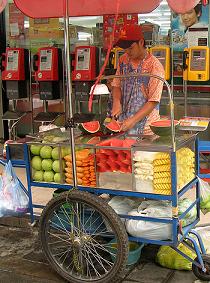
The Associated Press reports that a survey of fruit available via ubiquitous street carts in Thailand’s capital, Bangkok, found unsafe levels of bacteria and chemicals that help keep it looking fresh in the city’s tropical heat.
The Prime Minister’s Office launched a one-month campaign Monday to encourage fruit vendors and their suppliers to improve hygiene and provide consumers with safe, clean fruit. Authorities warned another survey will be taken at the end of the month after which vendors selling contaminated fruit will face up to two years in prison and fines of 20,000 baht ($650).
The study conducted throughout August by Bangkok City Hall, the Thai Food and Drug Administration and other health agencies sampled fruit from 38 vendors across the capital, where baggies packed with watermelon or pineapple sell for 10 baht (30 cents) and pricier guava costs 25 baht (80 cents).
Results of the study found that 67 percent of 153 samples of fresh fruit contained unsafe amounts of coliform bacteria. Coliform bacteria is common in digestive tracts and does not necessarily cause sickness, but its presence may indicate fecal matter, E. coli and other disease-causing organisms.
Why not? Wherever people eat, they should be able to get publicly-funded information about food safety; the smart operators will market their excellent food safety.
Los Angeles County public health officials are asking the Board of Supervisors to expand to food trucks the county’s popular letter grading system that evaluates safe food handling practices. The vote, originally scheduled for Tuesday, has been pushed back a week.
If approved, 6,000 full-service catering trucks and 3,500 hot dog, churro and other limited food service carts would be covered by the ordinance. If the supervisors approve it, enforcement would first begin in unincorporated areas of the county.
Dr. Jonathan Fielding, director of the county Department of Public Health, said,
“Even before this trend, we felt people were asking us: We go to a restaurant, we like the grading system, but what about all these trucks that are coming? How do we know? We’ve been looking at this for some time.”
Public health officials said the current program does not meet annual inspection goals because they cannot locate food vehicles that move constantly. The new ordinance will require vendors to give information about their vehicle whereabouts and mandates that the trucks be inspected twice a year.
Erin Glenn, chief executive officer of Asociacion de Loncheros, an association of lunch trucks, said,
“As long as enforcement is fair, and the inspectors treat local food vendors with respect, just like they do with the brick-and-mortar establishments, hopefully the inspection standards are the same, I think the regulations are fine. I think it’s a step in the right direction to improve public health, and we’re all for it.”
I’m confused with these conflicting handwashing studies.
And, as Les Nessman of WKRP in Cinncinatti said, when I get confused, I watch television. It somehow makes things simple. Television is never confusing.
Later today, it was the results of another of those creepy make-grad-students-hang –out-in-public-bathrooms studies, to see if people actually wash their hands, which found that 85 per cent of adults washed their hands in public restrooms, the highest number since the studies began in 1996.
But it’s a far cry from the 96% of adults who say they always wash their hands in public restrooms, based on a separate telephone survey conducted at the same time.
Men do a lot worse than women overall — just 77% scrubbed up, compared with 93% of women.
The study was sponsored by the American Society for Microbiology and the American Cleaning Institute (formerly the Soap and Detergent Association). It involved discreetly observing 6,028 adults in public restrooms in August to see whether they washed their hands.
Great. More people are attempting to wash their hands. But are they doing it correctly? Does any attempt count, or only if handwashing is done according to government prescriptions. What is the best way to wash hands? Can’t people with PhDs agree?
No.
A study by researchers at the University of Bradford and published in the current Journal of Applied Microbiology evaluated three kinds of hand drying and their effect on transfer of bacteria from the hands to other surfaces: paper towels, traditional hand dryers, which rely on evaporation, and a new model of hand dryer, which rapidly strips water off the hands using high velocity air jets.??
In this study the researchers quantified the effects of hand drying by measuring the number of bacteria on different parts of the hands before and after different drying methods. Volunteers were asked to wash their hands and place them onto contact plates that were then incubated to measure bacterial growth. The volunteers were then asked to dry their hands using either hand towels or one of three hand dryers, with or without rubbing their hands together, and levels of bacteria were re-measured.
The researchers found the most effective way of keeping bacterial counts low, when drying hands, was using paper towels. Amongst the electric dryers, the model that rapidly stripped the moisture off the hands was best for reducing transfer of bacteria to other surfaces.
Yet tomorrow’s N.Y. Times reports it’s a draw, and that “the best available evidence suggests that as far as germs go, the method of drying is less important than the amount of time invested: the longer the better.”
So my pants would be fine as long as I used them enough.
Dr. O. Peter Snyder at the St. Paul-based Hospitality Institute of Technology and Management summarized key aspects of handwashing and drying in a paper available at, http://www.hi-tm.com/Documents/Safehands.html. Snyder says that after hands are washed and rinsed, they must be thoroughly dried.
Blow dryers should not be used because they accumulate microorganisms from toilet aerosols, and can cause contamination of hands as they are dried by the drier (Knights, et al., 1993; Redway,et al., 1994).
Snyder notes that it is also apparent that many individuals do not dry their hands thoroughly when using a blow drier; hence, moisture, which is conducive to microbial growth, remains on hands, or people dry their hands on their clothing.
Proper handwashing requires access to the proper tools – and that means vigorously running water, soap and paper towel.
We’ve reviewed the literature on handwashing and how best to motivate people to wash hands, and conclude in a paper to be published shortly that,
“Although the role of hand hygiene in preventing infectious disease is well recognized, studies repeatedly show that compliance remains low. … Education and training have been cited often as essential to developing and maintaining hand hygiene compliance but, with few exceptions, this approach has not produced sustained improvement. … Hand hygiene was enhanced by provoking emotive sensations of discomfort, unpleasantness and disgust. Evidence suggests handwashing is a ritualized behavior mainly carried out as self-protection from infection and that patterns of handwashing behavior are likely established in childhood. Therefore, interventions that focus on culture, perception and behavior change may prove to be the most successful. How that success is measured must be carefully considered, as there is no standardized method for measuring hand hygiene compliance and current techniques have significant limitations.”
AFP reportsthe regular use of alcohol-based disinfecting hand gels authorities recommended during the swine flu pandemic has little effect on the disease’s infection rate, according to a US study.
The findings suggest that the pandemic virus A (H1N1) and similar strains may be most effectively transmitted in the air, rather than by contact with infected surfaces, the authors of the study said.
"An alcohol hand disinfectant with enhanced antiviral activity failed to significantly reduce the frequency of infection with either rhinovirus or influenza," wrote the authors of the study presented on Sunday at the Interscience Conference on Antimicrobial Agents and Chemotherapy (ICAAC) in Boston.
.
Participants in the study disinfected their hands roughly every three hours over ten weeks between August 25 and November 9, 2009. Of that group, 42 out of 100 contracted rhinovirus infections, compared to 51 out of 100 in the control group.
Similarly, 12 of those regularly disinfecting their hands contracted the so-called swine flu, compared to 15 in the control group.
"The hand treatment also did not significantly reduce the frequency of illnesses caused by the viruses," said the authors of the study led by Ronald Turner of the University of Virginia.
The study was financed by the Dial Corporation, which makes various care and cleaning products, including alcohol-based hand sanitiser.
Celebrity chef Heston Blumenthal’s latest attempt at PR salvation in this morning’s Daily Mail is another crass and superficial effort to blame others for the March 2009 norovirus outbreak that sickened 529 at The Fat Duck restaurant. Heston has a memory of convenience in yet another quest for salvation and, sympathy while pushing a new fancy restaurant and cookbook. Here’s a reminder.
“I thought my world was caving in.”
So did the 529 people barfing and confirmed as having norovirus from your Fat Duck.
“I’m just a chef who likes asking lots of questions.”
Not enough questions – like where those oysters came from, and if I’m going to use them in dishes such as jelly oyster with passion fruit and lavender, should they be cooked so people don’t barf?
“Blumenthal is still seething about the report into the incident published 12 months ago by the Health Protection Agency (HPA), which he believes maligns his £150-a-head establishment and his business methods. ‘The report insinuated things that I found very frustrating. For example, that staff were back at work while they were physically ill. Our staff training manual very clearly lays out a 48-hour return-to-work policy – you don’t come back until 48 hours after you feel better.’”
At the time of the outbreak, Blumethal reported conducting his own testing of staff and customers, and stated “so far it is categorically not food poisoning." Wrong.
The HPA report did state ongoing transmission at the restaurant—leading to illnesses from January 6 to February 22—was thought to have occurred through continuous contamination of foods prepared in the restaurant or by person-to-person spread between staff and diners or a mixture of both. Investigators identified several weaknesses in procedures at the restaurant may have contributed to ongoing transmission including: delayed response to the incident, the use of inappropriate environmental cleaning products, and staff working when ill. Up to 16 of the restaurant’s food handlers were reportedly working with norovirus symptoms before it was voluntarily closed.
“I took the decision to close the restaurant within 24 hours, as a precautionary measure. It was a financial blow but I couldn’t consider money at the time. … I felt desperately sorry for all the people who suffered. My instincts were to contact everyone personally and apologise but I was advised against this by my lawyers, insurers and official bodies conducting investigations. It was extremely frustrating, but my hands were tied.”
Blumenthal is arguing he took a financial blow, but wouldn’t risk a financial blow and say I’m sorry, which was the decent human thing to do instead of hiding behind barristers and bureaucrats.
When Blumenthal did finally issue an apology on September 25, 2009—seven months after the outbreak was discovered and more than two weeks after the Health Protection Agency report was released—it suggested that he viewed an empathetic apology as an admission of guilt.
"I am relieved to be able to finally offer my fullest apologies to all those who were affected by the outbreak at the Fat Duck,” said Blumenthal, “It was extremely frustrating to not be allowed to personally apologise (sic) to my guests until now. It was devastating to me and my whole team, as it was to many of our guests and I wish to invite them all to return to the Fat Duck at their convenience [for a free meal]." The apology was too late and again failed to accept responsibility for the aspects of the outbreak that were under the chef’s control—namely, acquiring seafood from unsafe sources and allowing sick employees to handle food.
“He has basically attempted to re-write the HPA report and its conclusions in his favour. It is pathetic and a complete PR disaster. There isn’t even a hint of apology.??“ At first I was extremely sympathetic to Heston Blumenthal, but the way this has been mishandled beggars belief. I could not believe what I was reading in this email – it was like we had been sent different reports. I am taking them to court and a lot of other people are too. A simple apology might have ended all this a long time ago.”
Another diner blogged, “I’m appalled because I was so entranced by Heston Blumenthal and he comes across as being very decent and clever. We had been so ill and, at the very least, we expected some kind of acknowledgment. We really thought they would be interested in what had happened to us.”
Boxing promoter Frank Warren commented, "Everything was fabulous about the evening – the food, the setting, the service, it was unbelievably good but unfortunately, afterwards, all of us were ill. … Since then we have not heard anything from the restaurant at all. I am very disappointed and I know that the people I went with are very disappointed with the feedback"
Blumenthal is now gearing up for the opening of a lavish new restaurant, Dinner, at London’s Mandarin Oriental Hotel in December. He is also working on a new, simpler cookbook, Heston At Home, which will be out in a year’s time.
Heston, you need to get a lot better at this PR thing if you expect either to sell.
My “mind went to dark places.”
We’ve all been to dark places; grow a pair and admit what went wrong rather than incessantly whining while promoting. Then maybe you’ll get some sympathy.
Doug and I traveled to Prince George (that’s in British Colombia, Canada) in October 2005 for a workshop for local health inspectors and the place creeped me out a bit. The town was like many small Canadian locales I’d been to: a few Tim Hortons outlets and Labatt 50 on tap at the crowded local pubs. The hosts were fantastic as were the Northern BC inspectors we hung out with. That wasn’t the creepy part.
What was creeping me out was the 800km through the bush from pretty well anywhere. I was only there for a couple of days but I felt pretty isolated.
I was also worried about the bears (and this was pre-Colbert Report).
Bears don’t like sauerkraut so maybe that’s why students in a Prince George school were messing around with a can of it. According to the Vancouver Sun, a canister of sauerkraut exploded causing some botulinum toxin exposure concern:
Two dozen students and four staff were quarantined while a hazardous materials technician and a safety officer investigated the substance.
It turned out to be sauerkraut, which had been fermenting in the can for several years.
When it was determined a botulism outbreak had not occurred, students were returned to their classes but dismissed early from school.
Could have been some incomplete fermentation allowing some gas-forming organisms to mess things up or maybe secondary fermentation. I’m not really a sauerkraut fan; I prefer fried onions and peppers on my grilled brats if I’m really trying to class them up but if you’re looking for some home-made bear-repelling sauerkraut check out this tested recipe from the folks at the National Center for Home Food Preservation.
In the on-again, off-again relationship between safety and reusable bags, NY-based Wegmans has stopped distributing a style of bag due to elevated levels of lead. According to reports, Paradigm Environmental Services recently tested an unknown number of green, red, black and purple colored Wegmans bags for heavy metals. At least one green bag was found to have a lead level of 799 ppm – exceeding the NY state allowable level of 100ppm for packaging. The issue is around the disposal of the lead-containing bags – not holding or storing food in them.
Judy Braiman, president of the Empire State Consumer Project and Rochesterians Against Misuse of Pesticides, alludes to a food safety concern with the bags by saying there’s a possibility of exposure if the bags become worn over time, “It’s lead, and lead is toxic. Why take the risk?”
While Wegmans has announced that they will replace customer’s pea green and Holiday 2009 bags as a precaution.
Wegmans will post notices in its 76 stores and on a website as soon as today, offering consumers a replacement, Jo Natale, a company spokeswoman, said in a telephone interview. More than 725,000 bags were sold at stores in New Jersey, New York, Pennsylvania, Virginia and Maryland, she said.
“This is not a food-safety issue,” Natale said. “It does not present a public-health risk. Even so, we are very committed to the environment, to sustainability, and decided to err on the side of caution.”
A couple from Upson County, Georgia, is suing a grocery store chain in federal court, claiming that the husband found a used tampon in his bowl of cereal.
According to the complaint, Thomas and Lynn Roddenberry said they bought a box of Chocolate Chip Crunch cereal from the Save-A-Lot store in Thomaston in October 2008. A day after buying the cereal, Thomas Roddenberry said he discovered the tampon in his bowl after taking a bite of the cereal.
The man said he spit out the cereal, immediately became nauseated and went to an emergency room.
The suit was filed on Wednesday in U.S. District Court in Macon. A spokesman for Save-A-Lot declined to comment on the case on Friday, citing pending litigation.

 project concept I watch incessantly on Sesame Street but I’d rather my kid didn’t barf from salmonella-contaminated eggs. I’ll do my part, but I want producers to do their part, and advertize the results so I can vote with my money.
 results for the bacteria, but it would be typical to have half a dozen to a dozen over that period at the most. The test results are from tests of areas around the hen houses rather than of the eggs themselves.
 consumers with safe, clean fruit. Authorities warned another survey will be taken at the end of the month after which vendors selling contaminated fruit will face up to two years in prison and fines of 20,000 baht ($650).
 Bar.
 The vote, originally scheduled for Tuesday, has been pushed back a week.
 give information about their vehicle whereabouts and mandates that the trucks be inspected twice a year.
 confusing.
 dryers, the model that rapidly stripped the moisture off the hands was best for reducing transfer of bacteria to other surfaces.
 may be most effectively transmitted in the air, rather than by contact with infected surfaces, the authors of the study said.
 restaurant. Heston has a memory of convenience in yet another quest for salvation and, sympathy while pushing a new fancy restaurant and cookbook. Here’s a reminder.
 suffered. My instincts were to contact everyone personally and apologise but I was advised against this by my lawyers, insurers and official bodies conducting investigations. It was extremely frustrating, but my hands were tied.”
 Blumenthal is now gearing up for the opening of a lavish new restaurant, Dinner, at London’s Mandarin Oriental Hotel in December. He is also working on a new, simpler cookbook, Heston At Home, which will be out in a year’s time.


 And the tampon.