Two salmonella outbreaks not related to DeCoster eggs

Salmonella is everywhere. And while the salmonella-in-eggs-from-Iowa outbreak is capturing media attention, other outbreaks continue.

The LaCrosse Tribune reports that salmonella poisoning did sicken about 30 people in Vernon County, Wisconsin late last week, but the illness is not thought to be connected to the recent nationwide egg recall.

The Wisconsin Lab of Hygiene confirmed Tuesday that patients who came into Vernon Memorial Healthcare had salmonella poisoning, Vernon County Health Department Director Beth Johnson said.

All of the cases were related to people who attended the same private party, Johnson said, and no local businesses or restaurants were involved.

While eggs are suspected in the outbreak, "it has nothing to do with the current egg recall," she said.

Meanwhile, a popular Mexican restaurant near Bakersfield, Calif., was forced to shut their doors Thursday, after four people were sickened with salmonella poisoning. Two of them remain hospitalized.

The Kern County health department says Don Perico may be the common denominator in these illnesses.

The sign posted on the restaurant’s front doors says the restaurant is remodeling, but the health department says they’re the ones who closed the doors. "There had been some past examples of significant violations," said Matt Constantine with the Health Department. "We have worked through them, we have allowed them to stay open. But in this case because of the potential health risk we took immediate action."
 

Salmonella in eggs: USDA graders and auditors were around filthy facilities, did they say anything?

Alison Young of USA Today reports today U.S. Department of Agriculture staff regularly on site at two Iowa egg processors implicated in a national salmonella outbreak were supposed to enforce rules against the presence of disease-spreading rodents and other vermin, federal regulations show.

Doug Powell, an associate professor of food safety at Kansas State University, said regulations are only as good as their enforcement, adding, "It goes back to the responsibility of whoever is producing the food. How do you establish a corporate culture where people pay attention to food safety?"

The USDA egg graders, part of an industry-paid program, were at Wright County Egg and Hillandale Farms at least 40 hours a week — including before the outbreak — inspecting the size and quality of eggs inside processing buildings.

Though USDA regulations say buildings and "outside premises" must be free of conditions that harbor vermin, the agency takes a narrow view of its responsibilities. Under the USDA’s unwritten interpretation of the regulations, egg graders only look for vermin inside the specific processing building where they are based, said Dean Kastner, an assistant USDA branch chief in poultry grading program.

The agency interprets outside premises as only the area immediately around the processing building’s loading dock and trash receptacle, he said.

Salmonella can be spread by rodents and wild birds. Outbreak investigators from the Food and Drug Administration (FDA) this week released reports documenting filthy conditions in and around egg laying barns at the two companies, including rodents, rodent holes, wild birds, flies and other vermin.

Hillandale Farms spokeswoman Julie DeYoung said the barns at its facility are about 50 feet from the processing building. At Wright County Egg, the laying barns are 50 feet apart and connected to the processing plant, said spokeswoman Hinda Mitchell.

Associated Press subsequently reported two former workers at Wright County Egg facilities, Robert and Deanna Arnold, say they reported problems such as leaking manure and dead chickens to USDA employees but were ignored and told to return to work.

The salmonella outbreak has led to a recall of about 550 million eggs.

Will E. coli O26 in beef recall lead to tightened rules?

William Neuman of the New York Times writes this morning that for the first time in the U.S., public health officials have linked ground beef to illnesses from a rare strain of E. coli, adding fuel to an already fierce debate over expanding federal rules meant to keep the toxic bacteria out of the meat supply.

Cargill Meat Solutions recalled 8,500 pounds of hamburger on Saturday after investigators determined that it was the likely source of a bacterial strain known as E. coli O26, which had sickened three people in Maine and New York.

Under federal rules, it is illegal to sell ground beef containing a more common strain of the bacteria, E. coli O157:H7, which has been responsible for thousands of illnesses, many deaths and the recall of millions of pounds of beef over the years. But federal regulators are now considering whether to give the same illegal status to at least six other E. coli strains, including O26, which can also make people violently sick.

The meat industry has opposed such a change, saying it is not needed. Among the arguments the industry has used was one stubborn fact: no outbreak in this country from the rarer strains of E. coli had ever been definitively tied to ground beef.

James Marsden, a professor of food safety and security at Kansas State University, said about the outbreak and recall,

“It might act as a catalyst. Clearly it’s back on the front burner, that’s for sure, and clearly USDA is under pressure.”

The federal Agriculture Department has been trying for several years to decide what to do about the additional strains of E. coli. The issue now falls in the lap of the Obama administration’s new head of food safety at the department, Dr. Elisabeth Hagen, who was appointed last month.

Dr. Hagen has yet to say publicly what she plans to do. But in a written statement provided to The New York Times, she said, “In order to best prevent illnesses and deaths from dangerous E. coli in beef, our policies need to evolve to address a broader range of these pathogens, beyond E.coli O157:H7. … Our approach should ensure that public health and food safety policy keeps pace with the demonstrated advances in science and data about foodborne illness to best protect consumers.”

The agency has said that it is reluctant to make additional forms of toxic E. coli illegal in ground beef until it has developed a rapid test that can detect those strains in packing plants. Such tests are not expected to be ready until at least late next year.
The beef industry argued against declaring the additional E. coli strains illegal in an Aug. 18 letter that the American Meat Institute, a trade group, sent to the agriculture secretary, Tom Vilsack.

Giving the strains illegal status could “cause more harm than good,” the letter said, by forcing costly testing when resources would be better spent on measures to prevent bacteria from getting into the meat in the first place.

It said that measures the industry had taken to combat the most common strain of E. coli were also effective against the other strains, and it urged the agency to conduct further studies before making a decision.

James H. Hodges, the meat institute’s executive vice president, said that a single outbreak did not alter the industry’s position.

“We have never said it wasn’t a potential public health problem. The debate is what’s the appropriate regulatory program.”

And once again, J. Patrick Boyle, president of the American Meat Institute, going mano-a-mano with Stephen Colbert on issues like non-O157 STECs.


The Colbert Report Mon – Thurs 11:30pm / 10:30c
Better Know a Lobby – American Meat Institute
www.colbertnation.com
Colbert Report Full Episodes 2010 Election Fox News

Food Safety Infosheet: Soyez prêt pendant les orages

Translated by Albert Amgar

Si il n’y plus de courant, que puis-je conserver ?

Les aliments qui peuvent être conservé de façon sécuritaire au-dessus de 5°C pendant quelques jours sont :

Les fruits et les végétaux frais non coupés,

Le ketchup, les condiments, les olives, les confitures et les gelées, la moutarde, la sauce barbecue, la sauce soja, le pain, les petits pains, les bagels, les gâteaux (sans crème, ni fourrage), les biscuits et les muffins et certains fromages à pâte dure.

Conserver les portes fermées de votre réfrigérateur et de votre congélateur aussi longtemps que possible pour maintenir une température froide. Vous pouvez recongeler de façon sécuritaire des aliments qui contiennent encore des cristaux de glace ou qui ont été conservés à 5°C ou en dessous.

Avec la porte fermée, les aliments dans la plupart des congélateurs vont rester en dessous de 5°C pendant au moins 3 jours, même en été.
La vitesse de décongélation dépend de :
• la quantité d’aliments présente dans le congélateur
• la nature des aliments
• la température de l’aliment
• la taille et l’isolation du congélateur
Remplir l’espace vide de votre congélateur avec de la glace pour aider à les aliments congelés à rester plus longtemps lorsque le courant est coupé.
Soyez préparé lorsque le courant est coupé
• Placer un thermomètre dans votre réfrigérateur et votre congélateur
• ayez un thermomètre digital sensible à lecteur rapide pour vérifier les aliments
• Ayez des aliments qui ne nécessite pas une réfrigération et qui peuvent être mangé froid ou chauffé avec un grill d’extérieur
• Congeler des poches d’eau pour en faire de la glace et aider ainsi à conserver froid les aliments dans les réfrigérateurs et les congélateurs
• Prévoyez à l’avance en préparant des glacières et en sachant où se trouvent de la glace sèche et des fournisseurs de blocs de glace
Les ouragans et les orages peuvent entraîner une coupure de courant et conduire à des problèmes de sécurité des aliments
Protégez vos aliments en étant prepare
 

8 sick with E. coli O157:H7 in Huron County, Michigan

Traverse City, Michigan, is not in the upper peninsula, or UP.

I’m sorry.

But something’s going on in Michigan, where last week several people were confirmed sick with shigatoxin-producing E. coli, and late Wednesday, Huron County health types announced several children and one adult are experiencing gastrointestinal (bowel) infections which are presumed to be E. coli O157:H7.

The Huron County Health Department issued a release Wednesday afternoon. with the usual snappy soundbites like,

“Some people may experience only mild diarrhea or no symptoms at all,” and, “Eating meat that is rare or inadequately cooked is the most common way of getting the infection.”

Maybe, but I doubt it. Cross contamination could be a bigger cause, based on direct observation of people in commercial or home kitchens.
 

Nuevo Folleto Informativo: Esté preparado para las tormentas

Benjamin Chapman
Traducido por Gonzalo Erdozain
Resumen del folleto informativo mas reciente:
– Huracanes 
y tormentas 
pueden causar cortes 
de luz y problemas con los alimentos
– Esté preparado y proteja sus alimentos
– Ponga un termómetro en su heladera y freezer
– Prepare conservadoras y esté al tanto de lugares donde pueda comprar hielo seco y hielo en bloque
Los folletos informativos son creados semanalmente y puestos en restaurantes, tiendas y granjas, y son usados para entrenar y educar a través del mundo. Si usted quiere proponer un tema o mandar fotos para los folletos, contacte a Ben Chapman a benjamin_chapman@ncsu.edu.
Puede seguir las historias de los folletos informativos y barfblog en twitter
@benjaminchapman y @barfblog.
 

Beef recalled from Ontario retailer; people sick with E. coli O157

The Canadian Food Inspection Agency (CFIA) warned the public last night not to consume the raw beef products described below because these products may be contaminated with E. coli O157:H7.

All cuts of raw beef, including but not limited to tenderloin, beef chunks and ground beef, sold on August 6, 2010 from Kabul Farms retail store located on the appropriately named Beverley Hills Drive in North York, Ontario, are affected by this alert. These beef products were wrapped at the store for sale on demand and may not bear a label indicating packing date, lot code, or a Best Before date. So that’s helpful. Consumers are advised to check their home refrigerator or freezer if they have the affected beef products.

CFIA is aware of an E. coli O157:H7 illness outbreak in Ontario and is collaborating with a bunch of agencies but won’t provide any information on how many got sick when and where, although does state the investigation is ongoing.
 

Fancy food does not mean safe food, NYC edition

Grub Street New York reports the city’s No. 1 restaurant, Le Bernardin, featuring celebrity Top Cheferer Eric Ripert (right, not exactly as shown), received 32 demerits (4 points above the C mark) on an inspection last Friday.

General Manager David Mancini says he’s expecting a follow-up on the initial “courtesy inspection” in the next week or two and tells us, “As aggressive as the inspection was, I don’t want to make any comment until they come back and reinspect us, and then I’ll probably have a great deal of comment.”

Failures in the current inspection included:

• cold food item held above 41º F (smoked fish and reduced oxygen packaged foods above 38 ºF) except during necessary preparation;

• raw, cooked or prepared food is adulterated, contaminated, cross-contaminated, or not discarded in accordance with HACCP plan;

• sanitized equipment or utensil, including in-use food dispensing utensil, improperly used or stored; and,

• plumbing not properly installed or maintained, anti-siphonage or backflow prevention device not provided where required; equipment or floor not properly drained, and ssewage disposal system in disrepair or not functioning properly.

Bon appetite.
 

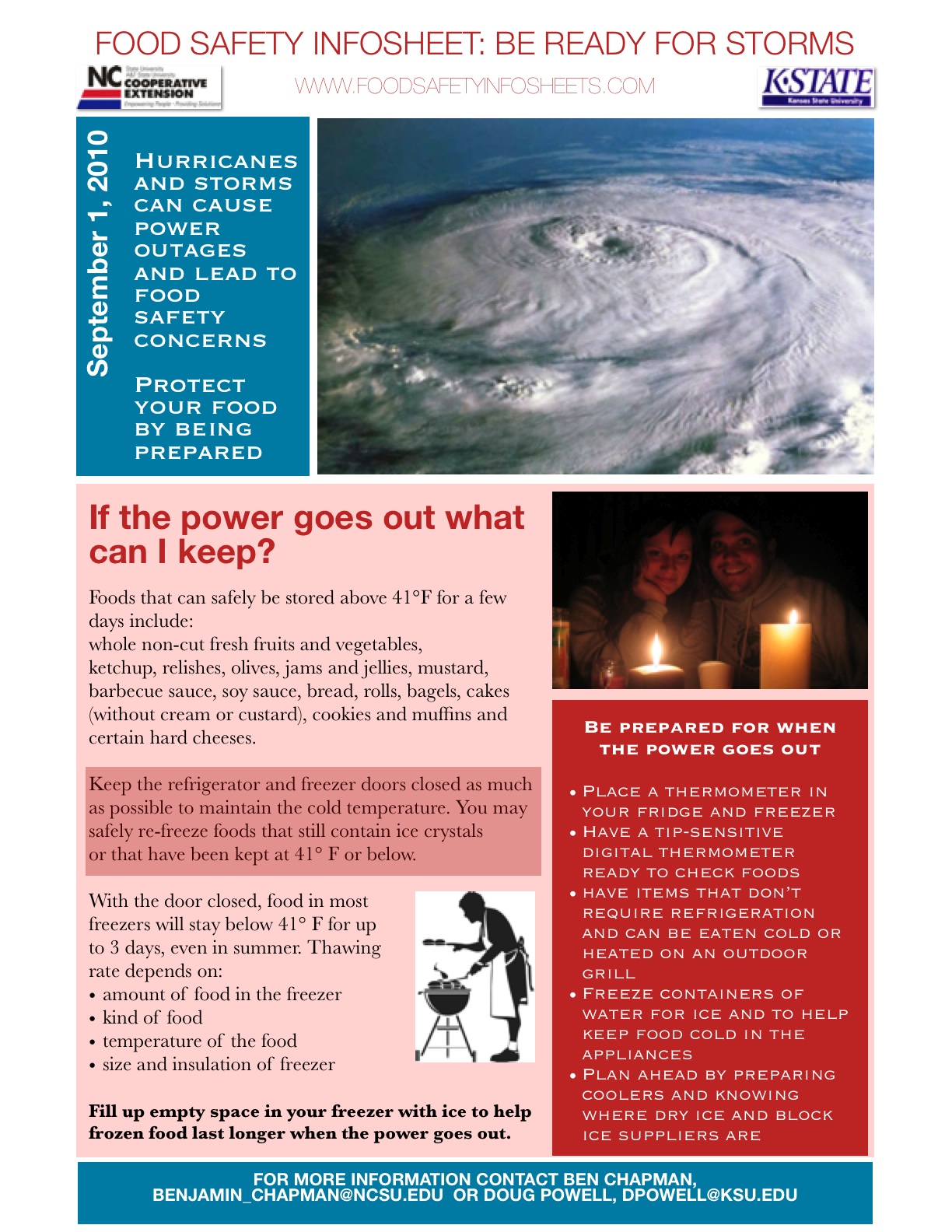
New food safety infosheet, Hurricane Earl edition: Be ready for storms

I’ve lived in North Carolina for just over 20 months and have yet to see the effects of a hurricane. Snow has shut things down in Raleigh a few times since December 2008, but nothing crazy has happened during the summer months. Our power went out about a month ago after a fire at a nearby power station and although it was 8:30pm, it only took 3 hours without electricity for the temperature in our house to go up about 5 or 6 degrees.

Living like that for a couple of days is a slight possibility with Hurricane Earl on its way sort of towards us. Fortuntely we’re far enough inland that it looks like we wont see the full effect, but many on the coast could find themselves without electricity, dealing with hot temps (close to 100F is forecasted for Friday) and a fridge/freezer full of food. Not fun.

Having a bit of a plan and prepping for losing power prior to an event can save food losses and reduce foodborne illness risks. That’s the focus of the newest food safety infosheet (which can be found here).

1 dead, 8 sick from salmonella after UK wedding

Nothing says, “I do” like wedding guests barfing and in this case, tragically, one dying after consuming the post-nuptial meal.

Rene Kwartz, 82, was one of four guests who needed hospital treatment after a meal at a hotel in Prestwich, Greater Manchester.

Three of those taken to hospital recovered and were discharged but Mrs Kwartz died last week.

Lawyers representing the guests at the wedding of Stephen Wicks and Jennifer Harris on August 8 are taking legal action against the outside caterers to the function.