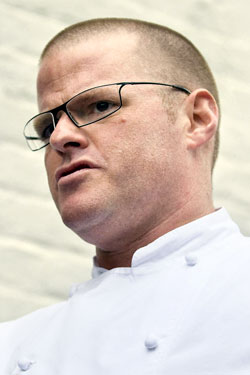
He may know molecular but he don’t know noro; Fat Duck restaurant ranked 1

BBC News reports that the Fat Duck restaurant, owned by chef Heston Blumenthal, has been named the U.K.’s best restaurant for the third year in a row by the Good Food Guide and described as producing "world-beating dishes for the bedazzled throngs."

The guide, compiled by consumer group Which?, should be more discerning on behalf of consumers, like the 529 who were left barfing with norovirus after dining at the Duc.

The tasting menu includes a course called Sound of the Sea, during which the diner eats smoked fish, edible "sand" and "seaweed" while listening to seagulls on an iPod.

I’m going to hurl.

E. coli O123:H in a family in France, 2009

King et al., report in Emerging Infectious Disease that on February 11, 2009, two cases of diarrhea were reported to a surveillance coordinator: 1 in a child with HUS and the other in that child’s sibling.

The 2 siblings, 2 and 6 years of age, had diarrhea beginning on February 4 and 5, 2009. Bloody diarrhea developed in the younger child, and HUS was diagnosed on February 9. The older child had non-bloody diarrhea for 3 days and abdominal pain. Questioning of the patients’ parents identified no recent history of travel, contact with farm animals, or outdoor bathing. A food history indicated that the 2 patients had shared an undercooked ground beef burger 4–5 days before symptom onset. The patients’ parents also ate burgers from the same package (box); they did not report any gastrointestinal symptoms.

And they found the same bug in a leftover frozen burger.

STEC serotype O123:H– has been isolated from feces of healthy lambs and sheep in Spain and in southwestern Australia and is considered to be among the predominant ovine STEC serotypes in these countries.

This family outbreak shows that STEC serotype O123:H–, albeit rarely described as causing human illness, can cause severe human infection. This serotype can also cause clusters of STEC infections and be transmitted by ingestion of undercooked ground beef.
 

Fast food drives Americans crazy; Ohio woman wants her Chicken McNuggets

The story may be old, but, as noted by Faded Tribune, the video is new and over the top.

And they can’t seem to get enough of it on the news stations here in Australia.

Footage from a surveillance camera at a McDonald’s in Toledo, Ohio shows an unhinged woman punching two workers and smashing the drive-through window because she could not get Chicken McNuggets in the wee hours of New Year’s Day.

For the vandalism, 24-year-old Melodi Dushane was sentenced last month to 60 days in jail, three years of community service and ordered to pay more than $1500 for the damage. She said she had been drinking and suffers panic attacks, which she blamed for leading up to her rampage.
 

Barfing, Berkeley and Brisbane

As director Kevin Smith would say, Brisbane, Australia, I’m inside you.
(Smith was inside Sydney last week as part of his touring standup Q&A sessions that get turned into fairly entertaining movies.)

Other than torturing Sorenne for 36 hours of transportation from Manhattan to Brisbane, the only excitement was the ‘Do Not Spit Here’ sign on the garbage can in the Auckland airport, also available in what looked like Chinese and Korean.

But there was a good food-related barf story out of Berkeley, Calif.
Julie R. Smith writes in The Berkeley Independent that she used to sneer at germs, but is now plagued with the “social food” problem, when you’re faced with food that has not been prepared in a state-licensed restaurant with a sanitation rating of A+. Unless I’ve actually watched you crack the eggs or cook the meat (and preferably inserted the thermometer myself), forget it. I’m a nervous wreck.

In 2007 I started throwing up at work, which led to throwing up in the parking lot, which became throwing up in my car (a co-worker was driving, thank God), which segued into throwing up all over the ER admittance desk.

After barfing on a nurse and two gurneys, the fun began: I started literally foaming at the mouth. Every time I retched, foam flew far and wide. My co-worker, a staff photographer who served in Viet Nam, was convinced I had rabies.

Two hours later, after shots and IVs and heated blankets, the ER doc announced that I appeared to have norovirus. “Nora who?” I asked fuzzily. …

A year ago, I returned from a trip to North Carolina feeling fine. At 1 a.m. I woke drenched in sweat, fell out of bed and threw up on the dog. Then the other end of my digestive system decided to join the party.

Five hours later I was again in the ER with dry heaves and a nifty potassium drip. The doctor asked if I’d eaten anything “that didn’t taste right.”

“Not really, but I pigged out all weekend,” I admitted. “Chicken, deviled eggs, pasta salad, fried fish, pie, baked potato with sour cream. Too much rich food, I guess.”

He shook his head. “When you eat something that doesn’t agree with you, you throw it up and life goes on,” he said. “This is food poisoning. You ate something that was contaminated.”

So there you have it: Norovirus and food poisoning. Life’s too short to spend it throwing up. Pass me the meat thermometer.

When bad things happen to good restaurants – New York City inspection disclosure edition of fancy food doesn’t mean safe food

NBC reports that the Health Department’s new restaurant grading program has already dinged some famous New York City establishments resulting in low grades.

Famed brasserie Les Halles has received 20 ‘violation points,’ which translates to a B. Inspectors found roaches and unprotected food in Les Halles’ kitchen, both critical violations. Poor plumbing and a lack of vermin-proofing were also listed on the Health Department’s Restaurant Inspection Information website.

Di Fara Pizzeria, considered to be one of the city’s top pizza restaurants, is just two violation points shy of a C. Three critical violations — mice, flies, and poor refrigeration or heating equipment — as well as three other violations brought its grade to 26 violation points.

McSorley’s Old Ale House and the Regency Hotel on Park Avenue have both received over 30 violation points. McSorley’s, the city’s oldest bar, received 38 points, including four critical violations for flies and "tobacco use, eating or drinking…in food preparation , storage, or dishwashing area." And the Regency Hotel, with 44 points, had six critical violations, including improperly sanitized utensils and food preparation surfaces, cross-contamination.

Of the 631 restaurants inspected since July 27, ninety-nine, or 16 percent have received As. Three hundred and five, or 48 percent, received Bs, and 227, or 36 percent, have received Cs. These initial grades can be appealed.

DNA Info reports a Barnes & Noble cafe received an "A" grade under the city’s new restaurant rating system, despite evidence of mice.

Health Department spokeswoman Celina De Leon said inspectors found a "small number of mice droppings" on the floor of the café adding,

"While this presents evidence of a problem, there was no evidence that the problem was widespread or had contaminated food.

Barney Greengrass, the legendary purveyor of smoked fish and bagels, racked up so many violations — 42 points — during a July 29 inspection that the restaurant could wind up with a C grade if it doesn’t correct problems.

Shake Shack’s Columbus Avenue location received 19 points during an April inspection, a score that would rate a B grade under the new system.

The burger joint was docked for having food that was "spoiled, adulterated, contaminated or cross-contaminated" and for "evidence of roaches."

 

Fairs, festivals and food safety

I’ve been hanging out at fairs and the sorts lately, like the Wamego Tulip Festival and Phillipsburg Rodeo. I always check for handwashing stations where there is contact with the animals and food involved. However, the animals are not the only risk at fairs and festivals and the consumer cannot always be the scapegoat.

Thirteen businesses and food stalls were ordered to shut down at the Oxegen and the Dún Laoghaire Festival of World Cultures in Ireland due to food safety violations.

“The FSAI said that it is unacceptable that some food businesses are continuing to breach food safety laws and warned all food business operators to place robust food safety systems and hygiene practices top of their agenda.”

Consumers should wash their hands and do everything they can to avoid foodborne illness, but when the food handlers are the problem there’s not much the consumer can do.
 

CDC: Feeding your pets in the kitchen (and washing their bowls) can lead to salmonellosis

Pet food/feeding just wont go away. Following last week’s frozen pet food linked outbreak, researchers led by CDC have released a report detailing salmonellosis associated with dry pet kibble from 2006-2008 linked to 79 illnesses in 21 states.

According to AP and USA Today:

Dry pet foods are an under-recognized source of salmonella infections in humans, and it’s likely other illnesses since then were unknowingly caused by tainted pet food, said Casey Barton Behravesh, the report’s lead author and a researcher at the federal Centers for Disease Control and Prevention.
 
While young children were most often affected, there’s no evidence that they got sick by eating pet food, Behravesh said. They probably became infected by touching affected animals or dirty pet food dishes, and then putting their hands in their mouths, she said.
 
In her study, sick children were no more likely to have played with or eaten pet food than other children. Instead, people were at risk for salmonella simply because they fed their pets in the kitchen, Behravesh says. People who became ill may have spread the bacteria around the kitchen because they failed to wash their hands after pouring dog chow into a bowl or handing the cat a treat.
 
With an almost-two-year old inquisitive boy in our house, I know how appealing pet food, pet food bowls, feeding pets and playing/laying on pet beds can be to a child. What’s most interesting to me is the reportedly 4-times higher rate of infection from feeding pets in the kitchen – as is the spread from washing pet food bowls as a factors. How this translates to general household dishwashing (especially after use with potentially contaminated raw foods such as meat) is worth looking at further and modeling.
 
Doug and Randy Phebus created the below video at the time of the pet food-linked outbreak. They’ve both aged a bit but the info remains current.
 

Restaurant Don’ts

Raw chicken is probably the first thing that most people think of when thinking of foodborne illness. You would think chefs would know to use a thermometer to prevent undercooked chicken from ending up on the table.

However, tonight I witnessed a chef on 24 Hour Restaurant Battle (on the Food Network) serve some raw chicken to his diners. Not just to any person at that, but Marcus Samuelsson and Scott Conant, who were judges on the show. At least they got it right, immediately recognizing the risks and spitting it out.

Every person in the vicinity turned around when Samuelsson pointed out: “That is dangerous; that is not undercooked, it’s raw.”

If your restaurant makes people barf, it’s not going to fare so well. Mr. Blumenthal learned that the hard way last year when his restaurant was shut down due to norovirus.
The chef on the show also learned the hard way; the raw chicken cost him the $10, 000 prize.
 

Ready-to-eat salads, new pathogens fuel rise in contaminated produce

Kevin Allen is still a goon – at least on ice.

He’s apparently a nice guy, loving father and snappy dresser when not bashing pucks off my goaltender’s head. He also plays academic sometimes.

University of British Columbia food scientist Kevin Allen told the Vancouver Sun this morning,

"If we look at the past decade, we can see a change in the epidemiology of food-borne disease, more specifically within the category of ready-to-eat foods. Part of the problem is that ready-to-eat foods are supposed to be ready to eat, so unlike poultry and your beef and your eggs, with salads and sprouts there is no cooking and so no pathogen-killing step. … Organisms like E. coli and salmonella that used to be associated solely with poultry and beef are now almost as frequently associated with leafy green vegetables. That is a tremendous shift from 20 years ago."

Christina Hilliard, a fresh fruit and produce specialist with the Canadian Food Inspection Agency said,

"Twenty-five years ago we weren’t even thinking about lettuce in terms of food safety, even five years ago we didn’t think that someone could die from eating spinach.”

Allen’s research at UBC is dedicated to minimizing the presence of E. coli in cattle with an eye to stopping the pathogen’s spread through the food chain.

Why everyone should be vaccinated for hepatitis A; food worker at 2 Colorado restaurants prompts call for shots

Patrons of two Grand Lake, Colorado, restaurants are being urged to get either immune globulin (IG) or hepatitis A shots following the discovery that a worker employed at both eateries has a case of hepatitis A.

The two restaurants were identified by the Denver Post as Sagebrush BBQ & Grill and Max & T’s Bar and Grill by the Grand County Public Health department.

Officials emphasized that both restaurants have had very good inspection records and are cooperating in the investigation.

The health department said there are no other confirmed cases of hepatitis A at this time.