.jpg)
.jpg)
The always colorful and geographically precise, Bill Keene, senior epidemiologist with Oregon Public Health, told The Oregonian yesterday that
mystery Mexican-style fast food chain restaurant A is Taco Bell.
"It’s been clear for weeks that Taco Bell was the source for many of the illnesses. It’s equally clear that it’s not all Taco Bell. It’s also not a single Taco Bell restaurant."
The first cases appeared at the beginning of April and continued through the third week in July. Dozens were sickened in Wisconsin, Indiana, Ohio and Kentucky, with a sprinkling of cases across the rest of the country. One person in Oregon — a woman in her 20s in Klamath County — got sick.
Keene said,
"It’s very striking to have two such similar outbreaks at roughly the same time and both of them affecting Taco Bell. The similarities might be a coincidence."
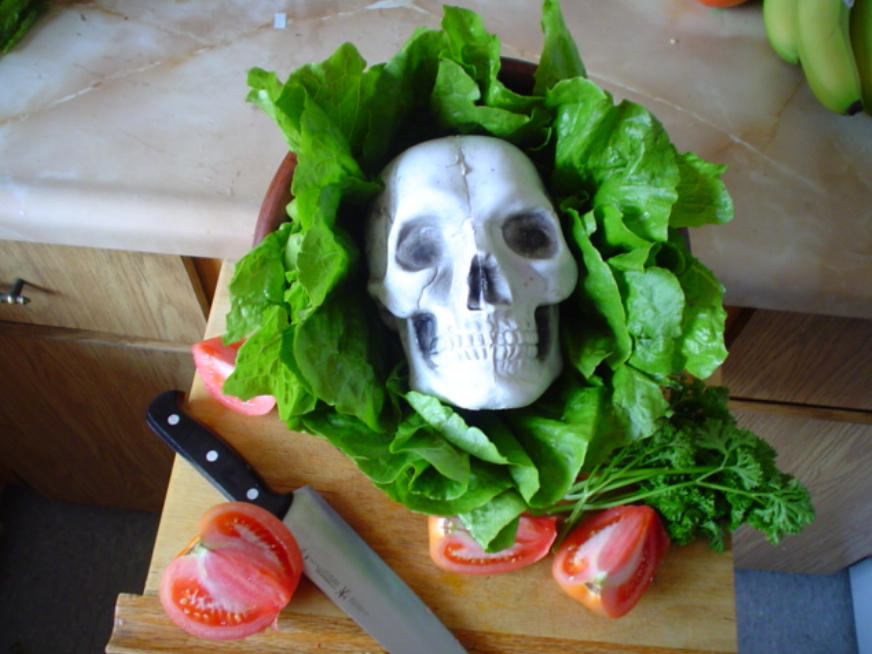
Although no one food or menu item has been named a culprit, Keene said epidemiologists think that lettuce, tomatoes or both were to blame.
"It’s not 100 percent sure it’s one or the other but those are the chief suspects," he said. "We’ve been unable to tease them apart because everyone eats both."
Keene said the food involved in the outbreaks was clearly contaminated before reaching Taco Bell franchises.
"It’s not something that they’re doing wrong. One of the products that they using in their food was contaminated."
The company did not return a phone call seeking comment.
CDC officials would not confirm that the company involved in the outbreaks was Taco Bell.
Naming a restaurant could have an economic impact on the company’s bottom line, said Kristen Nordlund, an agency spokeswoman.
The outbreak is also considered to be over though both the FDA and CDC are continuing to investigate.
"There’s no inherent reason for people to stop eating at Taco Bell now," Keene said.
There’s seven people in California that have been barfing from a rare strain of E. coli O157:H7 as determined by PFGE subtyping.
Those folks may not like being referred to as a “small cluster” of illness while
hanging out with the goddess of porcelain.
The California Department of Public Health (CDPH) identified six patients with illness onset dates between April 8 and June 18, 2010 and after further review, CDPH added another patient from February to the case count, bringing the count to seven.
The U.S. Department of Agriculture’s Food Safety and Inspection Service (FSIS) became aware of the problem on July 15, 2010, and eventually – early this morning, Aug, 6, 2010 – convinced Valley Meat Company, a Modesto, Calif. establishment to recall approximately one million pounds of frozen ground beef patties and bulk ground beef products that may be contaminated with E. coli O157:H7.
FSIS and the establishment are concerned that some product may still be frozen and in consumers’ freezers.
But not so concerned to issue a warning earlier. Who knew what when? Maybe it’s time to pull back the curtain on epidemiological investigations and when to go public with information that could prevent others from barfing.
Canadian Agriculture Minister and would-be comedian Gerry Ritz on Thursday told Postmedia News that last week’s massive recall of all Brandt ready-to-eat deli meats exposes gaps in Canada’s meat inspection system,
stating,
"I’m concerned that the paperwork that Brandt had was less than strenuous, I’ll call it. We are in there looking through some of that. We’re looking at different protocols, at having them reporting in different ways. At the end of the day, we’ll have a better plant."
Sarah Schmidt, following up on her Postmedia story yesterday about the delay in detecting problems at the Brandt Meats Toronto-area plant, said the Canadian Food Inspection Agency – which reports to the Canadian Parliament through the Minister of Agriculture – only checked out the Brandt plant after pressure from public health types.
As in, we got a bunch of sick people, it came from this plant, maybe you should look harder, do we have to do your job as well?
Ritz was further quoted as saying,
"It takes a combination of work between CFIA, public health and the industry of record. I think everyone learns from every one of things. We always do that ‘lessons-learned’ aspect of it. Having said that, we always strive to do better
and I think in this case, certainly it could always be worse and we try to make a better system as we move forward."

Minister, by worse, do you mean when 23 people die from listeria in Canada in 2008?
Ritz also said, "we hiring people as fast we can."
Inspectors? Scientists? PR hacks? How’s the quality control on those fast hires?
"I’m about to have the worst case of taco sh**s."?
That prophetic line offered by Clarissa before engaging in a good-natured game of "Battlesh**s" with Christy in the movie, Harold and Kumar Go To
White Castle, has been experienced by some of the 155 sick with salmonella who ate at a Taco Bell since April.
Earlier today, Phyllis Entis of eFoodAlert.com received independent confirmation that Mystery Mexican-style restaurant A was indeed Taco Bell.
In Dec. 2006, in the wake of the E. coli O157:H7 in spinach mess that killed four and sickened 200, Taco Bell became the butt of endless haranguing by David Letterman after the same bug in lettuce sickened over 100 people (“Their old slogan used to be ‘think outside the bun.. The new slogan is, ‘look outside for the ambulance.’” See the video clip, below).
The U.S. Centers for Disease Control said yesterday that no specific food item have been fingered but fresh produce was suspected.
The spinach outbreak of Sept. 2006 was supposed to be the tipping point (although I have argued the tipping point for fresh produce should have been the 1996 E. coli O157:H7 in Odwalla juice outbreak): for farmers dealing with
collapsed markets; for retailers who say they were now going to get serious about questioning their suppliers; and, for consumers who now realize that fresh produce is a significant source of foodborne illness and are voting with their wallets and their forks how can they know if the fresh stuff is safe??
The way this information trickles out does nothing to instill confidence, just like the salmonella outbreak and subsequent recalls in Fresh Express lettuce earlier this year. It’s nice that Taco Bell fully co-operated with CDC and other health types, but they can do better: brag about food safety requirements and back it up by making test results public, market food safety at retail so consumers can choose, and if people get sick from your product, be the first to tell the public.
Fresh fruits and vegetables are good for us; we should eat more, even at Taco Bell. Because fresh produce is just that – fresh, and not cooked — anything that comes into contact is a possible source of contamination. Every mouthful of fresh produce is an act of faith — faith in the growers, distributors, processors, retailers and our own hands.?
Some in the farm-to-fork food safety system want more of the same: stronger checks of good agricultural practices on the farm (which have been available but not necessarily followed or enforced since 1998); more research on how dangerous bugs get on or in healthy produce; more vague press releases.?
The American economy is driven by competition and the produce sector should compete for the food dollar in grocery stores and restaurants across
the country, using safety as a selling point. The farmers or company that uses the best science to keep poop off the plate matched with employee commitment through a strong food safety culture, will capture the imagination of a hungry public..
May the best food safety system win.? The diarrhea twins from Harold and Kumar will be first in line.
The owner of the Rock and Rolls Cafe, Chapel St Leonards, U.K., was fined £2,000 and ordered to pay costs of £400 after his cafe failed a food hygiene inspection in August 2009.
Breaches of food safety offences included failing to control flies and keep work surfaces clean.

In a refreshing restatement of why inspections take place, Coun Sandra Harrison, portfolio holder for health at East Lindsey District Council, said,
"It is important that food business owners remember that their reputation is on the line and they could receive a hefty fine if they are found to be breaching food safety standards. In this case we have seen significant improvements but these types of incidents should never occur. When we do detect food safety issues we will always take action because it is putting the health of our community at risk."
The Malaysian health ministry is stepping up scrutiny on the imported ‘Wang Wang’ rice crackers and collecting its samples for laboratory tests, following a
report that coliform and Escherichia coli bacteria were detected in the product in China.
The minister, Datuk Seri Liow Tiong Lai, said Malaysia imported 334,460 boxes of the product this year but was unsure how many were still in the market or whether they were contaminated.
As a precaution, he said the product was placed at Level 5 of the Food Safety Information of Malaysia (Fosim), where the product would be analysed before release into the market.
There are some recurring myths in the public discussion of foodborne illness and the reasons 76 million Americans barf every year from the food and water they consume, and the New York Times is recycling them all.
Author Eric Schlosser (“Unsafe at Any Meal,” New York Times, Op-Ed, July 25) overstates the protective role of government while casting aspersions against what he calls industrial agricultural and unchecked corporate power. His rant on the Colbert Report last year was legendary.
Henry Miller who used to do biotechnology work at the U.S. Food and Drug Administration writes in the Times this morning, “The vast majority of food poisoning is caused by individuals’ mishandling of food; common lapses include the mishandling or undercooking of poultry and the inadequate refrigeration of food. More expansive, expensive, onerous regulation is not the answer; better education of consumers is.”
Our review of the data found a complete mish-mash about where “the vast majority of food poisoning illness is caused” and that no conclusions could be drawn. Produce, pot pies, pet food and pizzas don’t have much to do with consumers. And how would this better education be conducted?
If someone wrote in and said Americans have the safest food supply in the world, all the big three mythologies would be represented.
Food safety is not simple and the public discussion – which affects individual behaviors from farm-to-fork – is a mess.
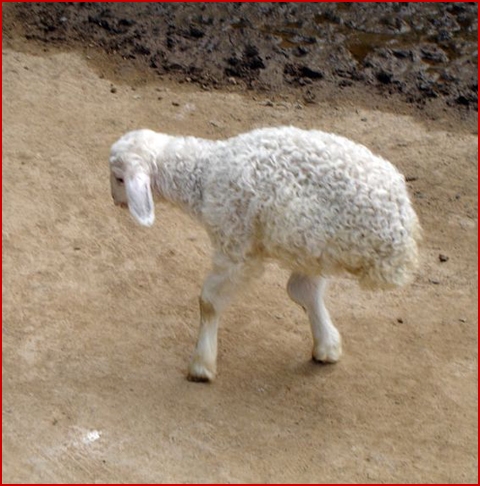
From the genetics-is-a-wonderfully-mutating-thing file, a two-legged lamb (right, exactly as shown) was born at a farm at Shangdong province in eastern China.
Faded Tribune reports that farmer Cui Jinxiu said,
“I did not think he would live very long, but then he managed to struggle up and stand on his two legs in order to drink some milk from his mother. He was surprisingly steady on his feet — and it did not seem to disturb his mother that he only had two legs. I was so impressed at his desire to survive that I began feeding him extra milk from a bottle. He gambols around with the other lambs when it’s sunny even though he is only a week old now. And he has such a friendly personality, he seems to enjoy life and I think he doesn’t realize he’s disabled.”
For years, no matter where I lived, there was a Kentucky Fried Chicken fast-food restaurant nearby – what’s now called KFC — and the scent of special herbs and spices was in the air and in my clothing.
I’d eat the stuff once a year, and immediately regret the indulgence.
There’s a tragic case involving a KFC that is being heard by the Australian Supreme Court involving 11-year-old Monika Samaan, who is suing KFC, claiming the source of her salmonella poisoning was a Twister her father said he bought at the outlet on October 24, 2005.
In testimony today, three former staff at KFC Villawood, near Sydney said they would drop chicken pieces on the floor, help themselves to food and throw chicken strips at each other as ‘pranks.
The Sydney Morning Herald reports KFC has denied responsibility for Samaan’s illness, which has left her with severe brain damage and quadriplegia.
Hatem Alhindawiq, 20, who began working at the Villawood branch in September 2005, told the court that a few weeks after he started there he and his friends would lock each other in the cool room and ”maybe chuck chips … at each other, that kind of stuff”.
They would also throw chicken nuggets and chicken strips and ”muck around, slap each other and run away, all that sort of stuff”, he said, adding that chicken strips were ”the easiest to chuck”.
Mr Alhindawiq said he saw a friend who was a cook at the outlet accidentally drop a piece of chicken as he was unloading the deep fry basket. It fell onto a
”breading table” where chicken is floured before being cooked, and then onto the floor. ”He was like, ‘Oh, don’t worry’ … look, it’s only flour,’ and he grabbed it and he chucked it back in.”
Danielle Cabassi, 19, who worked at the branch for two years from 2005, said she often saw the cooks fail to wash their hands between working with raw chicken and removing cooked chicken from the fryer. They would use tongs, but there was still blood on their hands, the interior student said.