Is street meat safe to eat?

During my undergraduate days in Canada I tended to grab a bite after hitting the town. Though I rarely do it now (BK burgers just aren’t made with the same care at 3am), I do recall scarfing down hotdogs from street vendors during the wee hours of the morning.

But is street meat, or any other food prepared on wheels, safe, asks the Hudson Reporter.

[S]hould customers trust food that’s stored and cooked in what’s essentially an old truck? Is the food kept in a cold – really cold – refrigerator? Is the food cooked at a temperature that will kill any bacteria in the meat? And how do the cooks wash their hands and utensils?

Alex Fernandez, a California native who sells south-western cuisine from a food truck in Jersey City, said,

“You wouldn’t believe the laws we have to follow. It’s more [regulated] than you think. It’s just like a restaurant. No different. We’re just on the sidewalk.”

Frank Sasso, health officer for Hoboken, where there are 33 food cart and food truck licenses, said,

“Both food trucks and food carts, which are generally hot dog stands, must have a stent thermometer to check the temperature of cooked foods…”

Vendors must also have a way to clean their hands. Food carts are required to have some type of hand sanitizer, but are not required to have water available for hand washing. Food trucks, as opposed to carts, are required to have a source of water for hand washing, although the water isn’t required to be hot. Carts must also have hand sanitizer in addition to the water.

Sasso noted that most food poisoning – from restaurants, supermarkets, home kitchens, and elsewhere – generally stems from improper storage or cooking temperatures.

Carts or trucks are annually inspected by the local health department.

 

It was the Methomy in the salsa: Kansas couple charged in mass poisonings

A couple who were upset at the owner of a Mexican restaurant were charged today with deliberately sickening dozens of patrons by spiking the salsa with an insecticide.

The Capital-Journal of Topeka (Kansas) reports today that Arnoldo Bazan, 30, and his wife  Yini De La Torre, 19, both of Shawnee (Kansas) and both in clear violation of the half-your-age-plus-7-rule for relationships, have been charged with mixing Methomyl into salsa served to patrons at Mi Ranchito restaurant in Lenexa (Kansas),.

That’s good for one count of conspiring to recklessly endanger other people by conspiring to tamper with a consumer product and two counts of tampering with a consumer product.

U.S. Attorney Lanny Welch explained Thursday that Bazan was employed at a Mi Ranchito restaurant in Olathe until June 27. De La Torre was employed at the Mi Ranchito in Lenexa until Aug. 30.

The indictment alleges Bazan perceived the owner of Mi Ranchito restaurants was responsible for Bazan losing his job and his vehicle. Bazan and De La Torre devised a plan to use a Methomyl-based pesticide to poison patrons of the restaurant in hopes the owner of Mi Ranchito would be blamed and suffer financial harm.

In July, Bazan followed the owner of the Mi Ranchito restaurant, Welch said. An anonymous notice was sent to the Mi Ranchito Web site threatening harm if Bazan’s vehicle wasn’t returned. On Aug. 10, De La Torre is accused of placing Methomyl into the salsa at the Mi Ranchito restaurant in Lenexa. On Aug. 11, 12 patrons immediately suffered nausea, abdominal cramps, weakness, sweating and discomfort.

On Aug. 28, Arnoldo Bazan sent word to the owner of Mi Ranchito by way of another person that "the worst" was yet to come, Welch said. On Aug. 30, De La Torre again placed Methomyl into salsa at the Mi Ranchito restaurant in Lenexa. On that day, 36 patrons immediately suffered nausea, abdominal cramps, weakness, sweating and chest discomfort.

On Sept. 8, Bazan reportedly told De La Torre not to speak with law enforcement investigators or she would suffer physical harm.

Welch said the following agencies took part in the investigation: the U.S. Food and Drug Administration’s Office of Criminal Investigation, the Environmental Protection Agency’s Criminal Investigation Division, the Lenexa Police Department, the Johnson County District Attorney’s Office, the Kansas Department of Agriculture, the Kansas Department of Health and Environment, and the Johnson County Health Department. Assistant U.S. Attorney Scott Rask is prosecuting.
 

Shopping cart sanitation (and don’t let kids lick packages of raw meat)

Amy, Sorenne and I go grocery shopping fairly frequently. The 11-month-old is curious about everything, a trait I called the day she was born; she’s alert, curious and increasingly mischievous.

When she was strong and co-ordinated enough to sit on her with a seatbelt on the seat behind the handle, a battle of wills soon emerged as Sorenne would have her hands on the handle, then in her mouth, or worse, would try to suckle the handle.

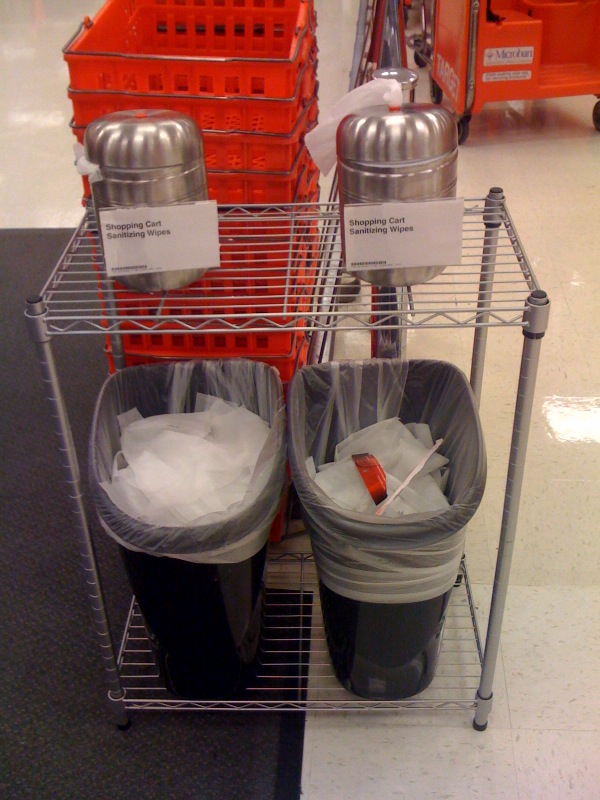
At this point I become much more rigorous and consistent about using those sanitary wipes  to wipe down the shopping cart seat and handle.

In 2004, clear displays promoting shopping cart sanitation were novel. And this one from Phoenix (upper right) is far more dramatic and attention-grabbing than a small container nailed to a bleak wall beside the shopping carts, which is still the norm today.

But things are changing.

Last year, USA Today reported that supermarkets and other retailers that provide shopping carts are increasingly looking to limit germ exposure for customers and their families.???, making sanitary wipes more readily available and in some cases, installing a whole cart cleaning system like this one in Wisconsin (photo by Peter J. Zuzga, for USA TODAY)

The trend continues to grow. Newspuller Gonzalo was in the Manhattan (Kansas) Target store recently and snapped these shots (below).

Parents and caregivers also have to think like the bad bug: like, don’t give the kids packages of raw meat to play with or leave within reach. Olga Henao, an epidemiologist for the U.S. Centers for disease control told USA Today last year that doing so triples the chance they may contract salmonella and quadruples it for campylobacter.

“Infants can become ill when they transfer bacteria from the packaging into their mouths.”


For the love of God, take it back and next time use a thermometer

Restaurants are always faced with the problem of rapid staff turnover rates resulting in an on-going regime of constant training. Fair enough but are new staff being trained in food safety? In certain provinces only one staff in five on any given shift are required to have some sort of food safety training through a professional organization. Theoretically, on-site managers will have taken the course in the hopes of shedding some of that knowledge to their staff. The concern, however, is that some managers simply don’t care about food safety and information is not being relayed to front line service staff. That’s when typically the public, you, barf. It is one thing to train someone on the basics of food safety in a classroom setting but it is another thing to change ones’ behaviours and habits when dealing with issues on food safety. For instance, this is a picture of an undercooked chicken burger served to a customer during a lunch rush. The manager was more concerned about dealing with the influx of customers than paying attention to food safety, as a result the cooks followed suit and a raw burger was served. Managers have a responsibility to promote safe food practices and encourage staff to do the same. It apparently seems that attitudes and behaviours tend to change when something horrible happens, like a foodborne outbreak. It is time to be proactive and not reactive.

UK: Restaurant receives Michelin stars, but no food safety stars

The Star Inn restaurant in North Yorkshire has been closed after more than 80 customers developed symptoms of vomiting and diarrhoea, reports YorkPress.co.uk.

The Star Inn has won a raft of prestigious awards since 1996, including a Michelin star, the Egon Ronay Gastropub of the Year title and, most recently, The Good Pub Guide County Dining Pub of the Year for 2010.

Jacquie Pern, who jointly runs the venue with her husband, leading chef Andrew Pern, said yesterday,
“We can confirm that The Star restaurant is temporarily closed as a precautionary measure. Early indications are consistent with a viral incident. We are taking the matter very seriously and are co-operating with the health authorities and look forward to returning to our normal food standard as soon as possible.”

A spokesman for Ryedale District Council said,

“More than 80 people are known to have developed symptoms after eating at the restaurant between October 18 and October 28. A number of restaurant staff are also known to be affected by symptoms.”

Upon reading the story I immediately went to Scores on the Doors website, which lists a restaurant’s food safety-star rating based on the most recent inspection. The Star Inn is located in an area of North Yorkshire which appears to not yet be registered with the Scores on the Doors programme. Although Michelin stars are nice, I’d rather know the restaurant’s food safety rating.
 

Canada reminds Canadians about the risks of eating raw sprouts – dos this mean there’s an outbreak?

When Canadian bureaucrats send out a food safety press release for no apparent reason other than to remind Canadians of something it usually means there is an outbreak going on.

Once again, it’s raw sprouts, and it’s not like it’s sprout season or something (unlike the often terrible turkey food safety advice the surfaces at Thanksgiving).

Health Canada and the Canadian Food Inspection Agency
are reminding Canadians that raw or undercooked sprouts should not be eaten by children, the elderly, pregnant women or those with weakened immune systems.

Sprouts, such as alfalfa and mung beans, are a popular choice for Canadians as a low-calorie, healthy ingredient for many meals. Onion, radish, mustard and broccoli sprouts, which are not to be confused with the actual plant or vegetable, are also common options.

These foods, however, may carry harmful bacteria such as Salmonella and E. coli O157:H7, which can lead to serious illness.

Fresh produce can sometimes be contaminated with harmful bacteria while in the field or during storage or handling. This is particularly a concern with sprouts. Many outbreaks of Salmonella and E. coli infections have been linked to contaminated sprouts. The largest recent outbreak in Canada was in the fall of 2005, when more than 648 cases of Salmonella were reported in Ontario.
 

Camp and cheeseburgers shouldn’t kill – mother and son describe effects of E. coli O157 illness linked to Rhode Island camp; ‘I want it to be Ponderosa night again’

Stephen Smith of the Boston Globe writes this morning,

The signs of trouble arrived deep in the night: first, bloody diarrhea, then nausea

Austin Richmond nor his mother knew it at the time, but he had been infected with a potentially lethal germ known as E. coli O157:H7. And, according to a lawsuit filed yesterday, the 11-year-old from Lincoln, R.I., caught it doing what many children do when they are away at camp, by eating a cheeseburger.

There were trips to the emergency room, trips to the doctor’s office, and initial confusion over what was causing him to be so sick. For more than two weeks, Austin, a sixth-grader, has been banished from school and not just because of his own illness. There is also concern that, because his immune system has been so ravaged battling the E. coli infection, he might prove especially susceptible to swine flu, which killed another student at Lincoln Middle School over the weekend.

Austin’s mother, Jaimee Richmond, said,

“He just wants to go back to being him. He wants to be able to play soccer. He wants to go to Boy Scouts. He wants to go back to church, which are words I never thought I would hear coming out of his mouth. … “I’m angry, I’m sad, I’m confused, I’m overwhelmed. I just want to go back to normal life. Tuesday night, it used to be Ponderosa night because it’s cheap, it’s family, the kids loved it. I just want it to be Ponderosa night again.’’
 

Honey on a dummy could have killed tot

The Scots have a way with headlines  — and in this case it’s deadly serious.

Call it what you will, a dummy, pacifier, soother, nuk – that’s Sorenne with one of hers a few weeks ago – they should never be dipped in honey.

A child in Scotland has been in hospital for six weeks fighting for his life with botulism and he could have caught it from sucking a dummy which had been dipped in honey, it emerged last night.

Since 1976, over 1,000 cases of infant botulism have been reported worldwide, most of them in America.

Clostridium botulinum can cause sickness in very young children, and infants under the age of 1 years old are most at risk. Honey may contain Clostridium botulinum spores that can grow in the digestive tract of children less than one-year-old because their digestive system is less acidic. The bacteria produces toxin in the body and can cause severe illness. Even pasteurized honey can contain botulism spores and should be not be given to children under the age of 12 months.
 

I got an H1N1 vaccine and a really cool sticker

I’m H1N1-ready. The vaccine that I received this evening will start providing immunity in a few weeks. I received one of a thousand doses available at the Riley County Health Department in Manhattan, KS.

The first wave of high-risk people received vaccinations a few weeks ago.  The high-risk category includes infants, pregnant women, the elderly and the immunocompromised. Tonight’s clinic offered the vaccine to people in the lower-risk category, including healthy people between the ages of 6 months and 24 years. I was excited to be able to receive a vaccine, but even better was that I didn’t pay anything – a college student’s dream.

As with most free things, the line was unbelievably long. Unfortunately I didn’t remember Doug’s advice to always carry my camera around, but the sight was pretty crazy with a long line snaking out of the building and police directing traffic. It made me wonder what the scene would look like if the virus being vaccinated against was more pathogenic or more virulent. Would the Riley County Police Department be able to handle the panicked Manhattan-ites? Would the health care staff manning the clinic be able to herd people through as efficiently?

After some Internet wandering I found the Kansas Department of Health’s Pandemic Flu Preparedness and Response Plan.  It looks like a decent plan, but I’m having a hard time imagining it working well after tonight’s mild chaos outside the clinic. Thankfully H1N1 is not as deadly as Ebola.  Perhaps the H1N1 scare is just a practice run for future bioterrorism?

For more information about where to get an H1N1 vaccination in Kansas you can visit the Kansas Department of Health and Environment H1N1 Flu Virus homepage.  For other locations throughout the US, or to learn more about the seasonal flu and H1N1, visit Flu.gov

I also got this awesome sticker to put on my computer at school:

Rats, mice, roaches, the need for more inspectors


Astonishing and amazing, like the recent Pet Shop Boys concert I attended, what one can find during a restaurant inspection.

KITV writes

In mid-August, a customer complained about finding a roach in a hamburger from a Honolulu fast-food restaurant. Two days later, an inspector found dead roaches in a plastic paper sheet cover at the same restaurant.

The state sends inspectors on unannounced inspections of restaurants. KITV followed along as inspector Raena Nishimura checked the conditions at Downtown Coffee, a coffee bar off Fort Street Mall.

"Just looking in the cupboards for any signs of droppings of rodents, roach droppings," Nishimura said.

There were none of those at Downtown Coffee, but an inspector found a live rat under the sink at a Kalihi noodle shop recently.

At another downtown restaurant, an inspector found mold in a soda dispenser, just a few days after a customer complained of finding mold in some lemonade.

The only way to find violations and get dirty restaurants to clean up their act is to inspect them on a regular basis.

"Our supervisor would like to have our establishments inspected twice a year, but that’s impossible," Nishimura said.

It is impossible because budget cuts have left a small number of inspectors to handle thousands of restaurants.

I couldn’t agree more, public health inspections are a culmination of hard work integrating a myriad of different scientific disciplines. As a result, they take time and more resources are needed if we are to take food safety seriously.