Salmonella in nuts…again.

Nuts and seeds seem to be prone to Salmonella contamination. This year alone peanuts, pistchios, sesame and sunflower seeds, and now potentially pecans have been recalled due to Salmonella contamination.

Today General Mills announced a voluntary recall of Nature Valley Granola Nut Clusters “Nut Lovers” (pictured right) due to potential Salmonella contamination believed to be from pecans in the product, reportsForbes.com.

The new product, a bag of bite-size granola clusters, is sold in stores and vending machines. General Mills ( GIS – news – people ) said pecans received from an unidentified supplier and used in the product are the source of the potential salmonella.

The recall only covers products with the following "best if used by" dates: March 7, 2010; March 8, 2010; March 9, 2010; March 10, 2010; and March 11, 2010.

The company said that no illnesses have been reported in connection with the product, and that no other types of Nature Valley products are being recalled.

Salmonella can cause fever, diarrhea, nausea, vomiting and abdominal pain. In young children, the elderly and people with weakened immune systems, it can cause more serious or even fatal infections.

A 1975 article in Applied Microbiology examined the survival of Salmonella in pecans during processing and storage conditions. The paper suggests that morphological differences in pecans will make some susceptible to cracking and water uptake during processing, and hence microbial contamination.

Know your supplier, and the steps they are taking to produce safe products.

Belgica mussels under the microscope; is New Zealand better than Old Zeeland?

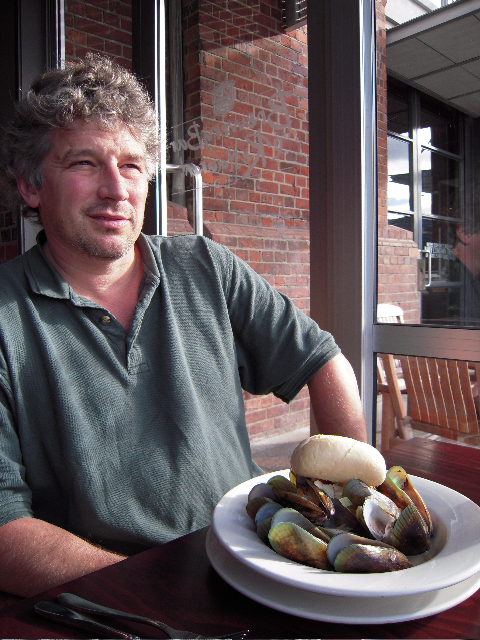
A year ago Amy and I were sitting in a Wellington, New Zealand restaurant overlooking the harbor, pulling mussels from the shell (it was a holiday complete).

Consumers in Belgium are just beginning to enjoy the annual harvest of so-called Belgica mussels. According to a report forwarded by our European safe food correspondent, Albert Amgar:

Last year there was a lot of hubbub
around the so-called presence of toxic substances in Belgica mussels. This toxin would provoke Diarrheic Shellfish Poisoning, characterized by gastric and intestinal problems, diarrhea, nausea, vomiting and intestinal cramps. Counter analyses could not confirm the presence of this toxin.

The mussels cultivated in Belgian waters underwent bimonthly bacteriological testing conducted by the Federal Agency for Food Safety. Weekly tests were also taken in order to detect the possible presence of toxins in mussels and the presence of toxin-bearing algae in the water where the mussels are raised. French authorities are responsible for testing the mussels raised in France.

Belgica was the name given to a Roman province encompassing parts of modern Belgium, France, the Netherlands, Germany and Luxembourg. These Belgica mussels are 20 per cent from Belgian waters and 80 per cent from French waters of the North Sea. Apparently, the less-fleshier Zeeland mussels, from the Zeeland waters of the North Sea – Zeeland is a southern province of The Netherlands – compete with Belgica mussels for the food dollars of Belgian consumers (apparently American and Canadian country-of-origin labels aren’t the only confusing – and largely meaningless – labels out there).

To continue on with the wiki-ized history, the name New Zealand originated with Dutch cartographers – Dutch explorers being the first Europeans to arrive — who called the islands Nova Zeelandia, after the Dutch province of Zeeland. British explorer James Cook subsequently anglicised the name to New Zealand.

Katie, enjoy some NZ mussels; cause as the poster says, New Zealand: Better than Old Zealand.
 

Not-so “Totally awesome, dude”: California pizza parlour home to rat(s)

Growing up my older cousin Adam was obsessed with the pizza-loving Teenage Mutant Ninja Turtles, and every time we visited his house my sisters and I were forced to re-enact fight scenes from the wildly popular TV series. Adam was always Leonardo, and somehow one of us was always the wise rat Splinter.

Perhaps it was Splinter that lead to the Round Table restaurant closure in Danville, CA this month. Danvilleweekly.com reports that following a customer-complaint the Contra Costa County Environmental Health Division investigated and confirmed the presence of a rat in the pizza parlor.

Joe Doser, supervising environmental health specialist, said

"We have to look into all of these reports. So we went out and investigated and confirmed the complaint."

The inspector found a number of issues with the restaurant, including a live rat found in a trap on the premises, droppings, cross contamination of food, improper food storage and improper storage of utensils.

The Round Table was closed for one day, while cleanup crews took care of the issues found by the inspectors. It was inspected again June 2 and again June 3. Several minor infractions were found and again evidence of rodents was seen.

Doser continued,

"The corrective plan they [the owner] provided to our office is pretty good. If they stick with it they should be OK."

The restaurant was placed on a one-year probation. During that time additional inspections are set up, at the cost of the restaurant. If the issues are not addressed in a timely fashion, the restaurant could be shut down again and the owners could potentially face civil or criminal charges.

Doser said there are approximately 4,000 restaurants operating the county, and each year, the office receives 1,000 consumer complaints, concluding,

"People think they saw a rat or a cockroach or they got sick. As with all complaints we have to check it out. About 75 percent of them turn out to be valid.”

Anywhere that serves food has the potential to attract rodents. Food operators should be aware of this potential, and take measures to prevent or control these issues.

An inspectors’ dream…..

I love food safety and hate pathogens, so sometimes I can get a little too excited when restaurant operators’ are engaged in food safety and really care about what they are doing. Just the other day on a routine restaurant inspection, the manager pulled me aside and asked me if I want to hear everything they are currently doing to ensure food safety. I responded, just as Alec Baldwin did on 30 Rock when asked if he liked Phil Collins, “I have two ears and a heart, don’t I?” And so he began showing me temperature log books, digital tip sensitive thermometers to ensure proper internal cooking temperatures with log books for quality assurance purposes, food from safe sources, proper handwashing, and sanitizer solutions equipped with test strips to ensure proper chemical concentrations. The manager would encourage staff to get involved in food safety, have regular meetings discussing the importance of food safety with demonstrations, essentially on-site food safety training. Wow, doesn’t really get better than this.

Welsh government responds to E. coli outbreak report; parents of Mason say it’s not enough

After the 2005 E. coli O157 outbreak which killed 5-year-old Mason Jones and sickened 160 schoolchildren in Wales, Professor Hugh Pennington led a public inquiry which revealed the futility of food safety training, government inspection, and pretty much anything to do with the so-called food safety system.

Yesterday, First Minister Rhodri Morgan announced
more of the same in responding to Pennington’s report in the Wales Assembly.

“We know already that the Food Standards Agency is to review the use of equipment such as vacuum-packing machinery for both raw and cooked products.”

Duh. It shouldn’t happen.

“The training of inspectors and their managers is also being examined, with the aim of making this more comprehensive, helping them develop a sixth sense of what is potentially catastrophic.”

So they can see dead people?

“Inspections will be unannounced unless there is a clear requirement otherwise.”

Just make the inspections unannounced.

Sharon Mills and Nathan Jones, the parents of Mason Jones (above, right) said they would like to see Mr Morgan take more direct action and impose measures on the authorities involved, instead of leaving them to correct their own mistakes, with Ms. Mills stating,

“It was a bit disappointing because there was nothing definite about what he said. I thought we were going to get some answers and there still aren’t any. I don’t think we are any further forward than we were before.”

Somewhere, Prof. Pennington, who also headed the inquiry after the 1996 E. coli O157 outbreak in Scotland that killed 21 and sickened over 400, is wondering how to escape this Groundhog-Day-esque cycle of outbreak-illness-death-report-repeat.
 

Powell to Times – stick it in

The following letter appeared in the Dining and Wine section of this morning’s N.Y. Times:

Re “The Perfect Burger and All Its Parts” July 1:

The only thin piece of metal that should be stuck into the side of a hamburger is a tip-sensitive digital thermometer. Chef Seamus Mullen’s recommendation to put any thin piece of metal into the side of a burger, and “If it’s barely warm to the lips, it’s rare. If it’s like bath water, it’s medium rare,” only demonstrates the divide between food safety and food pornography.

Color is a lousy indicator of burger safety, as is the taste of metal sticks. Rather than putting E. coli O157:H7 on precious testing lips, use a thermometer.

Dr. Douglas Powell
Manhattan, Kan.

The writer is an associate professor of food safety at Kansas State University.

Andrew Stormer: stick it in for safety (a thermometer)

Andrew Stormer (right, exactly as shown), a Kansas State food science grad who used to work with me writes from Topeka:

Food is my career and a passion, so I often find myself in conversations with people regarding trendy food topics (organic, healthy, safe etc.).  Today I found myself in the midst of a debate about the doneness of burgers with a plant employee.

The other dude was talking about the burgers he had grilled on July 4th. I asked him if he used a tip sensitive digital thermometer to determine if it had been cooked to 160°F, and the debate ensued.  He proudly proclaimed that he could tell if they are cooked “just right” by looking at the color and pushing on them with his finger.  I countered, stating that both of his methods were terrible indicators of doneness and that temperature is the only way to tell for sure.  I mentioned premature browning and that 160°F was the necessary temperature to reach to ensure the death of the common patty-pathogen E. coli O157:H7.

He persisted, saying I was wrong, and that his method had always worked and he had never made anyone sick.  How did he know that for sure, I wondered, explaining that the incubation period for E. coli was usually anywhere from about 18 to 72 hours, and that a person won’t exhibit symptoms of the infection until well after leaving the BBQ. 

He didn’t have much of a response. 

I then offered to find and show him studies, books, articles etc. that supported my claim.  He wanted none of it, and wrapped up the debate nicely with, “I just know.”  I was left frustrated and dismayed. 

This is a dangerous and arrogant attitude to have towards food safety, but unfortunately I have come across countless others that share the same “I just know” train of thought.  That said; his method is still a step above the “put-a-thin-piece-of-metal-in-the-burger-and-taste” method.

E. coli cause of kidney failure in Iowa child?

KSFY is reporting that a one-year-old boy from Sioux Center, Iowa is in a Sioux Falls hospital tonight, fighting hemolytic uremic syndrome or HUS.

His dad told Action News today that Isaiah is normally an active kid, but this has slown him down and their time in the hospital has been heart-wrenching saying "you never think you’re going to see your child in the hospital and the reality of it is, is that it can happen to anyone. … It’s hard on us, but with God’s help we’re doing OK."
 

How many food poisoners can you spot on this list?

As Eddie Murphy said in the movie, 48 Hours, “A badge and a gun goes a long way. … There’s a new sheriff in town.”

That’s the impression the Obama Administration is trying to project with a spate of announcements to enhance food safety, which makes me feel it’s 1994 all over again … and look, there’s Michael Taylor back as a food safety advisor at the Food and Drug Administration (good choice, BTW).

For all the various announcements and endorsements today, the list of invitees to the White House is the most telling. How many food poisoners can you spot on this list, the ones who profit from selling food, have proven themselves incapable of providing safe food, and now have to ask for a babysitter?

Below is a list of expected attendees at today’s Food Safety Announcement, including representatives from consumer, industry, producer associations, public health, and academic organizations.
ADMINISTRATION OFFICIALS:
* Vice President Joe Biden
* Secretary of the Department of Health and Human Services Kathleen Sebelius
* Secretary of Agriculture Tom Vilsack
* Dr. Peggy Hamburg, Commissioner, FDA
* Dr. Joshua Sharfstein, Deputy Commissioner, FDA
* Melody Barnes, Director, Domestic Policy Council
* Dr. John Holdren, Director, Office of Science and Technology Policy
MEMBERS OF CONGRESS:
* Representative Rosa DeLauro (D-CT)
* Representative John Dingell (D-MI)
* Representative Bart Stupak (D-MI)
OTHER EXPECTED ATTENDEES INCLUDE
(in alphabetical order by last name)
* Brent Baglien, ConAgra Foods
* Andrew Bailey, National Turkey Federation
* Scott Becker, Association of Public Health Laboratories
* Georges Benjamin, American Public Health Association
* Ellen Bloom, Consumers Union
* Abigail Blunt, Kraft Foods
* Melane Boyce, Confectioners Association
* Thomas Bradshaw, American Frozen Food Institute
* David Buck, Center for Foodborne Illness, Research & Prevention
* Christine Bushway, Organic Trade Association
* Jonathan Cantu, Government Accountability Project
* Barry Carpenter, National Meat Association
* Anthony Corbo, Food and Water Watch
* Jo Ellen Deutsch- United Food & Commercial Workers International Union
* Caroline DeWaal, Center for Science in the Public Interest
* Orlo Ehart, NASDA
* Cathleen Enright, Western Growers Association
* Sandra Eskin, Georgetown University, Health Policy Institute
* Scott Faber, Grocery Manufacturers of America
* Gregory Ferrara, National Grocers Association
* Anthony Flood, International Food Information Council
* Molly Fogarty, Nestle
* Randall Gordon, National Grain and Feed Association
* Robert Green, United Egg Producers
* Sally Greenberg, National Consumers League
* Lisa Griffith, National Family Farm Coalition
* Robert Guenther, United Fresh Produce Association
* Margaret Henderson, National Fisheries Institute
* James Hodges, American Meat Institute
* Katherine Houston, Cargill, Inc.
* Jonathan James, Allen Family Foods, Inc
* Alice Johnson, ButterBall
* G. Chandler Keys, JBS
* Lonnie King, CDC
* Barbara Masters, Olsson Frank Weeda Terman Bode Matz PC
* Margaret Mellon, Union of Concerned Scientists
* Joel Newman, American Feed Industry Association
* Donna Norton, Mom’s Rising
* Erik Olson, Mars
* H. R. Bert Pena, Stinson Morrison Hecker LLP
* Robert Pestronk, National Association of County and City Health Officials
* Adam Reichardt, Association of State and Territorial Health Officials
* Tanya Roberts, Center for Foodborne Illness, Research & Prevention
* Welford Roberts, National Environmental Health Association
* Donna Rosenbaum, S.T.O.P. – Safe Tables Our Priority
* Marianne Rowden, American Association of Exporters and Importers
* Ruth Saunders, International Dairy Foods Association
* Bryan Silbermann, Produce Marketing Association
* Brian Snyder, Sustainable Agriculture Coalition
* Steven Steinhoff, Association of Food and Drug Officials
* Michael Taylor, George Washington University, School of Public Health and Health Services
* Mary Toker, General Mills, Inc.
* Omar Vargas, Pepsi-Cola North America
* Christopher Waldrop, Consumer Federation of America
* Deborah White, Food Marketing Institute
* Heather White, Environmental Working Group
* Andrea Yabulonsky, ConAgra Foods

Food poisoning strikes Birmingham police

In 1984, the Pope visited the restored 350-year-old Jesuit mission of Ste. Marie-among-the-Hurons in Midland, Ontario. After departing, 1,600 hungry Ontario Provincial Police officers who had worked the ropes gathered for a boxed lunch. Of those 500 officers who chose ones with roast beef sandwiches, 423 came down with salmonella.

On Saturday, July 4, 2009, more than 40 police officers in Birmingham, U.K., were stricken with food poisoning after consuming a boxed lunch of  a sandwich, packet of crisps, chocolate bar and piece of fruit, as they prepared to police a demonstration which passed off peacefully.

Dozens of fireman, police and ambulance staff rushed to the scene as British Transport Police shut the station at about 5pm on the advice of health agencies.

The station re-opened 50 minutes later.